


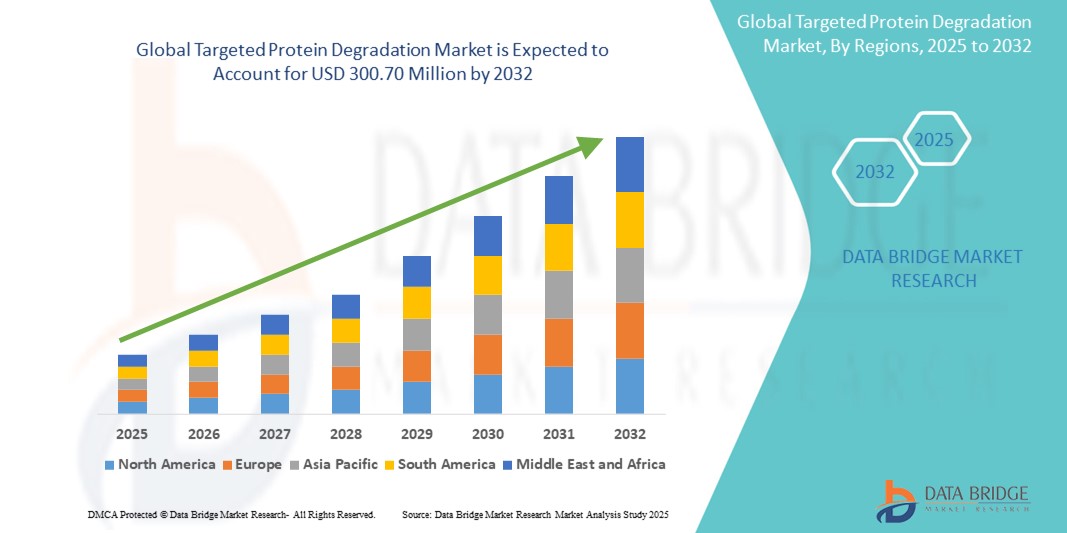
Targeted Protein Degradation Market Size
- The global targeted protein degradation market was valued at USD 138.25 million in 2024 and is expected to reach USD 300.70 million by 2032
- During the forecast period of 2025 to 2032 the market is likely to grow at a CAGR of 10.20%, primarily driven by the rising demand for novel therapeutics and increasing investment in drug discovery technologies
- This growth is driven by factors such as the increasing prevalence of cancer and neurodegenerative diseases, along with advancements in proteomics and targeted drug development
Targeted Protein Degradation Market Analysis
- Targeted protein degradation is an emerging therapeutic strategy that uses engineered molecules to selectively degrade disease-causing proteins, offering a novel approach to treat conditions that are difficult to address with traditional drugs. It is particularly impactful in oncology, neurodegenerative disorders, and autoimmune diseases
- The market’s growth is significantly driven by the rising need for more effective therapies for drug-resistant diseases and continued advancements in protein degradation technologies such as PROTACs and molecular glues. Increasing R&D investments by pharmaceutical and biotech companies further accelerate market expansion
- North America stands out as one of the dominant regions in the targeted protein degradation market, fueled by its strong biopharmaceutical sector, high research funding, and a growing number of clinical trials in this space
- For instance, the several leading U.S.-based biotech firms have entered strategic partnerships and licensing agreements to accelerate the development of targeted protein degraders, reinforcing the region’s leadership in this innovation-driven market
- Globally, targeted protein degradation platforms are considered one of the most promising frontiers in drug discovery and development, offering the potential to treat previously "undruggable" targets and fundamentally changing the landscape of precision medicine
Report Scope and Targeted Protein Degradation Market Segmentation
|
Attributes |
Targeted Protein Degradation Key Market Insights |
|
Segments Covered |
|
|
Countries Covered |
North America
Europe
Asia-Pacific
Middle East and Africa
South America
|
|
Key Market Players |
|
|
Market Opportunities |
|
|
Value Added Data Infosets |
In addition to the insights on market scenarios such as market value, growth rate, segmentation, geographical coverage, and major players, the market reports curated by the Data Bridge Market Research also include import export analysis, production capacity overview, production consumption analysis, price trend analysis, climate change scenario, supply chain analysis, value chain analysis, raw material/consumables overview, vendor selection criteria, PESTLE Analysis, Porter Analysis, and regulatory framework. |
Targeted Protein Degradation Market Trends
“Rising Focus on Molecular Glues and Next-Generation Degrader Technologies”
- One prominent trend in the global targeted protein degradation market is the increasing focus on molecular glues and next-generation degrader technologies, which are expanding the scope of targetable proteins beyond what was previously possible
- Molecular glues offer a simplified approach by inducing interactions between target proteins and E3 ligases without the need for complex linker structures, streamlining drug design and enhancing efficacy
- For instance, several biotech firms are actively developing molecular glue libraries and screening platforms, enabling the discovery of degraders for "undruggable" targets such as transcription factors and scaffold proteins involved in cancer and neurodegenerative diseases
- Alongside molecular glues, innovations in bifunctional degraders such as enhanced PROTACs are improving selectivity, bioavailability, and intracellular targeting, further pushing the boundaries of protein degradation therapies
- This trend is driving a new wave of drug discovery, attracting significant investment and reshaping the future of precision medicine by offering new therapeutic avenues for complex, previously untreatable conditions
Targeted Protein Degradation Market Dynamics
Driver
“Surging Demand for Novel Therapies Targeting Undruggable Proteins”
- The increasing need for innovative therapies that can effectively target and eliminate disease-causing proteins previously considered "undruggable" is a major driver for the global targeted protein degradation market
- Traditional small molecule inhibitors often fail to address proteins without well-defined active sites; however, targeted degradation technologies such as PROTACs and molecular glues offer the ability to degrade these elusive targets, thereby expanding the druggable proteome
- This approach has shown significant promise in treating complex and resistant conditions such as various cancers, neurodegenerative disorders, and autoimmune diseases—areas with high unmet medical needs and limited treatment options
- The flexibility and specificity of targeted degradation platforms also reduce off-target effects and drug resistance, improving treatment efficacy and patient outcomes
- Pharmaceutical companies and research institutions are increasingly investing in this field, leading to a growing number of preclinical and clinical studies focused on protein degraders
For instance,
- In September 2022, a report by the National Institutes of Health (NIH) highlighted the potential of targeted protein degradation to revolutionize treatment paradigms by addressing disease drivers beyond the reach of conventional drug discovery, particularly in oncology and neurodegeneration
- In January 2023, the development of next-generation degraders by U.S.-based biotech companies received major funding from venture capital firms, underscoring the growing confidence in the market’s long-term potential
- As a result of the increasing demand for therapies that can address hard-to-treat and resistant diseases, the global market for targeted protein degradation continues to experience strong growth, supported by technological innovations and robust research initiatives
Opportunity
“Unlocking Therapeutic Potential Through Artificial Intelligence and Computational Drug Discovery”
- Integration of artificial intelligence (AI) and advanced computational tools presents a major opportunity for accelerating drug discovery in the targeted protein degradation market
- AI can streamline the identification of viable degrader compounds by predicting protein-ligase interactions, optimizing molecular designs, and simulating protein degradation pathways
- Machine learning algorithms can analyze massive datasets from proteomics, genomics, and structural biology to uncover new degron motifs and identify novel targets for degradation, drastically reducing the time and cost of early-stage drug development
- In addition, AI-driven platforms also enhance precision in designing bifunctional molecules such as PROTACs and molecular glues by predicting binding affinities, stability, and cellular permeability, thus improving the efficiency of lead optimization and candidate selection
For instance,
- In February 2024, according to a publication in Nature Reviews Drug Discovery, AI-based models demonstrated success in predicting degrader efficacy and selectivity by integrating protein structure data and real-world degradation outcomes, setting new standards for degrader design
- In October 2023, several biotech firms announced collaborations with AI-focused drug discovery startups to co-develop next-generation protein degraders, leveraging deep learning tools to accelerate the path from discovery to clinical trials
- The integration of AI and computational modeling, the targeted protein degradation market stands to benefit from increased R&D productivity, reduced time-to-market for new therapies, and a broader scope of druggable targets—paving the way for highly personalized and effective treatments
Restraint/Challenge
“High R&D Costs and Complex Development Processes”
- The high cost and complexity associated with the research and development of targeted protein degradation therapies pose a significant challenge to widespread market adoption, particularly for smaller biotech firms and startups
- Developing degraders such as PROTACs or molecular glues involves intricate design, extensive screening, and rigorous preclinical and clinical testing, all of which require substantial time and financial investment
- The lack of standardized protocols and limited understanding of the long-term biological effects of protein degradation mechanisms further complicate the development process and regulatory approvals
For instance,
- In August 2023, according to a report by BioProcess International, the cost of bringing a targeted protein degrader to market is considerably higher than traditional small molecule drugs, with a large portion of investment allocated to early-stage discovery, toxicology studies, and biomarker validation
- In June 2024, a white paper published by the Journal of Translational Medicine highlighted that the limited availability of validated E3 ligases and challenges in achieving tissue-specific degradation significantly raise the barrier to successful development and commercialization of these therapies
- Consequently, the high financial and technical barriers may restrict market entry for emerging players and slow down innovation, ultimately limiting the pace at which these novel therapies can reach patients and impact global healthcare outcomes
Targeted Protein Degradation Market Scope
The market is segmented on the basis of type, therapeutic area, route of administration, and application.
|
Segmentation |
Sub-Segmentation |
|
By Type |
|
|
By Therapeutic Area |
|
|
By Route of Administration |
|
|
By Application
|
|
Targeted Protein Degradation Market Regional Analysis
“North America is the Dominant Region in the Targeted Protein Degradation Market”
- North America leads the global targeted protein degradation market, primarily due to its well-established biopharmaceutical industry, advanced research infrastructure, and high investment in drug discovery and development
- U.S. holds the largest market share, driven by a strong pipeline of targeted protein degradation therapies, widespread clinical trials, and significant collaborations between biotech companies and academic institutions
- The favorable regulatory support, substantial funding from venture capital firms, and a concentration of key market players further bolster the region’s position as a leader in this emerging therapeutic field
- In addition, the presence of top-tier research centers and pharmaceutical giants actively investing in proteomics and next-generation degradation technologies enhances innovation and accelerates commercialization in North America
“Asia-Pacific is Projected to Register the Highest Growth Rate”
- Asia-Pacific is poised to witness the fastest growth in the targeted protein degradation market, fueled by rising investments in biotechnology, increasing disease burden, and expanding pharmaceutical R&D capabilities
- Countries such as China, Japan, and South Korea are emerging as key players, with growing government support for life sciences innovation and a surge in biotech startups focusing on novel drug development platforms
- Japan stands out with its strong clinical research infrastructure and early adoption of advanced therapeutic technologies, while China continues to expand its presence through major R&D initiatives and partnerships with global firms
- India is contributing to regional growth through its rapidly evolving pharmaceutical sector and increasing collaborations with international research organizations, making Asia-Pacific a vital frontier for the future of targeted protein degradation therapies
Targeted Protein Degradation Market Share
The market competitive landscape provides details by competitor. Details included are company overview, company financials, revenue generated, market potential, investment in research and development, new market initiatives, global presence, production sites and facilities, production capacities, company strengths and weaknesses, product launch, product width and breadth, application dominance. The above data points provided are only related to the companies' focus related to market.
The Major Market Leaders Operating in the Market Are:
- Lilly (U.S.)
- Gilead Sciences, Inc. (U.S.)
- GSK plc (U.K)
- Merck KGaA, Germany)
- Mission Therapeutics (U.K)
- Novartis AG (Switzerland)
- Pfizer Inc. (U.S.)
- Aurigene Oncology (India)
- Cambrex Corporation (U.S.)
- 5AM Venture Management LLC (U.S.)
- AbbVie Inc. (U.S.)
- Almac Group (U.K)
- Amgen Inc. (U.S.)
- Bayer AG (Germany)
- Biogen (U.S.)
- C4 Therapeutics Inc. (U.S.)
- Cosmo Bio USA (U.S.)
- Roivant Sciences Ltd. (Switzerland)
Latest Developments in Global Targeted Protein Degradation Market
- In January 2025, Arvinas Inc. reported encouraging Phase 2 clinical trial results for its PROTAC protein degraders, ARV-471 and ARV-766, in treating metastatic castration-resistant prostate cancer (mCRPC). The trials demonstrated a clinical benefit rate of 38% in evaluable patients, with both drugs exhibiting a favorable tolerability profile
- In April 2024, Arvinas, Inc. entered into a strategic license agreement with Novartis for the global development and commercialization of ARV-766, a second-generation PROTAC androgen receptor degrader aimed at treating prostate cancer
- In December 2023, The Austrian Science Fund approved a four-year extension for the Special Research Program (SFB) in Targeted Protein Degradation, focusing on advancing methods to target specific proteins for degradation, with potential applications in drug discovery and therapeutic interventions
- In November 2024, C4 Therapeutics announced a strategic discovery research collaboration with Merck KGaA to target critical oncogenic proteins using C4T’s proprietary Degronimid platform technology, aiming to advance the development of next-generation oncology therapies

- Interactive Data Analysis Dashboard
- Company Analysis Dashboard for high growth potential opportunities
- Research Analyst Access for customization & queries
- Competitor Analysis with Interactive dashboard
- Latest News, Updates & Trend analysis
- Harness the Power of Benchmark Analysis for Comprehensive Competitor Tracking
Data collection and base year analysis are done using data collection modules with large sample sizes. The stage includes obtaining market information or related data through various sources and strategies. It includes examining and planning all the data acquired from the past in advance. It likewise envelops the examination of information inconsistencies seen across different information sources. The market data is analysed and estimated using market statistical and coherent models. Also, market share analysis and key trend analysis are the major success factors in the market report. To know more, please request an analyst call or drop down your inquiry.
The key research methodology used by DBMR research team is data triangulation which involves data mining, analysis of the impact of data variables on the market and primary (industry expert) validation. Data models include Vendor Positioning Grid, Market Time Line Analysis, Market Overview and Guide, Company Positioning Grid, Patent Analysis, Pricing Analysis, Company Market Share Analysis, Standards of Measurement, Global versus Regional and Vendor Share Analysis. To know more about the research methodology, drop in an inquiry to speak to our industry experts.
Data Bridge Market Research is a leader in advanced formative research. We take pride in servicing our existing and new customers with data and analysis that match and suits their goal. The report can be customized to include price trend analysis of target brands understanding the market for additional countries (ask for the list of countries), clinical trial results data, literature review, refurbished market and product base analysis. Market analysis of target competitors can be analyzed from technology-based analysis to market portfolio strategies. We can add as many competitors that you require data about in the format and data style you are looking for. Our team of analysts can also provide you data in crude raw excel files pivot tables (Fact book) or can assist you in creating presentations from the data sets available in the report.













