


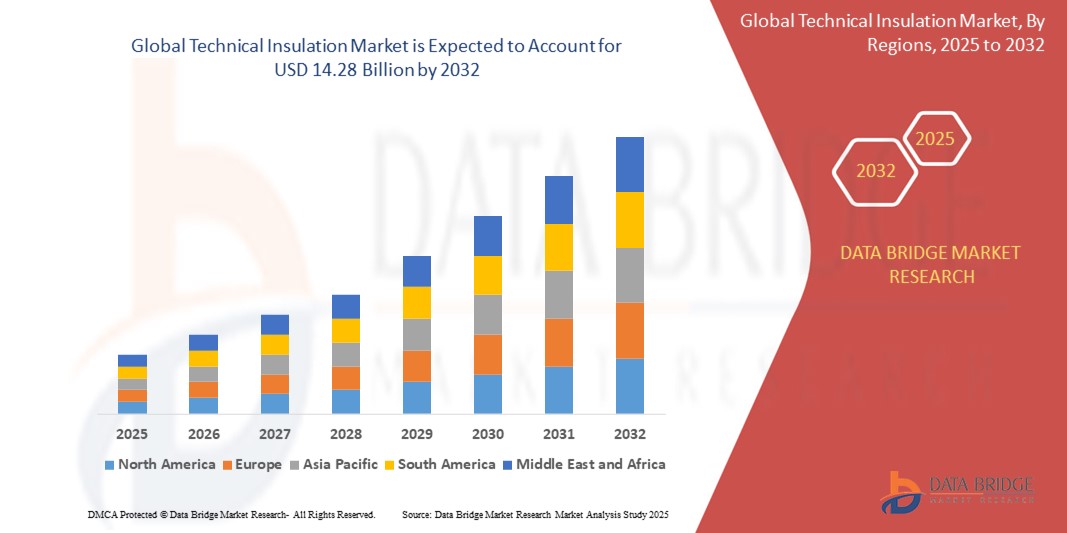
Technical Insulation Market Size
- The global technical insulation market size was valued at USD 9.96 billion in 2024 and is expected to reach USD 14.28 billion by 2032, at a CAGR of 4.60% during the forecast period
- The market growth is largely fueled by increasing demand for energy-efficient solutions across industrial, commercial, and residential sectors, as organizations aim to reduce operational energy consumption and comply with stringent environmental regulations
- Furthermore, rising investments in infrastructure development, industrialization, and district heating and cooling systems—particularly in emerging economies—are boosting the adoption of advanced thermal insulation materials
Technical Insulation Market Analysis
- Technical insulation involves materials and methods used to insulate industrial and commercial equipment, such as pipes, tanks, and HVAC insulation systems. It helps in thermal management, reducing energy loss, and controlling surface temperatures. Key benefits include energy efficiency, cost savings, and enhanced safety by minimizing heat transfer and preventing condensation and corrosion in various applications
- The escalating demand for technical insulation is primarily fueled by the expansion of industrial operations, growth in HVAC and district energy systems, and heightened focus on fire safety, acoustic control, and thermal performance in both new construction and retrofit projects
- Asia-Pacific dominated the technical insulation market with a share of 40.1% in 2024, due to rapid industrialization, growing energy infrastructure, and rising construction activities across emerging economies
- North America is expected to be the fastest growing region in the technical insulation market during the forecast period due to the need to upgrade aging industrial infrastructure, reduce operational energy costs, and comply with building energy codes.
- Hot insulation segment dominated the market with a market share of 41.1% in 2024, due to its critical role in minimizing heat loss in high-temperature industrial applications. These insulation materials are widely used in power plants, petrochemical facilities, and processing industries where thermal efficiency, personnel protection, and energy conservation are paramount. Their ability to withstand extreme temperatures while maintaining structural integrity contributes to widespread adoption across energy-intensive sectors
Report Scope and Technical Insulation Market Segmentation
|
Attributes |
Technical Insulation Key Market Insights |
|
Segments Covered |
|
|
Countries Covered |
North America
Europe
Asia-Pacific
Middle East and Africa
South America
|
|
Key Market Players |
|
|
Market Opportunities |
|
|
Value Added Data Infosets |
In addition to the insights on market scenarios such as market value, growth rate, segmentation, geographical coverage, and major players, the market reports curated by the Data Bridge Market Research also include import export analysis, production capacity overview, production consumption analysis, price trend analysis, climate change scenario, supply chain analysis, value chain analysis, raw material/consumables overview, vendor selection criteria, PESTLE Analysis, Porter Analysis, and regulatory framework. |
Technical Insulation Market Trends
“Rising Adoption of Sustainable and Energy-Efficient Solutions”
- A significant and accelerating trend in the global technical insulation market is the shift toward sustainable and energy-efficient materials, driven by global climate goals and stringent energy efficiency regulations. Industries and governments are emphasizing low-carbon construction and operational efficiency, making insulation a core component of energy management strategies
- For instance, manufacturers such as ROCKWOOL and Owens Corning are investing in eco-friendly mineral wool and fiberglass insulation solutions that offer high thermal resistance and recyclability, catering to growing environmental concerns
- Innovations in insulation materials now focus on reducing greenhouse gas emissions, minimizing energy loss, and ensuring fire resistance while meeting green building certifications such as LEED and BREEAM. Aerogel-based insulation and vacuum insulation panels (VIPs) are gaining traction in high-performance applications
- The use of technical insulation in HVAC systems, industrial processes, and building envelopes is enabling stakeholders to meet aggressive energy targets while improving operational efficiency. As a result, sectors such as power generation, chemicals, and commercial real estate are rapidly adopting sustainable insulation technologies
- This trend is fundamentally reshaping procurement strategies in industrial and construction sectors. Companies such as Armacell and Knauf Insulation are launching carbon-neutral or low-emission product lines to support customers in achieving their sustainability goals
- The demand for sustainable, energy-saving insulation materials is expanding rapidly across both developed and emerging economies, as businesses and governments prioritize long-term energy cost savings and environmental compliance
Technical Insulation Market Dynamics
Driver
“Rising Retrofitting and Renovation Projects”
- The increasing focus on enhancing energy efficiency in existing buildings and facilities is a major driver fueling demand for technical insulation. Retrofitting and renovation initiatives aimed at reducing energy loss and improving thermal performance are gaining momentum across both public and private sectors
- For instance, the European Union's Renovation Wave strategy targets the renovation of millions of buildings by 2030, mandating thermal insulation upgrades in residential and non-residential structures. Similar policies in North America and Asia are encouraging energy-efficient retrofits across commercial and industrial sectors
- Technical insulation plays a crucial role in reducing heat loss in outdated HVAC systems, pipelines, and mechanical infrastructure, making it indispensable in modernization efforts. Increased funding for public infrastructure upgrades and government incentives for energy retrofits are further accelerating this trend
- The growing need to align with international energy performance standards is also prompting asset owners to invest in insulation technologies that enhance both thermal and acoustic efficiency in existing systems
- The widespread use of technical insulation in renovation projects—ranging from industrial facilities to office buildings and educational institutions—is contributing significantly to market growth, especially in mature economies with aging infrastructure
Restraint/Challenge
“High Initial Costs”
- The relatively high upfront cost of technical insulation systems, particularly those involving advanced materials or specialized installations, poses a significant challenge to broader market adoption. Small- and medium-sized enterprises and cost-sensitive markets may find it difficult to justify the investment despite long-term energy savings
- For instance, premium insulation solutions such as aerogel, VIPs, or multi-layered systems used in cryogenic or high-temperature applications can involve substantial installation and maintenance expenses, making them less accessible in price-sensitive regions
- The cost barrier is further compounded in renovation projects where insulation upgrades may require dismantling existing systems or equipment downtime, leading to increased labor and operational costs
- To address this, manufacturers such as Johns Manville and Kingspan are focusing on developing cost-effective product lines and simplified installation processes to expand accessibility. However, the initial capital burden continues to hinder adoption, particularly in developing economies and low-margin industrial segments
- Bridging this gap through government subsidies, financing programs, and increased awareness of long-term cost benefits will be critical for market expansion across all end-user sectors
Technical Insulation Market Scope
The market is segmented on the basis of type, application, and end-user.
• By Type
On the basis of type, the technical insulation market is segmented into hot insulation, cold-flexible insulation, and cold-rigid insulation. The hot insulation segment accounted for the largest market revenue share 41.1% in 2024, driven by its critical role in minimizing heat loss in high-temperature industrial applications. These insulation materials are widely used in power plants, petrochemical facilities, and processing industries where thermal efficiency, personnel protection, and energy conservation are paramount. Their ability to withstand extreme temperatures while maintaining structural integrity contributes to widespread adoption across energy-intensive sectors.
The cold-flexible insulation segment is expected to witness the fastest CAGR from 2025 to 2032 due to rising demand in refrigeration and chilled water systems across food processing, pharmaceuticals, and commercial HVAC applications. These materials offer excellent flexibility, moisture resistance, and thermal performance, which makes them ideal for preventing condensation and ensuring energy efficiency in low-temperature environments. Their adaptability to complex pipework layouts also supports their growing utilization.
• By Application
On the basis of application, the technical insulation market is segmented into heating and plumbing, HVAC, refrigeration, industrial processes, and acoustic. The HVAC segment held the largest revenue share in 2024, driven by increasing installation of centralized air conditioning and ventilation systems in commercial, industrial, and residential buildings. Insulation plays a crucial role in maintaining thermal efficiency, reducing energy consumption, and supporting environmental sustainability standards, especially as building codes become more stringent.
The refrigeration segment is projected to register the highest growth rate from 2025 to 2032, fueled by the expansion of cold chain logistics, food processing units, and pharmaceutical storage systems. Technical insulation is vital in these applications for minimizing thermal transfer and preventing energy losses, thereby maintaining stable internal temperatures and enhancing operational efficiency. The growing need for temperature-sensitive transportation and storage solutions is accelerating adoption.
• By End-User
On the basis of end-user, the technical insulation market is categorized into industrial and OEM, energy transportation, and commercial buildings. The industrial and OEM segment captured the largest market share in 2024, supported by extensive use in manufacturing plants, chemical processing units, and power generation facilities. Technical insulation in these settings ensures energy conservation, equipment protection, and regulatory compliance, especially with growing awareness around carbon emissions and energy efficiency.
The commercial buildings segment is expected to witness the fastest CAGR during the forecast period due to rising investments in energy-efficient infrastructure and retrofitting of existing buildings. Insulation in commercial settings contributes to lowering HVAC loads, reducing utility costs, and achieving green building certifications, making it an essential component in sustainable construction practices.
Technical Insulation Market Regional Analysis
- Asia-Pacific dominated the technical insulation market with the largest revenue share of 40.01% in 2024, driven by rapid industrialization, growing energy infrastructure, and rising construction activities across emerging economies
- The region’s increasing focus on energy efficiency, expansion of manufacturing bases, and government initiatives promoting sustainable building practices are key factors fueling market growth
- In addition, rising demand for advanced HVAC systems, large-scale urban development projects, and favorable regulations for energy conservation are accelerating the adoption of technical insulation in both industrial and commercial sectors
China Technical Insulation Market Insight
The China technical insulation market held the largest share in Asia-Pacific in 2024, supported by robust industrial output, widespread district heating networks, and strong government mandates on energy efficiency and emission reduction. Rapid construction of power plants, refineries, and commercial buildings is boosting demand for both hot and cold insulation materials. Domestic manufacturers are investing in advanced insulation technologies to meet stringent thermal performance standards.
India Technical Insulation Market Insight
India’s market is expanding at a significant pace due to increasing infrastructure development, rising energy consumption, and growing demand for energy-efficient building materials. Government-led programs such as Smart Cities and Energy Conservation Building Code (ECBC) are propelling adoption across commercial and residential sectors. The growth of industrial corridors and expansion of petrochemical facilities are further contributing to market penetration.
Europe Technical Insulation Market Insight
The Europe technical insulation market is projected to grow steadily over the forecast period, driven by stringent regulations aimed at reducing energy consumption and carbon emissions in buildings and industrial processes. The region’s leadership in sustainability, renovation of aging infrastructure, and strong demand for thermal and acoustic insulation in construction are key growth drivers. Manufacturers are focusing on developing eco-friendly insulation materials to comply with EU directives.
Germany Technical Insulation Market Insight
Germany’s market is experiencing strong growth due to its focus on energy-efficient building renovations and industrial decarbonization. National climate targets and incentives for green construction are prompting widespread use of insulation across multiple applications. Innovation in non-combustible and recyclable insulation materials is also supporting market expansion in the country.
North America Technical Insulation Market Insight
The North America technical insulation market is expected to grow at a robust CAGR from 2025 to 2032, fueled by the need to upgrade aging industrial infrastructure, reduce operational energy costs, and comply with building energy codes. Rising adoption of HVAC systems in residential and commercial sectors and increasing awareness of environmental sustainability are accelerating demand for thermal insulation solutions across the region.
U.S. Technical Insulation Market Insight
The U.S. technical insulation market captured the largest revenue share in North America in 2024, driven by the expansion of the oil & gas and power generation sectors, along with increased retrofitting of existing buildings. Federal energy-efficiency initiatives and LEED certification programs are encouraging the use of insulation in both public and private infrastructure. Strong investment in industrial automation and advanced HVAC technologies further supports market growth.
Technical Insulation Market Share
The technical insulation industry is primarily led by well-established companies, including:
- Owens Corning (U.S.)
- Saint-Gobain Group (France)
- Knauf Insulation. (U.S.)
- Kingspan Group (Ireland)
- ROCKWOOL A/S (Denmark)
- Armacell (Luxembourg)
- Cabot Corporation (U.S.)
- Johns Manville. (U.S.)
- Insulcon (Netherlands)
- Promat SpA (Italy)
- Aerofoam (U.A.E)
- AFICO (Saudi Arabia)
- Kingspan Insulation, LLC. (U.S.)
- GlassRock (Egypt)
- HUTCHINSON (France)
- L'ISOLANTE K-FLEX S.p.A. (Italy)
- NMC International SA (Luxembourg)
- Temati (Netherlands)
- Unifrax (U.S.)
- UNION FOAM S.p.A (Italy)
Latest Developments in Global Technical Insulation Market
- In April 2024, Airbus Ventures announced a USD 22 million investment in OROS Labs, a pioneering thermal solutions company. This funding aims to enhance OROS Labs' growth across consumer, commercial, and government sectors. The round included participation from REI Co-op Path Ahead Ventures, Platinum Mile Ventures, and several others
- In January 2024, At CES 2024, Whirlpool Corporation launched SlimTech insulation, the first vacuum-insulated structure (VIS) technology in a North American refrigerator. This innovation promises increased capacity, improved performance, and potential for sustainable design upgrades, setting new standards for future appliance replacements
- In October 2023, Freudenberg Performance Materials Apparel launched two new thermal insulation products, Down Feel WA 150LB and Fiberball WB 400LB, made from recycled PET fibers with minimal Bisphenol A (BPA). These additions to the global comfort-emp range underline Freudenberg's commitment to sustainability and technological advancement in insulation
- In August 2020, Owens Corning introduced FOAMULAR NGX, a next-generation extruded polystyrene (XPS) foam product. Featuring a proprietary blowing agent, this innovation offers a 90% reduction in global warming potential (GWP), significantly advancing environmental performance in insulation materials

- Interactive Data Analysis Dashboard
- Company Analysis Dashboard for high growth potential opportunities
- Research Analyst Access for customization & queries
- Competitor Analysis with Interactive dashboard
- Latest News, Updates & Trend analysis
- Harness the Power of Benchmark Analysis for Comprehensive Competitor Tracking
Global Technical Insulation Market, Supply Chain Analysis and Ecosystem Framework
To support market growth and help clients navigate the impact of geopolitical shifts, DBMR has integrated in-depth supply chain analysis into its Global Technical Insulation Market research reports. This addition empowers clients to respond effectively to global changes affecting their industries. The supply chain analysis section includes detailed insights such as Global Technical Insulation Market consumption and production by country, price trend analysis, the impact of tariffs and geopolitical developments, and import and export trends by country and HSN code. It also highlights major suppliers with data on production capacity and company profiles, as well as key importers and exporters. In addition to research, DBMR offers specialized supply chain consulting services backed by over a decade of experience, providing solutions like supplier discovery, supplier risk assessment, price trend analysis, impact evaluation of inflation and trade route changes, and comprehensive market trend analysis.
Data collection and base year analysis are done using data collection modules with large sample sizes. The stage includes obtaining market information or related data through various sources and strategies. It includes examining and planning all the data acquired from the past in advance. It likewise envelops the examination of information inconsistencies seen across different information sources. The market data is analysed and estimated using market statistical and coherent models. Also, market share analysis and key trend analysis are the major success factors in the market report. To know more, please request an analyst call or drop down your inquiry.
The key research methodology used by DBMR research team is data triangulation which involves data mining, analysis of the impact of data variables on the market and primary (industry expert) validation. Data models include Vendor Positioning Grid, Market Time Line Analysis, Market Overview and Guide, Company Positioning Grid, Patent Analysis, Pricing Analysis, Company Market Share Analysis, Standards of Measurement, Global versus Regional and Vendor Share Analysis. To know more about the research methodology, drop in an inquiry to speak to our industry experts.
Data Bridge Market Research is a leader in advanced formative research. We take pride in servicing our existing and new customers with data and analysis that match and suits their goal. The report can be customized to include price trend analysis of target brands understanding the market for additional countries (ask for the list of countries), clinical trial results data, literature review, refurbished market and product base analysis. Market analysis of target competitors can be analyzed from technology-based analysis to market portfolio strategies. We can add as many competitors that you require data about in the format and data style you are looking for. Our team of analysts can also provide you data in crude raw excel files pivot tables (Fact book) or can assist you in creating presentations from the data sets available in the report.













