


Temperature Management Market Size
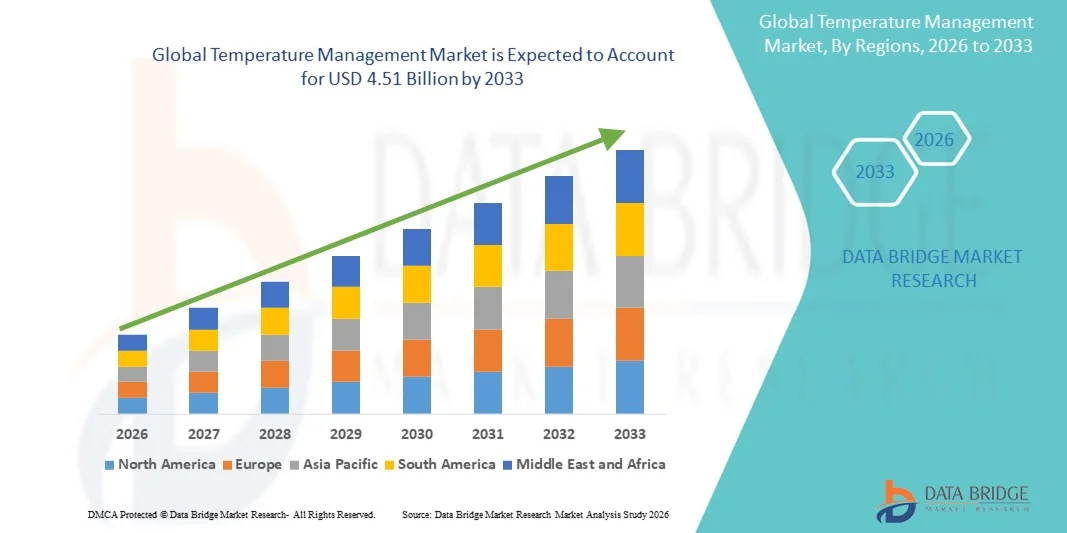
- The global temperature management market size was valued at USD 3.31 billion in 2025 and is expected to reach USD 4.51 billion by 2033, at a CAGR of 3.95% during the forecast period
- The market growth is largely driven by the increasing adoption of advanced temperature management systems across healthcare, industrial, and commercial sectors, coupled with innovations in thermal regulation technologies and wearable devices
- Furthermore, rising awareness regarding patient safety, process efficiency, and energy optimization is boosting demand for precise and reliable temperature control solutions. These factors are collectively accelerating the deployment of temperature management systems, thereby significantly propelling the market’s growth
Temperature Management Market Analysis
- Temperature management systems, encompassing devices and solutions designed to regulate and monitor patient temperature in medical settings, are becoming essential for patient safety, improving clinical outcomes, and enhancing operational efficiency across hospitals and care facilities
- The growing adoption of temperature management solutions is primarily driven by increasing awareness of temperature-related risks, rising demand for advanced perioperative and critical care technologies, and the integration of automated and precise thermal control systems in healthcare workflows
- North America dominated the temperature management market with the largest revenue share of 38.5% in 2025, attributed to advanced healthcare infrastructure, high adoption of technologically sophisticated medical devices, and a strong presence of leading industry players, with the U.S. witnessing significant uptake in patient warming and cooling systems across operating rooms and intensive care units
- Asia-Pacific is expected to be the fastest growing region in the temperature management market during the forecast period, supported by expanding healthcare facilities, rising investments in medical technology, and increasing adoption of temperature management solutions in perioperative, acute, and newborn care
- Patient warming systems dominated the temperature management market with a share of 43.2% in 2025, driven by their critical role in perioperative care, prevention of hypothermia, and growing utilization across operating rooms and intensive care units
Report Scope and Temperature Management Market Segmentation
|
Attributes |
Temperature Management Key Market Insights |
|
Segments Covered |
|
|
Countries Covered |
North America
Europe
Asia-Pacific
Middle East and Africa
South America
|
|
Key Market Players |
|
|
Market Opportunities |
|
|
Value Added Data Infosets |
In addition to the insights on market scenarios such as market value, growth rate, segmentation, geographical coverage, and major players, the market reports curated by the Data Bridge Market Research also include in-depth expert analysis, patient epidemiology, pipeline analysis, pricing analysis, and regulatory framework |
Temperature Management Market Trends
Rising Integration of AI-Enabled and Automated Thermal Regulation Systems
- A significant and accelerating trend in the global temperature management market is the growing integration of artificial intelligence (AI) and automated thermal control technologies in medical and critical care settings, greatly enhancing precision, monitoring efficiency, and clinician decision-making
- For instance, advanced perioperative warming and cooling systems now incorporate AI-driven algorithms to maintain optimal patient temperature, automatically adjusting based on physiological feedback and clinical workflow requirements
- AI integration in temperature management devices enables features such as predictive thermal regulation, early detection of abnormal temperature patterns, and intelligent alerts for intervention; for instance, several ICU-based systems leverage AI to optimize cooling rates during targeted temperature therapy and enhance patient safety
- The seamless integration of temperature-controlled devices with broader hospital information systems and smart monitoring platforms allows centralized management of patient temperature along with vital signs, improving coordinated care and reducing manual workload
- This trend toward more intelligent, intuitive, and interconnected thermal management systems is reshaping expectations in perioperative and critical care environments, prompting manufacturers to develop AI-enabled devices with automated warming/cooling cycles and real-time data analytics capabilities
- The demand for temperature management devices offering seamless automation and AI-driven optimization is rising rapidly across operating rooms, ICUs, and emergency departments as healthcare providers prioritize efficiency, safety, and improved treatment outcomes
Temperature Management Market Dynamics
Driver
Growing Need for Advanced Temperature Control Due to Rising Surgical Volume and Critical Care Demand
- The increasing number of surgical procedures worldwide, combined with heightened awareness of temperature-related complications in perioperative and critical care environments, is a major driver accelerating demand for advanced temperature management systems
- For instance, in 2025, several healthcare facilities globally expanded their adoption of automated perioperative warming systems to reduce hypothermia-related risks, reflecting a broader market shift toward temperature-optimized surgical care
- As clinicians recognize the importance of maintaining normothermia to prevent surgical site infections, improve hemodynamic stability, and enhance patient recovery, temperature management devices are becoming essential components of modern operating rooms and ICUs
- Furthermore, the growing burden of cardiac arrest, stroke, trauma, and neonatal complications is driving increased utilization of therapeutic cooling and warming systems, which play a critical role in stabilizing patients during emergency treatment
- The convenience, safety, and clinical value offered by advanced temperature management technologies especially devices that provide precise, real-time thermal control are significantly propelling adoption across hospitals and specialty care units
- The rising integration of temperature regulation systems with hospital equipment and monitoring platforms further supports their widespread acceptance and strengthens market growth
Restraint/Challenge
High Equipment Cost and Stringent Regulatory Compliance Requirements
- The high cost of temperature management equipment, particularly advanced warming and cooling systems used in surgical and critical care settings, poses a significant challenge to widespread adoption, especially for small hospitals and facilities in price-sensitive regions
- For instance, premium therapeutic hypothermia and targeted temperature management systems require substantial upfront investment, making it difficult for resource-constrained healthcare centers to deploy these technologies at scale
- In addition, strict regulatory requirements surrounding the safety, accuracy, and performance of temperature management devices can extend approval timelines, increasing development costs for manufacturers and slowing market penetration
- Concerns regarding device malfunction, overheating, or improper temperature control have prompted regulators to enforce rigorous testing and compliance standards, adding further complexity to product introduction
- The combination of high acquisition cost and stringent certification processes can limit technology adoption particularly in emerging economies where healthcare budgets remain constrained and procurement priorities vary widely
- Overcoming these challenges through cost-optimized product development, enhanced compliance strategies, and increased awareness of clinical benefits will be essential for sustaining market expansion
Temperature Management Market Scope
The market is segmented on the basis of product, application, medical specialty, and end-user.
- By Product
On the basis of product, the temperature management market is segmented into patient warming systems and patient cooling systems. The patient warming systems segment dominated the market with the largest market revenue share of 43.2% in 2025, driven by its essential role in preventing perioperative hypothermia and improving surgical outcomes. These systems are widely used in operating rooms, ICUs, and recovery units, making them foundational to modern hospital workflows. The increasing volume of surgical procedures globally further strengthens demand for forced-air warmers, fluid warmers, and conductive warming devices. Hospitals also rely on warming solutions to reduce complications and shorten patient recovery times, adhering to strict clinical guidelines. The high clinical efficacy, ease of integration, and ongoing technological advancements continue to reinforce the dominance of patient warming systems.
The patient cooling systems segment is anticipated to witness the fastest growth rate from 2026 to 2033, fueled by rising adoption of targeted temperature management (TTM) in cardiac arrest, stroke, and traumatic brain injury cases. Cooling solutions are increasingly recognized for improving neurological outcomes, prompting rapid uptake across ICU and emergency care settings. The segment is benefiting from technological advances in surface and intravascular cooling devices that reduce cooling time and enhance treatment precision. Clinical expansion of therapeutic hypothermia protocols is also boosting this demand. In addition, increasing investment in emergency and critical care infrastructure across emerging regions is contributing to strong segment growth.
- By Application
On the basis of application, the market is segmented into perioperative care, acute care, newborn care, and other applications. The perioperative care segment dominated the market with the largest market revenue share in 2025, driven by the mandatory requirement for temperature stabilization throughout the surgical process. Maintaining normothermia during surgery reduces complications, improves anesthesia performance, and enhances patient recovery. Hospitals regularly use warming systems before, during, and after surgeries, making perioperative care the largest application area. Global growth in surgical procedure volume further amplifies demand. Adoption of stringent temperature management guidelines in operating rooms continues to support segment leadership. With rising investments in OR modernization and improved clinical safety protocols, perioperative care remains central to temperature management adoption.
The acute care segment is anticipated to witness the fastest growth rate from 2026 to 2033, supported by increasing cases of cardiac arrest, neurological emergencies, sepsis, and trauma requiring precise temperature stabilization. Acute care units increasingly implement targeted temperature management to improve survival and neurological outcomes. Advancements in automated cooling and warming solutions significantly enhance treatment precision and support greater clinical adoption. The growing number of critical care beds globally further accelerates demand. Hospitals are also integrating acute care temperature systems with patient monitoring platforms for better decision-making. As emergency and critical care services expand, the acute care segment is expected to grow rapidly.
- By Medical Specialty
On the basis of medical specialty, the market is segmented into general surgery, cardiology, neurology, pediatrics, thoracic surgery, orthopedic surgery, and others. The general surgery segment dominated the market with the largest market revenue share in 2025, driven by widespread usage of temperature management solutions across nearly all surgical disciplines. Preventing perioperative hypothermia is a core requirement in general surgery, leading to consistent utilization of forced-air warming systems, fluid warmers, and conduction-based devices. Rising global demand for surgical procedures further amplifies adoption. Hospitals follow strict surgical safety protocols mandating temperature stabilization, reinforcing segment leadership. As healthcare systems continue modernizing their surgical departments, temperature control solutions remain foundational tools. Technological advancements enabling real-time automated warming further support dominance of this specialty.
The cardiology segment is anticipated to witness the fastest growth rate from 2026 to 2033, driven by increasing use of targeted temperature management for cardiac arrest patients and expanding adoption of cooling devices during cardiac surgeries. Therapeutic hypothermia significantly enhances neurological outcomes post-resuscitation, leading to widespread implementation of cooling protocols. Cardiac catheterization labs and advanced cardiac centers are integrating precise cooling devices to support complex interventions. Rising incidence of cardiovascular diseases worldwide is further boosting demand. Innovations in intravascular cooling technologies accelerate adoption due to their high accuracy and rapid cooling capabilities. As global cardiac emergency cases rise, cardiology is poised for substantial growth.
- By End-User
On the basis of end-user, the market is segmented into operating rooms, intensive care units (ICUs), emergency rooms, and others. The operating rooms segment dominated the market with the largest market revenue share in 2025, attributable to the critical need for temperature regulation during almost every surgical procedure. Maintaining optimal body temperature enhances surgical success rates and supports faster recovery. Forced-air warmers, conductive warming devices, and fluid warmer systems are routinely used in operating rooms worldwide. Growing global surgical volume continues to drive OR-related demand. Hospitals follow strict perioperative temperature standards, which further reinforce the segment’s dominance. Upgradation of operating rooms with technologically advanced warming and cooling systems also contributes to its leadership.
The intensive care unit (ICU) segment is anticipated to witness the fastest growth rate from 2026 to 2033, driven by rising adoption of targeted temperature management for critically ill patients. ICUs commonly manage conditions such as sepsis, cardiac arrest, traumatic brain injuries, and neurological emergencies, where temperature control is vital. Integration of advanced cooling and warming devices with ICU monitoring systems enhances precision and efficiency. Increasing investments in critical care capacity worldwide strengthen segment expansion. Automated TTM systems that reduce clinical workload are also boosting adoption. As global demand for advanced critical care services rises, ICUs are set to experience the fastest growth in temperature management adoption.
Temperature Management Market Regional Analysis
- North America dominated the temperature management market with the largest revenue share of 38.5% in 2025, attributed to advanced healthcare infrastructure, high adoption of technologically sophisticated medical devices, and a strong presence of leading industry players
- Healthcare providers in the region prioritize the use of temperature management solutions due to their proven ability to reduce complications, enhance surgical safety, and support targeted temperature management in cardiac and neurological emergencies
- This widespread adoption is further supported by a high volume of surgical procedures, strong presence of leading medical device manufacturers, and growing investments in critical care modernization, establishing temperature management systems as essential tools across hospitals and specialty centers
U.S. Temperature Management Market Insight
The U.S. temperature management market captured the largest revenue share within North America in 2025, fueled by the rising volume of surgical procedures and the extensive adoption of advanced warming and cooling systems across hospitals and specialty centers. Healthcare providers are increasingly prioritizing perioperative normothermia and targeted temperature management to reduce complications and improve patient outcomes. The growing use of automated systems in operating rooms, ICUs, and emergency departments further strengthens market adoption. Moreover, the U.S. benefits from strong clinical guidelines, high healthcare expenditure, and early integration of AI-enabled temperature control technologies, all of which significantly contribute to market expansion.
Europe Temperature Management Market Insight
The Europe temperature management market is projected to expand at a substantial CAGR throughout the forecast period, primarily driven by stringent clinical protocols and the region’s emphasis on patient safety during surgeries and critical care. Increasing adoption of advanced warming and cooling devices in hospitals is supported by modernization of healthcare infrastructure and rising surgical procedure volumes. European healthcare systems are also shifting toward precision-based thermal regulation to prevent hypothermia and improve recovery outcomes. The region is witnessing notable growth across perioperative care, emergency departments, and neonatal units, with temperature management solutions being integrated into both newly built and upgraded medical facilities.
U.K. Temperature Management Market Insight
The U.K. temperature management market is anticipated to grow at a noteworthy CAGR during the forecast period, driven by the increasing implementation of enhanced recovery protocols and a strong focus on maintaining normothermia during surgical care. Hospitals and clinics are adopting modern warming systems to minimize perioperative complications and improve patient satisfaction. Growing investments in emergency and critical care units, along with higher awareness among clinicians regarding the importance of targeted temperature management, support market expansion. The U.K.’s adoption of digital healthcare technologies and smart medical devices further accelerates the use of advanced thermal regulation systems.
Germany Temperature Management Market Insight
The Germany temperature management market is expected to expand at a considerable CAGR during the forecast period, fueled by growing awareness of postoperative complications linked to temperature fluctuations and the rising demand for technologically advanced thermal management solutions. The country’s strong healthcare infrastructure and emphasis on precision-driven medical technologies promote widespread adoption across surgical and intensive care units. Germany’s focus on sustainability and energy-efficient medical equipment further aligns with the use of advanced warming and cooling systems. Integration of temperature management devices with smart hospital platforms continues to gain traction, driven by high standards for patient safety and treatment accuracy.
Asia-Pacific Temperature Management Market Insight
The Asia-Pacific temperature management market is poised to grow at the fastest CAGR during the forecast period of 2026 to 2033, driven by rapid expansion of healthcare infrastructure, rising surgical volumes, and increased investments in critical care capacities across China, Japan, India, and Southeast Asia. The region’s shift toward advanced hospital equipment and adoption of evidence-based clinical practices are accelerating the demand for warming and cooling devices. Government initiatives promoting modernization of healthcare facilities further boost market penetration. In addition, APAC’s role as a manufacturing hub for medical devices enhances affordability and accessibility, expanding usage across both public and private hospitals.
Japan Temperature Management Market Insight
The Japan temperature management market is gaining momentum due to the country’s advanced healthcare ecosystem, high surgical case load, and emphasis on precision-driven medical treatments. Hospitals increasingly utilize thermal management systems to support complex cardiac, neurological, and perioperative procedures. Integration of temperature control solutions with IoT-based monitoring systems is becoming more common, enhancing accuracy and workflow efficiency. Moreover, Japan’s aging population is such asly to spur demand for improved critical care and postoperative recovery solutions, driving wider adoption of both warming and cooling devices across healthcare facilities.
India Temperature Management Market Insight
The India temperature management market accounted for the largest market revenue share in Asia Pacific in 2025, attributed to the country’s expanding hospital infrastructure, increasing surgical interventions, and rising awareness of perioperative temperature management. The growing middle class and investment in modern healthcare facilities are accelerating the adoption of warming systems in operating rooms and critical care units. India is also witnessing strong demand for cost-effective temperature management devices due to the presence of domestic manufacturers. Government-led healthcare programs, coupled with the rise of private multispecialty hospitals, are key factors propelling market growth in the country.
Temperature Management Market Share
The Temperature Management industry is primarily led by well-established companies, including:
- 3M (U.S.)
- Gentherm Incorporated (U.S.)
- Stryker (U.S.)
- BD (U.S.)
- ZOLL Medical Corporation (U.S.)
- Medtronic (Ireland)
- GE HealthCare (U.S.)
- Smiths Medical (U.S.)
- Cincinnati Sub-Zero Products, LLC (U.S.)
- Inspiration Healthcare Group plc (U.K.)
- Geratherm Medical AG (Germany)
- Drägerwerk AG & Co. KGaA (Germany)
- Ecolab Inc. (U.S.)
- Barkey GmbH & Co. KG (Germany)
- Enthermics Medical Systems (U.S.)
- Belmont Medical Technologies (U.S.)
- Mennen Medical Ltd. (Israel)
- The Surgical Company (Netherlands)
- Terumo Corporation (Japan)
What are the Recent Developments in Global Temperature Management Market?
- In July 2025, Medline launched the ComfortTemp Patient Warming System a 510(k)-class warming system (blankets and gowns) with a lock-in hose connection and rotating elbow-connector, aiming to improve perioperative temperature regulation and patient comfort
- In October 2023, BrainCool AB received FDA 510(k) clearance for the IQool System a targeted temperature management (TTM) device, expanding non-invasive cooling options for critical care and post-resuscitation treatment
- In April 2023, Baxter International unveiled a new conductive Baxter Patient Warming System integrated into surgical table pads eliminating need for disposables, reducing noise and waste, to help maintain patient normothermia in the OR
- In May 2022, LifeWarmer introduced the Quantum Blood and Fluid Warming System — an advanced warming solution for blood and fluids, aimed at enhancing the safety and efficiency of transfusions and resuscitation procedures
- In April 2021, MEQU, a Danish MedTech firm, introduced the in-hospital version of its °M Warmer System (called “M Station”) a portable blood/IV-fluid warmer, designed for hospitals and emergency settings to rapidly warm fluids and reduce risk of hypothermia

- Interactive Data Analysis Dashboard
- Company Analysis Dashboard for high growth potential opportunities
- Research Analyst Access for customization & queries
- Competitor Analysis with Interactive dashboard
- Latest News, Updates & Trend analysis
- Harness the Power of Benchmark Analysis for Comprehensive Competitor Tracking
Data collection and base year analysis are done using data collection modules with large sample sizes. The stage includes obtaining market information or related data through various sources and strategies. It includes examining and planning all the data acquired from the past in advance. It likewise envelops the examination of information inconsistencies seen across different information sources. The market data is analysed and estimated using market statistical and coherent models. Also, market share analysis and key trend analysis are the major success factors in the market report. To know more, please request an analyst call or drop down your inquiry.
The key research methodology used by DBMR research team is data triangulation which involves data mining, analysis of the impact of data variables on the market and primary (industry expert) validation. Data models include Vendor Positioning Grid, Market Time Line Analysis, Market Overview and Guide, Company Positioning Grid, Patent Analysis, Pricing Analysis, Company Market Share Analysis, Standards of Measurement, Global versus Regional and Vendor Share Analysis. To know more about the research methodology, drop in an inquiry to speak to our industry experts.
Data Bridge Market Research is a leader in advanced formative research. We take pride in servicing our existing and new customers with data and analysis that match and suits their goal. The report can be customized to include price trend analysis of target brands understanding the market for additional countries (ask for the list of countries), clinical trial results data, literature review, refurbished market and product base analysis. Market analysis of target competitors can be analyzed from technology-based analysis to market portfolio strategies. We can add as many competitors that you require data about in the format and data style you are looking for. Our team of analysts can also provide you data in crude raw excel files pivot tables (Fact book) or can assist you in creating presentations from the data sets available in the report.













