


Test Information Management Software Market Overview
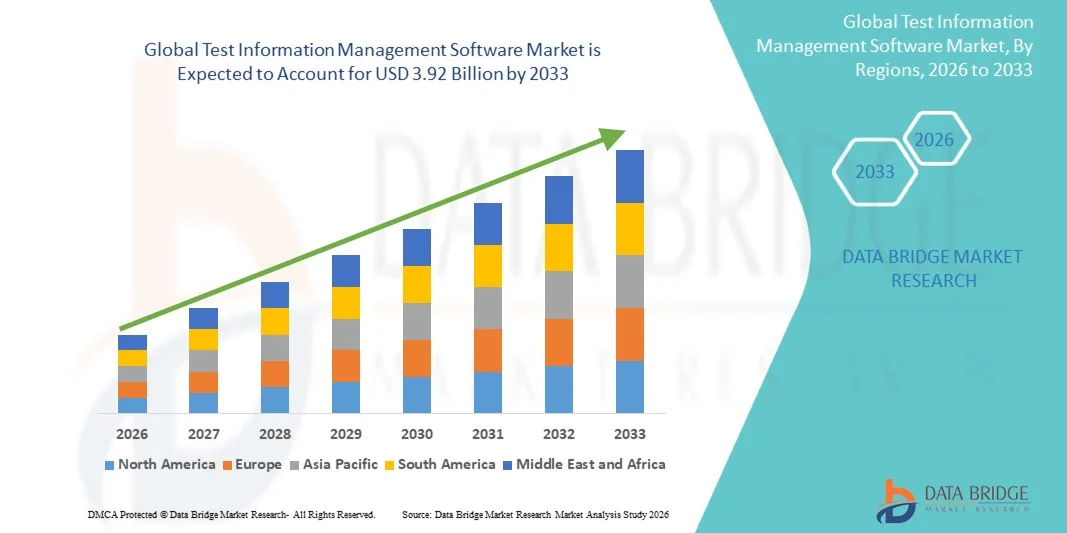
The Test Information Management Software Market was valued at USD 1.68 billion in 2025 and is projected to reach USD 3.92 billion by 2033, growing at a CAGR of 11.20% from 2026 to 2033. The market is experiencing consistent growth driven by the rising demand for digital quality management solutions, increasing adoption of laboratory automation technologies, and expanding use of data-driven testing workflows across healthcare, pharmaceuticals, biotechnology, food safety, and environmental testing industries. The growing need for centralized test data management, regulatory compliance, and real-time collaboration is encouraging laboratories and research organizations to adopt advanced Test Information Management Software (TIMS) platforms for improved operational efficiency and traceability.
The increasing volume of laboratory testing activities globally, combined with stringent regulatory requirements from organizations such as the FDA, ISO, CLIA, and CAP, is compelling diagnostic laboratories, pharmaceutical companies, and research institutes to modernize testing infrastructure through integrated software solutions. Cloud-based and AI-enabled Test Information Management Software platforms are increasingly replacing manual and paper-based laboratory processes in many organizations, offering scalable, automated, and error-reducing environments for sample tracking, workflow optimization, analytics, and regulatory reporting. In addition, advancements in interoperability, laboratory informatics, and predictive analytics technologies are accelerating adoption of next-generation TIMS platforms across both developed and emerging healthcare markets globally.
Key Market Trends & Insights
- North America dominated the Test Information Management Software Market with the largest revenue share of 39.24% in 2025, supported by strong adoption of laboratory informatics solutions, increasing investments in cloud-based testing infrastructure, stringent regulatory compliance requirements, and widespread deployment of advanced data management platforms across healthcare, BFSI, IT, and life sciences industries.
- The large enterprises segment dominated the market with a share of 64.93% in 2025 due to the extensive deployment of enterprise-scale testing infrastructures, large application ecosystems, and complex regulatory compliance requirements
- Asia-Pacific is expected to be the fastest-growing region at a CAGR of 8.1% from 2026 to 2033, fueled by rapid digital transformation, expanding healthcare and IT infrastructure, rising investments in cloud technologies, and increasing adoption of automated data management solutions across China, India, Japan, and Southeast Asia.
- The Synthetic Test Data Generation segment is projected to register the fastest CAGR of 8.4% from 2026 to 2033, reflecting growing demand for privacy-compliant test environments, AI-driven software testing, and secure data simulation platforms across highly regulated industries.
- The Healthcare and Life Sciences segment dominated the vertical category with a 27.46% revenue share in 2025, led by increasing adoption of laboratory information systems, regulatory compliance requirements, growing clinical testing volumes, and rising demand for secure and traceable healthcare data management solutions.
- The Yearly pricing segment accounted for 46.18% of the market in 2025, preferred by enterprises and healthcare organizations seeking cost-effective long-term licensing models, continuous software updates, technical support services, and enterprise-grade security capabilities.
- The Large Enterprises segment dominated the organization size category with a 64.52% share in 2025, driven by higher investments in digital transformation, large-scale data processing requirements, and increasing implementation of enterprise-wide testing and compliance management platforms across multinational organizations.
- The SMEs segment is anticipated to witness the fastest CAGR of 7.9% from 2026 to 2033, supported by growing availability of subscription-based cloud solutions, rising awareness regarding automated testing platforms, and increasing adoption of affordable software-as-a-service (SaaS)-based test information management systems among emerging businesses globally.
Market Size & Forecast
- Global Market Value (2025): USD 1.68 Billion
- Expected Market Value (2033): USD 3.92 Billion
- Forecast CAGR (2026–2033): 11.20%
- Leading Region in 2025: North America
- Fastest Growing Region: Asia-Pacific
Report Scope and Test Information Management Software Market Segmentation
|
Attributes |
Test Information Management Software Key Market Insights |
|
Segments Covered |
|
|
Countries Covered |
North America · U.S. · Canada · Mexico Europe · Germany · France · U.K. · Netherlands · Switzerland · Belgium · Russia · Italy · Spain · Turkey · Rest of Europe Asia-Pacific · China · Japan · India · South Korea · Singapore · Malaysia · Australia · Thailand · Indonesia · Philippines · Rest of Asia-Pacific Middle East and Africa · Saudi Arabia · U.A.E. · South Africa · Egypt · Israel · Rest of Middle East and Africa South America · Brazil · Argentina · Rest of South America |
|
Key Market Players |
• IBM Corporation (U.S.) |
|
Market Opportunities |
· Expansion of AI-Driven Test Automation and Predictive Analytics · Rising Adoption of Cloud-Based and SaaS Testing Platforms Among SMEs · Growing Demand for Data Privacy Compliance and Synthetic Test Data Solutions |
|
Value Added Data Infosets |
In addition to the insights on market scenarios such as market value, growth rate, segmentation, geographical coverage, and major players, the market reports curated by the Data Bridge Market Research also include in-depth expert analysis, geographically represented company-wise production and capacity, network layouts of distributors and partners, detailed and updated price trend analysis and deficit analysis of supply chain and demand. |
Test Information Management Software Market Trends
Trend: Rising Adoption of AI-Driven Test Automation and Cloud-Based Quality Management Platforms
Organizations across BFSI, healthcare, IT & telecom, and manufacturing sectors are increasingly adopting advanced Test Information Management Software (TIMS) platforms to improve software quality assurance, automate testing workflows, and ensure regulatory compliance. Enterprises are leveraging AI-enabled test management systems to streamline defect tracking, test data management, and application lifecycle monitoring while reducing manual testing complexity and operational costs. The growing shift toward DevOps, Agile development, and continuous integration/continuous deployment (CI/CD) environments is significantly increasing demand for centralized and cloud-based testing platforms. For instance, large enterprises are integrating AI-powered test analytics and synthetic test data generation tools to accelerate release cycles and improve testing accuracy in complex enterprise software environments. In addition, the rising adoption of cloud-native applications and digital transformation initiatives is further driving demand for scalable and secure test information management solutions globally.
Test Information Management Software Market Dynamics
Key Market Driver: Growing Demand for Automated Testing and Regulatory Compliance Solutions
The primary driver of the Test Information Management Software Market is the increasing need for automated software testing, centralized data management, and regulatory compliance across highly data-sensitive industries. Organizations are increasingly deploying advanced test management platforms to improve testing efficiency, reduce software deployment errors, and support large-scale digital transformation initiatives. According to industry estimates, enterprises adopting AI-enabled test automation solutions can reduce testing time by nearly 40–60% while significantly improving defect detection accuracy. BFSI and healthcare organizations are particularly investing in secure test data management solutions to comply with regulations such as GDPR, HIPAA, PCI-DSS, and ISO quality standards. In addition, growing adoption of cloud computing, mobile applications, and enterprise SaaS platforms is accelerating demand for scalable test information management solutions capable of handling complex testing environments and real-time analytics workflows.
Key Restraint/Challenge: High Implementation Complexity and Data Security Concerns
A major challenge in the Test Information Management Software Market is the high implementation cost and complexity associated with integrating advanced testing platforms into existing enterprise infrastructure. Large-scale deployment often requires substantial investment in cloud migration, API integration, cybersecurity architecture, software customization, and workforce training. In addition, organizations handling sensitive customer and healthcare data face increasing concerns regarding cybersecurity threats, data leakage, and regulatory non-compliance. According to IBM’s Cost of a Data Breach Report, the average global data breach cost exceeded USD 4 million in recent years, encouraging enterprises to invest heavily in secure testing and compliance infrastructure. However, small and medium-sized enterprises (SMEs) often face budgetary constraints and lack skilled IT professionals to manage sophisticated testing ecosystems. Furthermore, interoperability issues between legacy systems and modern AI-enabled testing platforms continue to create operational challenges for enterprises transitioning toward automated software quality management environments.
Key Market Opportunity: Expansion of AI, Synthetic Test Data Generation, and Cloud-Based Testing Platforms
The integration of artificial intelligence, machine learning, and synthetic test data technologies presents significant growth opportunities for the Test Information Management Software Market. AI-powered testing platforms are enabling predictive defect analysis, intelligent test case generation, automated regression testing, and real-time quality monitoring, significantly improving software deployment efficiency. The increasing adoption of synthetic test data generation tools is also helping enterprises comply with strict privacy regulations while maintaining realistic testing environments for application development. For example, financial institutions and healthcare providers are increasingly deploying synthetic datasets to test sensitive applications without exposing real customer information. In addition, growing demand for cloud-based testing environments is enabling organizations to scale testing operations across distributed teams while reducing infrastructure costs. Rising investments in digital transformation projects, expanding DevOps adoption, and increasing use of AI-driven analytics platforms across Asia-Pacific, North America, and Europe are expected to create substantial long-term growth opportunities for Test Information Management Software providers globally.
Test Information Management Software Market Scope
The Test Information Management Software market is segmented on the basis of type, application, pricing, vertical, and organization size.
By Type
On the basis of type, the Test Information Management Software Market is segmented into cloud based and web based. The cloud based segment dominated the market with a share of 58.46% in 2025 due to the increasing adoption of cloud-native enterprise applications, remote software testing environments, and scalable quality assurance platforms across large organizations. Cloud-based solutions provide real-time collaboration, centralized test data access, automated software updates, and lower infrastructure dependency, making them highly preferred among enterprises operating in agile and DevOps environments. Growing adoption of SaaS testing platforms across BFSI, healthcare, IT & telecom, and manufacturing sectors is further supporting segment growth. In addition, enterprises are increasingly shifting toward hybrid and multi-cloud infrastructures to improve testing efficiency, data accessibility, and deployment flexibility. Rising investments in AI-driven testing automation, integrated analytics, and cloud security solutions are also reinforcing the leadership of this segment. The ability of cloud platforms to support distributed teams, large-scale application testing, and continuous integration workflows further strengthens adoption globally.
The cloud based segment is also expected to witness the fastest CAGR of 8.4% from 2026 to 2033, driven by increasing demand for flexible, subscription-based testing environments and growing digital transformation initiatives across enterprises. Organizations are rapidly adopting cloud testing platforms to reduce operational costs, accelerate software deployment cycles, and improve scalability. Increasing integration of AI-powered testing tools, real-time monitoring capabilities, and automated compliance management solutions is further enhancing cloud platform adoption. In addition, rising demand for remote testing operations, API-driven testing environments, and cross-platform software validation is accelerating growth. Expanding adoption of cloud computing across SMEs and emerging economies is also contributing significantly to market expansion. The increasing use of containerized applications, microservices architectures, and CI/CD pipelines is expected to create sustained demand for cloud-based test information management solutions globally.
By Application
On the basis of application, the Test Information Management Software Market is segmented into data subsetting, data masking, data profiling and analysis, data compliance and security, and synthetic test data generation. The data masking segment dominated the market with a share of 31.28% in 2025 due to increasing concerns regarding cybersecurity, data privacy regulations, and protection of sensitive enterprise information during software testing processes. Organizations across BFSI, healthcare, government, and telecom sectors are increasingly implementing data masking solutions to comply with regulations such as GDPR, HIPAA, and PCI-DSS while maintaining secure testing environments. Rising frequency of cyberattacks and data breaches is further encouraging enterprises to adopt advanced masking technologies for protecting customer information and confidential datasets. In addition, the growing complexity of enterprise applications and digital ecosystems is increasing demand for secure test data management solutions. Enterprises are also integrating AI-enabled masking tools to automate compliance workflows and reduce operational risks. Strong demand for privacy-preserving testing environments is reinforcing the dominance of the data masking segment globally.
The synthetic test data generation segment is expected to witness the fastest CAGR of 9.1% from 2026 to 2033, driven by growing demand for privacy-compliant testing environments and AI-driven application development. Synthetic test data platforms enable organizations to create realistic datasets without exposing actual customer information, significantly improving security and regulatory compliance. Increasing adoption of machine learning models, predictive analytics platforms, and cloud-native enterprise applications is accelerating the need for scalable synthetic data generation tools. In addition, enterprises are increasingly leveraging synthetic datasets for automated software testing, performance benchmarking, and cybersecurity simulations. Rising investments in digital banking, healthcare analytics, and AI-powered business applications are further driving segment growth. The growing focus on reducing testing complexity, improving software quality, and enabling secure DevOps practices is expected to strengthen adoption of synthetic test data generation solutions globally.
By Pricing
On the basis of pricing, the Test Information Management Software Market is segmented into monthly, yearly, and one-time license. The yearly segment dominated the market with a share of 47.62% in 2025 due to its cost-effectiveness, predictable budgeting structure, and widespread adoption among enterprises seeking long-term software testing and compliance management solutions. Large organizations prefer yearly subscription models as they provide continuous software updates, technical support, cybersecurity enhancements, and integration capabilities under a single contract structure. In addition, yearly pricing plans are highly preferred by enterprises operating large-scale testing environments because they reduce procurement complexity and improve operational planning. Vendors are increasingly offering customizable annual subscription packages integrated with AI analytics, cloud deployment, and automation capabilities, further driving adoption. Strong adoption of enterprise SaaS models and recurring revenue strategies across software vendors is also reinforcing segment growth. Growing preference for scalable and centrally managed testing ecosystems continues to support dominance of the yearly pricing segment globally.
The monthly segment is expected to witness the fastest CAGR of 8.2% from 2026 to 2033, driven by increasing demand for flexible and low-cost subscription models among SMEs and startup organizations. Monthly pricing plans provide businesses with reduced upfront investment requirements, easier scalability, and rapid software deployment capabilities. Organizations adopting agile development methodologies and short-term testing projects are increasingly preferring monthly subscription-based testing platforms due to operational flexibility. In addition, rising adoption of cloud-based testing environments and SaaS platforms is accelerating demand for pay-as-you-go software models. Vendors are increasingly targeting SMEs through affordable monthly packages integrated with automation, analytics, and remote collaboration features. Expanding digital transformation initiatives across emerging economies are also contributing significantly to segment growth. The increasing demand for flexible enterprise software consumption models is expected to drive continued expansion of the monthly pricing segment.
By Vertical
On the basis of vertical, the Test Information Management Software Market is segmented into BFSI, IT and telecom, manufacturing, energy and utilities, healthcare and life sciences, education, aerospace and defense, and others. The BFSI segment dominated the market with a share of 27.84% in 2025 due to the growing need for secure software testing, regulatory compliance management, fraud prevention systems, and digital banking platform validation. Financial institutions are increasingly adopting advanced test information management solutions to ensure secure deployment of online banking applications, payment systems, insurance platforms, and customer data management solutions. Rising cybersecurity threats and stringent financial regulations are further driving demand for automated compliance testing and secure test data management tools. In addition, increasing adoption of AI-powered fintech platforms, mobile banking applications, and cloud-based financial services is accelerating software testing requirements across the BFSI sector. Enterprises are also investing heavily in continuous testing environments to improve customer experience and reduce operational risks. The rapid growth of digital financial ecosystems globally continues to reinforce the dominance of the BFSI segment.
The healthcare and life sciences segment is expected to witness the fastest CAGR of 8.8% from 2026 to 2033, driven by increasing digitization of healthcare systems, rising adoption of electronic health records (EHRs), and growing deployment of AI-enabled healthcare applications. Healthcare organizations are increasingly investing in advanced testing platforms to ensure regulatory compliance, data security, and interoperability of clinical software systems. In addition, growing use of telemedicine platforms, connected healthcare devices, laboratory information systems, and cloud-based patient management applications is driving testing complexity across the sector. Rising concerns regarding patient data privacy and increasing implementation of HIPAA-compliant testing environments are further accelerating adoption. Pharmaceutical and biotechnology companies are also utilizing automated testing solutions to improve operational efficiency and software reliability. Expanding healthcare IT investments and rapid digital transformation across hospitals and diagnostic centers are expected to significantly drive growth in this segment globally.
By Organization Size
On the basis of organization size, the Test Information Management Software Market is segmented into small and medium-sized enterprises (SMEs) and large enterprises. The large enterprises segment dominated the market with a share of 64.93% in 2025 due to the extensive deployment of enterprise-scale testing infrastructures, large application ecosystems, and complex regulatory compliance requirements. Large organizations across BFSI, healthcare, telecom, and manufacturing sectors are increasingly investing in AI-powered testing platforms, cloud-based quality management systems, and automated compliance solutions to improve operational efficiency and software reliability. In addition, large enterprises manage massive volumes of sensitive customer and operational data, increasing the need for secure test data management and centralized analytics platforms. Strong financial capabilities and continuous digital transformation initiatives are also supporting higher adoption of advanced test information management solutions among multinational enterprises. Enterprises are increasingly integrating DevOps, CI/CD pipelines, and AI-driven testing frameworks to accelerate software delivery cycles and improve business agility. Growing investments in cybersecurity, automation, and enterprise cloud migration continue to reinforce the leadership of the large enterprises segment globally.
The SMEs segment is expected to witness the fastest CAGR of 8.6% from 2026 to 2033, driven by increasing affordability of cloud-based testing solutions and rising digital transformation initiatives among small businesses. SMEs are increasingly adopting subscription-based testing platforms to reduce infrastructure costs, improve software quality, and streamline testing operations without heavy capital investments. In addition, growing awareness regarding cybersecurity, regulatory compliance, and application reliability is encouraging SMEs to implement automated testing and data management solutions. Vendors are increasingly offering low-cost SaaS platforms tailored specifically for SMEs, integrated with AI-powered analytics and remote collaboration tools. Rising adoption of e-commerce platforms, fintech applications, and cloud-native business software among small enterprises is further accelerating demand. Expanding internet penetration and growing startup ecosystems across Asia-Pacific, Latin America, and the Middle East are also supporting segment growth. The increasing need for scalable, flexible, and cost-efficient testing environments is expected to drive strong adoption among SMEs globally.
Test Information Management Software Market Regional Analysis
North America dominated the Test Information Management Software market and accounted for the largest revenue share of 39.24% in 2025, supported by strong adoption of laboratory informatics solutions, increasing investments in cloud-based testing infrastructure, stringent regulatory compliance requirements, and widespread deployment of advanced data management platforms across healthcare, BFSI, IT, and life sciences industries. The region also benefits from the strong presence of leading software vendors, rising adoption of AI-driven analytics, and growing demand for secure, scalable, and automated test data management solutions. Increasing focus on digital transformation, cybersecurity compliance, and enterprise data governance continues to strengthen North America’s leadership position in the global market.
U.S. Test Information Management Software Market Insight
The U.S. Test Information Management Software market is witnessing strong growth due to rising investments in cloud computing, enterprise software modernization, and advanced data governance technologies. Organizations across healthcare, BFSI, IT, and telecommunications sectors are increasingly adopting automated test information management platforms to improve software quality, ensure regulatory compliance, and accelerate digital transformation initiatives. In addition, growing adoption of AI-powered analytics, DevOps practices, and secure cloud-based testing environments is driving demand for advanced test data management and compliance solutions across enterprises in the country.
Europe Test Information Management Software Market Insight
The Europe Test Information Management Software market remains a major contributor to global revenue, driven by strict data privacy regulations, increasing adoption of enterprise testing platforms, and strong demand for automated compliance management solutions. Organizations across banking, healthcare, manufacturing, and government sectors are increasingly deploying advanced test information management systems to support digital operations and regulatory reporting requirements. Growing investments in cloud infrastructure, cybersecurity technologies, and AI-driven data management tools continue to support market expansion across Europe.
U.K. Test Information Management Software Market Insight
The U.K. Test Information Management Software market is experiencing steady growth, supported by rising adoption of cloud-native testing platforms, increasing focus on software quality assurance, and growing investments in digital transformation initiatives. Enterprises are increasingly implementing test information management solutions to improve operational efficiency, ensure compliance with evolving regulatory standards, and enhance data security. Furthermore, growing integration of AI, machine learning, and automation technologies is improving testing workflows and accelerating adoption across BFSI, healthcare, and IT industries in the U.K.
Germany Test Information Management Software Market Insight
The Germany Test Information Management Software market is expanding steadily due to the country’s strong industrial automation ecosystem, advanced IT infrastructure, and rising adoption of enterprise software testing solutions. Manufacturing, automotive, healthcare, and engineering companies are increasingly deploying advanced test information management platforms to improve software validation, streamline workflows, and support Industry 4.0 initiatives. Continuous investments in cybersecurity, cloud computing, and AI-enabled analytics platforms are further strengthening market growth in Germany.
Asia-Pacific Test Information Management Software Market Insight
The Asia-Pacific Test Information Management Software market is expected to witness rapid growth, driven by expanding digital transformation initiatives, rising healthcare and IT infrastructure investments, and increasing demand for cloud-based testing and data management platforms across China, India, Japan, and Southeast Asia. Growing adoption of automation technologies, increasing focus on software quality assurance, and rising enterprise investments in secure and scalable data management systems are supporting regional market expansion. In addition, rapid growth of the BFSI, healthcare, and telecommunications sectors is accelerating adoption of advanced testing and compliance management solutions across the region.
Japan Test Information Management Software Market Insight
The Japan Test Information Management Software market is witnessing consistent growth due to rising investments in enterprise automation, digital healthcare systems, and advanced IT infrastructure modernization. Organizations are increasingly adopting automated test information management platforms to enhance software testing efficiency, improve compliance management, and support secure digital operations. Moreover, growing integration of AI-powered analytics, cloud technologies, and intelligent automation solutions is further contributing to market growth in Japan.
China Test Information Management Software Market Insight
The China Test Information Management Software market is growing rapidly, driven by expanding digital infrastructure, increasing enterprise cloud adoption, and rising government support for digital transformation initiatives. Organizations across healthcare, finance, manufacturing, and telecommunications sectors are increasingly deploying automated testing and data management platforms to improve operational efficiency and ensure regulatory compliance. In addition, rapid advancements in AI, big data analytics, and cloud computing technologies, combined with growing investments in enterprise IT modernization, are positioning China as one of the fastest-growing markets for Test Information Management Software globally.
Test Information Management Software Market Share
The Test Information Management Software industry is primarily led by well-established companies, including:
- IBM Corporation (U.S.)
- Oracle Corporation (U.S.)
- Microsoft Corporation (U.S.)
- Infosys Limited (India)
- Capgemini SE (France)
- Wipro Limited (India)
- Tata Consultancy Services (TCS) (India)
- Accenture plc (Ireland)
- Qualitest Group (U.K.)
- Tricentis GmbH (Austria)
- SmartBear Software (U.S.)
- Broadcom Inc. (U.S.)
- OpenText Corporation (Canada)
- Micro Focus International plc (U.K.)
- Perforce Software Inc. (U.S.)
- Parasoft Corporation (U.S.)
- CA Technologies (U.S.)
- Inflectra Corporation (U.S.)
- QASymphony (U.S.)
- Keysight Technologies, Inc. (U.S.)
- Hexaware Technologies (India)
- Cigniti Technologies Limited (India)
- HCL Technologies Limited (India)
- Tech Mahindra Limited (India)
- Infosys Equinox (India)
- Applitools Ltd. (Israel)
- Ranorex GmbH (Austria)
- Testlio Inc. (U.S.)
- Katalon LLC (U.S.)
- Sauce Labs Inc. (U.S.)
- BrowserStack Software Pvt. Ltd. (India)
- LambdaTest Inc. (U.S.)
- Eggplant (Keysight Technologies) (U.S.)
- Worksoft Inc. (U.S.)
Latest Developments in Test Information Management Software Market
- In September 2025, Moog Inc. has unveiled its latest motion systems all electric E60 Series and the electro pneumatic P60 Series, setting a new benchmark for simulation across aviation, land, and maritime training with support for up to 14,000 kg loads and high fidelity motion for Level D flight simulators and other professional uses. The upgraded platforms deliver enhanced reliability, compact design and sustained operational uptime, reflecting modernized electronics and sustainable operation. These new systems strengthen Moog’s market leadership in simulation motion technology by boosting performance, energy efficiency, and usability
- In January 2025, Exail Technologies has acquired Leukos, a French photonics specialist known for pulsed micro lasers, supercontinuum laser sources, ultrafast lasers, and simulation-enabled optical systems, strengthening its technological and industrial capabilities in advanced laser and simulation technologies. The deal integrates Leukos’s expertise with Exail’s photonics, optical, and simulation platforms, broadening product offerings for applications in biophotonics, microelectronics, and high-fidelity training simulations. This strategic acquisition accelerates Exail’s innovation in high-tech technologies, creating synergies that expand its reach in scientific, industrial, and simulation applications while reinforcing its position as a leading advanced-technology provider
- In November 2025, IPG Automotive launched CarMaker 15.0, the latest version of its driving simulation software used for virtual vehicle development. The new release improves simulation accuracy by integrating virtual electronic control units (vECUs), allowing engineers to test software and vehicle systems at earlier development stages. It also includes enhanced sensor models and improved endurance testing capabilities for ADAS and autonomous vehicles. This development strengthens IPG Automotive’s position in the driving simulator market, as CarMaker enables automotive manufacturers to perform complex vehicle tests in a virtual driving environment instead of physical road testing.
- In November 2024, IPG Automotive released CarMaker 14.0, introducing new simulation capabilities including advanced sensor models and more realistic virtual environments. The update allows developers to simulate complex traffic scenarios involving pedestrians, vehicles, and different weather conditions. These features help automotive companies test ADAS and autonomous driving systems more efficiently in driving simulators, reducing development time and cost. The upgrade also expanded simulation capabilities for heavy-duty vehicles using the TruckMaker platform.
- In June 2023, IPG Automotive participated in the UNICARagil research project, collaborating with universities and industry partners to develop automated vehicle architectures. The company contributed its CarMaker driving simulation platform to support simulation and validation of automated driving systems in Software-in-the-Loop (SIL) and Hardware-in-the-Loop (HIL) environments. This collaboration demonstrates the application of Test Information Management Software in research and development of autonomous mobility solutions

- Interactive Data Analysis Dashboard
- Company Analysis Dashboard for high growth potential opportunities
- Research Analyst Access for customization & queries
- Competitor Analysis with Interactive dashboard
- Latest News, Updates & Trend analysis
- Harness the Power of Benchmark Analysis for Comprehensive Competitor Tracking
Data collection and base year analysis are done using data collection modules with large sample sizes. The stage includes obtaining market information or related data through various sources and strategies. It includes examining and planning all the data acquired from the past in advance. It likewise envelops the examination of information inconsistencies seen across different information sources. The market data is analysed and estimated using market statistical and coherent models. Also, market share analysis and key trend analysis are the major success factors in the market report. To know more, please request an analyst call or drop down your inquiry.
The key research methodology used by DBMR research team is data triangulation which involves data mining, analysis of the impact of data variables on the market and primary (industry expert) validation. Data models include Vendor Positioning Grid, Market Time Line Analysis, Market Overview and Guide, Company Positioning Grid, Patent Analysis, Pricing Analysis, Company Market Share Analysis, Standards of Measurement, Global versus Regional and Vendor Share Analysis. To know more about the research methodology, drop in an inquiry to speak to our industry experts.
Data Bridge Market Research is a leader in advanced formative research. We take pride in servicing our existing and new customers with data and analysis that match and suits their goal. The report can be customized to include price trend analysis of target brands understanding the market for additional countries (ask for the list of countries), clinical trial results data, literature review, refurbished market and product base analysis. Market analysis of target competitors can be analyzed from technology-based analysis to market portfolio strategies. We can add as many competitors that you require data about in the format and data style you are looking for. Our team of analysts can also provide you data in crude raw excel files pivot tables (Fact book) or can assist you in creating presentations from the data sets available in the report.













