


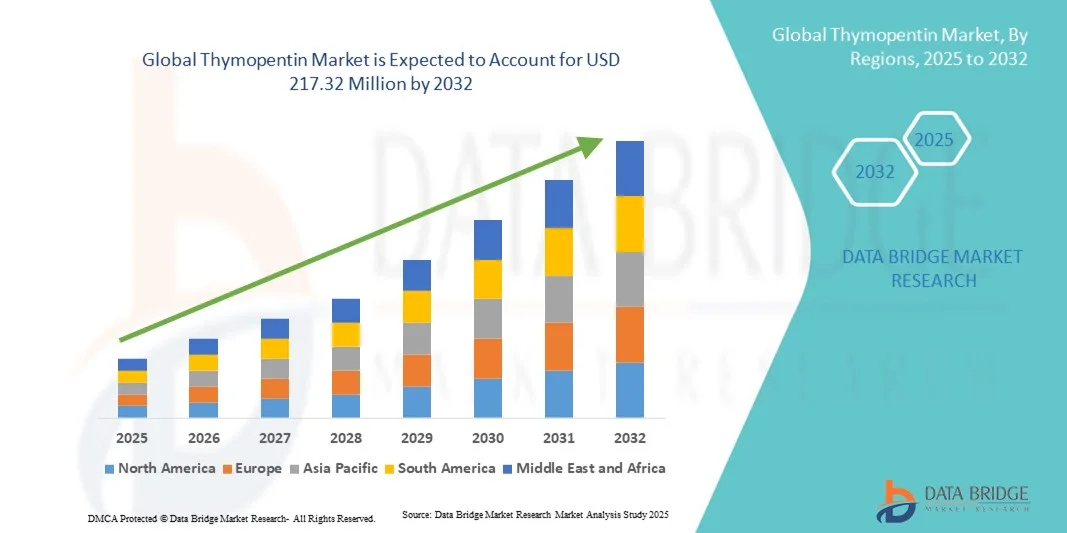
Thymopentin Market Size
- The global thymopentin market size was valued at USD 150.50 million in 2024 and is expected to reach USD 217.32 million by 2032, at a CAGR of 4.70% during the forecast period
- The market growth is largely fueled by the increasing prevalence of HIV and hepatocellular carcinoma, which is driving higher demand for effective therapeutic options and expanding the application of thymopentin in the pharmaceutical industry
- Furthermore, rising healthcare expenditures, government support for research and development, and continued clinical trials are establishing thymopentin as a promising therapeutic peptide. These converging factors are accelerating the uptake of thymopentin-based treatments, thereby significantly boosting the industry's growth
Thymopentin Market Analysis
- Thymopentin, a synthetic pentapeptide with immunomodulatory properties, is increasingly recognized for its therapeutic potential in treating immunodeficiency disorders, HIV, and certain cancers, making it a valuable component of modern pharmaceutical treatment regimens in both hospital and clinical settings due to its targeted mechanism of action and safety profile
- The rising demand for thymopentin is primarily fueled by the increasing prevalence of immune-related diseases, growing awareness among healthcare professionals, and a rising preference for peptide-based therapies over conventional treatments due to fewer side effects and enhanced efficacy
- North America dominated the thymopentin market with the largest revenue share of 39.9% in 2024, characterized by advanced healthcare infrastructure, high R&D investment, and a strong presence of key pharmaceutical companies, with the U.S. experiencing substantial growth in thymopentin prescriptions, particularly in hospitals and specialty clinics, driven by ongoing clinical trials and innovations in peptide formulations
- Asia-Pacific is expected to be the fastest growing region in the thymopentin market during the forecast period, due to increasing healthcare spending, rising prevalence of immunodeficiency disorders, and expanding access to advanced therapies in emerging economies
- Pre-filled injection segment dominated the thymopentin market with a market share of 46.7% in 2024, driven by its convenience, accuracy of dosing, reduced contamination risk, and preference in hospital and clinical treatment protocols for immune modulation and cancer support therapies
Report Scope and Thymopentin Market Segmentation
|
Attributes |
Thymopentin Key Market Insights |
|
Segments Covered |
|
|
Countries Covered |
North America
Europe
Asia-Pacific
Middle East and Africa
South America
|
|
Key Market Players |
|
|
Market Opportunities |
|
|
Value Added Data Infosets |
In addition to the insights on market scenarios such as market value, growth rate, segmentation, geographical coverage, and major players, the market reports curated by the Data Bridge Market Research also include in-depth expert analysis, pricing analysis, brand share analysis, consumer survey, demography analysis, supply chain analysis, value chain analysis, raw material/consumables overview, vendor selection criteria, PESTLE Analysis, Porter Analysis, and regulatory framework. |
Thymopentin Market Trends
Rising Preference for Pre-Filled Injectable Peptide Therapies
- A significant and accelerating trend in the global thymopentin market is the increasing adoption of pre-filled injection formats, offering improved convenience, accurate dosing, and reduced contamination risk in clinical and hospital settings
- For instance, pre-filled thymopentin syringes are being preferred over traditional vials in immunodeficiency treatment protocols, minimizing preparation time and ensuring precise administration
- This trend enhances patient compliance and facilitates easier integration into hospital workflows, allowing healthcare providers to deliver therapies more efficiently
- The pre-filled format also supports home-based administration for eligible patients, enabling safer self-injection and reducing the dependency on hospital visits
- Consequently, pharmaceutical companies such as SciClone and Hunan Dongting are developing pre-filled thymopentin solutions to cater to clinical demand and patient convenience
- The demand for pre-filled thymopentin injections is growing rapidly across both hospital and outpatient settings, as healthcare providers increasingly prioritize treatment accuracy, efficiency, and patient comfort
Thymopentin Market Dynamics
Driver
Increasing Prevalence of Immunodeficiency Disorders and Cancer
- The rising incidence of immune-related disorders and certain cancers is a significant driver for the heightened demand for thymopentin therapies in clinical and hospital settings
- For instance, the increasing number of HIV and hepatocellular carcinoma patients is boosting the use of immunomodulatory treatments such as thymopentin in hospitals and specialty clinics
- Thymopentin’s efficacy in enhancing immune response and supporting adjunct therapy in cancer and viral infections makes it a preferred choice for physicians and healthcare providers
- Furthermore, growing awareness among healthcare professionals regarding peptide-based therapies and their clinical benefits is expanding thymopentin adoption in treatment protocols
- The convenience of pre-filled injections, targeted immune modulation, and integration into standard hospital regimens are key factors propelling thymopentin adoption across regions
- The trend towards personalized immunotherapy and increasing investment in peptide research further contribute to market growth
Restraint/Challenge
Stringent Regulatory Requirements and Potential Side Effects
- Stringent regulatory guidelines for peptide-based therapeutics and potential side effects of thymopentin pose significant challenges to broader market penetration
- For instance, clinical trial approval processes for new formulations or pre-filled syringes require extensive safety and efficacy data, which can delay market entry
- Concerns regarding adverse reactions such as injection site irritation or immune overactivation may create hesitation among healthcare providers and patients
- Addressing these regulatory and safety concerns through rigorous clinical studies and post-marketing surveillance is crucial for building trust and facilitating adoption
- In addition, the relatively high cost of thymopentin therapies compared to alternative immunomodulators may limit adoption, particularly in price-sensitive regions or smaller healthcare facilities
- Overcoming these challenges through enhanced safety profiles, streamlined approval processes, and patient education will be vital for sustained market growth
Thymopentin Market Scope
The market is segmented on the basis of type, application, end-users, and distribution channel.
- By Type
On the basis of type, the thymopentin market is segmented into freeze-dry powder and pre-filled injection. The pre-filled injection segment dominated the market with a largest market revenue share of 46.7% in 2024, driven by its convenience, accuracy of dosing, and reduced contamination risk. Hospitals and clinics prefer pre-filled injections for faster administration and better patient compliance. The segment also benefits from increasing adoption of outpatient and home-based injectable therapies, minimizing hospital visits for eligible patients. In addition, pre-filled syringes support safe handling for healthcare staff and reduce preparation errors. The ease of integration into clinical treatment protocols for immune modulation and cancer support therapies further strengthens demand. Pharmaceutical companies are investing in pre-filled injection formats to meet clinical needs and streamline healthcare operations.
The freeze-dry powder segment is expected to witness the fastest CAGR of 8.1% from 2025 to 2032, fueled by its long shelf life, easier storage, and stability during transportation. Freeze-dry formulations are particularly suitable for regions with limited cold chain infrastructure, allowing wider market reach. Hospitals and research institutes adopt freeze-dry powders for compounding or personalized dosing requirements. Moreover, the cost-effectiveness of bulk freeze-dried products compared to pre-filled injections drives adoption in emerging markets. Increasing R&D in freeze-dried peptide formulations to enhance solubility and bioavailability is further supporting growth.
- By Application
On the basis of application, the thymopentin market is segmented into tumors, hepatitis, and others. The tumors segment dominated the market with the largest revenue share in 2024 due to the increasing use of thymopentin as an immunomodulatory adjunct therapy in cancer treatments. Hospitals and oncology centers favor thymopentin to improve patient immune response and reduce chemotherapy-related complications. Clinical studies supporting its efficacy in tumor management drive physician confidence. The segment benefits from the rising global incidence of cancers and increasing demand for supportive immunotherapies. In addition, integration into standardized cancer care protocols enhances adoption rates. Awareness programs and physician recommendations further boost market penetration in this segment.
The hepatitis segment is expected to witness the fastest CAGR of 7.4% from 2025 to 2032, driven by the growing prevalence of hepatitis B and C and the increasing use of thymopentin to enhance antiviral immunity. Clinics and hospitals adopt thymopentin to support conventional antiviral therapies and reduce infection-related complications. Government initiatives and healthcare funding for hepatitis treatment programs further support demand. The expanding awareness among physicians about immunotherapy benefits in hepatitis management is also contributing to market growth. Rising research in combination therapies with thymopentin is expected to create additional opportunities.
- By End-Users
On the basis of end-users, the thymopentin market is segmented into hospitals, clinics, research institutes, and others. The hospitals segment dominated the market with the largest revenue share of 52.1% in 2024, driven by large-scale adoption for immunodeficiency, tumor, and hepatitis treatments. Hospitals prefer thymopentin due to its standardized dosing options, pre-filled injectable format, and integration into established treatment protocols. The presence of trained medical staff and infrastructure for safe administration further strengthens market penetration. Hospitals also drive bulk procurement, improving economies of scale for manufacturers. Partnerships between pharmaceutical companies and hospital chains support consistent supply and adoption. The adoption in tertiary care and oncology centers particularly contributes to higher revenue.
The clinics segment is expected to witness the fastest CAGR of 7.9% from 2025 to 2032, fueled by the rising adoption of outpatient peptide therapies and home-care treatment programs. Clinics increasingly offer thymopentin for immunomodulation and supportive therapy for cancer or viral infections. The convenience of pre-filled injections and smaller patient volumes suits clinic settings. Growing awareness among private healthcare providers and patients contributes to adoption. Emerging telehealth and remote monitoring services further boost peptide therapy delivery in clinics.
- By Distribution Channel
On the basis of distribution channel, the thymopentin market is segmented into retail pharmacy, online pharmacy, and others. The retail pharmacy segment dominated the market with the largest revenue share of 49.5% in 2024, due to well-established supply chains, direct access to hospitals and clinics, and patient trust in traditional pharmacy networks. Retail pharmacies provide bulk procurement options for hospitals and clinics, ensuring consistent supply. Their presence across urban and semi-urban regions facilitates market penetration. Partnerships between manufacturers and retail chains further strengthen distribution efficiency. Retail pharmacies also support physician prescriptions and guidance for proper use. The segment benefits from strong regulatory compliance and established logistics.
The online pharmacy segment is expected to witness the fastest CAGR of 9.3% from 2025 to 2032, driven by the increasing preference for e-commerce platforms, convenient doorstep delivery, and digital prescription services. Patients and healthcare providers are adopting online pharmacies for faster access to pre-filled injections and freeze-dry formulations. Online platforms facilitate easier inventory management for small clinics and home-based therapy users. Rising internet penetration, mobile healthcare apps, and growing trust in digital transactions are supporting growth. Manufacturers are increasingly collaborating with online platforms to expand reach and improve availability in remote areas.
Thymopentin Market Regional Analysis
- North America dominated the thymopentin market with the largest revenue share of 39.9% in 2024, characterized by advanced healthcare infrastructure, high R&D investment, and a strong presence of key pharmaceutical companies
- Healthcare providers and hospitals in the region prioritize thymopentin for its efficacy in immunodeficiency disorders, tumors, and hepatitis, benefiting from well-established clinical protocols and trained medical staff
- This widespread adoption is further supported by increasing government funding for immunotherapy research, growing awareness among physicians, and strong presence of key pharmaceutical companies, establishing thymopentin as a preferred immunomodulatory treatment in hospitals and specialty clinics
U.S. Thymopentin Market Insight
The U.S. thymopentin market captured the largest revenue share of 42% in 2024 within North America, fueled by the increasing prevalence of immunodeficiency disorders, cancer, and hepatitis. Healthcare providers are prioritizing thymopentin for its proven immunomodulatory efficacy and integration into standard treatment protocols. The growing adoption of pre-filled injections and hospital-based peptide therapies further propels market growth. Moreover, robust R&D activities, clinical trials, and strong presence of key pharmaceutical players contribute significantly to the expansion of the U.S. thymopentin market.
Europe Thymopentin Market Insight
The Europe thymopentin market is projected to expand at a substantial CAGR throughout the forecast period, primarily driven by increasing awareness of immunotherapy, rising prevalence of tumors and viral infections, and government support for healthcare initiatives. The region’s strong healthcare infrastructure and focus on advanced treatments foster thymopentin adoption. European healthcare providers are incorporating thymopentin into hospital and clinic protocols, particularly for cancer and hepatitis therapy. Ongoing research and development in peptide formulations further support market growth.
U.K. Thymopentin Market Insight
The U.K. thymopentin market is anticipated to grow at a noteworthy CAGR during the forecast period, driven by rising demand for immunomodulatory treatments and personalized peptide therapies. Increasing cases of immune-related disorders and cancers encourage hospitals and specialty clinics to adopt thymopentin in treatment regimens. In addition, the U.K.’s strong healthcare system and government-backed initiatives for advanced therapies are expected to continue stimulating market growth. Awareness programs and clinical trial outcomes also enhance adoption rates.
Germany Thymopentin Market Insight
The Germany thymopentin market is expected to expand at a considerable CAGR during the forecast period, fueled by the growing focus on immunotherapy, advanced healthcare infrastructure, and rising prevalence of immune-related diseases. German hospitals and research institutes are increasingly incorporating thymopentin into treatment protocols for cancer, hepatitis, and immunodeficiency disorders. The emphasis on innovative therapies and regulatory support for peptide-based drugs promotes market adoption. Moreover, clinical awareness and physician preference for effective immunomodulatory treatments further strengthen growth.
Asia-Pacific Thymopentin Market Insight
The Asia-Pacific thymopentin market is poised to grow at the fastest CAGR of 9.2% during the forecast period of 2025 to 2032, driven by increasing prevalence of immunodeficiency disorders and viral infections, rising healthcare expenditure, and expanding hospital infrastructure in countries such as China, Japan, and India. Government initiatives supporting advanced therapies and growing awareness of peptide-based treatments are boosting adoption. Furthermore, improving healthcare access and growing investments in pharmaceutical R&D are creating significant opportunities for thymopentin in the region.
Japan Thymopentin Market Insight
The Japan thymopentin market is gaining momentum due to the country’s advanced healthcare system, rising incidence of immune-related diseases, and demand for effective immunomodulatory therapies. Hospitals and specialty clinics are increasingly using thymopentin to support cancer and hepatitis treatment regimens. Integration with pre-filled injectable formats facilitates safer and more convenient administration. Moreover, ongoing clinical trials and physician awareness programs are fueling market growth in both hospital and outpatient settings.
India Thymopentin Market Insight
The India thymopentin market accounted for the largest market revenue share in Asia-Pacific in 2024, attributed to rising prevalence of immunodeficiency disorders, expanding hospital networks, and increasing healthcare awareness. India’s growing pharmaceutical manufacturing capabilities and government initiatives to improve access to advanced therapies are supporting market growth. Pre-filled injection formats are increasingly preferred in hospitals and clinics for ease of administration. In addition, affordability, urbanization, and rising adoption of peptide-based therapies contribute to the expanding market in India.
Thymopentin Market Share
The Thymopentin industry is primarily led by well-established companies, including:
- Santa Cruz Biotechnology, Inc. (U.S.)
- Active Peptide Company (U.S.)
- YPRG (China)
- Graton Pharma (China)
- Hainan Zhonghe Pharmaceutical Co., Ltd. (China)
- SAIF PARTNERS (China)
- Jiangsu Kingsley Pharmaceutical Co., Ltd. (China)
- China National Pharmaceutical Group Co Ltd. (China)
- Hainan Shuangcheng Pharmaceuticals Co., Ltd. (China)
- Youcare Pharmaceutical Group Co., Ltd. (China)
- Changzhou Siyao Pharmaceuticals Co., Ltd. (China)
- Zhejiang Yongning Pharmaceutical Co., Ltd. (China)
- Wuhan Hualong Bio-Chemical Pharmaceutical Co., Ltd. (China)
- Bachem AG (Switzerland)
- Merck KGaA (Germany)
- Thermo Fisher Scientific Inc. (U.S.)
- GenScript Biotech Corporation (China)
- Peptides International, Inc. (U.S.)
- Creative Peptides (U.S.)
What are the Recent Developments in Global Thymopentin Market?
- In June 2025, a study introduced a self-assembling nanoplatform integrating thymopentin for enhanced photo-immunotherapy in diabetic wound healing. This advancement underscores the potential of thymopentin in regenerative medicine and tissue repair
- In January 2025, a study was published detailing a general supramolecular approach for improving the plasma resistance of Thymopentin. Researchers described the entire encapsulation of the peptide agent, Thymopentin (TP5), by a large-sized macrocycle called extended biphen[3]arene carboxylate (ExBP3C). This approach aims to enhance the metabolic stability of Thymopentin in the presence of rat plasma, which is a significant development for improving the delivery and effectiveness of the existing commercial peptide drug
- In July 2024, a study was published on the topical use of Thymopentin for alleviating psoriasis in a mouse model. The study demonstrated that topical administration of Thymopentin (TP5) could alleviate psoriasis-such as skin lesions in an imiquimod (IMQ)-induced mouse model. The mechanism was suggested to involve decreasing the expression of NF-KB signaling pathway components, altering immune cell populations, and improving the composition of the skin's surface microorganisms, which is a development pointing toward a new dermatological application
- In July 2023, a first-in-human, randomized, double-blind, placebo-controlled Phase I clinical trial commenced to evaluate the safety, tolerability, pharmacokinetics, and pharmacodynamics of retro enversio thymopentin (FC-12738) in healthy adult participants and patients with Amyotrophic Lateral Sclerosis (ALS). This trial represents a significant step in exploring the potential of thymopentin-based therapies for neurodegenerative diseases
- In April 2023, researchers developed a carrier-free nanogel delivery system for thymopentin, demonstrating enhanced immunotherapeutic efficacy against melanoma metastasis. This innovative approach offers a promising strategy for the application of thymopentin in cancer treatment

- Interactive Data Analysis Dashboard
- Company Analysis Dashboard for high growth potential opportunities
- Research Analyst Access for customization & queries
- Competitor Analysis with Interactive dashboard
- Latest News, Updates & Trend analysis
- Harness the Power of Benchmark Analysis for Comprehensive Competitor Tracking
Data collection and base year analysis are done using data collection modules with large sample sizes. The stage includes obtaining market information or related data through various sources and strategies. It includes examining and planning all the data acquired from the past in advance. It likewise envelops the examination of information inconsistencies seen across different information sources. The market data is analysed and estimated using market statistical and coherent models. Also, market share analysis and key trend analysis are the major success factors in the market report. To know more, please request an analyst call or drop down your inquiry.
The key research methodology used by DBMR research team is data triangulation which involves data mining, analysis of the impact of data variables on the market and primary (industry expert) validation. Data models include Vendor Positioning Grid, Market Time Line Analysis, Market Overview and Guide, Company Positioning Grid, Patent Analysis, Pricing Analysis, Company Market Share Analysis, Standards of Measurement, Global versus Regional and Vendor Share Analysis. To know more about the research methodology, drop in an inquiry to speak to our industry experts.
Data Bridge Market Research is a leader in advanced formative research. We take pride in servicing our existing and new customers with data and analysis that match and suits their goal. The report can be customized to include price trend analysis of target brands understanding the market for additional countries (ask for the list of countries), clinical trial results data, literature review, refurbished market and product base analysis. Market analysis of target competitors can be analyzed from technology-based analysis to market portfolio strategies. We can add as many competitors that you require data about in the format and data style you are looking for. Our team of analysts can also provide you data in crude raw excel files pivot tables (Fact book) or can assist you in creating presentations from the data sets available in the report.












