


Tire Cord Market Overview
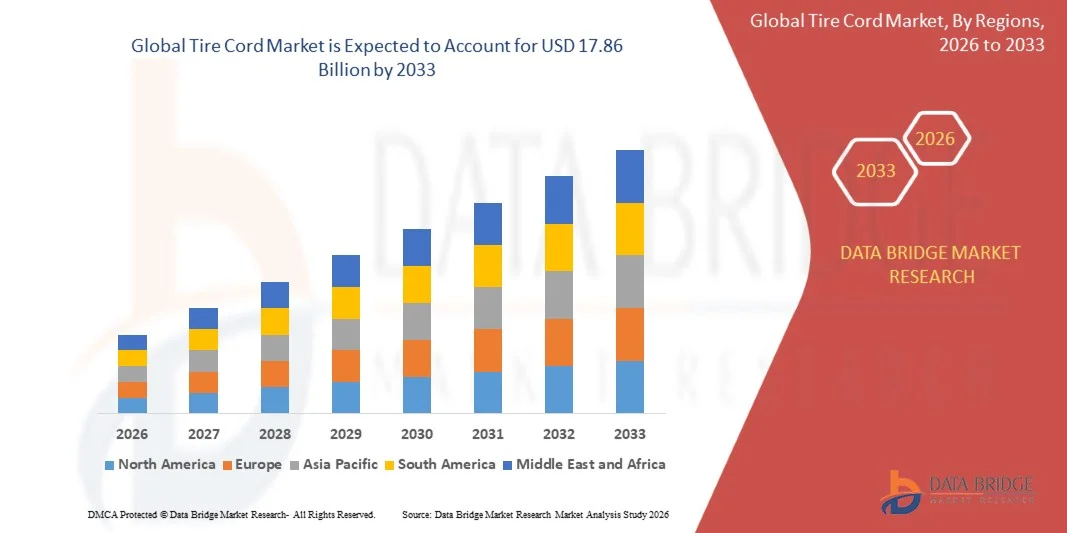
As per Data Bridge Market Research analysis the Tire Cord Market was valued at USD 10.25 billion in 2025 and is projected to reach USD 17.86 billion by 2033, growing at a CAGR of 7.20% from 2026 to 2033. The market is experiencing steady growth driven by rising vehicle production, increasing replacement tire demand, expanding adoption of radial tires, and growing requirements for high-strength reinforcement materials that improve tire durability, load-bearing capacity, and safety performance.
The expansion of electric vehicle production, commercial transportation fleets, and construction and agricultural equipment is increasing demand for tire cords made from polyester, nylon, rayon, steel, and aramid materials. Tire manufacturers are increasingly adopting lightweight and high-tenacity reinforcement solutions to reduce rolling resistance, improve fuel efficiency, and extend tire service life. In addition, rising infrastructure development, freight movement, and consumer vehicle ownership across emerging economies are supporting the use of advanced tire cord materials in passenger cars, trucks, buses, off-the-road vehicles, and specialty tires.
Key Market Trends & Insights
- North America dominated the tire cord market with the largest revenue share in 2025, supported by strong replacement tire demand, a well-established automotive and commercial vehicle manufacturing base, rising logistics and freight activity, and increasing adoption of high-performance radial tires reinforced with steel and polyester cords.
- Asia-Pacific is expected to be the fastest-growing region, recording a significant CAGR from 2026 to 2033. Growth is driven by rapid automotive production, expanding tire manufacturing capacity, rising vehicle ownership, infrastructure development, and increasing demand for passenger cars, two-wheelers, commercial vehicles, and electric vehicles in China, India, Japan, and South Korea.
- The steel cord segment held the largest market revenue share of approximately 38.6% in 2025 driven by its extensive use in radial tires for passenger cars, trucks, buses, and heavy-duty vehicles. Steel cords are preferred due to their high tensile strength, durability, heat resistance, and ability to improve tire load-bearing capacity, puncture resistance, and high-speed performance.
- The polyester segment is projected to register the fastest growth at a CAGR of 8.1% from 2026 to 2033, driven by increasing demand for lightweight tire reinforcement materials in passenger cars and electric vehicles. Rising adoption of high-tenacity polyester cords due to their dimensional stability, lower weight, and cost-effectiveness is accelerating segment expansion.
- The radial tire segment held the largest market revenue share of approximately 74.8% in 2025 driven by widespread adoption across passenger vehicles, commercial vehicles, buses, trucks, and electric vehicles. Radial tires are preferred due to their improved fuel efficiency, longer tread life, better road contact, reduced rolling resistance, and enhanced handling performance compared with conventional biased tires.
- The biased tire segment is projected to register the fastest growth at a CAGR of 6.4% from 2026 to 2033, driven by increasing demand for agricultural machinery, construction equipment, off-the-road vehicles, and two-wheelers in developing economies. Biased tires remain widely used in applications requiring strong sidewall resistance, high load support, and operation on rough or unpaved surfaces.
- The passenger cars segment held the largest market revenue share of approximately 41.7% in 2025 driven by rising passenger vehicle production, growing replacement tire demand, and increasing adoption of radial tires with polyester and steel reinforcement. Passenger car tire manufacturers are increasingly using advanced tire cords to improve durability, fuel efficiency, handling, and performance under higher torque conditions in electric and hybrid vehicles.
- The heavy duty vehicles segment is projected to register the fastest growth at a CAGR of 8.4% from 2026 to 2033, driven by expanding freight transportation, e-commerce logistics, infrastructure development, and rising demand for durable truck and bus tires. Heavy-duty tire applications require steel cord reinforcement to support higher loads, extended operating cycles, and resistance to puncture and fatigue, accelerating segment expansion.
Market Size & Forecast
- Global Market Value (2025): USD 10.25 Billion
- Expected Market Value (2033): USD 17.86 Billion
- Forecast CAGR (2026–2033): 7.20%
- Leading Region in 2025: North America
- Fastest Growing Region: Asia-Pacific
Report Scope and Tire Cord Market Segmentation
|
Attributes |
Tire Cord Key Market Insights |
|
Segments Covered |
|
|
Countries Covered |
North America
Europe
Asia-Pacific
Middle East and Africa
South America
|
|
Key Market Players |
• WABCO (Belgium) |
|
Market Opportunities |
|
|
Value Added Data Infosets |
In addition to the insights on market scenarios such as market value, growth rate, segmentation, geographical coverage, and major players, the market reports curated by the Data Bridge Market Research also include import export analysis, production capacity overview, production consumption analysis, price trend analysis, climate change scenario, supply chain analysis, value chain analysis, raw material/consumables overview, vendor selection criteria, PESTLE Analysis, Porter Analysis, and regulatory framework. |
Tire Cord Market Trends
Trend: Growing Adoption Of High-Performance And Sustainable Tire Reinforcement Materials
Increasing demand for durable, fuel-efficient, and high-load-bearing tires across passenger vehicles, commercial fleets, electric vehicles, and off-the-road equipment is accelerating the adoption of advanced tire cord materials. Conventional tire reinforcement materials can add weight and may not provide the heat resistance, dimensional stability, and fatigue performance required for modern high-speed and heavy-duty tires, encouraging tire manufacturers to use high-tenacity polyester, nylon, rayon, steel, and aramid tire cords.
In electric vehicles, manufacturers are increasingly using reinforced tire structures to manage higher vehicle weight, instant torque, and increased load requirements associated with battery systems. For instance, the International Energy Agency reported that global electric car sales exceeded 17 million units in 2024, increasing the need for tires designed to support heavier vehicle platforms while maintaining lower rolling resistance. High-strength tire cords improve casing durability, support tread stability, and help manufacturers develop tires that can withstand higher torque loads and repeated acceleration cycles.
The expansion of freight transportation, construction activity, and agricultural mechanization is also increasing demand for steel and textile tire cords used in truck, bus, agricultural, and off-the-road tires. In addition, tire manufacturers are focusing on recycled and lower-carbon reinforcement materials as sustainability requirements increase across the automotive value chain. Growing investment in circular tire manufacturing, recycled polyester yarns, and bio-based materials is supporting the development of tire cord solutions that reduce dependence on virgin petrochemical feedstocks.
Tire Cord Market Dynamics
Key Market Driver: Rising Vehicle Production And Replacement Tire Demand
The global automotive industry is experiencing increasing demand for durable and high-performance tires due to rising vehicle ownership, expanding freight movement, and growing replacement tire requirements. Tire cords provide structural reinforcement within tire carcasses and belts, helping tires maintain shape, withstand internal pressure, resist deformation, and support vehicle loads. Rising production of passenger cars, commercial vehicles, two-wheelers, and industrial equipment is creating strong demand for polyester, nylon, rayon, steel, and aramid tire cord materials.
Automotive and tire manufacturers are increasingly using high-tenacity textile and steel cords to improve tire strength, durability, and road safety. For instance, the International Organization of Motor Vehicle Manufacturers reported that global motor vehicle production reached approximately 93.5 million units in 2023, supporting large-scale demand for original equipment tires and reinforcement materials. The growing global vehicle parc is also expanding replacement tire consumption, particularly as commercial fleet operators seek longer tire life and lower maintenance costs.
Similarly, commercial transportation and logistics operators are adopting heavy-duty tires with steel cord reinforcement to improve load capacity and resistance to puncture, impact, and fatigue. The International Energy Agency reported that global oil demand for road transport remains significant despite electrification trends, indicating continued freight and commercial vehicle activity across major economies. Expanding road infrastructure, e-commerce logistics, and construction projects are further supporting tire cord consumption in truck, bus, agricultural, and off-the-road tire applications.
Key Restraint/Challenge: Volatile Raw Material Prices And Complex Manufacturing Requirements
Tire cords are manufactured using materials such as polyester, nylon, rayon, steel, and aramid, with production costs influenced by crude oil prices, petrochemical feedstocks, steel prices, energy costs, and specialized processing requirements. Fluctuations in the prices of purified terephthalic acid, monoethylene glycol, caprolactam, and steel wire rod can directly affect the cost of textile and steel tire cord production. This price volatility can pressure manufacturer margins and increase procurement costs for tire producers, particularly in highly competitive replacement tire markets.
In addition, tire cord production requires high-tenacity yarn spinning, twisting, dipping, heat treatment, calendaring compatibility, and strict quality control to ensure strong adhesion between the reinforcement material and rubber compounds. Small variations in cord strength, elongation, adhesion, or dimensional stability can affect tire safety, rolling resistance, and durability. These complex production requirements increase capital investment and limit the ability of smaller manufacturers to produce advanced tire reinforcement materials at scale.
The development of sustainable tire cord solutions also presents technical and commercial challenges. Recycled polyester and bio-based materials must meet demanding performance standards for fatigue resistance, heat stability, and rubber adhesion before they can be widely used in high-performance tires. Manufacturers must balance sustainability targets with cost, availability, and performance consistency, particularly for electric vehicle, commercial vehicle, and off-the-road tire applications.
Key Market Opportunity: Expansion Of Tire Cords In Electric Vehicles And Sustainable Tire Manufacturing
The growing transition toward electric mobility, low-emission transportation, and circular manufacturing is creating significant opportunities for tire cord manufacturers. Electric vehicles require tires with enhanced load-bearing capacity, lower rolling resistance, and improved durability because battery packs increase vehicle weight and electric motors deliver immediate torque. Advanced polyester, steel, aramid, and hybrid tire cords can help tire manufacturers develop stronger and lighter tire structures while supporting vehicle efficiency and driving range.
Automotive manufacturers are increasingly developing electric vehicle-specific tires that use reinforced carcass and belt structures to manage higher torque and vehicle mass. For instance, the International Energy Agency expects global electric car sales to exceed 20 million units in 2025, creating continued demand for advanced tire materials and reinforcement technologies. High-performance tire cords can support improved tire stiffness, handling, and tread wear resistance, helping reduce replacement frequency and improve operating efficiency for electric vehicle owners and fleet operators.
In addition, sustainability initiatives are encouraging tire manufacturers to increase the use of recycled polyester, renewable raw materials, and lower-carbon steel in tire reinforcement applications. The European Commission has introduced requirements under its sustainable product policy framework to improve product circularity and resource efficiency, increasing pressure on automotive suppliers to reduce material-related emissions. Advancements in recycled yarn processing, bio-based polyester, and high-strength lightweight reinforcement materials are expected to create opportunities across passenger vehicles, commercial fleets, electric mobility, and specialty tire markets.
Tire Cord Market Scope
The market is segmented on the basis of material, tire type, and application.
• By Material
On the basis of material, the tire cord market is segmented into steel cord, polyester, nylon, rayon, aramid, and others. The steel cord segment held the largest market revenue share of approximately 38.6% in 2025 driven by its extensive use in radial tires for passenger cars, trucks, buses, and heavy-duty vehicles. Steel cords are preferred due to their high tensile strength, durability, heat resistance, and ability to improve tire load-bearing capacity, puncture resistance, and high-speed performance.
The polyester segment is projected to register the fastest growth at a CAGR of 8.1% from 2026 to 2033, driven by increasing demand for lightweight tire reinforcement materials in passenger cars and electric vehicles. Rising adoption of high-tenacity polyester cords due to their dimensional stability, lower weight, and cost-effectiveness is accelerating segment expansion.
• By Tire Type
On the basis of tire type, the tire cord market is segmented into radial tire and biased tire. The radial tire segment held the largest market revenue share of approximately 74.8% in 2025 driven by widespread adoption across passenger vehicles, commercial vehicles, buses, trucks, and electric vehicles. Radial tires are preferred due to their improved fuel efficiency, longer tread life, better road contact, reduced rolling resistance, and enhanced handling performance compared with conventional biased tires.
The biased tire segment is projected to register the fastest growth at a CAGR of 6.4% from 2026 to 2033, driven by increasing demand for agricultural machinery, construction equipment, off-the-road vehicles, and two-wheelers in developing economies. Biased tires remain widely used in applications requiring strong sidewall resistance, high load support, and operation on rough or unpaved surfaces.
• By Application
On the basis of application, the tire cord market is segmented into aerospace, passenger cars, light commercial vehicles, heavy duty vehicles, two wheelers, tractors, and others. The passenger cars segment held the largest market revenue share of approximately 41.7% in 2025 driven by rising passenger vehicle production, growing replacement tire demand, and increasing adoption of radial tires with polyester and steel reinforcement. Passenger car tire manufacturers are increasingly using advanced tire cords to improve durability, fuel efficiency, handling, and performance under higher torque conditions in electric and hybrid vehicles.
The heavy duty vehicles segment is projected to register the fastest growth at a CAGR of 8.4% from 2026 to 2033, driven by expanding freight transportation, e-commerce logistics, infrastructure development, and rising demand for durable truck and bus tires. Heavy-duty tire applications require steel cord reinforcement to support higher loads, extended operating cycles, and resistance to puncture and fatigue, accelerating segment expansion.
Tire Cord Market Regional Analysis
North America Tire Cord Market Insight
North America dominated the tire cord market with the largest revenue share in 2025, supported by high replacement tire demand, a well-established automotive manufacturing base, and increasing adoption of reinforced radial tires across passenger and commercial vehicle applications. The region’s stringent vehicle safety standards and rising demand for fuel-efficient tires are encouraging tire manufacturers to use high-strength steel, polyester, and nylon cords. Growth in electric vehicle production is also increasing demand for advanced tire reinforcement materials that can withstand higher vehicle weight and torque requirements.
U.S. Tire Cord Market Insight
The U.S. tire cord market captured the largest revenue share in 2025 within North America, fueled by strong demand from passenger vehicles, light trucks, heavy-duty trucks, and replacement tire manufacturing. The expanding logistics, e-commerce, and freight transportation sectors are increasing demand for durable commercial vehicle tires reinforced with steel cord. In addition, growing electric vehicle sales and investments in domestic tire manufacturing are supporting the adoption of high-performance tire cord materials designed to improve rolling resistance, load capacity, and tire durability.
Europe Tire Cord Market Insight
The Europe tire cord market is expected to witness significant growth from 2026 to 2033, primarily driven by stringent tire labeling regulations, rising demand for low-rolling-resistance tires, and increasing adoption of sustainable tire manufacturing practices. European tire manufacturers are increasingly focusing on lightweight reinforcement materials, recycled content, and high-performance tire structures to improve fuel efficiency and reduce vehicle emissions. The region’s strong automotive industry and growing replacement tire demand continue to support market expansion across passenger and commercial vehicle applications.
Germany Tire Cord Market Insight
The Germany tire cord market is expected to witness substantial growth from 2026 to 2033, driven by the country’s advanced automotive manufacturing sector and rising production of premium, electric, and high-performance vehicles. German tire manufacturers are increasingly adopting steel cord, polyester, and aramid-based reinforcement materials to improve tire safety, durability, and energy efficiency. The growing emphasis on sustainable mobility, combined with demand for high-speed and heavy-load tire applications, is further supporting the market’s expansion.
U.K. Tire Cord Market Insight
The U.K. tire cord market is expected to witness steady growth from 2026 to 2033, supported by rising replacement tire demand, increasing adoption of electric vehicles, and the need for durable, fuel-efficient tire reinforcement materials. The country’s strong logistics, freight, and commercial vehicle sectors are driving demand for steel cord and polyester-based tire cords that improve load-bearing capacity, tire durability, and resistance to high-speed wear. In addition, stricter vehicle safety and emissions requirements are encouraging tire manufacturers to develop low-rolling-resistance tires using lightweight and high-strength reinforcement materials. Growing investment in sustainable tire production, recycled materials, and advanced radial tire technologies is further expected to support the expansion of the U.K. tire cord market
Asia-Pacific Tire Cord Market Insight
The Asia-Pacific tire cord market is expected to witness the fastest growth rate from 2026 to 2033, supported by rapid automotive production, increasing vehicle ownership, rising infrastructure development, and expanding tire manufacturing capacity in countries such as China, India, Japan, and South Korea. The region is a major production hub for passenger car, two-wheeler, truck, and off-the-road tires, creating substantial demand for steel, polyester, nylon, and rayon tire cords. Growing electric vehicle manufacturing and increasing replacement tire demand are further accelerating regional market expansion.
China Tire Cord Market Insight
The China tire cord market accounted for the largest market revenue share in Asia-Pacific in 2025, attributed to the country’s large automotive manufacturing industry, extensive tire production capacity, and expanding commercial vehicle fleet. China’s growing electric vehicle market is increasing demand for reinforced tires capable of handling higher battery weight and torque output. The presence of major domestic tire manufacturers, increasing exports of tires, and continued investment in industrial manufacturing infrastructure are key factors supporting market growth.
Japan Tire Cord Market Insight
The Japan tire cord market is expected to witness strong growth from 2026 to 2033 due to the country’s advanced automotive technology base, demand for high-performance tires, and focus on vehicle safety and fuel efficiency. Japanese manufacturers are increasingly using advanced steel, polyester, and aramid tire cords in premium passenger vehicles, hybrid vehicles, and commercial vehicle tires. The country’s emphasis on lightweight materials, low rolling resistance, and durable tire designs is expected to support continued demand for technologically advanced tire cord solutions.
Tire Cord Market Share
The Tire Cord industry is primarily led by well-established companies, including:
• WABCO (Belgium)
• EnPro Industries (U.S.)
• MICHELIN (France)
• The Goodyear Tire & Rubber Company (U.S.)
• Dana Incorporated (U.S.)
• SAF-HOLLAND (Luxembourg)
• IDEX Corporation (U.S.)
• The Boler Company (U.S.)
• PERIA TECHNOLOGIES, INC. (U.S.)
• Bridgestone Corporation (Japan)
• Continental AG (Germany)
• Meritor, Inc. (U.S.)
• CODA Development (U.S.)
• Hendrickson USA, L.L.C. (U.S.)
• Pirelli and C. S.p.A. (Italy)

- Interactive Data Analysis Dashboard
- Company Analysis Dashboard for high growth potential opportunities
- Research Analyst Access for customization & queries
- Competitor Analysis with Interactive dashboard
- Latest News, Updates & Trend analysis
- Harness the Power of Benchmark Analysis for Comprehensive Competitor Tracking
Global Tire Cord Market, Supply Chain Analysis and Ecosystem Framework
To support market growth and help clients navigate the impact of geopolitical shifts, DBMR has integrated in-depth supply chain analysis into its Global Tire Cord Market research reports. This addition empowers clients to respond effectively to global changes affecting their industries. The supply chain analysis section includes detailed insights such as Global Tire Cord Market consumption and production by country, price trend analysis, the impact of tariffs and geopolitical developments, and import and export trends by country and HSN code. It also highlights major suppliers with data on production capacity and company profiles, as well as key importers and exporters. In addition to research, DBMR offers specialized supply chain consulting services backed by over a decade of experience, providing solutions like supplier discovery, supplier risk assessment, price trend analysis, impact evaluation of inflation and trade route changes, and comprehensive market trend analysis.
Data collection and base year analysis are done using data collection modules with large sample sizes. The stage includes obtaining market information or related data through various sources and strategies. It includes examining and planning all the data acquired from the past in advance. It likewise envelops the examination of information inconsistencies seen across different information sources. The market data is analysed and estimated using market statistical and coherent models. Also, market share analysis and key trend analysis are the major success factors in the market report. To know more, please request an analyst call or drop down your inquiry.
The key research methodology used by DBMR research team is data triangulation which involves data mining, analysis of the impact of data variables on the market and primary (industry expert) validation. Data models include Vendor Positioning Grid, Market Time Line Analysis, Market Overview and Guide, Company Positioning Grid, Patent Analysis, Pricing Analysis, Company Market Share Analysis, Standards of Measurement, Global versus Regional and Vendor Share Analysis. To know more about the research methodology, drop in an inquiry to speak to our industry experts.
Data Bridge Market Research is a leader in advanced formative research. We take pride in servicing our existing and new customers with data and analysis that match and suits their goal. The report can be customized to include price trend analysis of target brands understanding the market for additional countries (ask for the list of countries), clinical trial results data, literature review, refurbished market and product base analysis. Market analysis of target competitors can be analyzed from technology-based analysis to market portfolio strategies. We can add as many competitors that you require data about in the format and data style you are looking for. Our team of analysts can also provide you data in crude raw excel files pivot tables (Fact book) or can assist you in creating presentations from the data sets available in the report.













