


What is the Traction Battery Market Size and Overview?
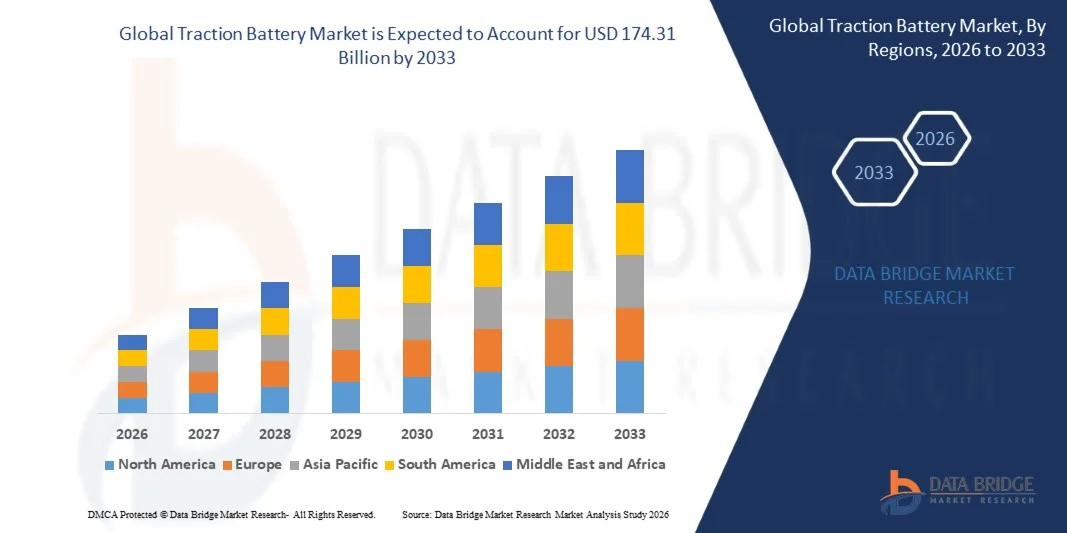
As per Data Bridge Market Research Analysis the global traction battery market was valued at USD 62.40 Billion in 2025 and is projected to reach USD 174.31 Billion by 2033, growing at a CAGR of 13.70% from 2026 to 2033. The market is experiencing consistent growth driven by rapid electrification of transportation, increasing adoption of electric vehicles, and expanding deployment of battery-powered industrial and logistics equipment. Rising demand for high-energy-density lithium-ion batteries and continuous advancements in battery chemistry, charging efficiency, and lifecycle performance are further accelerating market expansion across global regions.
The growing global focus on reducing carbon emissions and transitioning toward sustainable mobility solutions is significantly boosting demand for traction batteries across automotive, industrial, and commercial applications. Strong government incentives supporting electric vehicle adoption, combined with stringent emission regulations, are accelerating the replacement of internal combustion engine systems with battery-powered alternatives. In addition, increasing investments in battery manufacturing gigafactories and expanding charging infrastructure are strengthening supply capabilities and supporting long-term market growth.
Key Market Trends & Insights
- Asia-Pacific dominated the global traction battery market with the largest revenue share of 44% in 2025, supported by strong electric vehicle manufacturing base, expanding industrial automation, and large-scale deployment of battery-powered mobility solutions
- The lithium-ion based segment led the market with a 48% share in 2025, driven by high energy density, longer lifecycle, and increasing adoption across electric mobility and industrial traction systems
- North America is expected to be the fastest-growing region at a CAGR of 12% from 2026 to 2033, fueled by rapid electrification of transportation, strong investments in EV manufacturing, and increasing adoption of industrial battery-powered equipment
- 400 Ah and above are the fastest-growing capacity type, projected to register a CAGR of 15% from 2026 to 2033, supported by increasing demand for high-capacity energy storage in heavy-duty electric vehicles and industrial machinery
- The pure electric car segment dominated the application category with a 45% revenue share in 2025, led by rapid global adoption of electric vehicles and strong government incentives supporting zero-emission transportation
- 100-200 Ah accounted for 38% of the market in 2025, preferred by its optimal balance between energy output, cost efficiency, and suitability for electric vehicles and light industrial traction applications
- The two-wheeler segment is the fastest-growing application category, with a CAGR of 14% from 2026 to 2033, driven by strong electrification trends in emerging economies, particularly in Asia-Pacific
Market Size & Forecast
- Global Market Value (2025): USD 62.40 Billion
- Expected Market Value (2033): USD 174.31 Billion
- Forecast CAGR (2026–2033): 13.70%
- Leading Region in 2025: Asia-Pacific
- Fastest Growing Region: North America
Report Scope and Global Traction Battery Market Segmentation
|
Attributes |
Traction Battery Key Market Insights |
|
Segments Covered |
|
|
Countries Covered |
North America
Europe
Asia-Pacific
Middle East and Africa
South America
|
|
Key Market Players |
|
|
Market Opportunities |
|
|
Value Added Data Infosets |
In addition to the market insights such as market value, growth rate, market segments, geographical coverage, market players, and market scenario, the market report curated by the Data Bridge Market Research team includes in-depth expert analysis, import/export analysis, pricing analysis, production consumption analysis, and pestle analysis. |
What is the Key Trend in the Traction Battery Market?
Trend: Shift Toward Lithium-Ion and Solid-State Batteries
The global Traction Battery market is witnessing a strong transition toward advanced lithium-ion chemistries and emerging solid-state battery technologies, driven by the need for higher energy density, faster charging, and longer lifecycle performance in electric mobility and industrial applications. Lithium iron phosphate (LFP) batteries are gaining significant traction due to cost advantages and safety improvements, while solid-state batteries are advancing toward commercialization for next-generation EVs. Continuous R&D investments are improving thermal stability and reducing dependency on critical raw materials.
Companies such as Toyota Motor Corporation are actively developing solid-state battery technology, with pilot production programs aimed at next-generation electric vehicles to improve range, safety, and charging performance.
Global Traction Battery Market Dynamics
Key Market Driver: Rising EV Adoption Driven by Regulations and Incentives
The increasing global adoption of electric vehicles is a primary driver of the Traction Battery market, supported by stringent emission regulations, government subsidies, and national electrification targets across major economies. Rapid expansion of EV manufacturing and fleet electrification is significantly boosting demand for high-performance traction battery systems across passenger, commercial, and industrial segments. Infrastructure development, including charging networks and battery gigafactories, is further strengthening market growth.
Companies such as Tesla, BYD Company Ltd., and General Motors are scaling EV production and battery integration programs to meet rising global demand for electric mobility solutions.
Key Restraint/Challenge: Raw Material Supply and Cost Volatility
The Traction Battery market faces significant challenges due to supply chain constraints and price volatility of critical raw materials such as lithium, nickel, cobalt, and graphite. Geopolitical dependencies and limited mining capacity are creating fluctuations in battery production costs and affecting long-term supply stability. Environmental concerns and regulatory restrictions on mining activities are further intensifying supply pressures.
For instance, Contemporary Amperex Technology Co. Limited (CATL) and other major battery manufacturers have experienced cost pressures linked to lithium price surges, impacting pricing strategies and long-term procurement planning across global EV supply chains.
Key Market Opportunity: Expansion of Battery Recycling and Second-Life Applications
The growing focus on sustainability and circular economy practices is creating strong opportunities in battery recycling and second-life applications within the Traction Battery market. Retired EV batteries are increasingly being repurposed for stationary energy storage systems, reducing waste and improving resource efficiency. Advancements in hydrometallurgical and direct recycling technologies are enhancing material recovery rates and lowering environmental impact.
Companies such as LG Energy Solution and Redwood Materials are expanding large-scale battery recycling operations to recover lithium, nickel, and cobalt, supporting sustainable supply chains and reducing dependency on virgin raw materials.
How is the Traction Battery Market Segmented?
The traction battery market is segmented on the basis of product type, capacity, and application.
- By Product Type
On the basis of product type, the global Traction Battery market is segmented into Lead Acid Based, Nickel Based, Lithium-Ion Based, and Others. The Lithium-Ion Based segment dominated the market with the largest share of 48% in 2025, driven by high energy density, longer lifecycle, and increasing adoption across electric mobility and industrial traction systems. Strong deployment in electric vehicles and automated industrial equipment is reinforcing its leading position. Continuous advancements in battery chemistry and cost reduction through large-scale manufacturing are further strengthening demand. Expanding charging infrastructure and lightweight performance advantages also support widespread adoption.
The Lead Acid Based segment is also projected to register the fastest growth at a CAGR of 14% from 2026 to 2033, driven by strong demand in cost-sensitive industrial and backup power applications where affordability and reliability remain critical selection factors. Widespread usage in material handling equipment, forklifts, and low-speed electric vehicles continues to support steady volume consumption across emerging economies. Established recycling infrastructure and mature supply chains further enhance its economic attractiveness for large-scale deployment. In addition, its ability to deliver high surge currents makes it suitable for heavy-load traction requirements in short-duration operations.
- By Capacity
On the basis of capacity, the global Traction Battery market is segmented into Less Than 100 Ah, 100-200 Ah, 200-300 Ah, 300-400 Ah, and 400 Ah and Above. The 100-200 Ah segment dominated the market with a share of 38% in 2025, supported by its optimal balance between energy output, cost efficiency, and suitability for electric vehicles and light industrial traction applications. This capacity range is widely used in electric cars, two-wheelers, and warehouse equipment, strengthening its mass-market presence. Growing demand for mid-range EV battery packs is further reinforcing adoption. Manufacturers also prefer this range due to standardized production scalability.
The 400 Ah and Above segment is projected to register the fastest growth at a CAGR of 15% from 2026 to 2033, driven by increasing demand for high-capacity energy storage in heavy-duty electric vehicles and industrial machinery. Expansion of long-range electric buses, mining vehicles, and marine propulsion systems is accelerating adoption. Advancements in high-density cell architecture and thermal management systems are improving performance reliability. Rising focus on extended operational cycles and reduced downtime is further supporting segment growth.
- By Application
On the basis of application type, the global Traction Battery market is segmented into Heavy Industrial, Light Industrial and Commercial, Two-Wheeler, Hybrid Car, Pure Electric Car, Mobility for the Disabled, Golf Car, Military, Marine, and Others. The Pure Electric Car segment dominated the market with a share of 45% in 2025, driven by rapid global adoption of electric vehicles and strong government incentives supporting zero-emission transportation. Increasing consumer shift toward sustainable mobility and declining battery costs are strengthening demand. Expansion of EV manufacturing ecosystems and charging infrastructure is further reinforcing segment leadership. Continuous innovation in battery range and efficiency is supporting large-scale deployment.
The Two-Wheeler segment is projected to register the fastest growth at a CAGR of 14% from 2026 to 2033, driven by strong electrification trends in emerging economies, particularly in Asia-Pacific. High demand for affordable electric mobility solutions in urban and semi-urban regions is accelerating adoption. Growth in ride-sharing services and last-mile delivery networks is further boosting penetration. Improvements in lightweight battery systems and fast-charging capabilities are enhancing user acceptance and operational efficiency.
Which Region Holds the Largest Share of the Traction Battery Market?
Asia-Pacific dominated the traction battery market and accounted for the largest revenue share of 44% in 2025, supported by strong electric vehicle manufacturing base, expanding industrial automation, and large-scale deployment of battery-powered mobility solutions. The region benefits from well-established lithium-ion supply chains, cost-efficient production capabilities, and strong government support for clean energy transition. Rapid urbanization and increasing demand for electric two-wheelers, three-wheelers, and passenger EVs are further accelerating market growth. Rising investments in battery gigafactories and charging infrastructure are strengthening regional competitiveness. Expanding use of traction batteries across logistics, warehousing, and industrial applications continues to reinforce Asia-Pacific’s leading position.
China Traction Battery Market Insight
China held the largest share in the Asia-Pacific Traction Battery market in 2025, driven by its dominant electric vehicle manufacturing ecosystem and strong battery production capacity. The country benefits from vertically integrated supply chains covering raw materials, cell manufacturing, and EV assembly, enabling large-scale cost-efficient production. Strong domestic demand from passenger EVs, electric buses, and industrial vehicles is further supporting consumption. Government policies promoting electrification and carbon neutrality targets are accelerating adoption across mobility and industrial sectors. In addition, China’s leadership in battery innovation and exports is reinforcing its global market dominance.
India Traction Battery Market Insight
India is witnessing the fastest growth in the Asia-Pacific region, driven by rising adoption of electric two-wheelers, expanding last-mile delivery services, and increasing industrial electrification. Strong government incentives under national EV adoption programs are supporting rapid deployment of traction battery systems across mobility segments. Growing demand for affordable electric transport solutions in urban areas is further boosting market penetration. Expansion of domestic battery manufacturing capacity and localization initiatives are improving supply availability and reducing costs. In addition, rising fuel prices and increasing focus on emission reduction are strengthening long-term market growth.
Europe Traction Battery Market Insight
The Europe Traction Battery market is expanding steadily, supported by strong EV adoption, strict emission regulations, and increasing investments in clean mobility infrastructure. The region benefits from high penetration of electric passenger vehicles and growing deployment of battery-powered industrial equipment. Demand for advanced lithium-ion traction batteries is increasing across logistics, manufacturing, and public transportation sectors. Strong focus on carbon neutrality targets and government subsidies for EV adoption are further supporting market expansion. In addition, rising emphasis on energy efficiency and sustainable mobility solutions is strengthening regional demand.
Germany Traction Battery Market Insight
Germany accounted for the largest share in the Europe Traction Battery market in 2025, driven by its strong automotive manufacturing base and leadership in electric vehicle production. The country benefits from advanced engineering capabilities and extensive integration of traction batteries in passenger EVs, industrial automation, and material handling systems. Strong investments in battery gigafactories and R&D activities are enhancing domestic production capacity. Increasing consumer preference for premium electric vehicles is further driving demand for high-performance battery systems. In addition, government initiatives supporting industrial decarbonization are reinforcing Germany’s leading position.
U.K. Traction Battery Market Insight
The U.K. market is supported by rising adoption of electric vehicles, expanding public charging infrastructure, and increasing use of traction batteries in logistics and commercial fleets. Strong policy support for zero-emission transport is driving steady transition from internal combustion engines to electric mobility solutions. Growing demand from warehousing automation and last-mile delivery services is further supporting market growth. Increasing consumer awareness regarding sustainability and energy efficiency is strengthening EV adoption. In addition, expansion of fleet electrification programs is accelerating traction battery deployment across commercial sectors.
North America Traction Battery Market Insight
North America is projected to grow at the fastest CAGR of 12% from 2026 to 2033, driven by rapid electrification of transportation, strong investments in EV manufacturing, and increasing adoption of industrial battery-powered equipment. Rising demand for electric trucks, buses, and logistics fleets is significantly supporting traction battery consumption. Government incentives and emission reduction targets are accelerating market transition toward clean mobility solutions. Expansion of domestic battery production facilities and supply chain diversification is improving availability and reducing import dependency. In addition, increasing focus on energy efficiency and sustainable industrial operations is reinforcing regional growth momentum.
U.S. Traction Battery Market Insight
The U.S. accounted for the largest share in the North America Traction Battery market in 2025, supported by strong EV adoption, advanced industrial infrastructure, and high investments in battery technology development. The country benefits from expanding production of electric passenger vehicles, commercial fleets, and energy storage-enabled mobility systems. Growing focus on reducing carbon emissions and enhancing energy independence is driving rapid electrification across sectors. Strong presence of leading automotive and battery manufacturers is further strengthening domestic capabilities. In addition, increasing deployment of lithium-ion traction batteries in logistics and defense applications is reinforcing the U.S. leadership position.
Which are the Top Companies in Traction Battery Market?
The traction battery industry is primarily led by well-established companies, including:
- Cymbet Corporation (U.S.)
- Seeo Inc. (U.S.)
- STMicroelectronics N.V. (Switzerland)
- Toyota Motor Corporation (Japan)
- Sakti3 Inc. (U.S.)
- BrightVolt, Inc. (U.S.)
- Excellatron (U.S.)
- Infinite Power Solution, Inc. (U.S.)
- Planar Energy Devices, Inc. (U.S.)
- QuantumScape (U.S.)
- Altairnano (U.S.)
- Contemporary Amperemeter Technology Co. Limited (CATL) (China)
- BYD Company Ltd. (China)
- LG Energy Solution (South Korea)
- Panasonic Energy Co., Ltd. (Japan)
- Samsung SDI Co., Ltd. (South Korea)
- SK On Co., Ltd. (South Korea)
What are Latest Developments in Traction Battery Market?
- In November 2023, Stellantis’ partnership with CATL for LFP battery supply and planned manufacturing development in Spain is significantly impacting the Traction Battery market by strengthening the availability of cost-efficient lithium iron phosphate solutions in Europe. This development is accelerating mass-market electric vehicle adoption by reducing battery costs and stabilizing supply chains for OEMs. It is also intensifying competition among battery manufacturers in the region while expanding CATL’s strategic footprint in the European EV ecosystem. The collaboration is further supporting Stellantis’ electrification strategy by ensuring long-term access to scalable and affordable traction battery technology
- In April 2023, General Motors’ joint venture with Samsung SDI to establish a U.S.-based EV battery manufacturing facility is reshaping the Traction Battery market by enhancing domestic production capacity for advanced lithium-ion cells. This initiative is reducing dependence on imported batteries and strengthening North America’s supply chain resilience for electric mobility. It is also enabling GM to accelerate deployment of its Ultium-based EV platform through improved battery integration. The partnership is contributing to cost optimization and supporting faster commercialization of next-generation traction battery systems
- In February 2023, Ford Motor Company’s investment in an LFP battery plant in Marshall, Michigan is positively impacting the Traction Battery market by expanding access to low-cost, high-volume battery production in the U.S. This development is enabling Ford to introduce more affordable electric vehicle models, thereby widening EV adoption across price-sensitive consumer segments. It is also strengthening domestic battery manufacturing capabilities in alignment with government incentives under the Inflation Reduction Act. The initiative is reinforcing supply chain localization and increasing competition in the LFP battery segment
- In 2023, Hyundai Motor Group’s collaboration with SK On to establish a battery manufacturing facility in Georgia is influencing the Traction Battery market by expanding regional production capacity for high-performance EV batteries in North America. This development is improving supply security for Hyundai, Kia, and Genesis electric vehicles while reducing reliance on Asian imports. It is also accelerating the localization of EV value chains and strengthening industrial integration between automakers and battery suppliers. The investment is supporting faster EV rollout across the region and enhancing competitiveness in the traction battery ecosystem
- In 2022, Panasonic Energy’s expansion of its lithium-ion battery manufacturing operations in Kansas is impacting the Traction Battery market by increasing the supply of cylindrical EV battery cells in North America. This development is reinforcing its long-standing partnership with Tesla and supporting rising demand for high-energy-density traction batteries. It is also contributing to regional supply chain diversification and reducing bottlenecks in EV production. The expansion is strengthening the U.S. position in global battery manufacturing and supporting long-term electrification trends

- Interactive Data Analysis Dashboard
- Company Analysis Dashboard for high growth potential opportunities
- Research Analyst Access for customization & queries
- Competitor Analysis with Interactive dashboard
- Latest News, Updates & Trend analysis
- Harness the Power of Benchmark Analysis for Comprehensive Competitor Tracking
Data collection and base year analysis are done using data collection modules with large sample sizes. The stage includes obtaining market information or related data through various sources and strategies. It includes examining and planning all the data acquired from the past in advance. It likewise envelops the examination of information inconsistencies seen across different information sources. The market data is analysed and estimated using market statistical and coherent models. Also, market share analysis and key trend analysis are the major success factors in the market report. To know more, please request an analyst call or drop down your inquiry.
The key research methodology used by DBMR research team is data triangulation which involves data mining, analysis of the impact of data variables on the market and primary (industry expert) validation. Data models include Vendor Positioning Grid, Market Time Line Analysis, Market Overview and Guide, Company Positioning Grid, Patent Analysis, Pricing Analysis, Company Market Share Analysis, Standards of Measurement, Global versus Regional and Vendor Share Analysis. To know more about the research methodology, drop in an inquiry to speak to our industry experts.
Data Bridge Market Research is a leader in advanced formative research. We take pride in servicing our existing and new customers with data and analysis that match and suits their goal. The report can be customized to include price trend analysis of target brands understanding the market for additional countries (ask for the list of countries), clinical trial results data, literature review, refurbished market and product base analysis. Market analysis of target competitors can be analyzed from technology-based analysis to market portfolio strategies. We can add as many competitors that you require data about in the format and data style you are looking for. Our team of analysts can also provide you data in crude raw excel files pivot tables (Fact book) or can assist you in creating presentations from the data sets available in the report.













