


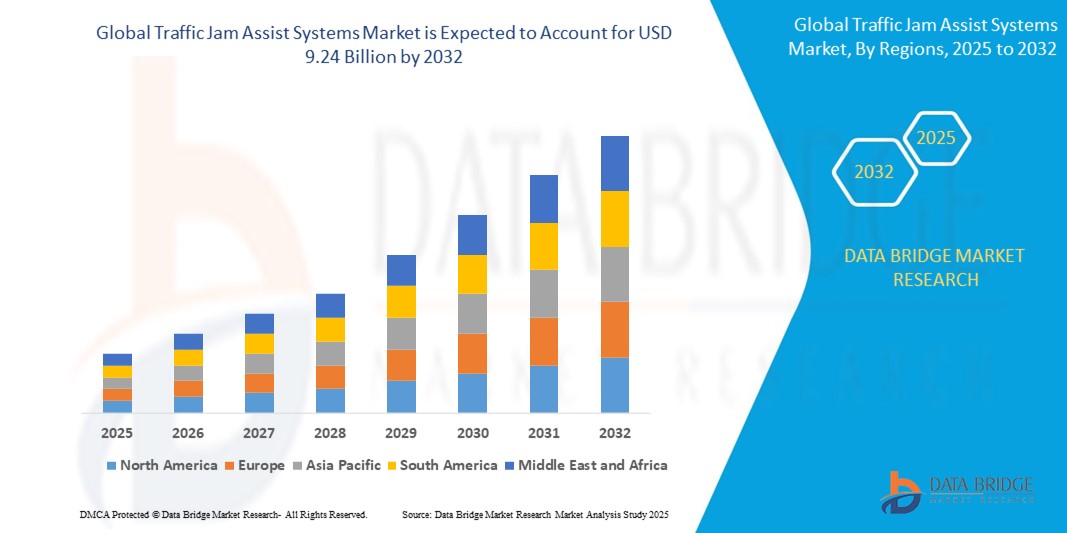
Traffic Jam Assist Systems Market Size
- The Global Traffic Jam Assist Systems Market size was valued at USD 3.90 Billion in 2024 and is expected to reach USD 9.24 Billion by 2032, at a CAGR of 11.39% during the forecast period
- The increase in road accidents due to human error is a major driver, prompting both consumers and regulators to seek advanced safety features like traffic jam assist systems to reduce collision risks and enhance overall vehicle safety.
- There is a surge in demand for ADAS technologies, including traffic jam assist, as consumers prioritize convenience and safety. Automakers are integrating these systems to stay competitive and meet evolving customer expectations.
Traffic Jam Assist Systems Market Analysis
- Innovations in sensor technology, including radar, LiDAR, and ultrasonic sensors, are enhancing the capabilities of TJA systems. The integration of artificial intelligence (AI) and machine learning algorithms allows for more accurate vehicle detection, lane tracking, and adaptive cruise control, improving overall system reliability.
- Traffic Jam Assist features are increasingly being designed for compatibility with broader in-vehicle infotainment and connectivity platforms. Integration with voice assistants such as Amazon Alexa, Google Assistant, and Apple CarPlay allows drivers to activate, monitor, and adjust assist functions using natural language commands, reducing distraction and supporting hands-free operation. This trend mirrors the broader move toward unified, user-friendly vehicle control interfaces.
- The growing demand for luxury and high-performance vehicles equipped with advanced features is propelling the integration of TJA systems. Automakers are increasingly offering TJA as a standard or optional feature, enhancing driving comfort and safety in congested traffic conditions.
- North America dominates the Traffic Jam Assist Systems Market with the largest revenue share of 45.09% in 2024, due to presence of technologically advanced research institutes and prominent players within the regions.
- Asia-Pacific is expected to be the fastest growing region in the Traffic Jam Assist Systems Market due to Growing Demand for Advanced Driver Assistance Systems (ADAS).
- Level 2 segment dominates the Traffic Jam Assist Systems Market with a market share of 60.6% in 2024, driven increase in road accidents due to human error is a major driver, prompting both consumers and regulators to seek advanced safety features like traffic jam assist systems to reduce collision risks and enhance overall vehicle safety.
Report Scope and Traffic Jam Assist Systems Market Segmentation
|
Attributes |
Traffic Jam Assist Systems Market Insights |
|
Segments Covered |
|
|
Countries Covered |
North America
Europe
Asia-Pacific
Middle East and Africa
South America
|
|
Key Market Players |
|
|
Market Opportunities |
|
|
Value Added Data Infosets |
In addition to the insights on market scenarios such as market value, growth rate, segmentation, geographical coverage, and major players, the market reports curated by the Data Bridge Market Research also include in-depth expert analysis, pricing analysis, brand share analysis, consumer survey, demography analysis, supply chain analysis, value chain analysis, raw material/consumables overview, vendor selection criteria, PESTLE Analysis, Porter Analysis, and regulatory framework. |
Traffic Jam Assist Systems Market Trends
“Growing Emphasis on Cybersecurity and Identity Management”
- TJA systems are evolving as part of broader Advanced Driver Assistance Systems (ADAS), integrating features such as adaptive cruise control, lane-keeping assist, and automatic braking. These technologies enable vehicles to autonomously manage acceleration, braking, and steering in slow-moving traffic, significantly reducing driver fatigue and enhancing road safety. The trend toward higher levels of vehicle automation, including Level 2 and Level 3 systems, is making TJA a standard feature in new premium and, increasingly, mid-range vehicles.
- Continuous advancements in sensor technology—including RADAR, LiDAR, and automotive cameras—are improving the reliability and effectiveness of TJA systems. The integration of artificial intelligence (AI) and real-time data exchange through connected car (V2X) technologies is enabling more predictive and proactive responses to traffic conditions, further enhancing the user experience and safety.
- The cost of TJA systems is gradually decreasing, making the technology more accessible to a broader range of vehicle segments beyond luxury models. This democratization is expected to accelerate adoption rates, especially as regulatory pressures and consumer awareness of safety features continue to rise.
- North America currently dominates the market, supported by strong R&D investments, high adoption of active safety systems, and favorable regulatory initiatives. However, the Asia Pacific region is expected to witness the fastest growth, driven by rapid urbanization, increasing vehicle sales, and significant investments in automotive technology in countries such as China, Japan, and India.
- Asia Pacific is emerging as the fastest-growing region fueled by surge in demand for ADAS technologies, including traffic jam assist, as consumers prioritize convenience and safety. Automakers are integrating these systems to stay competitive and meet evolving customer expectations.
Traffic Jam Assist Systems Market Dynamics
Driver
“Rising Demand for Semi-Autonomous Driving and Urban Traffic Management”
- The increasing adoption of advanced driver assistance systems (ADAS) and semi-autonomous vehicles is fueling demand for Traffic Jam Assist (TJA) systems, particularly in urban areas with frequent congestion.
- For instance, in early 2025, leading automotive OEMs are integrating TJA as a standard or optional feature in new vehicle models to enhance competitiveness and comply with evolving safety regulations.
- As urbanization accelerates globally, cities are experiencing higher traffic density, making features like TJA essential for improving commuter safety and reducing driver fatigue in stop-and-go traffic.
- TJA systems leverage a combination of sensors (cameras, radar, lidar) and AI-powered algorithms to maintain safe distances, automate acceleration and braking, and assist with lane-keeping during low-speed congestion.
Restraint/Challenge
“High System Complexity, Cost, and Environmental Limitations”
- Traffic Jam Assist systems require robust sensor suites and high-performance computing platforms to process real-time data from multiple sources, increasing both the cost and complexity of integration into vehicles.
- For instance, in 2025, the need to ensure reliable operation in diverse lighting, weather, and road conditions poses significant technical challenges, as sensor performance can degrade in heavy rain, fog, or poorly marked roads.
- The high computational demands of TJA, especially for real-time object detection and decision-making, can lead to increased power consumption and potential thermal management issues, particularly in compact or electric vehicles.
- Additionally, regulatory differences and infrastructure variability across regions may limit the scalability and effectiveness of TJA systems, requiring extensive validation and localization efforts by manufacturers.
Traffic Jam Assist Systems Market Scope
The market is segmented on the basis of Level of Automation, Component.
- By Level of Automation
On the basis of Level of Automation, the Traffic Jam Assist Systems Market is segmented into Level 2, Level 3. The Level 2 segment dominates the largest market revenue share of 60.6% in 2024, driven by implementing stricter safety regulations, often mandating the inclusion of driver assistance features in new vehicles. These rules accelerate the adoption of traffic jam assist systems, especially in regions like Europe and North America.
The Level 3 segment is anticipated to witness the fastest growth rate of 11.9% from 2025 to 2032, fueled by Rapid Urbanization and Traffic Congestion.
- By Component
On the basis of Component, the Traffic Jam Assist Systems Market is segmented into Automotive Cameras, Ultrasonic Sensors, RADAR, LiDAR, ECUs. The Automotive Cameras segment held the largest market revenue share in 2024 driven by surge in demand for ADAS technologies, including traffic jam assist, as consumers prioritize convenience and safety. Automakers are integrating these systems to stay competitive and meet evolving customer expectations.
The Ultrasonic Sensors segment is expected to witness the fastest CAGR from 2025 to 2032, driven by Digital Transformation Across Industries.
Traffic Jam Assist Systems Market Regional Analysis
- North America dominates the Traffic Jam Assist Systems Market with the largest revenue share of 45.01% in 2024, driven by improvements in sensor fusion, radar, cameras, and artificial intelligence are enhancing the performance, reliability, and affordability of traffic jam assist systems, making them accessible across more vehicle segments.
- The global growth in vehicle production, especially in emerging economies, is expanding the potential market for traffic jam assist systems as more vehicles are equipped with advanced technologies.
- Modern consumers increasingly value features that reduce driving stress and effort, particularly in heavy traffic. Traffic jam assist systems offer automated control of acceleration, braking, and steering, enhancing driving comfort.
U.S. Traffic Jam Assist Systems Market Insight
The U.S. Traffic Jam Assist Systems Market captured the largest revenue share of 57% in 2024 within North America, fueled by Rising Vehicle Production and Sales.
Europe Traffic Jam Assist Systems Market Insight
The global growth in vehicle production, especially in emerging economies, is expanding the potential market for traffic jam assist systems as more vehicles are equipped with advanced technologies in Europe.
U.K. Traffic Jam Assist Systems Market Insight
The U.K. Traffic Jam Assist Systems Market is anticipated to grow at a noteworthy CAGR during the forecast period, driven by Modern consumers increasingly value features that reduce driving stress and effort, particularly in heavy traffic. Traffic jam assist systems offer automated control of acceleration, braking, and steering, enhancing driving comfort.
Germany Traffic Jam Assist Systems Market Insight
The Germany Traffic Jam Assist Systems Market is expected to expand at a considerable CAGR during the forecast period, fueled by Traffic jam assist is often a foundational feature for higher levels of vehicle automation. Its integration with semi-autonomous and autonomous driving systems supports the broader trend toward automated mobility.
Asia-Pacific Traffic Jam Assist Systems Market Insight
The Asia-Pacific Traffic Jam Assist Systems Market is poised to grow at the fastest CAGR of 13% during the forecast period of 2025 to 2032, driven by the shift toward electric vehicles and smart city initiatives is boosting the adoption of advanced driver assistance features, including traffic jam assist, as part of comprehensive mobility solutions.
Japan Traffic Jam Assist Systems Market Insight
The Japan Traffic Jam Assist Systems Market is gaining momentum due to Major automotive manufacturers and technology companies are investing heavily in research and development to differentiate their offerings, leading to rapid innovation and deployment of traffic jam assist systems.
China Traffic Jam Assist Systems Market Insight
The China Traffic Jam Assist Systems Market accounted for the largest market revenue share in Asia-Pacific in 2024, driven by public awareness of road safety and the benefits of driver assistance systems is growing, encouraging more buyers to opt for vehicles equipped with traffic jam assist features.
Traffic Jam Assist Systems Market Share
The Traffic Jam Assist Systems Market is primarily led by well-established companies, including:
- Continental AG
- Delphi Technologies
- DENSO CORPORATION
- Infineon Technologies AG
- Magna International Inc.
- Mobileye
- NVIDIA Corporation
- Robert Bosch GmbH
- Valeo
- ZF Friedrichshafen AG
- HYUNDAI MOBIS
- AUDI AG
- Mercedes-Benz
- Automotive Group.
- Hitachi, Ltd.
- SEAT, S.A.
- The Ford Motor Company
- ŠKODA AUTO
- Miles Continental
- Aptiv
- BMW
Latest Developments in Global Traffic Jam Assist Systems Market
- In March 2025, Hitachi, through its subsidiary GlobalLogic, inaugurated a state-of-the-art Security Operations Center (SOC) in Kraków, Poland. This facility leverages Hitachi Cyber's capabilities to provide 24/7 monitoring and tailored solutions, addressing the growing cybersecurity challenges posed by AI-driven attacks and ransomware-as-a-service. The SOC aims to support organizations in mitigating risks and ensuring compliance with regulations like GDPR and NIS2.
- In February 2024, DENSO Corporation in collaboration with NTT Communications, DENSO announced on October 18, 2022, the development of a Vehicle Security Operation Center (VSOC) to counteract sophisticated cyber-attacks targeting vehicles. This joint initiative combines NTT Com's expertise in managed IT security with DENSO's experience in in-vehicle systems and connected car development, aiming to provide robust VSOC services for car manufacturers and mobility providers.
- In September 2024, Hyundai Mobis became the first Asian automotive supplier to obtain cybersecurity certification from the European Automotive Manufacturing and Supply Association (ENX). This certification, recognized as a global standard for automotive cybersecurity, underscores Hyundai Mobis's commitment to enhancing vehicle security management capabilities in line with global standards.
- In July 2025, Infineon has established a global Cyber Security Program, incorporating a Cyber & Information Security Management System (CISMS) to systematically identify and manage cyber risks. The program includes the Infineon Cyber Defense Center, CERT/CSIRT, and PSIRT teams, focusing on monitoring and responding to security vulnerabilities and threats affecting products, services, and infrastructure.
- In January 2025, NVIDIA introduced agentic AI systems in cybersecurity operations. These systems automate complex, multistep tasks such as alert management and vulnerability triage, enhancing the efficiency of security operations. By leveraging advanced reasoning and dynamic decision-making, NVIDIA's approach aims to streamline cybersecurity processes and reduce the manual workload of security analysts.[SP1]

- Interactive Data Analysis Dashboard
- Company Analysis Dashboard for high growth potential opportunities
- Research Analyst Access for customization & queries
- Competitor Analysis with Interactive dashboard
- Latest News, Updates & Trend analysis
- Harness the Power of Benchmark Analysis for Comprehensive Competitor Tracking
Global Traffic Jam Assist Systems Market, Supply Chain Analysis and Ecosystem Framework
To support market growth and help clients navigate the impact of geopolitical shifts, DBMR has integrated in-depth supply chain analysis into its Global Traffic Jam Assist Systems Market research reports. This addition empowers clients to respond effectively to global changes affecting their industries. The supply chain analysis section includes detailed insights such as Global Traffic Jam Assist Systems Market consumption and production by country, price trend analysis, the impact of tariffs and geopolitical developments, and import and export trends by country and HSN code. It also highlights major suppliers with data on production capacity and company profiles, as well as key importers and exporters. In addition to research, DBMR offers specialized supply chain consulting services backed by over a decade of experience, providing solutions like supplier discovery, supplier risk assessment, price trend analysis, impact evaluation of inflation and trade route changes, and comprehensive market trend analysis.
Data collection and base year analysis are done using data collection modules with large sample sizes. The stage includes obtaining market information or related data through various sources and strategies. It includes examining and planning all the data acquired from the past in advance. It likewise envelops the examination of information inconsistencies seen across different information sources. The market data is analysed and estimated using market statistical and coherent models. Also, market share analysis and key trend analysis are the major success factors in the market report. To know more, please request an analyst call or drop down your inquiry.
The key research methodology used by DBMR research team is data triangulation which involves data mining, analysis of the impact of data variables on the market and primary (industry expert) validation. Data models include Vendor Positioning Grid, Market Time Line Analysis, Market Overview and Guide, Company Positioning Grid, Patent Analysis, Pricing Analysis, Company Market Share Analysis, Standards of Measurement, Global versus Regional and Vendor Share Analysis. To know more about the research methodology, drop in an inquiry to speak to our industry experts.
Data Bridge Market Research is a leader in advanced formative research. We take pride in servicing our existing and new customers with data and analysis that match and suits their goal. The report can be customized to include price trend analysis of target brands understanding the market for additional countries (ask for the list of countries), clinical trial results data, literature review, refurbished market and product base analysis. Market analysis of target competitors can be analyzed from technology-based analysis to market portfolio strategies. We can add as many competitors that you require data about in the format and data style you are looking for. Our team of analysts can also provide you data in crude raw excel files pivot tables (Fact book) or can assist you in creating presentations from the data sets available in the report.













