


What is the Transistors Quantum Dots Market Size and Growth Rate?
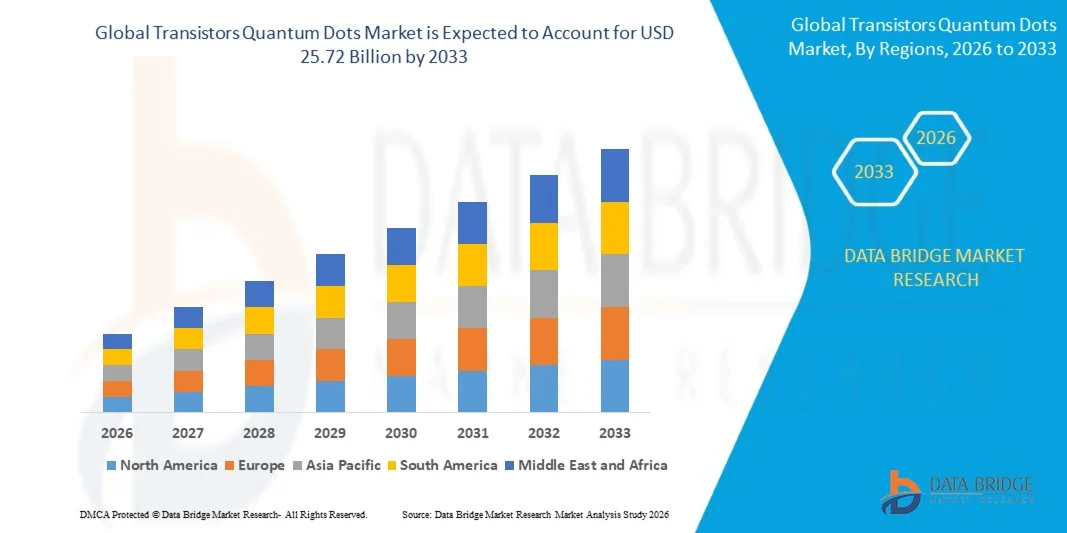
- As per Data Bridge Market Research analysis, the global transistors quantum dots market was valued at USD 10.8 billion in 2025 and is projected to reach USD 25.72 billion by 2033, growing at a CAGR of 11.45% from 2026 to 2033.
- The market is experiencing consistent growth driven by rising demand for high-speed and energy-efficient electronic devices, increasing investments in semiconductor and nanotechnology research, and expanding applications of quantum dots across optoelectronics, consumer electronics, telecommunications, defense, and other advanced technology sectors. Quantum dots offer tunable electronic properties, low-power operation, and high-speed switching capabilities, supporting their integration into next-generation transistor technologies.
- The increasing need for miniaturized, energy-efficient, and high-performance electronic components, combined with advancements in quantum dot synthesis and device fabrication, is encouraging the development of quantum dot-based transistor technologies. Cadmium-based and cadmium-free quantum dots can provide tunable bandgaps and enhanced charge transport characteristics, while improvements in surface treatment, material stability, and solution-based processing are supporting their potential use in flexible electronics, optoelectronic devices, logic circuits, sensors, and emerging computing applications.
Market Size & Forecast
- Global Market Value (2025): USD 10.8 Billion
- Expected Market Value (2033): USD 25.72 Billion
- Forecast CAGR (2026–2033): 11.45%
- Leading Region in 2025: North America
- Fastest Growing Region: Asia Pacific
What are the Major Takeaways of the Transistors Quantum Dots Market?
- North America dominated the Transistors Quantum Dots Market with the largest revenue share of 35.2% in 2025, supported by the region’s well-established semiconductor industry, advanced research infrastructure, strong presence of technology companies, and increasing investments in quantum computing, optoelectronics, and next-generation electronic devices.
- Asia-Pacific is expected to be the fastest-growing region at a CAGR of 12.1% from 2026 to 2033, fueled by rapid semiconductor industry development, expanding electronics manufacturing activities, increasing investments in nanotechnology and quantum technologies, and rising adoption of quantum dot-based devices across China, Japan, South Korea, and India.
- The cadmium-based quantum dots segment led the market with a 58.4% share in 2025, driven by their established manufacturing processes, high quantum efficiency, tunable electronic properties, and extensive application in transistors, displays, sensors, and optoelectronic devices.
- Cadmium-free quantum dots are the fastest-growing material type, projected to register a CAGR of 13.5%, reflecting the increasing focus on environmentally safer materials, stringent regulations concerning cadmium-based technologies, and growing adoption of indium phosphide and other cadmium-free alternatives.
- The II-VI semiconductors segment dominated the type category with a 47.6% revenue share in 2025, led by their favorable electronic and optical properties, established quantum dot fabrication technologies, and broad applicability across transistors, displays, sensors, and optoelectronic devices.
- Optoelectronics accounted for 31.8% of the market share in 2025, supported by the tunable optical and electronic properties of quantum dots and their increasing use in photodetectors, light-emitting devices, displays, imaging systems, and advanced sensing applications.
- Consumer electronics is the fastest-growing end-use category, with a CAGR of 13.8%, driven by increasing demand for compact and energy-efficient electronic components, expanding applications of quantum dot displays and sensors, and continued advancements in next-generation semiconductor and electronic devices.
Report Scope and Transistors Quantum Dots Market Segmentation
|
Attributes |
Transistors Quantum Dots Key Market Insights |
|
Segments Covered |
|
|
Countries Covered |
North America
Europe
Asia-Pacific
Middle East and Africa
South America
|
|
Key Market Players |
|
|
Market Opportunities |
|
|
Value Added Data Infosets |
In addition to the insights on market scenarios such as market value, growth rate, segmentation, geographical coverage, and major players, the market reports curated by the Data Bridge Market Research also include in-depth expert analysis, geographically represented company-wise production and capacity, network layouts of distributors and partners, detailed and updated price trend analysis and deficit analysis of supply chain and demand. |
What is the Key Trend in the Transistors Quantum Dots Market?
- Transistor’s quantum dots manufacturers are increasingly developing advanced quantum dot materials and transistor architectures to improve charge transport, switching performance, flexibility, and device efficiency while supporting next-generation electronic applications globally today.
- For instance, in March 2024, researchers demonstrated advances in solution-processed colloidal quantum dot transistors, supporting low-cost and flexible semiconductor fabrication for applications across displays, sensors, memory devices, and other advanced electronic systems.
- Demand is rising for quantum dot transistors with improved charge mobility, enhanced stability, tunable electronic properties, and scalable manufacturing capabilities that support high-performance electronic, optoelectronic, and sensing applications worldwide.
- Flexible electronics, wearable devices, displays, sensors, and high-performance computing applications increasingly require quantum dot transistor technologies that combine compact device structures, tunable properties, efficient charge transport, and compatibility with flexible substrates.
- For instance, in June 2024, research and development activities highlighted the use of cadmium-free quantum dots and advanced surface-engineering techniques to improve transistor performance while addressing environmental and material-related concerns associated with conventional heavy-metal-based quantum dots.
- Manufacturers are also adopting solution-based fabrication, advanced surface modification, and scalable processing techniques that support flexible device integration, improve manufacturing efficiency, and expand the use of quantum dot transistors across emerging electronic and optoelectronic applications worldwide today.
What are the Key Drivers of the Transistors Quantum Dots Market?
- The growing demand for high-performance and energy-efficient electronic devices is increasing the adoption of quantum dot transistors because these devices offer tunable electronic properties, efficient charge transport, and potential advantages for advanced computing and optoelectronic applications globally.
- For instance, in March 2024, researchers reported advances in colloidal quantum dot transistor technologies, highlighting solution-processed quantum dots as promising semiconductor materials for flexible and low-cost electronic devices.
- Increasing adoption of flexible displays, wearable electronics, sensors, and optoelectronic devices is creating demand for quantum dot transistors that provide compact device structures, tunable properties, and compatibility with flexible substrates.
- Solution-based fabrication and surface-engineering techniques are gaining adoption because they enable quantum dots to be processed at relatively low temperatures, support scalable manufacturing, and facilitate integration into thin-film and flexible electronic architectures.
- For instance, in June 2024, research activities highlighted advances in quantum dot field-effect transistors through improved surface chemistry and material engineering, supporting enhanced charge transport and device stability for emerging electronic applications.
- Manufacturers and technology developers increasingly prioritize quantum dot transistor technologies that improve device performance while supporting flexible integration, scalable processing, and expanded applications across displays, sensors, memory, optoelectronics, and next-generation computing environments.
Which Factors are Challenging the Growth of the Transistors Quantum Dots Market?
- Transistors quantum dots face growing material and environmental concerns because conventional quantum dots can contain heavy metals such as cadmium and other potentially hazardous elements, increasing pressure to develop safer and more environmentally compatible alternatives.
- For instance, in January 2025, research into quantum dot electronic devices continued to highlight the need for improved material stability and the replacement of toxic heavy-metal-based quantum dots with cadmium-free alternatives for broader commercial adoption.
- Limited availability of suitable high-quality quantum dot materials increases manufacturing challenges, particularly where consistent particle size, surface chemistry, electronic properties, and material purity are required for reliable transistor performance at commercial scale.
- Complex fabrication and integration requirements are also increasing development challenges for quantum dot transistor manufacturers, compelling technology developers to improve patterning, surface passivation, charge transport, device stability, and compatibility with existing semiconductor manufacturing processes globally.
- For instance, in August 2024, research activities in quantum dot electronics highlighted continuing challenges related to device stability, surface defects, charge trapping, and material interfaces, which can affect the long-term electrical performance of quantum dot transistor devices.
- These requirements can increase research, material development, testing, process optimization, and production costs, particularly for manufacturers seeking to transition quantum dot transistor technologies from laboratory-scale demonstrations toward reliable commercial-scale electronic and optoelectronic applications.
How is the Transistors Quantum Dots Market Segmented?
The Transistors Quantum Dots Market is segmented on the basis of processing technique, material, type, and end use.
- By Processing Technique
On the basis of processing technique, the Transistors Quantum Dots Market is segmented into colloidal synthesis, fabrication, bio-molecular self-assembly, viral assembly, electrochemical assembly, and others. The colloidal synthesis segment dominated the market with 38.5% share in 2025, owing to its scalable production capabilities, controlled quantum dot properties, and compatibility with solution-based processing. Colloidal synthesis enables quantum dots to be produced with controlled particle size, composition, and surface characteristics, supporting their integration into transistor structures and other electronic and optoelectronic applications. The technique also provides flexibility in material formulation and supports cost-effective processing for emerging quantum-dot devices.
The fabrication segment is projected to register the fastest growth at 24.1% CAGR during forecast period, supported by increasing demand for advanced transistor architectures and improved integration of quantum dots into electronic devices. Fabrication techniques enable precise control over thin-film formation, patterning, electrode integration, and device structures. These capabilities are particularly important for developing high-performance nanoscale transistors, flexible electronics, sensors, and optoelectronic components. Increasing research into miniaturized semiconductor devices and advanced manufacturing processes is further supporting the adoption of fabrication techniques.
- By Material
On the basis of material, the Transistors Quantum Dots Market is segmented into cadmium-based quantum dots and cadmium-free quantum dots. The cadmium-based quantum dots segment dominated the market with 58.0% share in 2025, owing to their established electronic and optical properties, extensive research base, and well-developed synthesis technologies. Cadmium-based quantum dots provide strong quantum confinement effects and tunable electronic characteristics, making them suitable for transistor research, optoelectronics, displays, and sensing applications. Their established material performance and availability of established processing methods continue to support their use across quantum-dot-based electronic technologies.
The cadmium-free quantum dots segment is projected to register the fastest growth at 24.2% CAGR during forecast period, supported by increasing environmental concerns associated with heavy-metal-containing materials and growing demand for safer quantum-dot technologies. Cadmium-free materials are being developed to provide suitable optical and electronic performance while reducing concerns related to toxicity and environmental impact. Continued research into alternative semiconductor compositions, improved surface engineering, and enhanced device stability is supporting their integration into next-generation transistors, displays, sensors, and other electronic applications.
- By Type
On the basis of type, the Transistors Quantum Dots Market is segmented into III-V-semiconductors, II-VI semiconductors, and silicon (Si). The II-VI semiconductors segment dominated the market with 48.0% share in 2025, owing to their established quantum confinement properties, tunable band structures, and extensive application in quantum-dot research. II-VI semiconductor quantum dots offer controlled electronic and optical characteristics that support transistor development, optoelectronics, displays, and sensing applications. Established synthesis methods and extensive research into their material properties have further supported their adoption in quantum-dot-based electronic devices.
The III-V-semiconductors segment is projected to register the fastest growth at 24.5% CAGR during forecast period, driven by increasing demand for high-performance semiconductor materials with enhanced carrier transport and tunable electronic properties. III-V semiconductor quantum dots offer characteristics suitable for high-speed transistors, optoelectronic devices, and advanced nanoscale electronic architectures. Increasing research into high-frequency electronics, miniaturized devices, and improved charge transport is supporting the development of III-V quantum-dot transistor technologies.
- By End Use
On the basis of end use, the Transistors Quantum Dots Market is segmented into optoelectronics, healthcare, light emitting diode lighting, solar modules, consumer electronics, commercial, defense, telecommunications, and others. The optoelectronics segment dominated the market with 22.0% share in 2025, owing to the increasing use of quantum dots in advanced optical and electronic components. Quantum dots provide tunable electronic and optical properties that support applications in photodetectors, displays, optical sensors, and signal-processing devices. Their ability to provide controlled light absorption and emission characteristics has supported increasing research and development across optoelectronic systems and quantum-dot-based transistor technologies.
The consumer electronics segment is projected to register the fastest growth at 25.0% CAGR during forecast period, supported by increasing demand for compact, energy-efficient, and high-performance electronic devices. Quantum-dot transistors can support advanced electronic architectures with improved optical and electronic performance, making them suitable for displays, sensors, wearable devices, and other consumer electronics. Growing demand for miniaturized and flexible electronic products is further encouraging research into quantum-dot integration, while developments in semiconductor fabrication are supporting the potential commercialization of quantum-dot-based components.
Which Region Holds the Largest Share of the Transistors Quantum Dots Market?
- North America dominated the Transistors Quantum Dots Market with the largest revenue share of nearly 41% in 2025, supported by the region’s strong semiconductor research ecosystem, high investment in nanotechnology and quantum technologies, advanced electronics manufacturing capabilities, and growing adoption of high-performance electronic and optoelectronic devices.
- The region also benefits from increasing research and development activities in quantum-dot technologies, growing demand for energy-efficient electronic components, and the presence of established semiconductor and technology companies. Rising applications of quantum dots in displays, optoelectronics, healthcare, telecommunications, defense, and consumer electronics are further supporting regional market expansion. The United States represents the major market within the region, supported by its advanced semiconductor industry, strong R&D capabilities, and established technology ecosystem.
U.S. Transistors Quantum Dots Market Insight
The U.S. Transistors Quantum Dots Market is witnessing strong growth due to increasing research and development activities in quantum-dot technologies, advanced semiconductor manufacturing capabilities, and growing demand for high-performance electronic devices. The country has a well-established ecosystem for nanotechnology and semiconductor innovation, supported by investments in next-generation electronics, optoelectronics, telecommunications, healthcare, and defense applications. In addition, increasing demand for energy-efficient and high-speed electronic components is encouraging the development and adoption of quantum-dot-based transistor technologies. The presence of leading technology companies, research institutions, and advanced fabrication facilities continues to create significant opportunities for market growth in the United States.
Asia-Pacific Transistors Quantum Dots Market Insight
The Asia-Pacific Transistors Quantum Dots Market is expected to witness rapid growth, driven by expanding semiconductor manufacturing activities, increasing investments in nanotechnology research, and rising demand for advanced electronic and optoelectronic devices across countries such as China, Japan, South Korea, and India. Growing production of consumer electronics, displays, semiconductor components, and telecommunications equipment is supporting the adoption of quantum-dot technologies across the region. In addition, increasing government and private-sector investments in semiconductor manufacturing and advanced materials research are strengthening the regional technology ecosystem. The expanding electronics manufacturing base and growing demand for energy-efficient devices are further supporting market expansion across Asia-Pacific.
Japan Transistors Quantum Dots Market Insight
The Japan Transistors Quantum Dots Market is witnessing consistent growth due to the country's strong semiconductor, electronics, and advanced materials industries. Increasing research activities related to quantum-dot materials, nanotechnology, and next-generation electronic components are supporting the development of transistor applications. Japanese electronics manufacturers are increasingly focusing on high-performance, energy-efficient, and miniaturized technologies for consumer electronics, optoelectronics, healthcare, and industrial applications. Moreover, the country's advanced research infrastructure, technological expertise, and established semiconductor ecosystem continue to provide significant opportunities for the development and commercialization of quantum-dot transistor technologies.
China Transistors Quantum Dots Market Insight
The China Transistors Quantum Dots Market is growing rapidly, driven by expanding semiconductor manufacturing capabilities, increasing investments in advanced materials, and strong demand for consumer electronics, displays, optoelectronics, and telecommunications equipment. Growing government and industry support for domestic semiconductor and quantum technology development is strengthening the country's research and manufacturing ecosystem. In addition, China's large electronics manufacturing base and increasing focus on energy-efficient and high-performance electronic components are encouraging the adoption of quantum-dot technologies. Continued investments in semiconductor fabrication, nanotechnology research, and next-generation display and electronic applications are expected to create significant opportunities for the transistors quantum dots market in China.
U.K. Transistors Quantum Dots Market Insight
The U.K. Transistors Quantum Dots Market is experiencing steady growth, supported by increasing research activities in quantum technologies, nanotechnology, advanced materials, and semiconductor applications. The country's strong academic and research ecosystem is contributing to the development of quantum-dot-based electronic technologies for optoelectronics, healthcare, telecommunications, and advanced computing applications. Increasing emphasis on energy-efficient electronic devices and next-generation semiconductor technologies is further supporting market development. In addition, collaboration between research institutions, technology companies, and advanced manufacturing organizations is creating opportunities for the development and commercialization of quantum-dot transistor technologies across the U.K.
Germany Transistors Quantum Dots Market Insight
The Germany Transistors Quantum Dots Market is expanding steadily due to the country's strong semiconductor, automotive, electronics, and industrial technology sectors. Increasing demand for advanced electronic components, high-performance sensors, optoelectronic systems, and energy-efficient technologies is supporting the development of quantum-dot-based transistor applications. Germany's established industrial research infrastructure and strong focus on advanced materials and semiconductor technologies are further contributing to market growth. In addition, increasing investments in next-generation electronics, automotive technologies, telecommunications, and industrial automation are creating opportunities for quantum-dot transistor technologies across the country.
Which are the Top Companies in Transistors Quantum Dots Market?
The transistors quantum dots industry is primarily led by well-established companies, including:
- Nanosys Inc. (U.S.)
- Samsung Electronics Co., Ltd. (South Korea)
- Nanoco Group plc (U.K.)
- NNCrystal US Corporation (U.S.)
- Ocean NanoTech (U.S.)
- Quantum Materials Corp. (U.S.)
- OSRAM Opto Semiconductors GmbH (Germany)
- Crystalplex Corporation (U.S.)
- Navillum Nanotechnologies (U.S.)
- UbiQD, Inc. (U.S.)
- Fraunhofer Institute for Applied Polymer Research IAP (Germany)
- Quantum Solutions (U.K.)
- DuPont (U.S.)
- QDI Systems (Netherlands)
- Sony Corporation (Japan)
- LG Display Co., Ltd. (South Korea)
- Merck KGaA (Germany)
- Thermo Fisher Scientific Inc. (U.S.)
- QD Laser, Inc. (Japan)
- 3M Company (U.S.)
What are Latest Developments in Transistors Quantum Dots Market?
- In April 2025, Nanosys announced its participation in Display Week 2025, where the company planned to showcase its latest quantum-dot innovations and participate in technical discussions covering the development and commercialization of quantum-dot technologies. Nanosys highlighted continued work on quantum-dot materials, display integration, and emerging applications, demonstrating ongoing technological development in semiconductor-based quantum-dot materials and supporting the broader advancement of quantum-dot technologies relevant to next-generation electronic and optoelectronic applications.
- In March 2025, Samsung Electronics announced that its quantum-dot display technology had received SGS certification confirming that the quantum-dot sheet used in its QD TVs was cadmium-free and compliant with the Restriction of Hazardous Substances requirements. The development demonstrated continued advancement in cadmium-free quantum-dot materials and supported the broader adoption of quantum-dot technologies in electronic and optoelectronic applications.
- In January 2025, Nanoco Group highlighted research conducted in collaboration with the University of Manchester on singly doped quantum dots for next-generation quantum technologies. The research focused on precisely doped quantum dots designed as a platform for quantum memories and quantum repeaters, with potential applications in secure communications and distributed quantum computing. The development demonstrated continued innovation in quantum-dot material engineering and their potential integration into advanced electronic and quantum technology applications.
- In April 2025, UbiQD announced the completion of a USD 20 million Series B financing round to scale its quantum-dot technology, expand manufacturing, accelerate research and development, and strengthen its intellectual property capabilities. The company stated that the investment would support upgrades to its existing facilities and the development of a larger quantum-dot supply chain. The initiative demonstrated increasing investment in scalable quantum-dot manufacturing and advanced nanomaterial technologies.
- In July 2025, UbiQD announced a multi-year agreement with First Solar to supply its proprietary fluorescent quantum-dot technology for incorporation into thin-film bifacial photovoltaic modules. The companies also expanded their photovoltaic research and development collaboration to optimize the performance of utility-scale solar modules. The agreement represented an important expansion of quantum-dot technology into photovoltaic applications and demonstrated increasing commercialization of quantum-dot-based materials beyond display technologies.
- In June 2025, Nanosys highlighted advances in quantum-dot crystal engineering, explaining how precise control of quantum-dot growth and ligand chemistry can improve optical performance, stability, and color characteristics. The company's research emphasized the importance of material-level engineering in producing quantum dots with controlled properties for advanced display and electronic applications. The development demonstrated continued innovation in quantum-dot synthesis and materials optimization.
- In September 2025, Nanoco Group highlighted its work on short-wave infrared sensing using colloidal quantum dots, with its technology being developed for high-performance SWIR sensing applications. The company continued expanding its quantum-dot material portfolio for sensing applications and reported ongoing development of semiconductor quantum dots with controlled optical properties. The initiative demonstrated continued advancement of colloidal quantum-dot technologies for next-generation sensing and optoelectronic devices.
- In August 2025, Nanosys highlighted the application of quantum-dot technology in automotive displays and presented research addressing wide-color-gamut performance under challenging ambient-light conditions. The development demonstrated the increasing application of quantum-dot materials in advanced automotive display systems and highlighted continued research into improving the performance of quantum-dot-based optoelectronic technologies.

- Interactive Data Analysis Dashboard
- Company Analysis Dashboard for high growth potential opportunities
- Research Analyst Access for customization & queries
- Competitor Analysis with Interactive dashboard
- Latest News, Updates & Trend analysis
- Harness the Power of Benchmark Analysis for Comprehensive Competitor Tracking
Global Transistors Quantum Dots Market, Supply Chain Analysis and Ecosystem Framework
To support market growth and help clients navigate the impact of geopolitical shifts, DBMR has integrated in-depth supply chain analysis into its Global Transistors Quantum Dots Market research reports. This addition empowers clients to respond effectively to global changes affecting their industries. The supply chain analysis section includes detailed insights such as Global Transistors Quantum Dots Market consumption and production by country, price trend analysis, the impact of tariffs and geopolitical developments, and import and export trends by country and HSN code. It also highlights major suppliers with data on production capacity and company profiles, as well as key importers and exporters. In addition to research, DBMR offers specialized supply chain consulting services backed by over a decade of experience, providing solutions like supplier discovery, supplier risk assessment, price trend analysis, impact evaluation of inflation and trade route changes, and comprehensive market trend analysis.
Data collection and base year analysis are done using data collection modules with large sample sizes. The stage includes obtaining market information or related data through various sources and strategies. It includes examining and planning all the data acquired from the past in advance. It likewise envelops the examination of information inconsistencies seen across different information sources. The market data is analysed and estimated using market statistical and coherent models. Also, market share analysis and key trend analysis are the major success factors in the market report. To know more, please request an analyst call or drop down your inquiry.
The key research methodology used by DBMR research team is data triangulation which involves data mining, analysis of the impact of data variables on the market and primary (industry expert) validation. Data models include Vendor Positioning Grid, Market Time Line Analysis, Market Overview and Guide, Company Positioning Grid, Patent Analysis, Pricing Analysis, Company Market Share Analysis, Standards of Measurement, Global versus Regional and Vendor Share Analysis. To know more about the research methodology, drop in an inquiry to speak to our industry experts.
Data Bridge Market Research is a leader in advanced formative research. We take pride in servicing our existing and new customers with data and analysis that match and suits their goal. The report can be customized to include price trend analysis of target brands understanding the market for additional countries (ask for the list of countries), clinical trial results data, literature review, refurbished market and product base analysis. Market analysis of target competitors can be analyzed from technology-based analysis to market portfolio strategies. We can add as many competitors that you require data about in the format and data style you are looking for. Our team of analysts can also provide you data in crude raw excel files pivot tables (Fact book) or can assist you in creating presentations from the data sets available in the report.













