


What is the Transparent Armor Materials Market Size and Growth Rate?
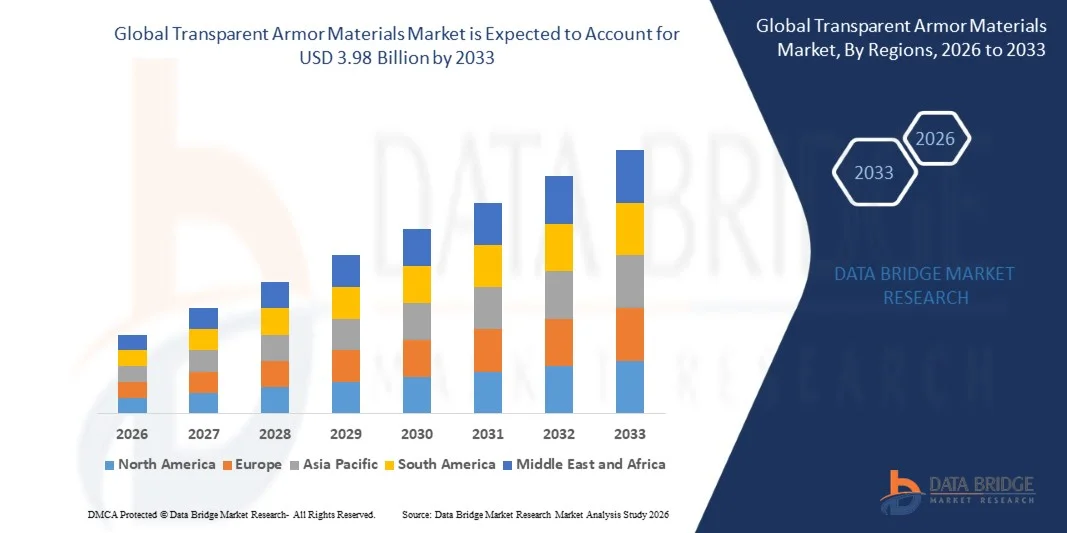
- As per Data Bridge Market Research analysis, the transparent armor materials market was valued at USD 2.30 billion in 2025 and is projected to reach USD 3.98 billion by 2033, growing at a CAGR of 7.1% from 2026 to 2033.
- The market is experiencing steady growth driven by increasing demand for lightweight ballistic protection systems, rising military modernization programs, and the growing adoption of advanced transparent armor solutions in military vehicles, aircraft, naval platforms, and security applications.
- The increasing focus on enhancing survivability of defense personnel and platforms, combined with advancements in materials such as polycarbonate, glass laminates, acrylic, and ceramic-based transparent armor, is encouraging defense forces and security agencies to adopt next-generation protective solutions. Transparent armor materials are replacing conventional glass systems by offering improved ballistic resistance, reduced weight, and enhanced optical performance for armored vehicles, tactical systems, and high-threat environments.
Market Size & Forecast
- Global Market Value (2025): USD 2.30 Billion
- Expected Market Value (2033): USD 3.98 Billion
- Forecast CAGR (2026–2033): 7.1%
- Leading Region in 2025: North America
- Fastest Growing Region: Asia-Pacific
What are the Major Takeaways of the Transparent Armor Materials Market?
- North America dominated the transparent armor materials market with the largest revenue share in 2025, supported by significant defense spending, modernization of armored vehicle fleets, and strong demand for advanced ballistic protection systems across military and security applications.
- Asia-Pacific is expected to be the fastest-growing region from 2026 to 2033, fueled by increasing defense budgets, rising procurement of armored military vehicles, and growing investments in advanced protection technologies across China, India, Japan, and South Korea.
- The glass-based transparent armor segment led the market in 2025, driven by its long-standing use in military vehicles, armored windows, and security applications due to high optical clarity, reliability, and established manufacturing processes.
- Transparent ceramics are the fastest-growing material type, reflecting the surge in demand for lightweight armor solutions with superior ballistic performance.
- The rifle-resistant segment dominated the protection level category in 2025, led by increasing demand for armored military vehicles, tactical vehicles, and security platforms requiring protection against intermediate and high-velocity ammunition threats.
- Glass lamination accounted for largest market share in 2025, preferred by its widespread adoption in producing transparent ballistic glass systems for military, security, and automotive protection applications.
- The transparent armor canopies segment is the fastest-growing product type category, driven by increasing demand for advanced protection systems in aerospace and aviation applications.
Report Scope and Transparent Armor Materials Market Segmentation
|
Attributes |
Transparent Armor Materials Key Market Insights |
|
Segments Covered |
|
|
Countries Covered |
North America
Europe
Asia-Pacific
Middle East and Africa
South America
|
|
Key Market Players |
|
|
Market Opportunities |
|
|
Value Added Data Infosets |
In addition to the market insights such as market value, growth rate, market segments, geographical coverage, market players, and market scenario, the market report curated by the Data Bridge Market Research team includes in-depth expert analysis, import/export analysis, pricing analysis, production consumption analysis, and pestle analysis. |
What is the Key Trend in the Transparent Armor Materials Market?
- Defense manufacturers are increasingly adopting advanced transparent armor materials to develop lightweight, high-performance protection systems for armored vehicles, aircraft, and tactical platforms while improving mobility and survivability.
- For instance, in July 2023, researchers published a study on bullet-resistant Al₂O₃ transparent ceramics, highlighting advancements in transparent ceramic armor development to address military requirements for lightweight and high-performance protective materials.
- The integration of transparent ceramics, glass laminates, and polymer-based composites is accelerating as next-generation armor solutions demand enhanced ballistic resistance, optical clarity, and reduced weight compared with conventional glass systems.
- For instance, in 2024, Saint-Gobain Ceramics developed advanced transparent ceramic solutions using spinel and ALON materials for lightweight ballistic protection applications, supporting next-generation defense platforms.
- Research organizations and defense suppliers are focusing on hybrid transparent armor designs that combine multiple material layers to improve protection against evolving ballistic and blast threats.
- For instance, in April 2021, Fraunhofer Institute for Ceramic Technologies and Systems (IKTS) expanded its transparent ceramics development capabilities through the integration of CeramTec-ETEC’s PERLUCOR transparent ceramics activities, strengthening research and development of transparent ceramic materials for advanced protection applications.
- As military forces continue prioritizing lightweight survivability technologies and advanced vehicle protection systems, the adoption of transparent armor materials is expected to accelerate, reinforcing advanced materials as a critical component of modern defense platforms.
What are the Key Drivers of the Transparent Armor Materials Market?
- The increasing global defense modernization programs and rising procurement of armored vehicles have significantly increased demand for transparent armor materials capable of providing enhanced ballistic protection and improved operational performance.
- Military organizations, homeland security agencies, and defense contractors are integrating lightweight transparent armor systems into combat vehicles, aircraft, and naval platforms to improve crew protection and mission effectiveness.
- For instance, in March 2024, the U.S. Government Accountability Office (GAO) reported that the U.S. Army continued modernization of Stryker armored vehicle platforms through upgrades focused on increasing lethality, survivability, and situational awareness capabilities
- Growing geopolitical tensions and increasing investments in advanced defense technologies are encouraging manufacturers to develop transparent armor solutions with improved strength, durability, and multi-threat protection capabilities.
- For instance, in March 2023, the U.S. Department of Defense released its FY 2024 Defense Budget request, highlighting record investments in research, development, procurement, and modernization programs to strengthen military capabilities and advance next-generation defense technologies.
- With defense forces increasingly relying on lightweight and advanced protection technologies to improve battlefield survivability, transparent armor materials will remain essential for future military vehicle and platform development.
Which Factors are Challenging the Growth of the Transparent Armor Materials Market?
- Advanced transparent armor materials require significant manufacturing investment due to complex processing technologies, specialized raw materials, and precision fabrication requirements for achieving ballistic protection and optical performance.
- These high production costs limit adoption among smaller defense suppliers and organizations operating with restricted procurement budgets, particularly in developing regions with limited defense expenditure.
- For instance, in December 2022, research published in the Journal of the Korean Ceramic Society highlighted that transparent aluminum oxynitride (AlON) ceramics face challenges related to fabrication cost, ease of manufacturing, and processing limitations, which restrict their wider adoption in armor applications
- The difficulty of balancing lightweight design, transparency, ballistic resistance, and cost efficiency continues to create technical challenges for manufacturers developing next-generation transparent armor solutions.
- For instance, in July 2021, research published in the Journal of the European Ceramic Society investigated transparent AlON ceramics and highlighted the complex fabrication processes, including optimized pre-sintering, hot isostatic pressing, and annealing requirements needed to achieve high transparency and performance.
- The high material costs and complex production processes associated with advanced transparent armor systems continue to restrict widespread deployment, particularly among cost-sensitive users and emerging defense markets.
How is the Transparent Armor Materials Market Segmented?
The transparent armor materials market is segmented on the basis of material type, protection level, manufacturing technology, product type, end user, and distribution channel.
- By Material Type
On the basis of material type, the transparent armor materials market is segmented into glass-based transparent armor, transparent ceramics, polymer-based transparent armor, glass-ceramic composites, glass-polymer laminates, and nanomaterial-based transparent armor. The glass-based transparent armor segment dominated the market in 2025, owing to its long-standing use in military vehicles, armored windows, and security applications due to high optical clarity, reliability, and established manufacturing processes. Glass-based armor systems provide effective ballistic protection against handgun, rifle, and fragmentation threats when combined with laminated structures. Their widespread availability, cost advantage compared with advanced ceramics, and compatibility with existing armored platforms support market dominance. Increasing demand for armored vehicles and security infrastructure continues to sustain adoption. However, higher weight compared with ceramic-based alternatives is encouraging manufacturers to develop lightweight hybrid solutions. The segment remains preferred for applications requiring proven protection performance and large-scale deployment.
The transparent ceramics segment is projected to register the fastest growth during the forecast period, driven by increasing demand for lightweight armor solutions with superior ballistic performance. Materials such as aluminum oxynitride (ALON), spinel, and sapphire-based ceramics offer high hardness, impact resistance, and improved weight efficiency compared with conventional glass armor. Rising military modernization programs and the need for enhanced vehicle survivability are accelerating adoption of transparent ceramic systems. These materials enable thinner armor designs while maintaining high protection levels against advanced threats. Continuous research in ceramic processing, manufacturing optimization, and cost reduction is improving commercial feasibility. Growing adoption in aerospace, defense vehicles, and high-threat security applications is expected to strengthen segment growth.
- By Protection Level
On the basis of protection level, the transparent armor materials market is segmented into handgun resistant, rifle resistant, armor-piercing protection, blast resistant, fragmentation resistant, and multi-hit protection. The rifle-resistant segment dominated the market in 2025, supported by increasing demand for armored military vehicles, tactical vehicles, and security platforms requiring protection against intermediate and high-velocity ammunition threats. Rifle-resistant transparent armor systems provide a balance between protection capability, optical performance, and weight efficiency. Military and law enforcement agencies widely deploy these solutions for personnel protection in combat and high-risk environments. Rising asymmetric warfare and increasing security threats are driving demand for advanced ballistic protection. Manufacturers are focusing on laminated glass, ceramic composites, and hybrid materials to improve rifle protection performance. The segment continues to represent a major application area for transparent armor manufacturers.
The multi-hit protection segment is expected to witness the fastest growth during the forecast period, driven by increasing operational requirements for repeated ballistic impact resistance in modern combat environments. Advanced military platforms require transparent armor systems capable of maintaining visibility and protection after multiple strikes. Innovations in layered armor designs, transparent ceramics, and composite materials are improving multi-hit performance. Defense forces are increasingly prioritizing survivability and mission continuity, supporting demand for advanced protection levels. Growing deployment of armored vehicles in conflict zones is further increasing the need for durable transparent protection solutions. The segment is benefiting from continuous research focused on improving damage tolerance and structural integrity.
- By Manufacturing Technology
On the basis of manufacturing technology, the transparent armor materials market is segmented into glass lamination, hot pressing, hot isostatic pressing (HIP), sintering, chemical strengthening, thermal tempering, vacuum bonding, precision polishing, optical coating, and anti-reflective coating. The glass lamination segment dominated the market in 2025, due to its widespread adoption in producing transparent ballistic glass systems for military, security, and automotive protection applications. Laminated glass technologies provide effective impact resistance by combining multiple glass and polymer layers. The technology offers established production methods, reliability, and compatibility with existing armor designs. Increasing demand for armored vehicles, security windows, and protective barriers supports its continued adoption. Manufacturers continue improving laminate structures to enhance ballistic performance and reduce weight. The segment remains widely preferred due to cost efficiency and scalability.
The hot isostatic pressing (HIP) segment is projected to grow at the fastest rate during the forecast period, driven by increasing production of advanced transparent ceramic armor materials. HIP technology enables the production of dense ceramic structures with improved mechanical strength, reduced defects, and enhanced optical transparency. Growing adoption of ALON and spinel transparent ceramics is increasing demand for advanced manufacturing processes. Defense manufacturers are investing in high-performance materials requiring precise fabrication technologies. Improvements in processing efficiency and material quality are supporting broader application of HIP-produced transparent armor. The technology is expected to gain importance as demand rises for lightweight and high-strength protection systems.
- By Product Type
On the basis of product type, the transparent armor materials market is segmented into transparent armor panels, transparent armor windows, windshields, canopies, vision blocks, observation windows, transparent ballistic doors, transparent ballistic barriers, and others. The transparent armor windows segment dominated the market in 2025, owing to extensive deployment in military vehicles, armored personnel carriers, security vehicles, and protected facilities. Transparent armor windows provide essential visibility while maintaining ballistic protection for occupants. Increasing procurement of armored vehicles and tactical platforms is driving demand for advanced window solutions. Manufacturers are focusing on lightweight designs with improved optical quality and multi-threat protection. The segment benefits from rising security concerns and defense modernization initiatives worldwide. Continued replacement of conventional windows with ballistic solutions supports market expansion.
The transparent armor canopies segment is expected to witness the fastest growth during the forecast period, driven by increasing demand for advanced protection systems in aerospace and aviation applications. Military aircraft and helicopters require lightweight transparent structures that provide visibility while protecting occupants from ballistic and environmental threats. Development of advanced transparent ceramics and composite materials is improving canopy performance. Rising investments in military aviation modernization are supporting adoption of protected canopy systems. Aerospace manufacturers are focusing on reducing weight while maintaining strength and optical clarity. The segment is expected to expand as next-generation aircraft platforms incorporate advanced transparent armor technologies.
- By End User
On the basis of end user, the transparent armor materials market is segmented into military & defense, homeland security, law enforcement, government agencies, aerospace & aviation, naval defense, commercial security, and financial institutions. The military & defense segment dominated the market in 2025, supported by increasing defense expenditure, armored vehicle modernization programs, and rising demand for advanced survivability solutions. Military organizations extensively use transparent armor systems in combat vehicles, tactical platforms, aircraft, and naval applications. Growing geopolitical tensions are encouraging investments in advanced protective technologies. Defense agencies are prioritizing lightweight armor solutions to improve mobility and operational effectiveness. Increasing procurement of armored vehicles globally continues to drive demand. The segment remains the largest consumer of transparent armor materials.
The aerospace & aviation segment is projected to register the fastest growth during the forecast period, driven by increasing adoption of lightweight transparent protection systems in military aircraft and helicopters. Aerospace platforms require advanced materials that combine ballistic protection, transparency, and reduced structural weight. Growing defense aviation modernization programs are creating opportunities for transparent ceramic and composite armor solutions. Manufacturers are developing advanced canopy and window systems to improve aircraft survivability. Rising investments in next-generation aircraft technologies are further supporting market growth. The segment is expected to benefit from increasing demand for high-performance aerospace protection materials.
- By Distribution Channel
On the basis of distribution channel, the transparent armor materials market is segmented into direct sales, OEMs, defense contractors, government procurement, authorized distributors, system integrators, and others. The defense contractors segment dominated the market in 2025, owing to their critical role in integrating transparent armor systems into military vehicles, aircraft, and defense platforms. Defense contractors collaborate with material manufacturers to provide customized protection solutions according to military specifications. Large-scale defense programs typically involve specialized suppliers and system integrators. Increasing military procurement activities are strengthening partnerships between armor manufacturers and defense contractors. The segment benefits from long-term contracts and platform modernization programs. Its strong integration capabilities continue to support market dominance.
The system integrators segment is expected to witness the fastest growth during the forecast period, driven by increasing demand for complete protection solutions combining armor materials, vehicle systems, sensors, and advanced technologies. System integrators help defense and security organizations implement customized transparent protection solutions. Growing complexity of modern military platforms is increasing reliance on integrated defense suppliers. Rising adoption of advanced armored vehicles and smart protection systems supports segment expansion. Integration of transparent armor with digital battlefield technologies is creating new opportunities. The segment is expected to gain importance as defense platforms become increasingly interconnected and technology-driven.
Which Region Holds the Largest Share of the Transparent Armor Materials Market?
- North America dominated the transparent armor materials market with the largest revenue share in 2025, supported by significant defense spending, modernization of armored vehicle fleets, and strong demand for advanced ballistic protection systems across military and security applications.
- The region also benefits from increasing procurement of armored military vehicles, growing investments in lightweight ballistic protection technologies, and strong research and development activities focused on transparent ceramics and advanced composite armor systems. Rising demand for enhanced soldier survivability, homeland security applications, and next-generation combat platforms continues to strengthen North America's leadership position in the global market.
U.S. Transparent Armor Materials Market Insight
The U.S. transparent armor materials market is witnessing strong growth due to rising investments in military modernization programs, advanced armored vehicle procurement, and next-generation soldier protection technologies. The country's robust defense industrial base, along with increasing adoption of lightweight transparent ceramics and composite armor systems, is driving demand across military, aerospace, and homeland security applications. In addition, growing emphasis on enhancing battlefield survivability and reducing vehicle weight is accelerating the deployment of advanced transparent armor solutions across defense platforms. The U.S. Department of Defense requested approximately USD 143.2 billion for Research, Development, Test & Evaluation (RDT&E) in its FY2025 budget, reflecting continued investment in advanced defense technologies.
Asia-Pacific Transparent Armor Materials Market Insight
The Asia-Pacific transparent armor materials market is expected to witness rapid growth, driven by increasing defense expenditure, expanding military modernization programs, and rising procurement of armored vehicles across countries such as China, India, Japan, and South Korea. Growing investments in indigenous defense manufacturing, increasing demand for lightweight ballistic protection, and rising geopolitical tensions are supporting regional market expansion. In addition, continuous development of advanced military platforms and border security infrastructure is accelerating adoption of transparent armor materials across land, air, and naval defense sectors. In March 2025, China announced a 7.2% increase in its 2025 defense budget to approximately USD 245.7 billion, continuing investments in military modernization and advanced defense capabilities, which is expected to support demand for high-performance protection materials, including transparent armor.
Japan Transparent Armor Materials Market Insight
The Japan transparent armor materials market is witnessing consistent growth due to increasing investments in defense capability enhancement, advanced military technologies, and domestic aerospace development programs. Defense manufacturers are increasingly adopting lightweight transparent armor solutions for military vehicles, naval systems, and aviation applications. Moreover, growing government focus on strengthening national security and defense readiness is further contributing to market growth. In December 2024, Japan approved a record national budget for fiscal year 2025, including a defense budget of approximately USD 58.8 billion (JPY 8.7 trillion) to strengthen military capabilities and accelerate defense modernization.
China Transparent Armor Materials Market Insight
The China transparent armor materials market is growing rapidly, driven by increasing defense modernization, expanding armored vehicle production, and rising investments in advanced military protection technologies. Growing domestic manufacturing capabilities, increasing deployment of military vehicles, and continuous development of indigenous defense systems are significantly boosting market demand. In addition, rising expenditure on defense research and advanced materials is positioning China as one of the fastest-growing markets for transparent armor materials globally. China announced a 7.2% increase in its national defense budget for 2025, continuing long-term investment in military modernization.
U.K. Transparent Armor Materials Market Insight
The U.K. transparent armor materials market is experiencing steady growth, supported by increasing investments in military capability development, armored vehicle modernization, and advanced defense material technologies. Growing demand for lightweight ballistic protection systems across land and aerospace platforms is contributing to market expansion. Furthermore, collaboration between defense manufacturers, research organizations, and government agencies is accelerating innovation in transparent armor technologies, positioning the U.K. as an important defense materials development hub. The U.K. Ministry of Defence continues to implement the Land Industrial Strategy, promoting modernization of armored vehicle capabilities and domestic defense manufacturing.
Germany Transparent Armor Materials Market Insight
The Germany transparent armor materials market is expanding steadily due to the country's strong defense manufacturing base, advanced materials engineering capabilities, and increasing investments in military modernization. Defense companies are increasingly utilizing advanced transparent armor materials for armored vehicles, tactical platforms, and aerospace applications. Continuous innovation in ceramic technologies, ballistic protection systems, and lightweight defense materials, along with increased government defense spending, is further driving market growth in Germany. In June 2024, Rheinmetall announced that the Bundeswehr ordered an additional 1,515 military logistics vehicles worth more than 1.04 billion under Germany's special defence fund, reflecting continued investment in modern protected military platforms and supporting demand for advanced armor technologies.
Which are the Top Companies in Transparent Armor Materials Market?
The transparent armor materials industry is primarily led by well-established companies, including:
- AGP Glass (Peru)
- SCHOTT AG (Germany)
- Isoclima S.p.A. (Italy)
- Nippon Sheet Glass Co., Ltd (Japan)
- Guardian Industries Holdings (U.S.)
- GENTEX CORPORATION (U.S.)
- PPG Industries, Inc. (U.S.)
- Armortex (U.S.)
- OSG (Israel)
- Glas Trösch Holding AG (Switzerland)
- APOGEE ENTERPRISES, INC. (U.S.)
- AGC Inc. (Japan)
- Rheinmetall AG (Germany)
- BAE Systems plc (U.K.)
- CoorsTek, Inc. (U.S.)
- Surmet Corporation (U.S.)
- CeramTec GmbH (Germany)
- Morgan Advanced Materials plc (U.K.)
- Coherent Corp. (U.S.)
- KYOCERA Corporation (Japan)
What are Latest Developments in Transparent Armor Materials Market?
- In November 2024, Ballistic Glass & Armor Solutions (BGAS) announced that its Defendoor all-glass ballistic and forced-entry door surpassed one million continuous operating cycles, setting a new industry benchmark for transparent ballistic protection systems. The product combines UL 752 Level 3 ballistic protection with ASTM F3561 Level 8 forced-entry resistance, demonstrating enhanced durability and long-term performance for critical infrastructure, government, and defense applications.
- In June 2024, OSG introduced its latest transparent armor technologies at Eurosatory 2024, featuring CERALITE ultra-lightweight transparent armor, ADI long-life transparent armor, and ScreeneX glass-embedded display technology. The solutions are designed to improve ballistic protection, reduce system weight, and enhance survivability for military vehicles and aircraft.
- In September 2023, OSG (Oran Safety Glass) unveiled its latest transparent armor technologies at DSEI 2023, including lightweight transparent armor systems for light, medium, and heavy armored vehicles, a new lightweight helicopter transparent armor solution, and its first glass-embedded display for combat vehicles. The developments were designed to improve vehicle survivability while reducing weight and enhancing operational capability.
- In August 2022, Surmet Corporation announced the expansion of its ALON production capabilities to meet growing demand for lightweight transparent armor. The expanded production enables higher-volume manufacturing of ALON transparent ceramic materials for military vehicles, aircraft, and security applications while improving scalability and affordability.
- In April 2021, the Fraunhofer Institute for Ceramic Technologies and Systems (IKTS) expanded its transparent ceramics research capabilities by integrating CeramTec-ETEC's PERLUCOR transparent ceramics activities. The development strengthened research into transparent ceramic materials for defense, security, and other high-performance engineering applications.

- Interactive Data Analysis Dashboard
- Company Analysis Dashboard for high growth potential opportunities
- Research Analyst Access for customization & queries
- Competitor Analysis with Interactive dashboard
- Latest News, Updates & Trend analysis
- Harness the Power of Benchmark Analysis for Comprehensive Competitor Tracking
Data collection and base year analysis are done using data collection modules with large sample sizes. The stage includes obtaining market information or related data through various sources and strategies. It includes examining and planning all the data acquired from the past in advance. It likewise envelops the examination of information inconsistencies seen across different information sources. The market data is analysed and estimated using market statistical and coherent models. Also, market share analysis and key trend analysis are the major success factors in the market report. To know more, please request an analyst call or drop down your inquiry.
The key research methodology used by DBMR research team is data triangulation which involves data mining, analysis of the impact of data variables on the market and primary (industry expert) validation. Data models include Vendor Positioning Grid, Market Time Line Analysis, Market Overview and Guide, Company Positioning Grid, Patent Analysis, Pricing Analysis, Company Market Share Analysis, Standards of Measurement, Global versus Regional and Vendor Share Analysis. To know more about the research methodology, drop in an inquiry to speak to our industry experts.
Data Bridge Market Research is a leader in advanced formative research. We take pride in servicing our existing and new customers with data and analysis that match and suits their goal. The report can be customized to include price trend analysis of target brands understanding the market for additional countries (ask for the list of countries), clinical trial results data, literature review, refurbished market and product base analysis. Market analysis of target competitors can be analyzed from technology-based analysis to market portfolio strategies. We can add as many competitors that you require data about in the format and data style you are looking for. Our team of analysts can also provide you data in crude raw excel files pivot tables (Fact book) or can assist you in creating presentations from the data sets available in the report.












