


What is the Turbine Blade Imaging Inspection Systems Market Size and Growth Rate?
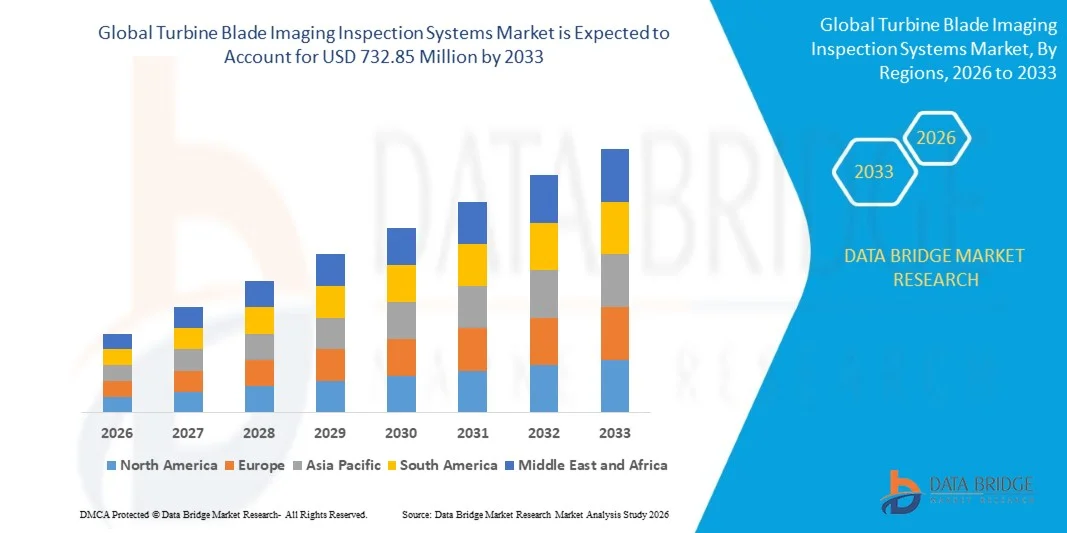
- As per Data Bridge Market Research analysis, the turbine blade imaging inspection systems market was valued at USD 329.7 Million in 2025 and is projected to reach USD 732.85 Million by 2033, growing at a CAGR of 10.50% from 2026 to 2033.
- The market is expanding as operators of gas turbines, steam turbines, and aero-engines face growing pressure to detect leading-edge erosion, cracking, and thermal-barrier-coating degradation earlier in the maintenance cycle, reducing unplanned outage risk.
- Rising adoption of AI-assisted image analysis and robotic or drone-mounted imaging payloads is enabling faster, more consistent blade inspections across power generation, aerospace MRO, and wind energy applications, supporting the shift away from manual visual checks.
Market Size & Forecast
- Global Market Value (2025): USD 329.7 Million
- Expected Market Value (2033): USD 732.85 Million
- Forecast CAGR (2026–2033): 10.50%
- Leading Region in 2025: North America
- Fastest Growing Region: Asia-Pacific
What are the Major Takeaways of the Turbine Blade Imaging Inspection Systems Market?
- North America dominated the global turbine blade imaging inspection systems market with the largest revenue share of 36.20% in 2025, supported by a large installed base of gas and steam turbines and the presence of major aerospace MRO providers.
- Asia-Pacific is expected to be the fastest-growing region at a CAGR of 12.70% from 2026 to 2033, fueled by expanding power generation capacity, rising offshore wind installations, and growing investment in domestic turbine inspection technology across China, India, and Japan.
- The borescope and video inspection segment led the market with a 40.50% share in 2025, reflecting its established role as the standard internal inspection method for gas turbines and aero-engines during scheduled maintenance intervals.
- X-ray and computed tomography imaging is the fastest-growing technology segment, projected to register a CAGR of 12.80%, driven by rising demand for detecting sub-surface defects and internal cooling-channel blockages that surface imaging methods cannot capture.
- The gas turbines segment held the leading share by turbine type with a 44.70% revenue share in 2025, supported by extensive use of imaging inspection during scheduled power-plant outages and combustion-inspection intervals.
- The wind turbines segment is expected to witness the fastest CAGR of 12.10% from 2026 to 2033, driven by expanding offshore wind capacity and rising adoption of drone-based imaging for blade condition monitoring.
- Robotic and crawler-mounted systems accounted for 31.60% of deployment-mode revenue in 2025 and are gaining share rapidly as utilities and MRO providers seek to reduce inspection downtime and improve repeatability compared with manual borescope inspection.
- Power generation utilities represented the largest end-user segment with a 39.60% share in 2025, reflecting the criticality of blade inspection to outage planning and asset-life extension programs, while wind farm operators are projected to grow fastest at a CAGR of 11.60%.
Report Scope and Turbine Blade Imaging Inspection Systems Market Segmentation
|
Attributes |
Turbine Blade Imaging Inspection Systems Market Insights |
|
Segments Covered |
|
|
Countries Covered |
North America
Europe
Asia-Pacific
Middle East and Africa
South America
|
|
Key Market Players |
|
|
Market Opportunities |
|
|
Value Added Data Infosets |
In addition to the insights on market scenarios such as market value, growth rate, segmentation, geographical coverage, and major players, the market reports curated by the Data Bridge Market Research also include in-depth expert analysis, geographically represented company-wise production and capacity, network layouts of distributors and partners, detailed and updated price trend analysis and deficit analysis of supply chain and demand. |
What is the Key Trend in the Turbine Blade Imaging Inspection Systems Market?
- Turbine operators and MRO providers are increasingly integrating AI-assisted image analysis into borescope and video inspection workflows to accelerate defect tagging and reduce reliance on manual review by trained inspectors.
- For instance, in July 2024, Waygate Technologies expanded its visual inspection software with AI-assisted defect tagging capabilities, reducing blade image review time significantly for aero-engine and gas turbine inspection customers.
- Robotic crawler and drone-mounted imaging systems are being adopted more widely to inspect turbine interiors and wind blade exteriors without requiring full equipment shutdown or scaffolding access.
- For instance, in November 2023, Siemens Energy integrated automated inspection robots into its long-term service agreements for gas turbines, targeting shorter outage cycles for utility customers.
- Inspection service providers are increasingly bundling imaging hardware with cloud-based blade health dashboards, allowing utilities and wind farm operators to trend defect progression across multiple inspection cycles rather than reviewing each inspection in isolation.
- For instance, in April 2025, SkySpecs expanded its automated drone inspection platform with enhanced defect-trending analytics, enabling wind farm operators to track blade erosion and damage progression across successive inspection campaigns.
- Growing use of 3D laser scanning alongside traditional imaging is enabling more precise quantification of blade profile deviation and erosion depth, supporting more accurate repair-versus-replace decisions.
- For instance, in May 2024, Perceptual Robotics introduced enhanced 3D scanning capabilities within its drone-based wind blade inspection service, aimed at improving erosion-depth measurement accuracy for offshore wind operators.
- Overall, the turbine blade imaging inspection systems market is shifting toward AI-enabled, automated, and data-driven inspection workflows, with increasing integration of robotics, drones, 3D scanning, and cloud analytics. These technologies are improving defect detection, measurement accuracy, inspection efficiency, and lifecycle monitoring while reducing dependence on manual inspection processes and supporting more informed maintenance and repair decisions.
What are the Key Drivers of the Turbine Blade Imaging Inspection Systems Market?
- Rising average age of the global gas and steam turbine fleet is increasing the frequency and criticality of blade inspection to detect creep, cracking, and coating degradation before they lead to unplanned outages.
- For instance, in July 2022, GE Inspection Robotics launched a magnetic crawler system rated for high-temperature surfaces, addressing internal inspection needs in high-pressure steam turbine applications.
- Growing offshore wind capacity additions are driving demand for drone-based blade imaging to detect leading-edge erosion and delamination without requiring rope-access technicians.
- For instance, in April 2023, Eddyfi Technologies acquired a probe specialist to strengthen its eddy current testing coverage for turbine blade inspection applications, broadening its non-destructive testing portfolio for power generation customers.
- Utilities are increasingly adopting predictive maintenance strategies that rely on periodic imaging inspection to extend turbine service intervals and defer costly capital replacement decisions.
- For instance, in December 2023, Mistras Group expanded its digital inspection data platform to integrate turbine blade imaging results with broader asset-integrity management systems, supporting predictive maintenance programs for power generation customers.
- Increasing regulatory and insurance-driven inspection requirements for aging power infrastructure and aviation fleets are compelling operators to adopt more frequent and higher-resolution imaging inspection regimes.
Which Factors are Challenging the Growth of the Turbine Blade Imaging Inspection Systems Market?
- High-resolution imaging systems capable of detecting sub-surface and internal defects, such as X-ray and computed tomography platforms, require significant capital investment, limiting adoption among smaller independent service providers.
- For instance, in January 2025, several independent turbine MRO providers cited the cost of qualifying advanced computed tomography inspection equipment as a barrier relative to established OEM service networks, illustrating the capital intensity facing smaller players in the market.
- A shortage of experienced non-destructive testing inspectors capable of interpreting complex imaging data continues to constrain inspection throughput at utilities and MRO facilities globally.
- Harsh operating environments, including offshore wind sites and high-temperature turbine interiors, continue to limit the operating envelope and reliability of certain imaging payloads, requiring ongoing hardware ruggedization.
- For instance, in July 2025, several offshore wind operators reported that adverse weather conditions continued to restrict drone inspection windows at North Sea wind farms, underscoring the operational constraints that limit inspection scheduling flexibility in offshore environments.
- Overall, market growth is constrained by high equipment and qualification costs, shortages of skilled inspection personnel, and operational limitations associated with harsh turbine environments. Offshore weather conditions further restrict inspection windows and scheduling flexibility. These challenges are encouraging equipment manufacturers and service providers to improve system ruggedness, automate inspection workflows, and develop more cost-efficient imaging and analysis solutions.
How is the Turbine Blade Imaging Inspection Systems Market Segmented?
The turbine blade imaging inspection systems market is segmented on the basis of technology, turbine type, deployment mode, and end user.
- By Technology
On the basis of technology, the global turbine blade imaging inspection systems market is segmented into borescope and video inspection, X-ray and computed tomography imaging, ultrasonic imaging, thermal and infrared imaging, and 3D laser scanning. The borescope and video inspection segment led the market with a 40.50% share in 2025, supported by its established role as the standard method for internal inspection of gas turbines and aero-engines during scheduled maintenance, its relatively low per-inspection cost, and its compatibility with a wide range of engine and turbine access ports.
The X-ray and computed tomography imaging segment is projected to register the fastest growth at a CAGR of 12.80% from 2026 to 2033, driven by increasing demand for detecting sub-surface cracking, porosity, and internal cooling-channel blockages that cannot be identified through surface-level borescope inspection, particularly for single-crystal turbine blades used in high-performance gas turbines and aero-engines.
- By Turbine Type
On the basis of turbine type, the global turbine blade imaging inspection systems market is segmented into gas turbines, steam turbines, wind turbines, and aero-engine turbines. The gas turbines segment held the leading share of 44.70% in 2025, supported by extensive use of imaging inspection during scheduled power-plant outages, combustion-inspection intervals, and hot-gas-path maintenance programs across utility-scale power generation fleets.
The wind turbines segment is expected to grow at the fastest pace, registering a CAGR of 12.10%, driven by expanding offshore wind capacity, rising blade counts in service, and growing adoption of drone-based imaging for leading-edge erosion and delamination detection.
- By Deployment Mode
On the basis of deployment mode, the global turbine blade imaging inspection systems market is segmented into handheld/portable systems, robotic & crawler-mounted systems, drone-mounted systems, and fixed inline systems. Handheld/portable systems accounted for the largest share of 46.20% in 2025, supported by their flexibility, portability, and widespread use for borescope and video-based inspection across gas turbines, steam turbines, and aero-engine turbines.
Drone-mounted systems are expected to be the fastest-growing deployment mode, registering a CAGR of 12.40% from 2026 to 2033, supported by increasing adoption for wind turbine blade inspection, particularly across large onshore and offshore wind farms. Drone-based imaging enables efficient inspection of extensive blade surfaces while reducing dependence on rope-access personnel and minimizing inspection-related downtime.
- By End User
On the basis of end user, the global turbine blade imaging inspection systems market is segmented into power generation utilities, aerospace MRO providers, wind farm operators, oil & gas companies, and OEM service centers. Power generation utilities accounted for the largest share of 39.60% in 2025, reflecting the central role of blade inspection in outage planning, life-extension programs, and regulatory compliance for aging thermal power assets.
Wind farm operators are expected to be the fastest-growing end-user segment, registering a CAGR of 11.60%, supported by the expansion of offshore wind installations and growing reliance on drone-based imaging for scalable, low-cost blade health monitoring across large wind farm portfolios.
Which Region Holds the Largest Share of the Turbine Blade Imaging Inspection Systems Market?
- North America dominated the global turbine blade imaging inspection systems market and accounted for the largest revenue share of 36.20% in 2025, supported by a large installed base of gas and steam turbines, an established aerospace MRO industry, and early adoption of robotic and AI-assisted inspection technologies.
- The region also benefits from the presence of major turbine OEMs and inspection technology providers, along with stringent regulatory requirements for scheduled turbine maintenance across power generation and aviation sectors. Continued investment in predictive maintenance programs by U.S. and Canadian utilities is further reinforcing North America's leadership position.
U.S. Turbine Blade Imaging Inspection Systems Market Insight
The U.S. turbine blade imaging inspection systems market is experiencing steady growth, supported by a large installed base of gas turbines, aircraft engines, and wind turbines, along with a mature aerospace and power-generation MRO ecosystem. Increasing adoption of video borescopes, 3D imaging, drones, robotic crawlers, and AI-assisted defect recognition is improving inspection efficiency and defect-detection accuracy. Furthermore, growing investments in predictive maintenance and digital asset management are encouraging utilities, aerospace MRO providers, and wind operators to integrate imaging data into broader turbine condition-monitoring workflows.
Germany Turbine Blade Imaging Inspection Systems Market Insight
Germany's turbine blade imaging inspection systems market is expanding due to its strong industrial manufacturing base, established power-generation infrastructure, and significant wind-energy sector. Gas turbine operators, aerospace companies, and wind-farm operators are increasingly adopting automated imaging, drone-based inspection, 3D measurement, and AI-supported defect analysis to improve maintenance planning. The country's emphasis on industrial automation and engineering innovation is further supporting demand for high-resolution inspection technologies. In addition, the growing need to improve the reliability and operating life of aging industrial and renewable-energy assets is encouraging the use of advanced turbine blade inspection systems.
China Turbine Blade Imaging Inspection Systems Market Insight
China's turbine blade imaging inspection systems market is growing rapidly, driven by the country's extensive power-generation infrastructure, large wind-turbine fleet, expanding aerospace industry, and continued investment in domestic turbine manufacturing. Increasing deployment of wind turbines is creating demand for drone-based visual inspection, automated image analysis, and blade condition-monitoring technologies, particularly for large wind farms. Meanwhile, the expansion of domestic gas-turbine and aircraft-engine capabilities is supporting demand for advanced borescope, non-destructive testing, and high-resolution imaging systems. Government emphasis on industrial digitalization and development of domestic high-end equipment is further supporting the adoption of automated inspection technologies.
Japan Turbine Blade Imaging Inspection Systems Market Insight
Japan's turbine blade imaging inspection systems market is witnessing consistent growth, supported by its established thermal power infrastructure, mature aerospace industry, and continued development of offshore and onshore wind power. A significant installed base of thermal-generation equipment creates recurring requirements for turbine inspection, maintenance, and life-extension activities, while aerospace manufacturers and MRO providers require high-precision imaging for engine and component inspection. Domestic utilities and engineering companies are increasingly adopting advanced video borescopes, robotic inspection technologies, 3D measurement, and AI-assisted image analysis to improve defect identification and maintenance planning. Furthermore, Japan's focus on equipment reliability, predictive maintenance, and digital transformation is supporting the integration of imaging inspection systems with broader asset-monitoring platforms.
Which are the Top Companies in Turbine Blade Imaging Inspection Systems Market?
The turbine blade imaging inspection systems industry is primarily led by well-established companies, including:
- Olympus Corporation (Japan)
- Waygate Technologies (Baker Hughes) (U.S.)
- GE Vernova (U.S.)
- Siemens Energy AG (Germany)
- Eddyfi Technologies (Canada)
- Mistras Group, Inc. (U.S.)
- Invert Robotics (New Zealand)
- SkySpecs, Inc. (U.S.)
- Perceptual Robotics (U.K.)
- Karl Storz SE & Co. KG (Germany)
- Flyability SA (Switzerland)
- Vestas Wind Systems A/S (Denmark)
What are Latest Developments in Turbine Blade Imaging Inspection Systems Market?
- In February 2024, Waygate Technologies launched the Mentor Visual iQ+ video borescope with AI and machine-learning capabilities for turbine inspection. The system introduced automated blade identification through its Blade Counter 2.0 feature, along with advanced imaging and 3D measurement capabilities for blade defects such as missing corners and tip-curl deformation. The platform targets gas turbine, aviation, and power-generation inspection applications.
- In April 2024, Waygate Technologies and GE Aerospace expanded their collaboration on machine vision and robotics for aircraft-engine inspections. The two companies focused on machine-vision analytics and robotics automation to improve inspection workflows for maintenance, repair, and overhaul operations and on-wing applications.
- In October 2024, Waygate Technologies and GE Aerospace announced an AI-assisted borescope inspection solution for commercial aircraft engines. The solution increased defect-detection recall by approximately 33.6% and improved precision by 13.5% compared with the previous Gas Power-assist model. The technology was developed for high-pressure compressor inspections of GEnx and CFM LEAP engines and was scheduled for deployment through the Mentor Visual iQ+ platform.
- In September 2024, RES acquired Sulzer Schmid to strengthen its digital wind-turbine inspection capabilities. Sulzer Schmid's 3DX Blade Platform combines autonomous drone inspections, AI-driven analysis, and a SaaS platform for turbine-blade condition monitoring. The platform also supports lifetime records, trend analysis, and benchmarking across wind-turbine fleets.
- In January 2025, TNO, SpectX, GE Vernova, and LM Wind Power launched a two-year project to develop drone-based X-ray inspection of wind-turbine blades. The system is designed to identify subsurface blade defects that conventional visual drone inspections cannot detect. AI-based image processing is being combined with a digital-twin model to support targeted inspections and improve blade-life prediction.
- In February 2025, RES secured a U.S. patent for its 3DX turbine-blade inspection technology. The technology combines drone imagery, AI, and robotics to provide internal and external views of blade damage within a single inspection platform, supporting more detailed condition assessment and maintenance planning.
- In June 2025, RES highlighted further development of its 3DX Blade Platform, integrating automated drones, AI, robotics, and inspection data into a unified blade-management workflow. The platform is being developed to support damage identification, damage progression tracking, repair prioritization, and fleet-level analysis, reflecting the market's movement toward predictive and data-driven turbine maintenance.

- Interactive Data Analysis Dashboard
- Company Analysis Dashboard for high growth potential opportunities
- Research Analyst Access for customization & queries
- Competitor Analysis with Interactive dashboard
- Latest News, Updates & Trend analysis
- Harness the Power of Benchmark Analysis for Comprehensive Competitor Tracking
Global Turbine Blade Imaging Inspection Systems Market, Supply Chain Analysis and Ecosystem Framework
To support market growth and help clients navigate the impact of geopolitical shifts, DBMR has integrated in-depth supply chain analysis into its Global Turbine Blade Imaging Inspection Systems Market research reports. This addition empowers clients to respond effectively to global changes affecting their industries. The supply chain analysis section includes detailed insights such as Global Turbine Blade Imaging Inspection Systems Market consumption and production by country, price trend analysis, the impact of tariffs and geopolitical developments, and import and export trends by country and HSN code. It also highlights major suppliers with data on production capacity and company profiles, as well as key importers and exporters. In addition to research, DBMR offers specialized supply chain consulting services backed by over a decade of experience, providing solutions like supplier discovery, supplier risk assessment, price trend analysis, impact evaluation of inflation and trade route changes, and comprehensive market trend analysis.
Data collection and base year analysis are done using data collection modules with large sample sizes. The stage includes obtaining market information or related data through various sources and strategies. It includes examining and planning all the data acquired from the past in advance. It likewise envelops the examination of information inconsistencies seen across different information sources. The market data is analysed and estimated using market statistical and coherent models. Also, market share analysis and key trend analysis are the major success factors in the market report. To know more, please request an analyst call or drop down your inquiry.
The key research methodology used by DBMR research team is data triangulation which involves data mining, analysis of the impact of data variables on the market and primary (industry expert) validation. Data models include Vendor Positioning Grid, Market Time Line Analysis, Market Overview and Guide, Company Positioning Grid, Patent Analysis, Pricing Analysis, Company Market Share Analysis, Standards of Measurement, Global versus Regional and Vendor Share Analysis. To know more about the research methodology, drop in an inquiry to speak to our industry experts.
Data Bridge Market Research is a leader in advanced formative research. We take pride in servicing our existing and new customers with data and analysis that match and suits their goal. The report can be customized to include price trend analysis of target brands understanding the market for additional countries (ask for the list of countries), clinical trial results data, literature review, refurbished market and product base analysis. Market analysis of target competitors can be analyzed from technology-based analysis to market portfolio strategies. We can add as many competitors that you require data about in the format and data style you are looking for. Our team of analysts can also provide you data in crude raw excel files pivot tables (Fact book) or can assist you in creating presentations from the data sets available in the report.













