


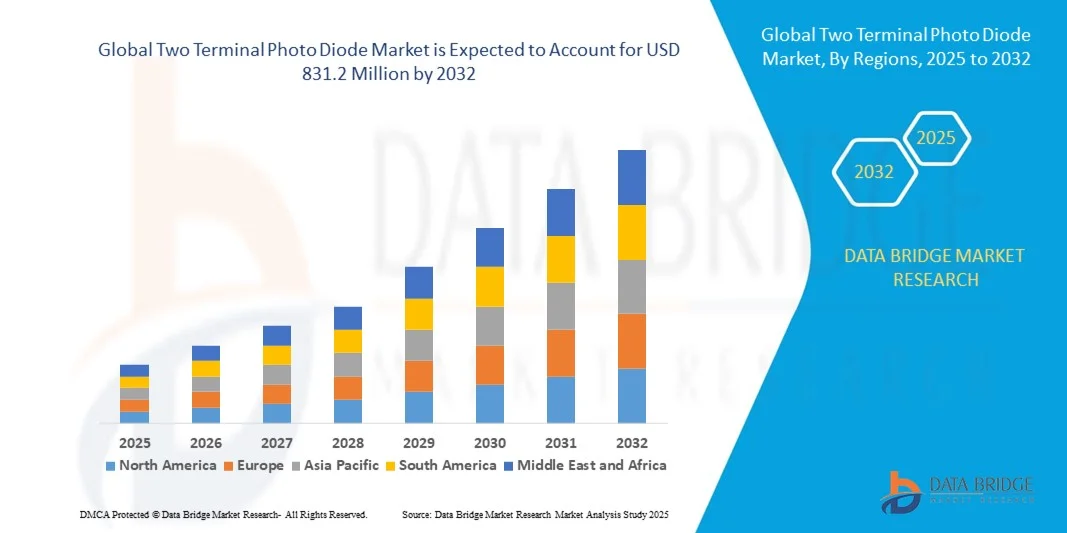
What is the Global Two Terminal Photo Diode Market Size and Growth Rate?
- The global two terminal photo diode market size was valued at USD 476.6 million in 2024 and is expected to reach USD 831.2 million by 2032, at a CAGR of 7.20% during the forecast period
- The increasing usages of the product in consumer electronics industry, rising applications of the product in various other industries such as automotive, communication, and others, increasing demand of the photo diode due to its features which include linearity, low noise, better frequency response ration, high sensitivity to light, which makes them highly efficient for focused light-based applications are some of the major as well as important factors which will such asly to augment the growth of the two terminal photo diode market
What are the Major Takeaways of Two Terminal Photo Diode Market?
- Availability of low cost device along with offers a linear response and high operational speed which will further contribute by generating immense opportunities that will led to the growth of the two terminal photo diode market in the above mentioned projected timeframe
- Increasing need for amplification at low illumination levels, poor temperature stability which will likely to act as market restraints factor for the growth of the two terminal photo diode in the above mentioned forecasted period. Small active area as well as rapid increase in dark current which will become the biggest and foremost challenge for the growth of the market
- North America dominated the two terminal photo diode market with the largest revenue share of 41.2% in 2024, driven by strong adoption across electronics, communication systems, and safety equipment
- The Asia-Pacific two terminal photo diode market is poised to grow at the fastest CAGR of 11.69% during the forecast period of 2025 to 2032, driven by rapid urbanization, rising disposable incomes, and technological advancements in countries such as China, Japan, and India
- The PIN Photodiode segment dominated the market in 2024 with a revenue share of 41.5%, owing to its high sensitivity, fast response time, and versatility across diverse applications such as optical communication, medical devices, and consumer electronics
Report Scope and Two Terminal Photo Diode Market Segmentation
|
Attributes |
Two Terminal Photo Diode Key Market Insights |
|
Segments Covered |
|
|
Countries Covered |
North America
Europe
Asia-Pacific
Middle East and Africa
South America
|
|
Key Market Players |
|
|
Market Opportunities |
|
|
Value Added Data Infosets |
In addition to the insights on market scenarios such as market value, growth rate, segmentation, geographical coverage, and major players, the market reports curated by the Data Bridge Market Research also include in-depth expert analysis, pricing analysis, brand share analysis, consumer survey, demography analysis, supply chain analysis, value chain analysis, raw material/consumables overview, vendor selection criteria, PESTLE Analysis, Porter Analysis, and regulatory framework. |
What is the Key Trend in the Two Terminal Photo Diode Market?
Expansion of High-Speed, High-Sensitivity Applications
- A major trend in the global two terminal photo diode market is the increasing demand for high-speed and high-sensitivity photodiodes in applications such as optical communication, LiDAR systems, and advanced imaging. This trend is driven by the need for faster data transfer, precise detection, and miniaturized electronic devices
- For instance, InGaAs-based Two Terminal Photo Diodes are widely used in fiber-optic communication networks for high-speed data transmission, while silicon photodiodes are increasingly integrated into consumer electronics and medical devices for precise light detection
- Advancements in materials and design, such as avalanche photodiodes (APDs) with higher gain and lower noise, are enabling applications in industrial sensors, automotive LiDAR, and environmental monitoring
- The growing adoption of compact, energy-efficient, and highly sensitive Two Terminal Photo Diodes facilitates the development of portable devices, such as wearable health monitors, spectrometers, and handheld environmental sensors
- Companies such as Hamamatsu Photonics and ROHM are actively innovating in high-speed Two Terminal Photo Diodes for optical communication, industrial automation, and scientific instrumentation
- The trend toward higher sensitivity and faster response times is expected to redefine performance standards in optical detection, enabling broader adoption across communication, medical, automotive, and industrial sectors
What are the Key Drivers of Two Terminal Photo Diode Market?
- The surge in global data traffic and the expansion of fiber-optic communication networks are major drivers for the Two Terminal Photo Diode market. Faster and more reliable photodiodes are essential for high-speed optical signal detection
- For instance, in 2024, Hamamatsu Photonics launched enhanced APD modules for optical communication, enabling higher sensitivity and lower noise for long-distance data transmission
- Rapid growth in industrial automation, medical imaging, environmental monitoring, and automotive LiDAR applications is increasing the demand for precise, fast-response photodiodes
- The miniaturization of electronic devices and the push for energy-efficient solutions are driving the development of compact Two Terminal Photo Diodes suitable for portable and wearable applications
- Increasing investments in next-generation technologies, including 5G networks, autonomous vehicles, and smart medical devices, further support the growth of high-performance Two Terminal Photo Diodes across multiple sectors
Which Factor is Challenging the Growth of the Two Terminal Photo Diode Market?
- The high manufacturing costs associated with advanced materials such as InGaAs and APDs, combined with complex fabrication processes, pose a significant challenge to market expansion
- For instance, specialized high-speed or high-sensitivity Two Terminal Photo Diodes require precision manufacturing and quality control, which increases production costs and limits adoption in price-sensitive segments
- Temperature sensitivity, noise interference, and limited operating wavelength ranges for certain photodiode types can restrict their use in specific industrial or outdoor applications
- Competition from alternative light-detection technologies, such as CMOS sensors and avalanche photodiode arrays, may also impact market penetration
- Overcoming these challenges requires cost-effective manufacturing innovations, improved material stability, and enhanced performance across a wider range of applications to sustain growth
How is the Two Terminal Photo Diode Market Segmented?
Two terminal photo diode market is segmented on the basis of type, material, mode, and application.
- By Type
On the basis of type, the two terminal photo diode market is segmented into PN Photodiode, PIN Photodiode, Avalanche Photodiode, and Schottky Photodiode. The PIN Photodiode segment dominated the market in 2024 with a revenue share of 41.5%, owing to its high sensitivity, fast response time, and versatility across diverse applications such as optical communication, medical devices, and consumer electronics. PIN photodiodes are favored for their ability to handle moderate to high-frequency signals while maintaining low noise, making them ideal for both industrial and residential use.
The Avalanche Photodiode segment is expected to witness the fastest growth from 2025 to 2032, driven by its high gain and superior performance in low-light detection applications. Industries such as aerospace, automotive, and medical imaging are increasingly adopting avalanche photodiodes for precision sensing and long-distance optical communication, fueling its rapid market expansion.
- By Material
On the basis of material, the market is segmented into Silicon, Germanium, Indium Gallium Arsenide (InGaAs), and Lead (II) Sulphide (PbS). The Silicon segment held the largest revenue share of 45.3% in 2024, attributed to its wide availability, cost-effectiveness, and compatibility with most standard electronic systems. Silicon photodiodes are extensively used in consumer electronics, medical devices, and general safety equipment due to their reliable performance and ease of integration.
The Indium Gallium Arsenide (InGaAs) segment is projected to record the fastest CAGR from 2025 to 2032, driven by its superior sensitivity to near-infrared wavelengths, making it highly suitable for high-speed optical communication, industrial sensors, and advanced imaging applications. The increasing adoption of InGaAs photodiodes in precision industries is expected to significantly propel this segment’s growth over the forecast period.
- By Mode
On the basis of mode, the market is segmented into Photovoltaic Mode, Photoconductive Mode, and Others. The Photoconductive Mode segment dominated the market in 2024 with a revenue share of 42.8%, owing to its fast response time and adaptability to high-speed detection applications in communications, medical imaging, and industrial automation. Photoconductive photodiodes are widely preferred in scenarios requiring rapid signal conversion and low-noise output, which makes them suitable for both commercial and defense applications.
The Photovoltaic Mode segment is expected to witness the fastest growth from 2025 to 2032, driven by the rising demand for energy-efficient, self-powered photodiodes in portable devices, remote sensing, and renewable energy monitoring. Its ability to generate voltage without an external bias contributes to expanding adoption across multiple sectors.
- By Application
On the basis of application, the two terminal photo diode market is segmented into Electronics, Medical, Safety Equipment, Automotive, Aerospace and Defence, Communication Systems, and Others. The Electronics segment held the largest market revenue share of 44.6% in 2024, fueled by the increasing integration of photodiodes in consumer electronics, mobile devices, and display systems for enhanced functionality and efficiency.
The Communication Systems segment is expected to witness the fastest growth from 2025 to 2032, driven by the escalating demand for high-speed optical communication networks, data centers, and fiber-optic systems. The critical role of photodiodes in signal detection and transmission in modern telecommunication infrastructure is encouraging widespread adoption, supporting robust growth in this segment
Which Region Holds the Largest Share of the Two Terminal Photo Diode Market?
- North America dominated the two terminal photo diode market with the largest revenue share of 41.2% in 2024, driven by strong adoption across electronics, communication systems, and safety equipment. High industrialization, advanced R&D infrastructure, and the presence of leading manufacturers in the U.S. and Canada are key factors supporting market leadership
- Consumers and industries in the region highly value high-performance, reliable, and precise photodiode solutions for applications in medical devices, automotive sensors, and fiber-optic communications
- The market is further strengthened by robust industrial automation, growing investments in advanced manufacturing, and a technology-savvy population, establishing North America as the preferred region for photodiode solutions across both commercial and industrial applications
U.S. Two Terminal Photo Diode Market Insight
The U.S. two terminal photo diode market accounted for the largest share of 81% in 2024 within North America, driven by robust demand for high-speed optical communication, industrial sensing, and medical imaging solutions. The presence of leading photodiode manufacturers, coupled with significant investments in 5G networks and LiDAR technology, is propelling market growth. Moreover, the adoption of high-performance silicon, InGaAs, and avalanche photodiodes across electronics and automotive sectors is further strengthening the U.S. market.
Europe Two Terminal Photo Diode Market Insight
The Europe two terminal photo diode market is projected to expand at a substantial CAGR over the forecast period, supported by increasing industrial automation, smart manufacturing initiatives, and technological advancements in communication systems. Germany, France, and Italy are witnessing notable adoption due to a strong focus on high-speed data transmission, environmental monitoring, and medical applications. The integration of photodiodes into advanced electronics and imaging devices is further driving market growth.
U.K. Two Terminal Photo Diode Market Insight
The U.K. two terminal photo diode market is anticipated to grow at a noteworthy CAGR during the forecast period, fueled by rising demand for high-speed optical networks, smart devices, and industrial sensing applications. The country’s technological infrastructure, combined with government-backed initiatives for digitalization and innovation, is expected to continue stimulating market adoption.
Germany Two Terminal Photo Diode Market Insight
The Germany two terminal photo diode market is expected to expand at a considerable CAGR, driven by increasing deployment of automation systems, automotive LiDAR, and advanced industrial sensors. Germany’s focus on sustainable and energy-efficient technologies, coupled with strong industrial R&D, supports the adoption of high-performance photodiodes. Integration with smart manufacturing and connected systems is also boosting market growth.
Which Region is the Fastest Growing Region in the Two Terminal Photo Diode Market?
The Asia-Pacific two terminal photo diode market is poised to grow at the fastest CAGR of 11.69% during the forecast period of 2025 to 2032, driven by rapid urbanization, rising disposable incomes, and technological advancements in countries such as China, Japan, and India. The region’s increasing adoption of high-speed communication networks, automotive LiDAR systems, and medical imaging devices is fueling demand. In addition, APAC’s position as a manufacturing hub for photodiode components is enhancing affordability and accessibility, further expanding the consumer base.
Japan Two Terminal Photo Diode Market Insight
The Japan two terminal photo diode market is gaining momentum due to advanced industrial automation, high-tech communication systems, and widespread adoption of medical imaging technologies. Japanese industries prioritize precision, reliability, and efficiency, which drives photodiode adoption across electronics, healthcare, and automotive sectors.
China Two Terminal Photo Diode Market Insight
The China two terminal photo diode market held the largest revenue share in the Asia-Pacific region in 2024, supported by rapid industrial growth, smart city initiatives, and technological advancements. China’s expanding electronics, automotive, and healthcare industries are driving the adoption of high-speed, high-sensitivity photodiodes. Local manufacturing capabilities and government incentives for digitalization are further strengthening the market.
Which are the Top Companies in Two Terminal Photo Diode Market?
The Two Terminal Photo Diode industry is primarily led by well-established companies, including:
- Everlight Electronics Co., Ltd. (Taiwan)
- OSRAM Opto Semiconductors GmbH (Germany)
- ROHM Co., Ltd. (Japan)
- Hamamatsu Photonics K.K. (Japan)
- KODENSHI CORP. (Japan)
- TT Electronics plc (U.K.)
- First Sensor AG (Germany)
- Illinois Tool Works Inc. (U.S.)
- Liteon Group (Taiwan)
- Semiconductor Components Industries, LLC (U.S.)
- Global Communication Semiconductors, LLC (U.S.)
- KYOTO SEMICONDUCTOR Co., Ltd. (Japan)
- Vishay Intertechnology, Inc. (U.S.)
- Centronic (U.K.)
- APIC Corporation (Japan)
- Diodes Incorporated (U.S.)
- Agilent Technologies, Inc. (U.S.)
- New Japan Radio Co., Ltd. (Japan)
- MACOM (U.S.)
- Central Semiconductor Corp (U.S.)
What are the Recent Developments in Global Two Terminal Photo Diode Market?
- In December 2024, Imec and its partners introduced a lead-free shortwave infrared (SWIR) sensor at IEEE IEDM 2024, incorporating indium arsenide quantum dot photodiodes, In this breakthrough provides environmentally friendly and cost-effective infrared imaging solutions for autonomous driving, medical diagnostics, and AR/VR applications, In the sensor demonstrated 1390 nm imaging with over 300-hour air stability, ensuring CMOS compatibility and paving the way for large-scale adoption, In this launch marks a significant advancement in sustainable, high-performance photodiode technology
- In January 2024, CMC Electronics unveiled a new InGaAs Avalanche Photodiode (APD), In this sensor delivers enhanced laser range-finding capability and LiDAR performance with superior speed, accuracy, and dual-wavelength detection at 1064 nm and 1570 nm, In featuring multiple active areas of 50, 80, and 200 μm within a compact TO-46 package, the APD ensures precise measurements for aerospace, defense, and industrial applications, In this product sets a new benchmark in high-precision photodiode technology
- In June 2023, Kyoto Semiconductor launched the KPR series SWIR reflective sensors, integrating photodiodes and LEDs into a compact package measuring 4.2 mm × 2.0 mm × 0.9 mm, In these sensors provide precise detection capabilities for biomedical, industrial, and gas sensing applications operating within 1300–1650 nm near-infrared wavelengths, In offering a 30% reduction in size and high efficiency in reflection-based measurements, In this release represents a significant step forward in compact, high-performance photodiode integration

- Interactive Data Analysis Dashboard
- Company Analysis Dashboard for high growth potential opportunities
- Research Analyst Access for customization & queries
- Competitor Analysis with Interactive dashboard
- Latest News, Updates & Trend analysis
- Harness the Power of Benchmark Analysis for Comprehensive Competitor Tracking
Global Two Terminal Photo Diode Market, Supply Chain Analysis and Ecosystem Framework
To support market growth and help clients navigate the impact of geopolitical shifts, DBMR has integrated in-depth supply chain analysis into its Global Two Terminal Photo Diode Market research reports. This addition empowers clients to respond effectively to global changes affecting their industries. The supply chain analysis section includes detailed insights such as Global Two Terminal Photo Diode Market consumption and production by country, price trend analysis, the impact of tariffs and geopolitical developments, and import and export trends by country and HSN code. It also highlights major suppliers with data on production capacity and company profiles, as well as key importers and exporters. In addition to research, DBMR offers specialized supply chain consulting services backed by over a decade of experience, providing solutions like supplier discovery, supplier risk assessment, price trend analysis, impact evaluation of inflation and trade route changes, and comprehensive market trend analysis.
Data collection and base year analysis are done using data collection modules with large sample sizes. The stage includes obtaining market information or related data through various sources and strategies. It includes examining and planning all the data acquired from the past in advance. It likewise envelops the examination of information inconsistencies seen across different information sources. The market data is analysed and estimated using market statistical and coherent models. Also, market share analysis and key trend analysis are the major success factors in the market report. To know more, please request an analyst call or drop down your inquiry.
The key research methodology used by DBMR research team is data triangulation which involves data mining, analysis of the impact of data variables on the market and primary (industry expert) validation. Data models include Vendor Positioning Grid, Market Time Line Analysis, Market Overview and Guide, Company Positioning Grid, Patent Analysis, Pricing Analysis, Company Market Share Analysis, Standards of Measurement, Global versus Regional and Vendor Share Analysis. To know more about the research methodology, drop in an inquiry to speak to our industry experts.
Data Bridge Market Research is a leader in advanced formative research. We take pride in servicing our existing and new customers with data and analysis that match and suits their goal. The report can be customized to include price trend analysis of target brands understanding the market for additional countries (ask for the list of countries), clinical trial results data, literature review, refurbished market and product base analysis. Market analysis of target competitors can be analyzed from technology-based analysis to market portfolio strategies. We can add as many competitors that you require data about in the format and data style you are looking for. Our team of analysts can also provide you data in crude raw excel files pivot tables (Fact book) or can assist you in creating presentations from the data sets available in the report.













