What is the Ultra Soft Exoskeleton Market Size and Growth Rate?
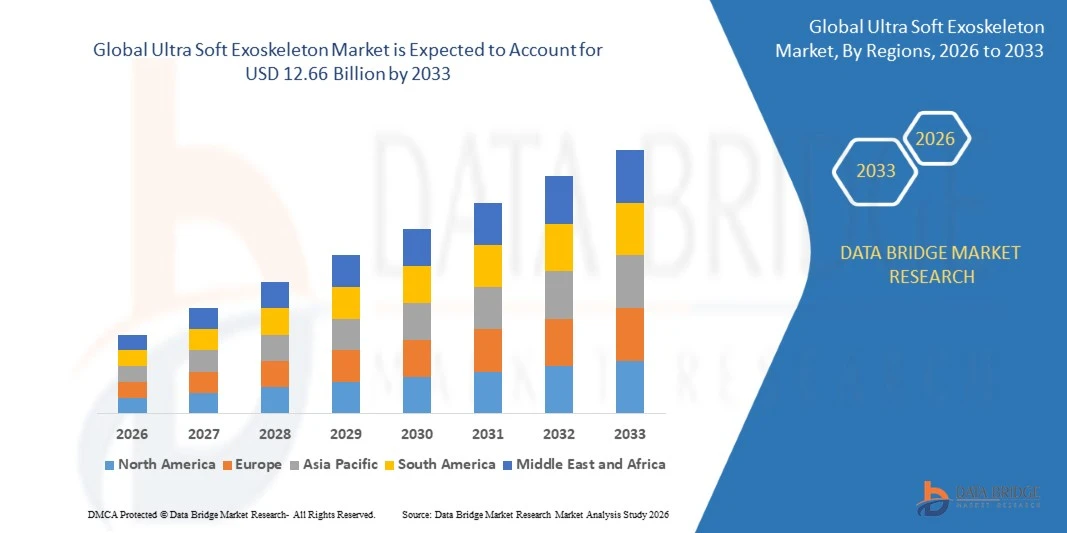
- As per Data Bridge Market Research analysis, the ultra soft exoskeleton market was valued at USD 6.50 billion in 2025 and is projected to reach USD 12.66 billion by 2033, growing at a CAGR of 8.70% from 2026 to 2033.
- The market is experiencing consistent growth driven by rising demand for mobility assistance and rehabilitation solutions, rapid advancements in wearable robotics and flexible materials, and expanding applications across healthcare, industrial manufacturing, and military sectors.
- The growing need to support individuals with mobility impairments, reduce workplace fatigue, and improve rehabilitation outcomes is encouraging healthcare providers and industrial organizations to adopt ultra soft exoskeleton technologies. Lightweight textile-based designs, flexible actuators, and advanced sensors are improving comfort and movement assistance, expanding the use of these systems in physical therapy, elderly care, and physically demanding workplaces.
Market Size & Forecast
- Global Market Value (2025): USD 6.50 Billion
- Expected Market Value (2033): USD 12.66 Billion
- Forecast CAGR (2026–2033): 8.70%
- Leading Region in 2025: North America
- Fastest Growing Region: Asia Pacific
What are the Major Takeaways of the Ultra Soft Exoskeleton Market?
- North America dominated the ultra soft exoskeleton market with the largest revenue share of 44.1% in 2025, supported by advanced healthcare infrastructure, strong research investments, and increasing adoption of wearable robotic technologies.
- Asia-Pacific is expected to be the fastest-growing region at a CAGR of 17.0% from 2026 to 2033, fueled by rising demand for rehabilitation technologies, an aging population, and increasing adoption of lightweight wearable robotic systems.
- The hardware segment led the market with a 73.05% share in 2025, driven by the essential role of physical components in delivering movement assistance, force support, and wearable functionality.
- Software are the fastest-growing component type, projected to register a CAGR of 12.05%, reflecting the surge in integration of intelligent control algorithms, motion analysis, and real-time feedback systems
- The electric-based exoskeletons segment dominated the technology category with a 35% revenue share in 2025, led by precise movement control, efficient actuation, and compatibility with advanced sensors and control systems.
- Lower limbs accounted for 48.3% of the market share in 2025, preferred by the need for walking assistance, gait rehabilitation, balance improvement, and mobility support.
- The upper limbs segment is the fastest-growing application category, with a CAGR of 16.4%, driven by demand for shoulder, arm, wrist, and hand assistance in rehabilitation and workplace applications.
Report Scope and Ultra Soft Exoskeleton Market Segmentation
|
Attributes |
Ultra Soft Exoskeleton Key Market Insights |
|
Segments Covered |
|
|
Countries Covered |
North America
Europe
Asia-Pacific
Middle East and Africa
South America
|
|
Key Market Players |
|
|
Market Opportunities |
|
|
Value Added Data Infosets |
In addition to the market insights such as market value, growth rate, market segments, geographical coverage, market players, and market scenario, the market report curated by the Data Bridge Market Research team includes in-depth expert analysis, import/export analysis, pricing analysis, production consumption analysis, and pestle analysis. |
What is the Key Trend in the Ultra Soft Exoskeleton Market?
- Manufacturers are increasingly developing lightweight, textile-based ultra soft exoskeletons to improve user comfort, flexibility, and natural movement while supporting mobility assistance, rehabilitation, and industrial activities.
- For instance, in November 2025, researchers published a study in Advanced Science describing a textile-based exoskeleton glove that achieved 270-degree bending, generated 2 N of gripping force, and operated using 10.8 W of power, demonstrating advances in lightweight, flexible, and energy-efficient wearable robotics
- Advances in flexible actuators, smart fabrics, and wearable sensors are enabling exoskeletons to provide movement assistance without the rigid frames associated with conventional robotic systems.
- These innovations are expanding the potential use of soft exoskeletons in daily living, physical rehabilitation, and physically demanding workplaces.
Integration of intelligent sensing and adaptive control technologies is improving the ability of wearable systems to respond to users’ movements and provide assistance according to individual requirements.
- For instance, in December 2025, researchers from Yonsei University and Seoul National University published a study on a soft wearable robotic garment incorporating fabric-based pneumatic artificial muscles to support muscle movement and postural alignment, highlighting the trend toward comfortable, garment-integrated exoskeleton designs.
- As manufacturers prioritize comfort, portability, and personalized assistance, lightweight textile-based designs are expected to become increasingly important in the development of next-generation ultra soft exoskeletons.
What are the Key Drivers of the Ultra Soft Exoskeleton Market?
- The increasing prevalence of mobility impairments, neurological disorders, and musculoskeletal conditions is strengthening demand for lightweight wearable technologies that support rehabilitation and everyday movement.
- For instance, in July 2024, researchers published a study in Journal of Robotics describing a soft robotic hand exoskeleton with pneumatic actuators and embedded sensors for controlled finger movements. The design supports rehabilitation and movement assistance, highlighting the role of flexible actuation and sensor integration in expanding wearable robotic applications.
- Industrial manufacturers and logistics operators are increasingly exploring wearable robotic solutions to reduce physical strain, improve worker endurance, and support repetitive lifting and handling activities.
- For instance, in September 2025, researchers published a randomized controlled trial in BMC Neurology evaluating a real-time hip-wearable exoskeleton for lower-limb rehabilitation in 40 patients recovering from stroke. The study reported improvements in gait speed, cadence, step length, and balance, highlighting the growing demand for wearable robotic rehabilitation technologies
- With continued advances in wearable sensing, soft actuation, and ergonomic design, ultra soft exoskeletons are expected to gain wider acceptance across healthcare, rehabilitation, and industrial applications.
What Factors are Challenging the Growth of the Ultra Soft Exoskeleton Market?
- Ultra soft exoskeleton development faces challenges related to manufacturing costs, complex actuator integration, sensor reliability, and the durability of flexible materials under repeated use.
- For instance, in January 2023, researchers published an article in the Journal of NeuroEngineering and Rehabilitation identifying safety concerns, device cost, difficulty of putting on and removing exoskeletons, weight distribution, and limited adaptability to individual users as barriers to clinical adoption. These challenges increase development requirements and can restrict wider adoption of ultra soft exoskeleton technologies.
- These limitations can increase development and maintenance expenses, restricting adoption among smaller healthcare facilities, rehabilitation centers, and industrial organizations.
- Soft wearable systems must also balance flexibility and comfort with sufficient assistance, reliable control, and consistent performance across different body types and activities.
- The need for stronger evidence of effectiveness, user acceptance, and long-term reliability continues to challenge commercialization, particularly in applications requiring consistent performance and measurable safety benefits.
- For instance, in July 2021, researchers published an article in Actuators examining the development and challenges of soft exoskeletons. The study identified limited durability of flexible materials, reduced portability due to pneumatic power supplies, and difficulties with comfort, control, and continuous daily use as technical barriers to commercialization
- These technical and adoption barriers may slow large-scale deployment until manufacturers improve affordability, validate performance in real-world conditions, and establish more consistent testing and evaluation practices.
How is the Ultra Soft Exoskeleton Market Segmented?
The ultra soft exoskeleton market is segmented on the basis of component, technology, application, and vertical.
- By Component
On the basis of component, the ultra soft exoskeleton market is segmented into hardware and software. The hardware segment dominated the broader wearable robots and exoskeletons market with 73.05% share in 2025, supported by the essential role of physical components in delivering movement assistance, force support, and wearable functionality. Hardware includes soft actuators, sensors, flexible textile structures, power supplies, and embedded electronic components. These components determine device comfort, flexibility, durability, and assistance capability. Increasing demand for lightweight and ergonomic wearable systems is encouraging manufacturers to improve material performance and actuator efficiency. Advances in sensor technology and flexible electronics are further supporting hardware development.
The software segment is projected to register the fastest growth at CAGR of 12.05% from 2026 to 2033 during forecast period, in the broader wearable robots and exoskeletons market, driven by increasing integration of intelligent control algorithms, motion analysis, and real-time feedback systems. Software enables exoskeletons to interpret user movements and adjust assistance according to individual requirements. Machine learning and adaptive control technologies can improve movement coordination and personalized support. Advanced software also enables clinicians and researchers to monitor rehabilitation progress and assess user performance. Increasing integration with wearable sensors is strengthening the ability to deliver responsive assistance. Growing demand for personalized rehabilitation and data-driven industrial ergonomics is expected to accelerate software adoption.
- By Technology
On the basis of technology, the ultra soft exoskeleton market is segmented into pneumatic-based exoskeletons, electric-based exoskeletons, hydraulic-based exoskeletons, spring-based exoskeletons, cable-driven exoskeletons, and other technologies. The electric-based exoskeletons segment is estimated to account for 35% share in 2025 of the broader exoskeleton technology market, driven by precise movement control, efficient actuation, and compatibility with advanced sensors and control systems. Electric actuators support controlled assistance across rehabilitation and industrial applications. Their integration with compact batteries enables portable wearable systems. Advances in motor miniaturization and adaptive control are improving device responsiveness. Electric-powered designs are also compatible with software-based movement monitoring.
The cable-driven exoskeletons segment is estimated to grow at CAGR of 15% from 2026 to 2033 within the broader soft exoskeleton market, supported by its lightweight construction and flexible force transmission. Cable-driven systems position motors away from joints, reducing the weight carried by the user. They can transmit assistance through flexible cables integrated into wearable garments. This architecture supports natural movement and improved comfort during repetitive activities. Increasing research into textile-based exosuits is strengthening their potential for rehabilitation and mobility assistance. Improvements in compact motors, cable routing, and sensor-based control are further supporting development.
- By Application
On the basis of application, the ultra soft exoskeleton market is segmented into upper limbs, lower limbs, and full body. The lower limbs segment accounted for 48.3% share of the broader soft exoskeleton market in 2025, driven by the need for walking assistance, gait rehabilitation, balance improvement, and mobility support. Lower-limb exosuits can assist hip, knee, and ankle movements while allowing users to retain a relatively natural walking pattern. These devices are being investigated for people recovering from stroke and those experiencing neurological or musculoskeletal impairments. Healthcare providers are exploring wearable assistance technologies to support repetitive movement training and functional recovery. Industrial applications also include lower-body support for physically demanding activities.
The upper limbs segment is expected to witness strong growth, with upper-body soft exoskeletons projected to register CAGR of 16.4% from 2026 to 2033 in a broader soft exoskeleton market estimate. Growth is driven by demand for shoulder, arm, wrist, and hand assistance in rehabilitation and workplace applications. Upper-limb soft exoskeletons can support reaching, grasping, lifting, and repetitive arm movements. Their flexible construction helps preserve movement freedom while providing targeted assistance. Rehabilitation applications include support for patients recovering from stroke and other conditions affecting upper-limb function. In industrial environments, wearable shoulder and arm support can help reduce muscular effort during repetitive overhead tasks.
- By Vertical
On the basis of vertical, the ultra soft exoskeleton market is segmented into industrial, healthcare, military, and others. The healthcare segment accounted for 42.5% share of the broader soft exoskeleton market in 2025, supported by rising demand for rehabilitation technologies, mobility assistance, and wearable devices that help restore or support physical function. Hospitals and rehabilitation centers are exploring exosuits for gait training, upper-limb rehabilitation, and repetitive therapeutic exercises. Soft designs can provide targeted assistance while offering greater flexibility than rigid robotic structures. The growing prevalence of stroke, spinal cord injuries, and age-related mobility limitations is strengthening demand for these technologies. Integration with motion sensors and rehabilitation monitoring software is improving the potential for personalized treatment.
The industrial segment is projected to register the fastest growth at CAGR of 17.2% from 2026 to 2033 in the broader soft exoskeleton market, driven by increasing attention to worker ergonomics, occupational fatigue, and musculoskeletal injury prevention. Soft exoskeletons can provide support during repetitive lifting, overhead assembly, and physically demanding tasks. Their lightweight and flexible construction can make them more suitable for workplaces where workers need to move freely. Manufacturing, automotive, warehousing, and logistics operations are potential adoption areas. Employers are evaluating wearable support technologies to improve comfort and reduce physical workload during repetitive activities. Advances in ergonomic design and task-specific assistance are further supporting industrial deployment.
Which Region Holds the Largest Share of the Ultra Soft Exoskeleton Market?
- North America dominated the ultra soft exoskeleton market with the largest revenue share of 44.1% in 2025, supported by advanced healthcare infrastructure, strong research investments, and increasing adoption of wearable robotic technologies
- The region also benefits from increasing adoption of robotic rehabilitation systems, growing demand for mobility assistance, and expanding research into lightweight wearable robotics across healthcare and industrial applications. Rising investments in medical technology innovation and increasing emphasis on workplace ergonomics continue to strengthen North America's position in the global exoskeleton market.
U.S. Ultra Soft Exoskeleton Market Insight
The U.S. ultra soft exoskeleton market is witnessing strong growth due to rising investments in rehabilitation robotics, wearable medical technologies, and advanced mobility assistance solutions. The country’s mature healthcare ecosystem, along with increasing adoption of lightweight textile-based exosuits and sensor-enabled wearable systems, is driving demand across healthcare, industrial, and research applications. In addition, growing emphasis on improving rehabilitation outcomes, supporting an aging population, and reducing workplace musculoskeletal injuries is accelerating the adoption of ultra soft exoskeleton technologies.
Asia-Pacific Ultra Soft Exoskeleton Market Insight
The Asia-Pacific ultra soft exoskeleton market is expected to witness rapid growth, driven by expanding healthcare infrastructure, rising industrial automation, and increasing demand for rehabilitation technologies across countries such as China, Japan, and South Korea. Growing awareness of wearable robotics, rising investments in medical technology research, and increasing demand for lightweight mobility assistance solutions are supporting regional market expansion. In addition, the growing manufacturing sector and rising focus on workplace ergonomics are accelerating the adoption of flexible exoskeleton systems across healthcare and industrial applications.
Japan Ultra Soft Exoskeleton Market Insight
The Japan ultra soft exoskeleton market is witnessing consistent growth due to rising investments in assistive robotics, rehabilitation technologies, and solutions addressing age-related mobility challenges. Healthcare providers, research institutes, and industrial organizations are increasingly exploring lightweight wearable systems for physical rehabilitation, mobility support, and worker assistance. Moreover, advancements in flexible actuators, smart textiles, and wearable sensors, combined with Japan’s established robotics industry and aging population, are further contributing to market development.
China Ultra Soft Exoskeleton Market Insight
The China ultra soft exoskeleton market is growing rapidly, driven by expanding healthcare infrastructure, increasing demand for rehabilitation services, and rising investments in wearable robotics. Growing adoption of flexible robotic technologies across medical rehabilitation, manufacturing, and industrial ergonomics is supporting market demand. In addition, government support for advanced manufacturing, increasing research into soft robotic actuators, and growing awareness of mobility assistance technologies are strengthening China’s position as an important developing market for ultra soft exoskeleton systems.
U.K. Ultra Soft Exoskeleton Market Insight
The U.K. ultra soft exoskeleton market is experiencing steady growth, supported by increasing adoption of wearable rehabilitation technologies, assistive devices, and ergonomic support systems. Investments in healthcare innovation and research into soft robotics are contributing to the development of flexible exoskeleton solutions for clinical and industrial applications. Furthermore, integration of motion sensors, adaptive control software, and lightweight textile materials is improving device comfort and functionality, positioning the U.K. as an important research and development market for wearable robotic technologies.
Germany Ultra Soft Exoskeleton Market Insight
The Germany ultra soft exoskeleton market is expanding steadily due to the country’s strong industrial manufacturing base, advanced engineering capabilities, and increasing interest in ergonomic workplace technologies. Healthcare institutions, research organizations, and industrial manufacturers are exploring soft exoskeletons for rehabilitation, mobility support, and reducing physical strain during repetitive tasks. Continuous advancements in wearable sensors, flexible actuators, and textile-based robotic systems, alongside growing emphasis on occupational health and automation, are further supporting market development in Germany.
Which are the Top Companies in Ultra Soft Exoskeleton Market?
The ultra soft exoskeleton industry is primarily led by well-established companies, including:
- Ekso Bionics, Inc. (U.S.)
- Myomo, Inc. (U.S.)
- HeroWear (U.S.)
- Levitate Technologies, Inc. (U.S.)
- Verve Motion, Inc. (U.S.)
- Innophys Co., Ltd. (Japan)
- CYBERDYNE Inc. (Japan)
- Auxivo AG (Switzerland)
- Laevo B.V. (Netherlands)
- B-Temia Inc. (Canada)
- BioServo Technologies AB (Sweden)
- Fourier Intelligence Co., Ltd. (China)
- GOGOA Mobility Robots (Spain)
- Wearable Robotics Srl (Italy)
- Ottobock SE & Co. KGaA (Germany)
- Honda Motor Co., Ltd. (Japan)
- ReWalk Robotics Ltd. (Israel)
- ExoAtlet (Russia)
- ATOUN Inc. (Japan)
What are Latest Developments in Ultra Soft Exoskeleton Market?
- In April 2025, the University of Houston’s BRAIN Center and TIRR Memorial Hermann announced the development of MyoStep, a lightweight, smart-material-based soft exoskeleton designed to help children with cerebral palsy improve walking ability. The wearable system integrates flexible fabrics, wireless sensors, and safety mechanisms to monitor movement and provide assistance. The development highlights progress in pediatric mobility support and personalized wearable rehabilitation technologies.
- In March 2025, researchers at the University of Notre Dame announced a soft robotic wrist exosuit powered by pneumatic artificial muscles made from strong, airtight woven nylon fabric. The design uses controlled inflation and deflation to assist wrist movement while maintaining flexibility and reducing the bulk associated with traditional rigid devices. The development highlights the potential of soft actuators for rehabilitation, hand and wrist assistance, and wearable robotics.
- In March 2024, TWI announced the EU-funded SWAG (Soft Wearable Assistive Garments) project, which aims to develop fully soft exoskeletons using inflatable materials instead of rigid structural components. The project focuses on supporting the lower body and core through flexible fabrics and films designed to accommodate natural joint movements. This initiative represents an important development in lightweight, adaptable wearable assistance technologies for mobility and physical support.
- In April 2023, Vanderbilt University announced the workplace pilot deployment of HeroWear Apex exosuits, developed from research conducted by Vanderbilt engineers. The university acquired 27 suits for a six-week trial involving facilities, campus dining, athletics concessions, and mail services. The lightweight, elastic-based wearable devices were designed to support the back during bending, lifting, and squatting, demonstrating the potential for soft exosuits to reduce physical strain in occupational settings.
- In August 2022, Vanderbilt University researchers announced the completion of a collaborative project with the U.S. Army’s 101st Airborne Division to develop and test the Soldier Assistive Bionic Exosuit for Resupply (SABER). The lightweight, non-powered wearable system was designed to assist soldiers with lifting and logistics tasks while reducing back strain and preserving mobility. The project progressed toward manufacturing and commercialization, demonstrating the potential for flexible exosuit technologies in military and physically demanding applications.
- In September 2021, Victoria University announced the development of a self-powered ankle exoskeleton designed to assist foot clearance and obstacle crossing without batteries, external power supplies, or electronic sensors. Developed by researcher Soheil Bajelan, the device harvests energy from the wearer's body movement and incorporates a compact mechanism into a running-shoe-like design. This development highlighted an alternative approach to lightweight wearable assistance, potentially reducing the weight, complexity, and power requirements associated with powered exoskeletons.
- Interactive Data Analysis Dashboard
- Company Analysis Dashboard for high growth potential opportunities
- Research Analyst Access for customization & queries
- Competitor Analysis with Interactive dashboard
- Latest News, Updates & Trend analysis
- Harness the Power of Benchmark Analysis for Comprehensive Competitor Tracking
Data collection and base year analysis are done using data collection modules with large sample sizes. The stage includes obtaining market information or related data through various sources and strategies. It includes examining and planning all the data acquired from the past in advance. It likewise envelops the examination of information inconsistencies seen across different information sources. The market data is analysed and estimated using market statistical and coherent models. Also, market share analysis and key trend analysis are the major success factors in the market report. To know more, please request an analyst call or drop down your inquiry.
The key research methodology used by DBMR research team is data triangulation which involves data mining, analysis of the impact of data variables on the market and primary (industry expert) validation. Data models include Vendor Positioning Grid, Market Time Line Analysis, Market Overview and Guide, Company Positioning Grid, Patent Analysis, Pricing Analysis, Company Market Share Analysis, Standards of Measurement, Global versus Regional and Vendor Share Analysis. To know more about the research methodology, drop in an inquiry to speak to our industry experts.
Data Bridge Market Research is a leader in advanced formative research. We take pride in servicing our existing and new customers with data and analysis that match and suits their goal. The report can be customized to include price trend analysis of target brands understanding the market for additional countries (ask for the list of countries), clinical trial results data, literature review, refurbished market and product base analysis. Market analysis of target competitors can be analyzed from technology-based analysis to market portfolio strategies. We can add as many competitors that you require data about in the format and data style you are looking for. Our team of analysts can also provide you data in crude raw excel files pivot tables (Fact book) or can assist you in creating presentations from the data sets available in the report.