


What is Ultrasound Basins Market Size & Growth Rate?
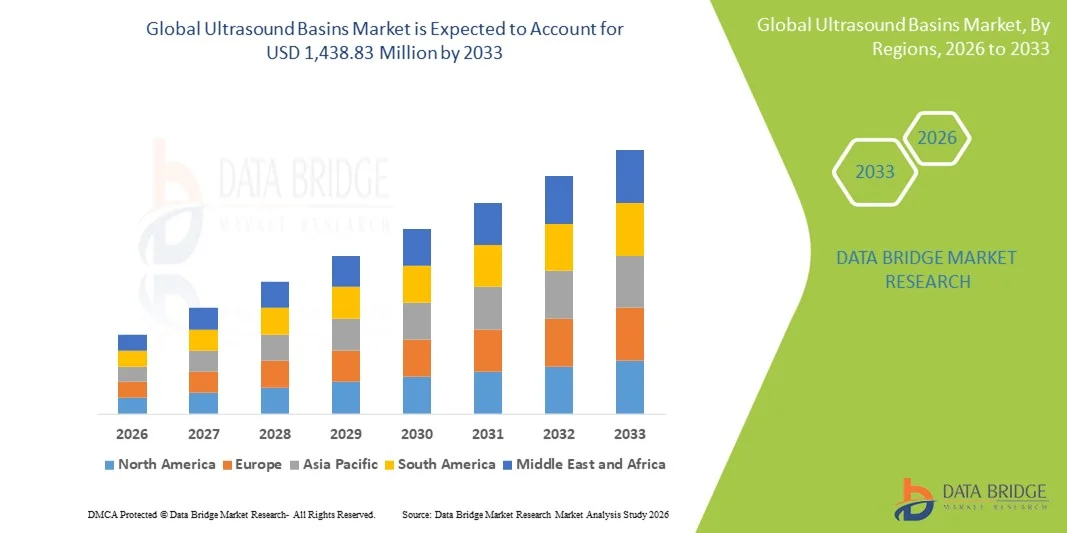
- As per Data Bridge Market Research Analysis the global ultrasound basins market size was valued at USD 957.69 million in 2025 and is expected to reach USD 1,438.83 million by 2033, at a CAGR of 5.22% during the forecast period
- The market growth is largely fueled by the rising prevalence of target diseases, increased patient preference for minimally invasive diagnostic procedures, ongoing technological advancements and modernization in healthcare techniques, and a growing demand from emerging economies
- Furthermore, the convergence of enhanced healthcare infrastructure, increased research and development activities, and expanding healthcare access is driving higher investment in ultrasound-based technologies. This rising demand for effective, non-invasive imaging tools is establishing ultrasound basins as essential equipment in diagnostic and therapeutic procedures, thereby significantly boosting industry growth over the forecast period
Market Size and Forecast:
- Global Market Value (2025): USD 957.69 million
- Expected Market Value (2033): USD 1,438.83 million
- Forecast CAGR (2026–2033):5.22%
How Ultrasound Basins Market Analysed?
- Ultrasound basins, essential for cleaning, preparation, and maintenance of ultrasound equipment, are increasingly critical in hospitals, diagnostic centers, and specialty clinics due to their efficiency, contamination control, and support for high-throughput imaging workflows
- The escalating demand for ultrasound basins is primarily fueled by the rising prevalence of cardiovascular, gynecological, and orthopedic conditions, increasing adoption of ultrasound-based diagnostics, and ongoing technological advancements in imaging systems and associated accessories
- North America dominated the ultrasound basins market with the largest revenue share of 38.7% in 2025, driven by advanced healthcare infrastructure, early adoption of diagnostic technologies, and the strong presence of key market players. The U.S. experienced substantial growth in installations within hospitals and specialized imaging centers, supported by innovations in workflow automation, hygiene control, and integration with advanced imaging devices
- Asia-Pacific is expected to be the fastest-growing region in the ultrasound basins market during the forecast period due to rapid expansion of healthcare services, rising healthcare expenditure, increasing patient awareness, and growing investments in diagnostic imaging facilities across emerging economies
- Cardiology segment dominated the market with a market share of 34.5% in 2025, driven by high demand for cardiovascular diagnostics, frequent patient monitoring, and widespread use of ultrasound imaging in cardiac care
How Ultrasound Basins Market Segmented?
|
Attributes |
Ultrasound Basins Key Market Insights |
|
Segments Covered |
|
|
Countries Covered |
North America
Europe
Asia-Pacific
Middle East and Africa
South America
|
|
Key Market Players |
|
|
Market Opportunities |
|
|
Value Added Data Infosets |
In addition to the insights on market scenarios such as market value, growth rate, segmentation, geographical coverage, and major players, the market reports curated by the Data Bridge Market Research also include in-depth expert analysis, patient epidemiology, pipeline analysis, pricing analysis, and regulatory framework |
What are Ultrasound Basins Market Trends?
Integration with Automated Cleaning and Sterilization Technologies
- A significant and accelerating trend in the global ultrasound basins market is the increasing incorporation of automated cleaning, sterilization, and drying features, enhancing workflow efficiency and hygiene compliance in hospitals and diagnostic centers
- For instance, modern ultrasonic basins from companies such as Elma and Branson integrate programmable cleaning cycles and automated temperature control, reducing manual intervention and minimizing cross-contamination risks
- Automation enables features such as adjustable cleaning intensity, pre-programmed protocols for different probe types, and alerts for maintenance or cleaning completion. For instance, advanced systems from Medisafe notify staff when a basin requires attention or when sterilization cycles are complete
- The seamless integration of ultrasound basins with other diagnostic workflows, including probe storage and ready-to-use imaging accessories, ensures centralized and efficient handling of equipment, saving time and reducing procedural delays
- This trend toward more intelligent, efficient, and hygienic ultrasound cleaning systems is fundamentally reshaping expectations in clinical settings. Consequently, companies such as Sonotech are developing basins with IoT-enabled monitoring and automated cycle optimization to meet hospital hygiene standards
- The demand for ultrasound basins offering automated and integrated cleaning and sterilization is growing rapidly across both hospitals and specialty diagnostic centers, as healthcare providers increasingly prioritize operational efficiency and infection control
- Integration with digital tracking and maintenance software is another emerging trend, enabling hospitals to log cleaning cycles, track equipment usage, and ensure regulatory compliance.
What are Ultrasound Basins Market Dynamics?
Driver
Rising Demand Due to Increased Diagnostic Imaging and Hospital Workflows
- The growing need for efficient cleaning and maintenance of ultrasound equipment, driven by expanding diagnostic imaging procedures, is a significant driver for the heightened demand for ultrasound basins
- For instance, in March 2025, Medisafe launched an advanced ultrasonic basin designed to support high-volume hospital imaging departments, enhancing hygiene and workflow efficiency
- As hospitals and diagnostic centers handle increasing patient loads, ultrasound basins with automated cleaning and sterilization features reduce equipment downtime and improve overall clinical productivity
- Furthermore, the expanding adoption of minimally invasive procedures and the growing prevalence of chronic diseases requiring frequent imaging are increasing the utilization of ultrasound systems, making basins an essential ancillary device
- The convenience of automated cleaning, maintenance reminders, and compatibility with multiple probe types is propelling the adoption of ultrasound basins in high-throughput hospital and imaging center environments
- Increasing regulatory focus on infection control and hygiene standards in healthcare facilities is further driving demand for automated ultrasound basin solutions
- The rising adoption of multi-departmental imaging centers in large hospitals, where a single basin must service numerous ultrasound systems, is creating opportunities for high-capacity and automated basin solutions
Restraint/Challenge
High Equipment Cost and Maintenance Complexity
- The relatively high cost of advanced ultrasound basins with automated cleaning and sterilization features poses a significant barrier to adoption in smaller clinics and developing regions
- For instance, high-end basins with IoT-enabled monitoring and multi-probe cleaning capabilities may cost several times more than basic models, limiting access for budget-conscious healthcare providers
- Maintenance and calibration requirements for automated systems can also be complex, necessitating trained personnel and regular servicing, which can increase operational costs
- While more affordable models are emerging, premium features such as programmable cleaning cycles, temperature-controlled sterilization, and IoT connectivity continue to command higher prices
- Overcoming these challenges through cost-effective designs, simplified maintenance protocols, and training programs for clinical staff will be vital for broader adoption and sustained market growth
- Another restraint is limited awareness in smaller clinics or rural healthcare facilities, where staff may not fully recognize the benefits of investing in advanced ultrasound basins
- In addition, integration challenges with older ultrasound systems can discourage adoption, as some automated basins require compatibility with modern probes and equipment interfaces
What is Ultrasound Basins Market Scope?
The market is segmented on the basis of application, end-user, and display.
- By Application
On the basis of application, the ultrasound basins market is segmented into gynecology, urology, cardiology, and orthopedic. The Cardiology segment dominated the market with the largest revenue share of 34.5% in 2025, driven by the high utilization of ultrasound imaging for cardiovascular diagnosis and monitoring. Hospitals and diagnostic centers prioritize cardiac ultrasound due to the increasing prevalence of heart diseases and the need for regular patient monitoring. Cardiology-focused ultrasound basins are widely adopted for cleaning and preparing probes used in echocardiography, ensuring hygiene and accuracy. The segment’s dominance is further supported by specialized basin designs that accommodate high-volume use in cardiac units. Continuous technological improvements in probe compatibility and automation also enhance operational efficiency in this segment. Cardiology applications remain critical in both inpatient and outpatient settings, maintaining consistent demand for high-quality ultrasound basins.
The Gynecology segment is anticipated to witness the fastest growth rate of 7.2% CAGR from 2026 to 2033, fueled by increasing demand for prenatal care and women’s health imaging services in emerging economies. Gynecology ultrasound basins are being increasingly adopted in maternity clinics and specialty hospitals for probe cleaning and sterilization. Rising awareness about maternal health, coupled with the expansion of outpatient clinics, is driving the adoption of automated basins in gynecology applications. The growth is further supported by the integration of compact and portable basin systems for smaller facilities. Technological advancements in ultrasound probes for obstetric imaging are creating a need for efficient cleaning and preparation solutions. The convenience, hygiene assurance, and regulatory compliance offered by specialized basins contribute to the segment’s rapid growth.
- By End-User
On the basis of end-user, the market is segmented into hospitals and others. The Hospitals segment dominated with a revenue share of 71.2% in 2025, driven by large patient volumes and the presence of dedicated imaging departments. Hospitals require high-capacity ultrasound basins capable of servicing multiple probes daily, ensuring quick turnaround and strict hygiene standards. The dominance is reinforced by regulatory mandates on infection control and standardized cleaning protocols. Hospitals increasingly prefer automated basins that reduce manual labor and minimize contamination risk. High patient throughput and diversified ultrasound applications make hospitals the primary buyers of advanced basins. Continuous investment in healthcare infrastructure in developed regions further sustains the segment’s market leadership.
The Others segment, including diagnostic centers, clinics, and mobile imaging services, is expected to witness the fastest growth with a CAGR of 8.1% from 2026 to 2033, driven by increasing outpatient diagnostics and portable ultrasound adoption. Smaller clinics and mobile units benefit from compact and easy-to-use basins. Expanding telemedicine and point-of-care diagnostics also contribute to higher demand in non-hospital settings. The segment growth is fueled by healthcare decentralization, rising patient awareness, and cost-effective automated solutions. Improved design and portability allow these facilities to maintain hygiene standards comparable to hospitals. This trend is expected to continue as healthcare services increasingly move beyond traditional hospital settings.
- By Display
On the basis of display, the market is segmented into Colour and B&W. The Colour segment dominated the market with a 59.6% share in 2025, due to widespread adoption of color Doppler imaging and advanced diagnostic workflows. Colour ultrasound basins are preferred in hospitals and specialized diagnostic centers for cleaning probes used in high-resolution imaging. Their compatibility with advanced ultrasound systems, especially those requiring color visualization, enhances their demand. The segment benefits from increasing cardiac, gynecology, and vascular diagnostic procedures that rely on color Doppler technology. Colour basins support efficient probe handling and reduce cross-contamination, aligning with hospital hygiene standards. Continuous innovation in basin design to accommodate larger, color-compatible probes further strengthens this segment’s dominance.
The B&W segment is expected to witness the fastest growth with a CAGR of 6.5% from 2026 to 2033, driven by cost-sensitive clinics and smaller hospitals adopting basic ultrasound systems. Black-and-white basins provide efficient cleaning for B&W probes used in general imaging, ensuring hygiene without high investment. The growth is supported by rising demand in emerging economies and small-scale diagnostic setups. B&W basins also appeal to outpatient centers where space and budget are limited. Their straightforward design, reliability, and ease of maintenance make them increasingly popular. As more clinics expand their ultrasound services, B&W basins are projected to capture significant market share in the next decade.
Which Region Holds the Largest Share of the Ultrasound Basins Market?
-
North America dominated the ultrasound basins market with the largest revenue share of 38.7% in 2025, driven by advanced healthcare infrastructure, early adoption of diagnostic technologies, and the strong presence of key market players
-
Hospitals and diagnostic centers in the region prioritize efficiency, hygiene, and compliance with strict infection control standards, making automated ultrasound basins a key component of imaging workflows
- This widespread adoption is further supported by high healthcare expenditure, early adoption of innovative medical technologies, and growing awareness of hygiene and operational efficiency, establishing ultrasound basins as essential equipment in both hospitals and specialized diagnostic facilities
U.S. Ultrasound Basins Market Insight
The U.S. ultrasound basins market captured the largest revenue share of 82% in 2025 within North America, driven by the widespread adoption of automated cleaning and sterilization systems in hospitals and diagnostic centers. Healthcare providers are increasingly prioritizing hygiene compliance and operational efficiency for high-volume imaging workflows. The growing preference for multi-probe compatible basins and IoT-enabled maintenance alerts further supports market expansion. Moreover, integration with advanced ultrasound systems used in cardiology, gynecology, and orthopedics is significantly contributing to the market’s growth. The demand for compact and efficient basin solutions in outpatient clinics and specialized imaging centers is also rising.
Europe Ultrasound Basins Market Insight
The Europe ultrasound basins market is projected to expand at a substantial CAGR during the forecast period, primarily driven by stringent infection control regulations and increasing demand for automated diagnostic equipment. Urbanization and rising patient volumes are fostering the adoption of ultrasound basins in hospitals and diagnostic centers. European healthcare providers are also attracted to solutions that improve workflow efficiency while ensuring compliance with hygiene standards. The region is witnessing significant growth across cardiac, gynecology, and orthopedic applications, with ultrasound basins being incorporated into both new facilities and existing imaging departments. Continuous innovation in automation and probe compatibility is further boosting adoption.
U.K. Ultrasound Basins Market Insight
The U.K. ultrasound basins market is anticipated to grow at a noteworthy CAGR during the forecast period, driven by the rising adoption of automated sterilization systems and the need for enhanced operational efficiency. In addition, concerns regarding hospital-acquired infections are encouraging healthcare facilities to invest in high-quality, automated ultrasound basins. The U.K.’s advanced healthcare infrastructure and strong regulatory environment support the adoption of such systems. Integration with multi-probe ultrasound equipment and compatibility with high-throughput workflows is also increasing market penetration. Both public and private hospitals are focusing on improving hygiene compliance, fueling growth.
Germany Ultrasound Basins Market Insight
The Germany ultrasound basins market is expected to expand at a considerable CAGR during the forecast period, fueled by increasing awareness of infection prevention and the need for technologically advanced solutions. Germany’s well-developed healthcare infrastructure and emphasis on quality and sustainability promote the adoption of automated basins in hospitals and specialized imaging centers. Integration with advanced ultrasound systems for cardiology, gynecology, and orthopedic applications is becoming increasingly prevalent. Healthcare facilities are focusing on operational efficiency, probe safety, and regulatory compliance, which strengthens market demand. The strong presence of local manufacturers and innovation in automation technologies further supports growth.
Asia-Pacific Ultrasound Basins Market Insight
The Asia-Pacific ultrasound basins market is poised to grow at the fastest CAGR of 25% during 2026–2033, driven by rapid urbanization, increasing healthcare expenditure, and rising awareness of hygiene and operational efficiency in hospitals and diagnostic centers. Countries such as China, Japan, and India are seeing expanding adoption of automated and compact basin systems in both large hospitals and smaller clinics. Government initiatives promoting digitalization and modernization of healthcare infrastructure are further accelerating adoption. In addition, the region’s growing role as a manufacturing hub for ultrasound equipment and ancillary devices is improving affordability and accessibility. The expansion of outpatient diagnostic centers and mobile imaging services also contributes to market growth.
Japan Ultrasound Basins Market Insight
The Japan ultrasound basins market is gaining momentum due to the country’s high-tech healthcare infrastructure, aging population, and demand for efficient clinical workflows. Hospitals and diagnostic centers are increasingly adopting automated basins to improve hygiene compliance and reduce manual labor. Integration with high-resolution cardiac, gynecology, and orthopedic ultrasound systems is fueling growth. Moreover, Japan’s emphasis on patient safety and operational efficiency is encouraging widespread basin adoption. Compact, IoT-enabled, and multi-probe compatible basins are particularly popular in outpatient clinics and private hospitals. The trend toward smart healthcare facilities is expected to further drive market expansion.
India Ultrasound Basins Market Insight
The India ultrasound basins market accounted for the largest revenue share in Asia-Pacific in 2025, attributed to rapid urbanization, expanding hospital infrastructure, and rising adoption of advanced medical technologies. India is one of the fastest-growing markets for automated and portable ultrasound basins, with demand spanning hospitals, diagnostic centers, and maternity clinics. Government initiatives promoting smart hospitals and healthcare modernization are supporting market growth. The availability of affordable, locally manufactured basin solutions further fuels adoption. Increased awareness of hygiene and infection control standards in both urban and semi-urban healthcare facilities is also driving market expansion.
What is Ultrasound Basins Market Share?
The Ultrasound Basins industry is primarily led by well-established companies, including:
- Nanosonics Ltd (Australia)
- Germitec S.A. (France)
- CIVCO Medical Solutions, Inc. (U.S.)
- Tristel plc (U.K.)
- Metrex Research, LLC (U.S.)
- CS Medical LLC (U.S.)
- STERIS plc (U.S.)
- Schülke & Mayr GmbH (Germany)
- Parker Laboratories, Inc. (U.S.)
- Soluscope SAS (France)
- Medivators Inc. (Cantel Medical) (U.S.)
- Getinge AB (Sweden)
- Belimed AG (Switzerland)
- GE HealthCare (U.S.)
- IMA X (U.S.)
- UV Smart (Spain)
- EDM Medical Solutions (U.S.)
- Virox Technologies Inc. (Canada)
- Ecolab Inc. (U.S.)
- Advanced Sterilization Products (ASP) (U.S.)
What are the Recent Developments in Global Ultrasound Basins Market?
- In June 2025, Germitec commercially launched Chronos® Max in Europe, a next‑generation high‑level disinfection system with CE MDR certification targeting gynecology, cardiology, urology, and emergency departments. Regulatory proceedings in the UK and Australia are ongoing, with U.S. FDA clearance expected in 2026 signaling expanding global footprint and adoption of advanced UV‑C disinfection solutions
- In September 2024, Germitec’s Chronos UV‑C high‑level disinfection system for ultrasound probes received FDA De Novo clearance, marking the first chemical‑free automated disinfection device approved for ultrasound use in the U.S. The technology delivers fast, standardized probe disinfection in about 90 seconds, aiming to reduce cross‑contamination and healthcare‑associated infection risks in clinical environments
- In June 2024, CS Medical introduced the Ethos® Automated Ultrasound Probe Cleaner Disinfector, the first FDA‑cleared system combining both cleaning and high‑level disinfection in one device for transvaginal, transrectal, and surface probes. It streamlines reprocessing workflows, improves consistency, and enhances patient safety across hospital and diagnostic settings
- In June 2023, CS Medical detailed the AquaCide™ + Ethos cleaning/disinfection workflow receiving FDA validation, allowing healthcare professionals to clean and disinfect ultrasound probes in a standardized, guided process with electronic record retention. This represents a shift toward validated, streamlined probe reprocessing practices
- In March 2023, industry reporting highlighted the global ultrasound probe disinfection market’s push toward automated high‑level disinfection systems, driven by increased regulatory standards and infection prevention emphasis. Automated systems began displacing manual methods as healthcare facilities sought reliable, compliant solutions for semi‑critical probes, laying groundwork for subsequent product launches and technology adoption

- Interactive Data Analysis Dashboard
- Company Analysis Dashboard for high growth potential opportunities
- Research Analyst Access for customization & queries
- Competitor Analysis with Interactive dashboard
- Latest News, Updates & Trend analysis
- Harness the Power of Benchmark Analysis for Comprehensive Competitor Tracking
Data collection and base year analysis are done using data collection modules with large sample sizes. The stage includes obtaining market information or related data through various sources and strategies. It includes examining and planning all the data acquired from the past in advance. It likewise envelops the examination of information inconsistencies seen across different information sources. The market data is analysed and estimated using market statistical and coherent models. Also, market share analysis and key trend analysis are the major success factors in the market report. To know more, please request an analyst call or drop down your inquiry.
The key research methodology used by DBMR research team is data triangulation which involves data mining, analysis of the impact of data variables on the market and primary (industry expert) validation. Data models include Vendor Positioning Grid, Market Time Line Analysis, Market Overview and Guide, Company Positioning Grid, Patent Analysis, Pricing Analysis, Company Market Share Analysis, Standards of Measurement, Global versus Regional and Vendor Share Analysis. To know more about the research methodology, drop in an inquiry to speak to our industry experts.
Data Bridge Market Research is a leader in advanced formative research. We take pride in servicing our existing and new customers with data and analysis that match and suits their goal. The report can be customized to include price trend analysis of target brands understanding the market for additional countries (ask for the list of countries), clinical trial results data, literature review, refurbished market and product base analysis. Market analysis of target competitors can be analyzed from technology-based analysis to market portfolio strategies. We can add as many competitors that you require data about in the format and data style you are looking for. Our team of analysts can also provide you data in crude raw excel files pivot tables (Fact book) or can assist you in creating presentations from the data sets available in the report.













