


Umbilical Cord Blood Banking Market Size
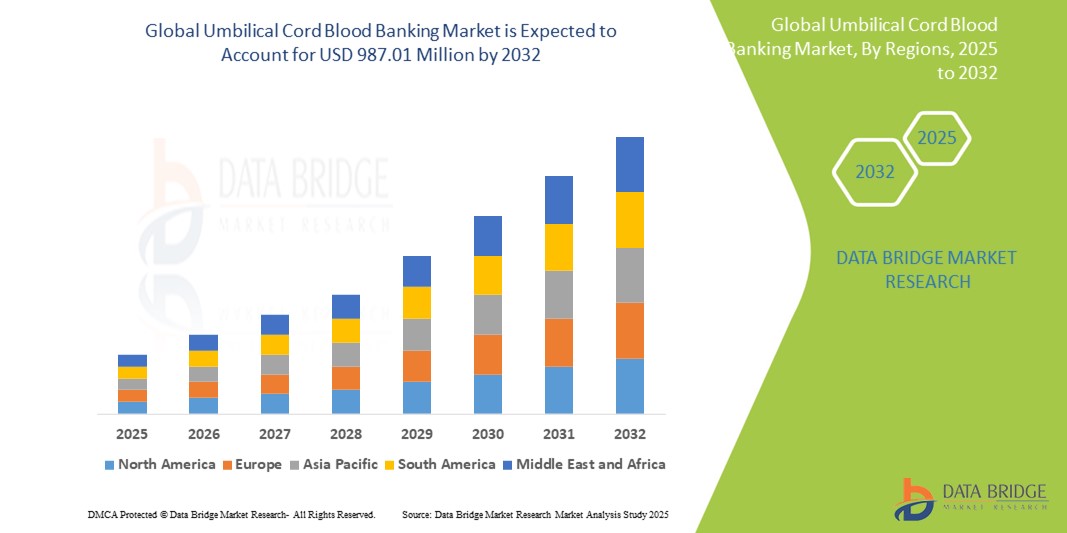
- The global Umbilical cord blood banking market was valued at USD 542.63 Million in 2024 and is expected to reach USD 987.01 Million by 2032
- During the forecast period of 2025 to 2032 the market is likely to grow at a CAGR of 7.30%, primarily driven by the primarily driven by rising awareness of stem cell therapies and increasing prevalence of genetic and blood disorders
- This growth is driven by factors such as the advancements in stem cell research, growing support from government and private initiatives, and increasing demand for regenerative medicine
Umbilical Cord Blood Banking Market Analysis
- Umbilical cord blood banking involves collecting and storing blood from the umbilical cord post-delivery, which is rich in hematopoietic stem cells used to treat various genetic, immune, and blood-related disorders. It plays a crucial role in regenerative medicine and stem cell therapies
- The market is witnessing significant growth due to rising awareness of stem cell applications, an increasing number of treatments approved for stem cell use, and the growing prevalence of life-threatening diseases such as leukemia, lymphoma, and sickle cell anemia
- The North America holds a dominant position in the market, supported by a strong regulatory framework, higher public and private investments in biobanking, and increased participation in cord blood donation and preservation programs
- For instance, the U.S. has seen a surge in both public and private cord blood banks, with enhanced public awareness and accessibility driving participation. Research institutions and biotech companies in the region are actively collaborating to expand the therapeutic use of cord blood stem cells
- Globally, umbilical cord blood banks are regarded as one of the most rapidly advancing components of the stem cell preservation industry, offering life-saving potential and long-term storage solutions in personalized medicine
Report Scope and Umbilical Cord Blood Banking Market Segmentation
|
Attributes |
Umbilical Cord Blood Banking Key Market Insights |
|
Segments Covered |
|
|
Countries Covered |
North America
Europe
Asia-Pacific
Middle East and Africa
South America
|
|
Key Market Players |
|
|
Market Opportunities |
|
|
Value Added Data Infosets |
In addition to the insights on market scenarios such as market value, growth rate, segmentation, geographical coverage, and major players, the market reports curated by the Data Bridge Market Research also include import export analysis, production capacity overview, production consumption analysis, price trend analysis, climate change scenario, supply chain analysis, value chain analysis, raw material/consumables overview, vendor selection criteria, PESTLE Analysis, Porter Analysis, and regulatory framework. |
Umbilical Cord Blood Banking Market Trends
“Integration of Advanced Cryopreservation and Expansion Technologies”
- One prominent trend in the umbilical cord blood banking market is the integration of advanced cryopreservation techniques and stem cell expansion technologies
- These innovations are enhancing the viability and therapeutic potential of stored cord blood units, allowing for improved long-term storage and broader application in stem cell transplants
- For instance, new cryoprotectants and automated freezing systems are minimizing cell damage during preservation, while stem cell expansion methods are enabling the use of smaller cord blood volumes for adult treatments
- These advancements are not only increasing the efficiency and reliability of cord blood storage but are also expanding the scope of clinical applications, driving demand across both public and private banking sectors
- This trend is reshaping the future of regenerative medicine by making cord blood therapies more accessible and effective for a wider range of diseases and patient demographics
Umbilical Cord Blood Banking Market Dynamics
Driver
“Rising Prevalence of Chronic and Genetic Disorders”
- The growing prevalence of chronic and genetic disorders such as leukemia, lymphoma, thalassemia, and sickle cell anemia is a major driver for the umbilical cord blood banking market
- Stem cells derived from cord blood have proven therapeutic potential in treating over 80 life-threatening diseases, making them a critical resource in regenerative and personalized medicine
- With increasing awareness among expecting parents about the potential future use of stored cord blood for family members, both public and private cord blood banking are seeing rising enrollment
- The advancements in stem cell transplantation techniques and growing clinical trials for new therapeutic applications are further boosting the adoption of cord blood banking services
For instance,
- The World Health Organization and various national health bodies have reported a steady increase in childhood leukemia and other blood disorders, which are treatable with hematopoietic stem cells derived from cord blood, reinforcing the importance of accessible cord blood storage solutions
- According to the U.S. Department of Health & Human Services, over 40,000 cord blood transplants have been performed globally, underscoring the expanding reliance on cord blood for life-saving therapies
- As the incidence of treatable conditions continues to rise and clinical applications broaden, the demand for umbilical cord blood banking is expected to grow steadily, offering hope for more effective and accessible treatments
Opportunity
“Harnessing Artificial Intelligence for Enhanced Stem Cell Matching and Processing”
- The integration of artificial intelligence in umbilical cord blood banking presents a transformative opportunity, enhancing stem cell matching accuracy, optimizing storage processes, and accelerating research in regenerative medicine
- AI algorithms can analyze vast datasets to predict donor-recipient compatibility more effectively, improving transplant success rates and reducing complications related to immune rejection
- In addition, AI-driven platforms can streamline the processing and classification of cord blood units by identifying high-quality samples, ensuring better preservation and utilization of stem cells
For instance,
- AI tools are increasingly being used in stem cell research to predict differentiation pathways, optimize culture conditions, and identify ideal candidates for therapy—significantly speeding up discovery and clinical application
- In 2024, several biotech firms and research institutions have initiated pilot programs using AI to enhance the selection of cord blood units for clinical trials, leading to more targeted and efficient therapeutic strategies
- This integration of AI is expected to drive greater precision in personalized treatments, reduce operational costs in banking facilities, and ultimately improve patient outcomes, positioning AI as a critical enabler in the future of cord blood therapies
Restraint/Challenge
“High Costs and Limited Awareness in Emerging Economies”
- The high cost associated with the collection, processing, and long-term storage of umbilical cord blood units presents a significant barrier, especially in low- and middle-income countries where healthcare budgets and individual affordability are limited
- Private cord blood banking can cost several thousand dollars upfront, along with annual storage fees, which may discourage many families from opting for preservation services, particularly in regions lacking financial incentives or insurance coverage
For instance,
- In reports from global health organizations indicate that awareness of the medical benefits of cord blood banking remains relatively low in emerging economies, further contributing to the underutilization of this life-saving resource
- Countries with limited public banking infrastructure, families often face the difficult choice of foregoing cord blood preservation due to a lack of accessible and affordable options
- Consequently, these challenges hinder the expansion of the market in underdeveloped areas, contributing to disparities in access to advanced stem cell therapies and limiting the global potential of umbilical cord blood banking
Umbilical Cord Blood Banking Market Scope
The market is segmented on the basis of bank type, service and end user.
|
Segmentation |
Sub-Segmentation |
|
By Bank Type |
|
|
By Service |
|
|
By End User |
|
Umbilical Cord Blood Banking Market Regional Analysis
“North America is the Dominant Region in the Umbilical Cord Blood Banking Market”
- North America leads the global umbilical cord blood banking market, driven by a well-established healthcare system, strong regulatory support, and high levels of public and private participation in cord blood collection and storage
- U.S. holds a major share due to growing awareness among expectant parents, a rising number of hematopoietic stem cell transplants, and a mature network of both public and private cord blood banks
- The favorable reimbursement scenarios for select treatments using cord blood-derived stem cells and continued investments in regenerative medicine and clinical trials contribute significantly to the region's dominance
- In addition, the presence of key market players, along with government initiatives promoting stem cell research and public banking, further bolsters the market across North America
“Asia-Pacific is Projected to Register the Highest Growth Rate”
- Asia-Pacific is anticipated to register the fastest growth in the umbilical cord blood banking market due to an increasing birth rate, rising awareness of stem cell preservation, and expanding healthcare infrastructure
- Countries such as China, India, and Japan are becoming critical growth hubs owing to growing investments in biotechnology, higher prevalence of treatable genetic disorders, and supportive government policies around stem cell research
- Japan stands out for its technological advancements in regenerative medicine and public interest in personalized therapies, while India and China are witnessing increased participation in both private and community-based cord blood banking programs
- The growing affordability of cord blood banking services, coupled with expanding collaborations between local healthcare providers and global biotech firms, is accelerating market penetration in the region
Umbilical Cord Blood Banking Market Share
The market competitive landscape provides details by competitor. Details included are company overview, company financials, revenue generated, market potential, investment in research and development, new market initiatives, global presence, production sites and facilities, production capacities, company strengths and weaknesses, product launch, product width and breadth, application dominance. The above data points provided are only related to the companies' focus related to market.
The Major Market Leaders Operating in the Market Are:
- The Sanpower Group (China)
- Generate Life Sciences Co. (U.S.)
- Cryo-Cell International, Inc. (U.S.)
- ViaCord, LLC (U.S.)
- Cordlife (Singapore)
- Famicord Group (Germany)
- Zhongyuan Xiehe Cell Gene Engineering Co., Ltd. (China)
- LifeCell (India)
- CryoHoldco (Mexico)
- MEDIPOST (South Korea)
- Vita 34, Inc. (Germany)
- Future Health Biobank (U.K)
- StemCyte India Therapeutics Pvt. Ltd. (India)
- Reliance Life Sciences (India)
- Cryoviva India (India)
- Regrow Biosciences Pvt. Ltd. (India)
- ReeLabs Private Limited (India)
- Novacord (India)
- Cryo StemCell (India)
- Cryovault (India)
Latest Developments in Global Umbilical Cord Blood Banking Market
- In September 2024, Cordlife Group resumed its cord blood banking activities in Singapore with an enhanced processing and storage facility, featuring improved operational protocols and an advanced laboratory monitoring system
- In July 2024, NMDP Biosciences and the Cord Blood Bank Alliance (CBBA) announced the availability of pre-identified cord blood units optimized for manufacturing cord-derived cell therapies, particularly natural killer (NK) cell therapies
- In May 2024, The Department of Health (DOH) and M42 collaborated to launch the Abu Dhabi Biobank, the region's largest hybrid cord blood bank, aiming to reduce treatment waiting times and improve therapeutic access for patients
- In February 2024, Americord released cord blood stem cells to a client’s grandmother in India for the treatment of motor neuron disease, demonstrating the expanding therapeutic applications of stored cord blood
- In November 2024, Sidra Medicine, part of Qatar Foundation, launched Qatar’s first local cord blood banking service, offering families the opportunity to preserve their newborns’ stem cells for potential future medical needs

- Interactive Data Analysis Dashboard
- Company Analysis Dashboard for high growth potential opportunities
- Research Analyst Access for customization & queries
- Competitor Analysis with Interactive dashboard
- Latest News, Updates & Trend analysis
- Harness the Power of Benchmark Analysis for Comprehensive Competitor Tracking
Data collection and base year analysis are done using data collection modules with large sample sizes. The stage includes obtaining market information or related data through various sources and strategies. It includes examining and planning all the data acquired from the past in advance. It likewise envelops the examination of information inconsistencies seen across different information sources. The market data is analysed and estimated using market statistical and coherent models. Also, market share analysis and key trend analysis are the major success factors in the market report. To know more, please request an analyst call or drop down your inquiry.
The key research methodology used by DBMR research team is data triangulation which involves data mining, analysis of the impact of data variables on the market and primary (industry expert) validation. Data models include Vendor Positioning Grid, Market Time Line Analysis, Market Overview and Guide, Company Positioning Grid, Patent Analysis, Pricing Analysis, Company Market Share Analysis, Standards of Measurement, Global versus Regional and Vendor Share Analysis. To know more about the research methodology, drop in an inquiry to speak to our industry experts.
Data Bridge Market Research is a leader in advanced formative research. We take pride in servicing our existing and new customers with data and analysis that match and suits their goal. The report can be customized to include price trend analysis of target brands understanding the market for additional countries (ask for the list of countries), clinical trial results data, literature review, refurbished market and product base analysis. Market analysis of target competitors can be analyzed from technology-based analysis to market portfolio strategies. We can add as many competitors that you require data about in the format and data style you are looking for. Our team of analysts can also provide you data in crude raw excel files pivot tables (Fact book) or can assist you in creating presentations from the data sets available in the report.













