


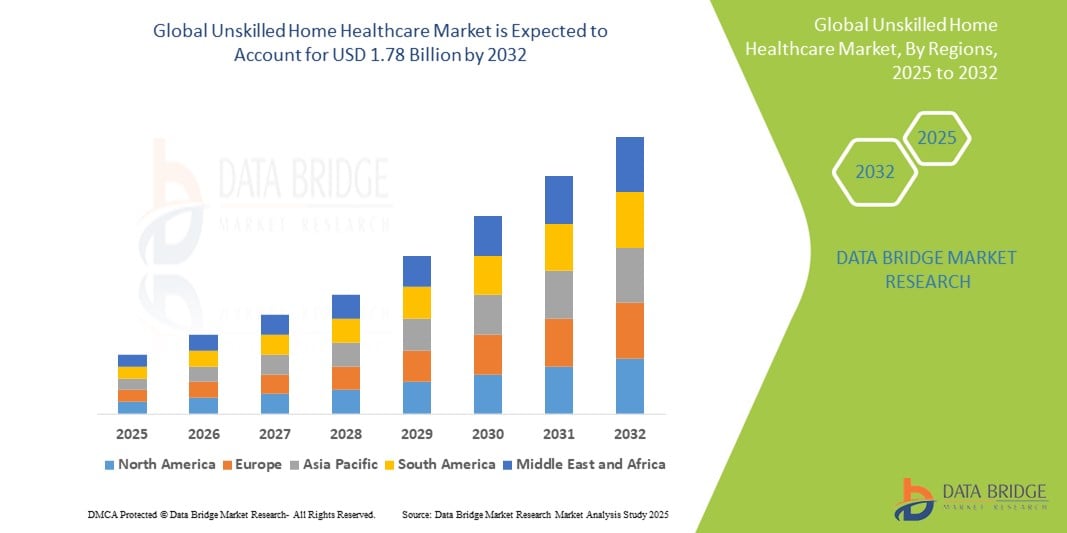
Unskilled Home Healthcare Market Size
- The global unskilled home healthcare market was valued at USD 1.06 billion in 2024 and is expected to reach USD 1.78 billion by 2032
- During the forecast period of 2025 to 2032 the market is likely to grow at a CAGR of 8.7%, primarily driven by the rising aging population and increasing demand for affordable, non-clinical in-home care services
- This growth is driven by factors such as the growing prevalence of chronic diseases, a shift toward home-based care, and the rising need for cost-effective healthcare solutions
Unskilled Home Healthcare Market Analysis
- Unskilled home healthcare services encompass non-medical support such as assistance with daily living activities, hygiene, meal preparation, companionship, and basic mobility support, often delivered by caregivers without formal medical training. These services are vital for individuals with chronic illnesses, disabilities, or aging-related limitations
- The demand for unskilled home healthcare is rising sharply due to the global aging population, increased prevalence of chronic diseases, and a growing preference for aging in place. This segment is especially crucial in managing long-term care needs without the high costs associated with institutional care
- North America stands out as one of the dominant regions for unskilled home healthcare, supported by its well-established healthcare infrastructure, higher healthcare spending, and favorable reimbursement frameworks. The region has a high penetration of professional home care agencies and growing demand for personalized in-home support services
- For instance, in the U.S., the number of individuals aged 65 and older is projected to nearly double by 2060, significantly driving the need for in-home assistance and long-term care services. This trend is being met with increasing investment in caregiver training and digital tools to support remote care coordination
- Globally, unskilled home healthcare services are becoming an integral part of value-based care models, contributing to reduced hospital readmissions, better chronic disease management, and improved patient satisfaction, especially in aging societies with evolving care needs
Report Scope and Unskilled Home Healthcare Market Segmentation
|
Attributes |
Unskilled Home Healthcare Key Market Insights |
|
Segments Covered |
|
|
Countries Covered |
North America
Europe
Asia-Pacific
Middle East and Africa
South America
|
|
Key Market Players |
|
|
Market Opportunities |
|
|
Value Added Data Infosets |
In addition to the insights on market scenarios such as market value, growth rate, segmentation, geographical coverage, and major players, the market reports curated by the Data Bridge Market Research also include import export analysis, production capacity overview, production consumption analysis, price trend analysis, climate change scenario, supply chain analysis, value chain analysis, raw material/consumables overview, vendor selection criteria, PESTLE Analysis, Porter Analysis, and regulatory framework. |
Unskilled Home Healthcare Market Trends
“Rising Integration of Digital Platforms and Remote Monitoring Tools”
- One prominent trend in the global unskilled home healthcare market is the increasing integration of digital platforms and remote monitoring tools to enhance the efficiency and coordination of non-medical caregiving service
- These technologies support caregivers and families by enabling real-time tracking of daily activities, medication reminders, and communication with healthcare professionals, thereby improving the overall quality of care delivered at home
- For instance, mobile apps and wearable devices are being used to monitor patient movement, schedule care routines, and alert family members or care managers in case of emergencies, promoting better oversight and faster response times
- Digital platforms also streamline caregiver scheduling, service documentation, and compliance reporting for home care agencies, making operations more efficient and scalable
- This trend is transforming the delivery of unskilled home healthcare services by bridging the gap between informal caregiving and professional support, ultimately boosting patient satisfaction, safety, and caregiver accountability in the growing home-based care landscape
Unskilled Home Healthcare Market Dynamics
Driver
“Rising Demand Due to Aging Population and Chronic Conditions”
- The growing aging population worldwide is a major driver of the unskilled home healthcare market, as older adults increasingly require assistance with activities of daily living, mobility, and basic personal care at home
- As life expectancy rises, a larger segment of the population is living with chronic conditions such as arthritis, diabetes, Alzheimer’s disease, and cardiovascular issues—conditions that often necessitate long-term, non-clinical support rather than hospitalization
- Unskilled home healthcare offers a cost-effective and comforting solution for these individuals, allowing them to receive care in the familiarity of their own homes while maintaining independence and dignity
- In addition, the shift toward value-based care and reducing hospital readmissions has prompted healthcare systems to promote home-based support services, boosting demand for unskilled caregivers who can assist with daily monitoring, hygiene, nutrition, and companionship
For instance,
- According to the U.S. Census Bureau, by 2030, all baby boomers will be older than 65, meaning 1 in every 5 U.S. residents will be of retirement age. This demographic shift is expected to create a surge in demand for home-based elder care services
- As per the World Health Organization (WHO), the global population aged 60 years and older is expected to double by 2050, reaching over 2 billion, which will significantly strain traditional healthcare systems and push demand for home-based care solutions
- As more individuals age and face chronic conditions that require daily assistance but not medical intervention, the need for reliable, unskilled home healthcare services continues to rise, making it a critical component of modern long-term care strategies
Opportunity
“Expanding Role of Technology and AI in Caregiver Support and Remote Monitoring”
- The integration of artificial intelligence and digital tools into unskilled home healthcare services presents a major opportunity to enhance care delivery, caregiver efficiency, and patient monitoring without requiring clinical intervention
- AI-powered platforms can support caregivers by automating scheduling, tracking daily routines, monitoring vital signs through smart devices, and alerting healthcare providers or family members in case of irregularities, improving safety and response times
- In addition, virtual assistants and AI chatbots can help elderly or disabled individuals with reminders for hydration, medication, appointments, and basic health education—providing consistent, supportive interaction even when caregivers are not physically present
For instance,
- In February 2024, a report by the Global Coalition on Aging highlighted the growing use of AI-enabled wearable devices in home care, which monitor movement, detect falls, and send automatic alerts to caregivers or emergency services—greatly reducing response time in critical situations
- In October 2023, a pilot project in Canada demonstrated the use of AI algorithms in predicting caregiver burnout by analyzing care logs and behavioral patterns, allowing agencies to intervene early and provide relief or mental health support to reduce turnover
- These innovations not only improve the quality and continuity of care but also support caregivers by reducing manual tasks and emotional strain, ultimately expanding the scalability of unskilled home healthcare services in both urban and rural settings
Restraint/Challenge
“Shortage of Trained Caregivers and Workforce Retention Issues”
- The major challenge in the global unskilled home healthcare market is the shortage of adequately trained caregivers, coupled with high turnover rates and workforce burnout, which limits the capacity to meet the growing demand for in-home support services
- Despite being a critical part of the healthcare continuum, unskilled caregiving roles often come with low wages, limited career advancement opportunities, and physically and emotionally demanding work environments, making recruitment and retention difficult
- This workforce gap is especially pronounced in rural and underserved areas, where access to reliable caregiving services is already limited, leading to unmet needs among elderly and chronically ill populations
For instance,
- In August 2024, a report by the U.S. Bureau of Labor Statistics noted that the demand for home health and personal care aides is projected to grow by 25% from 2021 to 2031; however, staffing shortages and high turnover remain persistent barriers to scaling services effectively
- In a 2023 report by the World Health Organization, many countries—especially in low- and middle-income regions—identified the lack of trained home care workers as a major obstacle to implementing sustainable community-based care models
- Consequently, the ongoing challenge not only hampers the quality and consistency of care provided but also puts pressure on families and healthcare systems, potentially slowing the expansion and effectiveness of unskilled home healthcare services globally
Unskilled Home Healthcare Market Scope
The market is segmented on the basis of products, type, disease, and distribution channel.
|
Segmentation |
Sub-Segmentation |
|
By Products |
|
|
By Type |
|
|
By Disease |
|
|
By Distribution Channel |
|
Unskilled Home Healthcare Market Regional Analysis
“North America is the Dominant Region in the Unskilled Home Healthcare Market”
- North America leads the global unskilled home healthcare market, supported by a well-developed healthcare infrastructure, rising demand for aging-in-place services, and a strong network of home care agencies offering non-clinical support
- U.S. holds a substantial market share due to its rapidly aging population, high prevalence of chronic conditions, and favorable reimbursement systems that support long-term in-home care
- The Federal and state-level programs, such as Medicaid waivers, and private long-term care insurance options play a key role in increasing access to unskilled home care services, particularly for seniors and individuals with disabilities
- In addition, advancements in digital health platforms and the growing integration of remote monitoring technologies have enabled more efficient caregiver coordination and improved the quality of care provided at home across the region
“Asia-Pacific is Projected to Register the Highest Growth Rate”
- Asia-Pacific is expected to register the fastest growth in the unskilled home healthcare market, driven by an accelerating aging population, urbanization, and a shift toward home-based care models
- Countries such as Japan, China, and India are witnessing a surge in demand for elderly care due to demographic shifts and changing family structures that limit traditional caregiving options within households
- Japan stands out with its established long-term care insurance system and focus on integrating robotics and digital support into home care, enhancing the quality and scalability of unskilled caregiving services
- Meanwhile, China and India are investing heavily in caregiver training programs, public-private healthcare collaborations, and community-based care initiatives to address the growing care needs of their large elderly populations. The rise of startups and telehealth platforms is further improving access to in-home care, particularly in urban and semi-urban regions
Unskilled Home Healthcare Market Share
The market competitive landscape provides details by competitor. Details included are company overview, company financials, revenue generated, market potential, investment in research and development, new market initiatives, global presence, production sites and facilities, production capacities, company strengths and weaknesses, product launch, product width and breadth, application dominance. The above data points provided are only related to the companies' focus related to market.
The Major Market Leaders Operating in the Market Are:
- Omron Healthcare, Inc. (Japan)
- Air Liquide (France)
- B. Braun SE (Germany)
- Medtronic (Ireland)
- DaVita Inc. (U.S)
- Cardinal Health (U.S)
- Sunrise Medical (U.S)
- GE HealthCare (U.S)
- A&D Company (Japan)
- BAYADA Home Health Care, (U.S)
- Koninklijke Philips N.V., (Netherlands)
- Fresenius SE & Co. KGaA (Germany)
- Baxter (U.S.)
- F. Hoffmann-La Roche Ltd (Switzerland)
- Bupa (U.K.)
- Health Care at Home (U.K.)
- Linde PLC (Ireland)
Latest Developments in Global Unskilled Home Healthcare Market
- In January 2025, Merago Inc. launched its home healthcare services in collaboration with Portea Medical in India. This service includes urgent and postoperative care, making healthcare more accessible in regions with limited access to advanced medical facilities
- In October 2024, the global adoption of telehealth services surged due to the increasing need for home healthcare. Telehealth is improving patient care, particularly for the elderly, and reducing the need for physical visits to healthcare providers, thus reducing costs and improving outcomes
- In September 2024, several companies in the home healthcare sector began integrating AI-powered remote patient monitoring systems. These systems allow caregivers to monitor patients with chronic conditions at home, improving outcomes and reducing hospital readmissions
- In May 2024, the U.S. government announced policy changes that provide greater insurance coverage for home healthcare services. This change aims to make home healthcare more affordable and accessible to a wider population, especially for elderly patients and those with disabilities
- In June 2023, Amedisys reached an agreement to merge with Optum, a company specializing in diversified health services. Amedisys provides personalized home health and hospice care services and conducts over 11.2 million visits to patient homes annually

- Interactive Data Analysis Dashboard
- Company Analysis Dashboard for high growth potential opportunities
- Research Analyst Access for customization & queries
- Competitor Analysis with Interactive dashboard
- Latest News, Updates & Trend analysis
- Harness the Power of Benchmark Analysis for Comprehensive Competitor Tracking
Data collection and base year analysis are done using data collection modules with large sample sizes. The stage includes obtaining market information or related data through various sources and strategies. It includes examining and planning all the data acquired from the past in advance. It likewise envelops the examination of information inconsistencies seen across different information sources. The market data is analysed and estimated using market statistical and coherent models. Also, market share analysis and key trend analysis are the major success factors in the market report. To know more, please request an analyst call or drop down your inquiry.
The key research methodology used by DBMR research team is data triangulation which involves data mining, analysis of the impact of data variables on the market and primary (industry expert) validation. Data models include Vendor Positioning Grid, Market Time Line Analysis, Market Overview and Guide, Company Positioning Grid, Patent Analysis, Pricing Analysis, Company Market Share Analysis, Standards of Measurement, Global versus Regional and Vendor Share Analysis. To know more about the research methodology, drop in an inquiry to speak to our industry experts.
Data Bridge Market Research is a leader in advanced formative research. We take pride in servicing our existing and new customers with data and analysis that match and suits their goal. The report can be customized to include price trend analysis of target brands understanding the market for additional countries (ask for the list of countries), clinical trial results data, literature review, refurbished market and product base analysis. Market analysis of target competitors can be analyzed from technology-based analysis to market portfolio strategies. We can add as many competitors that you require data about in the format and data style you are looking for. Our team of analysts can also provide you data in crude raw excel files pivot tables (Fact book) or can assist you in creating presentations from the data sets available in the report.













