


What is the Urinary Drainage Bags Market Size and Growth Rate?
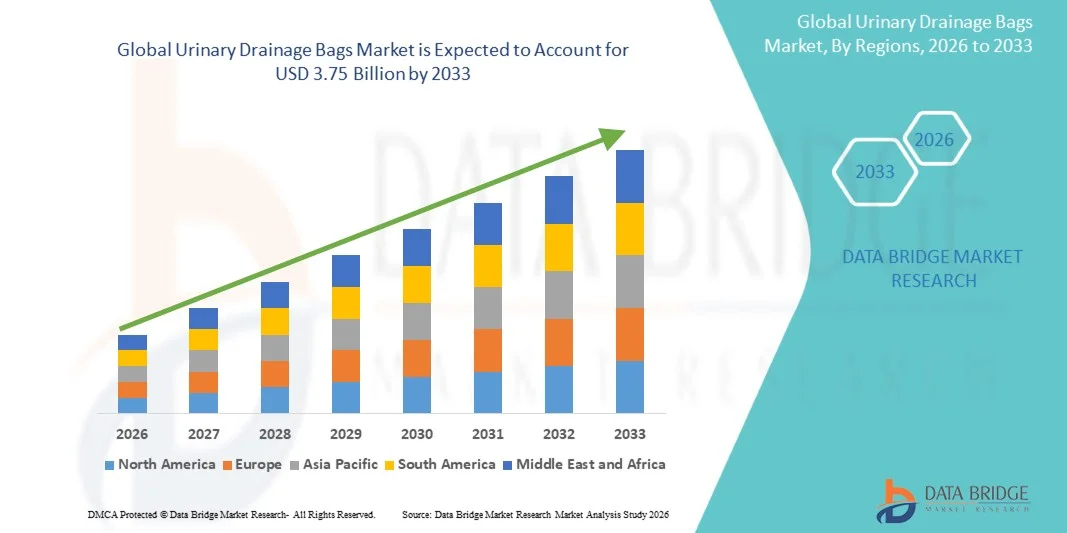
- As per Data Bridge Market Research analysis, the urinary drainage bags market was valued at USD 2.58 billion in 2025 and is projected to reach USD 3.75 billion by 2033, growing at a CAGR of 4.82% from 2026 to 2033.
- The market is experiencing steady growth driven by the rising prevalence of urinary incontinence and other urological disorders, a rapidly expanding geriatric population, increasing demand for long-term and home healthcare, and growing adoption of disposable urinary drainage bags for infection prevention and patient convenience.
- The increasing number of urological and gynecological surgeries, combined with the growing burden of chronic conditions such as benign prostatic hyperplasia, bladder cancer, spinal cord injuries, and urinary retention, is encouraging hospitals, clinics, and home healthcare providers to adopt advanced urinary drainage solutions. Disposable and leg urinary drainage bags are increasingly preferred over reusable alternatives due to their lower risk of catheter-associated urinary tract infections, improved hygiene, and greater patient mobility, supporting continued market expansion.
Market Size & Forecast
- Global Market Value (2025): USD 2.58 Billion
- Expected Market Value (2033): USD 3.75 Billion
- Forecast CAGR (2026–2033): 4.82%
- Leading Region in 2025: North America
- Fastest Growing Region: Asia Pacific
What are the Major Takeaways of the Urinary Drainage Bags Market?
- North America dominated the urinary drainage bags market with the largest revenue share of 39.5% in 2025, supported by a high prevalence of urological disorders, favorable reimbursement policies, and well-established healthcare infrastructure.
- Asia-Pacific is expected to be the fastest-growing region at a CAGR of 5.3% from 2026 to 2033, fueled by the expanding geriatric population, increasing awareness of urinary incontinence management, improving access to home healthcare services, and growing demand for advanced urinary drainage products.
- The urinary leg bags segment led the market with a 58.4% share in 2025, driven by their widespread use among ambulatory patients requiring long-term catheterization and urinary incontinence management
- Urinary bedside bags are the fastest-growing product type, projected to register a CAGR of 5.2%, reflecting the surge in hospitalization rates, long-term care admissions, and postoperative catheterization procedures
- The PVC segment dominated the material category with a 55.0% revenue share in 2025, led by its cost-effectiveness, durability, transparency, and compatibility with large-scale medical device manufacturing.
- Disposable accounted for 58.8% of the market share in 2025, preferred by its ability to reduce cross-contamination and catheter-associated urinary tract infection (CAUTI) risks.
- The 1000–2000 ml segment is the fastest-growing capacity category, with a CAGR of 5.4%, driven by increasing demand for overnight drainage and long-duration urine collection in hospitals and long-term care facilities
Report Scope and Urinary Drainage Bags Market Segmentation
|
Attributes |
Urinary Drainage Bags Key Market Insights |
|
Segments Covered |
|
|
Countries Covered |
North America
Europe
Asia-Pacific
Middle East and Africa
South America
|
|
Key Market Players |
|
|
Market Opportunities |
|
|
Value Added Data Infosets |
|
What is the Key Trend in the Urinary Drainage Bags Market?
- Healthcare providers are increasingly adopting advanced urinary drainage bags with anti-reflux valves, needle-free sampling ports, and closed drainage systems to reduce catheter-associated urinary tract infections (CAUTIs) while improving patient comfort and clinical workflow.
- For instance, in September 2025, research presented at the International Continence Society (ICS) Annual Meeting demonstrated that combining chlorhexidine (CHG) antimicrobial activation with hydrophilic catheter surface technology significantly reduced bacterial colonization, supporting new strategies for catheter-associated urinary tract infection (CAUTI) prevention.
- Closed urinary drainage systems help minimize bacterial entry by maintaining a sterile urine collection pathway and reducing unnecessary manipulation during catheter management.
- Hospitals and home healthcare providers are increasingly prioritizing infection-control-focused drainage solutions to improve long-term catheter care and comply with evidence-based clinical guidelines.
- For instance, in June 2025, an article published in the British Journal of Surgery demonstrated that a pump-ball catheter drainage bag improved clot management, reduced bladder washouts, and lowered inpatient costs compared with conventional drainage bags.
- As healthcare systems continue to prioritize infection prevention, patient safety, and efficient catheter management, adoption of advanced urinary drainage bags is expected to accelerate, reinforcing their role in modern urological and long-term care.
What are the Key Drivers of the Urinary Drainage Bags Market?
- The rising prevalence of urinary incontinence, chronic urinary retention, spinal cord injuries, and age-related urological disorders has significantly increased demand for safe and reliable urinary drainage bags across hospitals and home healthcare settings.
- For instance, in April 2025, The Ohio State University completed evaluation of the B3 Buddy device designed to securely position urinary drainage bags during walking, supporting improved patient mobility and catheter management.
- Healthcare providers are expanding the use of portable drainage systems to improve patient mobility, reduce hospitalization, and support long-term catheter management outside acute care facilities.
- For instance, in June 2025, an article published in the British Journal of Surgery reported that the pump-ball catheter drainage bag significantly reduced bladder washouts, lowered inpatient costs, and improved the management of catheter blockages in patients with visible haematuria.
- With healthcare systems increasingly emphasizing infection prevention, home-based care, and improved quality of life for catheterized patients, urinary drainage bags are expected to remain essential across acute, chronic, and community healthcare settings.
Which Factors are Challenging the Growth of the Urinary Drainage Bags Market?
- The persistent risk of catheter-associated urinary tract infections, together with strict infection-control requirements, continues to challenge the widespread adoption and long-term use of urinary drainage systems.
- Healthcare providers must maintain closed drainage systems and follow rigorous catheter management protocols to minimize contamination and infection risk throughout catheterization.
- For instance, in May 2025, a study published in the Journal of Family Medicine and Primary Care found that patients using open urinary drainage systems had a more than six-fold higher risk of developing catheter-associated urinary tract infections than those using closed drainage systems, highlighting infection risk as a major challenge in urinary drainage management.
- Compliance with infection-control protocols increases operational complexity and requires continuous staff training, particularly in hospitals and long-term care facilities managing large catheterized patient populations.
- For instance, in January 2025, a meta-analysis published in Biological Research for Nursing concluded that there is insufficient evidence to support routine catheter clamping before removal in patients with neurogenic bladder, highlighting the lack of standardized catheter drainage practices and the need for further high-quality clinical evidence to optimize urinary drainage management.
- The ongoing need to balance infection prevention, regulatory compliance, and cost-effective catheter management continues to limit market growth, particularly in resource-constrained healthcare settings where adherence to best practices remains challenging.
How is the Urinary Drainage Bags Market Segmented?
The urinary drainage bags market is segmented on the basis of product type, material, usage type, capacity, and end user.
- By Product Type
On the basis of product type, the urinary drainage bags market is segmented into urinary leg bags, urinary bedside bags, drainage catheter bags, and urinary collection bags. The urinary leg bags segment dominated the market with a 58.4% revenue share in 2025, owing to their widespread use among ambulatory patients requiring long-term catheterization and urinary incontinence management. These bags offer greater mobility, discretion, and comfort, making them highly suitable for home healthcare and outpatient settings. Their compact design enables patients to maintain daily activities without compromising drainage efficiency. Increasing adoption among the growing geriatric population and individuals with chronic urological disorders continues to strengthen demand. Advancements such as anti-reflux valves, odor-control technology, and improved fastening systems have further enhanced product acceptance. Rising preference for home-based care and improved quality of life continues to support the segment's leadership.
The urinary bedside bags segment is projected to register the fastest growth at a CAGR of 5.2% during the forecast period, driven by increasing hospitalization rates, long-term care admissions, and postoperative catheterization procedures. These bags provide higher urine collection capacity for overnight and extended drainage requirements, reducing the frequency of bag replacement. Healthcare facilities increasingly prefer bedside bags for critically ill and immobilized patients requiring continuous urinary drainage. Growing emphasis on infection prevention through closed drainage systems is further driving adoption. Expanding healthcare infrastructure and rising surgical procedures across emerging economies continue to create growth opportunities. Increasing demand for high-capacity drainage solutions is expected to accelerate segment expansion.
- By Material
On the basis of material, the urinary drainage bags market is segmented into PVC, silicone, rubber, and vinyl. The PVC segment dominated the market with an estimated revenue share of 55.0% in 2025, due to its cost-effectiveness, durability, transparency, and compatibility with large-scale medical device manufacturing. PVC-based drainage bags provide excellent flexibility and reliable fluid collection while maintaining product integrity during prolonged use. The material is widely utilized across hospitals and home healthcare because it supports sterile production and disposable product manufacturing. Manufacturers continue to improve PVC formulations to enhance patient comfort and reduce environmental concerns. Its well-established supply chain and lower production costs further strengthen market dominance. Broad regulatory acceptance also contributes to continued adoption globally.
The silicone segment is anticipated to register the fastest growth at a CAGR of 5.6% during the forecast period, owing to increasing demand for biocompatible and latex-free medical products. Silicone offers superior flexibility, patient comfort, chemical resistance, and reduced risk of allergic reactions compared with conventional materials. Healthcare providers are increasingly adopting silicone-based urinary drainage products for patients requiring long-term catheterization. Rising awareness regarding patient safety and infection prevention is encouraging the transition toward premium materials. Technological advancements in medical-grade silicone manufacturing continue to improve product performance. Growing demand for high-quality long-term urinary management solutions is expected to support rapid segment growth.
- By Usage Type
On the basis of usage type, the urinary drainage bags market is segmented into reusable and disposable. The disposable segment accounted for the largest market share of 58.8% in 2025, due to its ability to reduce cross-contamination and catheter-associated urinary tract infection (CAUTI) risks. Hospitals and healthcare providers increasingly prefer single-use drainage bags because they eliminate the need for cleaning and reprocessing while supporting infection-control protocols. Disposable products also improve clinical workflow and reduce maintenance requirements. Rising awareness regarding healthcare-associated infections and strict regulatory standards continue to encourage adoption. Growing surgical volumes and increasing catheterization procedures further contribute to demand. Continuous innovation in cost-effective disposable drainage systems reinforces the segment's market leadership.
The reusable segment is expected to witness the fastest growth at a CAGR of 5.0% during the forecast period, owing to increasing demand for cost-effective urinary management solutions in long-term home healthcare. Reusable drainage bags provide economic benefits for patients requiring prolonged catheterization while reducing medical waste generation. Manufacturers are introducing improved cleaning-compatible materials and durable product designs to enhance safety and lifespan. Rising emphasis on sustainable healthcare practices is supporting adoption in selected healthcare settings. Increasing healthcare expenditure in developing countries also contributes to market expansion. Improved patient education regarding proper maintenance is expected to support continued growth.
- By Capacity
On the basis of capacity, the urinary drainage bags market is segmented into 0–500 ml, 500–1000 ml, and 1000–2000 ml. The 500–1000 ml segment held the highest revenue share of 43.5% in 2025, because it represents the standard capacity used in urinary leg bags for ambulatory patients. The segment provides an optimal balance between urine storage capacity, patient comfort, and mobility during daily activities. These drainage bags minimize frequent emptying while remaining lightweight and discreet for extended wear. Their suitability for home healthcare, rehabilitation, and outpatient care continues to drive widespread adoption. Healthcare providers also recommend this capacity for long-term catheter users requiring active mobility. Consistent product availability across major manufacturers further strengthens market dominance.
The 1000–2000 ml segment is projected to register the fastest growth at a CAGR of 5.4% during the forecast period, due to increasing demand for overnight drainage and long-duration urine collection in hospitals and long-term care facilities. Higher-capacity bags reduce emptying frequency and improve convenience for bedridden and critically ill patients. Rising numbers of surgical procedures requiring postoperative catheterization are supporting demand. Healthcare providers increasingly utilize these bags in intensive care and inpatient settings. Growing prevalence of chronic urological disorders requiring continuous drainage further contributes to expansion. Increasing investments in hospital infrastructure are expected to sustain segment growth.
- By End User
On the basis of end user, the urinary drainage bags market is segmented into hospitals, clinics, home healthcare, ambulatory surgical centers, and others. The hospitals segment accounted for the largest revenue share of 44.6% in 2025, due to the large number of catheterization procedures performed for surgical, intensive care, emergency, and long-term inpatient management. Hospitals represent the primary setting for urinary drainage bag utilization because of high patient volumes and continuous clinical monitoring requirements. Increasing incidence of urological disorders and rising surgical admissions continue to drive product demand. Strict infection prevention protocols also encourage widespread use of advanced closed drainage systems. Availability of skilled healthcare professionals further supports product adoption. Continued investments in hospital infrastructure reinforce the segment's leading position.
The home healthcare segment is anticipated to witness the fastest growth at a CAGR of 5.8% during the forecast period, owing to increasing preference for home-based chronic disease management and long-term catheter care. Growing geriatric populations and rising prevalence of urinary incontinence are encouraging patients to receive treatment outside hospital settings. Portable urinary drainage bags improve patient independence, mobility, and overall quality of life. Expansion of reimbursement coverage and home nursing services further supports adoption. Healthcare systems are increasingly promoting home healthcare to reduce hospitalization costs and improve resource utilization. Continuous development of user-friendly drainage products is expected to accelerate future growth.
Which Region Holds the Largest Share of the Urinary Drainage Bags Market?
- North America dominated the urinary drainage bags market with the largest revenue share of 39.5% in 2025, supported by a high prevalence of urological disorders, favorable reimbursement policies, and well-established healthcare infrastructure.
- The region also benefits from well-established reimbursement systems, growing awareness regarding catheter-associated urinary tract infection (CAUTI) prevention, and increasing utilization of urinary drainage solutions across hospitals, long-term care facilities, and home healthcare settings. Rising demand for disposable drainage bags and advancements in closed urinary drainage systems continue to strengthen North America’s leading position in the global market.
U.S. Urinary Drainage Bags Market Insight
The U.S. urinary drainage bags market is witnessing steady growth due to the rising prevalence of urinary incontinence, increasing number of urological procedures, and growing demand for home-based catheter management solutions. The country’s advanced healthcare infrastructure, strong adoption of disposable drainage systems, and increasing focus on preventing catheter-associated urinary tract infections (CAUTIs) are driving demand across hospitals, long-term care facilities, and home healthcare settings. In addition, the increasing geriatric population and high burden of chronic conditions requiring urinary catheterization are accelerating product adoption. According to the U.S. Census Bureau, the population aged 65 years and older reached 58 million in 2022 and continues to expand, increasing demand for long-term urinary care solutions.
Asia-Pacific Urinary Drainage Bags Market Insight
The Asia-Pacific urinary drainage bags market is expected to witness rapid growth, driven by increasing healthcare expenditure, expanding elderly populations, rising prevalence of urinary disorders, and improving access to medical devices across countries such as China, India, and Japan. Growing awareness regarding infection prevention, increasing adoption of disposable urinary drainage products, and development of healthcare infrastructure are supporting regional market expansion. In addition, the rising number of surgical procedures and increasing demand for home healthcare solutions are accelerating urinary drainage bag adoption across emerging economies. According to the United Nations Population Fund (UNFPA), the number of people aged 60 years and above in Asia-Pacific is projected to reach close to 1.3 billion by 2050, making the region one of the fastest-aging populations globally and increasing demand for long-term healthcare and urinary care solutions
Japan Urinary Drainage Bags Market Insight
The Japan urinary drainage bags market is witnessing consistent growth due to rising demand for elderly care solutions, advanced healthcare services, and long-term catheter management products. Hospitals, nursing care facilities, and home healthcare providers are increasingly adopting urinary drainage systems to support Japan’s rapidly aging population and increasing prevalence of age-related urological conditions. Moreover, the country’s focus on infection control, advanced medical technology adoption, and expansion of home-based care services is further contributing to market growth. According to Japan’s Ministry of Internal Affairs and Communications, the population aged 65 years and above accounted for approximately 29.3% of Japan’s total population in 2024, creating sustained demand for elderly healthcare products including urinary management devices.
China Urinary Drainage Bags Market Insight
The China urinary drainage bags market is growing rapidly, driven by increasing healthcare infrastructure development, rising prevalence of chronic diseases, and expanding access to medical devices in hospitals and community healthcare settings. Growing demand for urinary catheterization products among elderly patients and individuals undergoing surgical procedures is significantly boosting market growth. In addition, government initiatives to strengthen healthcare services, improve hospital capacity, and expand elderly care facilities are supporting urinary drainage product adoption. According to China’s National Health Commission, China has continued expanding medical service capacity, with the number of medical institutions exceeding one million in recent years, supporting broader access to healthcare products and services.
U.K. Urinary Drainage Bags Market Insight
The U.K. urinary drainage bags market is experiencing steady growth, supported by increasing demand for catheter care products, rising adoption of home healthcare services, and strong emphasis on reducing healthcare-associated infections. Hospitals and community healthcare providers are increasingly utilizing advanced urinary drainage systems to improve patient safety and support long-term catheter users. Furthermore, national initiatives focused on CAUTI prevention and quality improvement in healthcare facilities are encouraging the adoption of effective urinary management solutions. The National Institute for Health and Care Excellence (NICE) provides evidence-based guidance on urinary catheter management, emphasizing infection prevention and appropriate catheter use across healthcare settings
Germany Urinary Drainage Bags Market Insight
The Germany urinary drainage bags market is expanding steadily due to the country’s advanced healthcare system, growing elderly population, and increasing demand for hospital and home-based urinary care solutions. Healthcare providers are increasingly adopting disposable and closed urinary drainage systems to improve infection prevention and patient management. Continuous investment in healthcare infrastructure, strong medical device manufacturing capabilities, and rising demand for long-term care solutions are further driving market growth in Germany. According to Germany’s Federal Statistical Office (Destatis), people aged 65 years and older represented more than 22% of Germany’s population in 2023, increasing demand for age-related healthcare products and chronic care solutions.
Which are the Top Companies in Urinary Drainage Bags Market?
The urinary drainage bags industry is primarily led by well-established companies, including:
- BD (U.S.)
- Coloplast A/S (Denmark)
- Hollister Incorporated (U.S.)
- B. Braun SE (Germany)
- Teleflex Incorporated (U.S.)
- Convatec Group PLC (U.K.)
- Cardinal Health (U.S.)
- Cook (U.S.)
- Medline Industries, LP (U.S.)
- C.R. Bard, Inc. (U.S.)
- Boston Scientific Corporation (U.S.)
- Laborie Medical Technologies Corp. (U.S.)
- Romsons International (India)
- Vogt Medical Vertrieb GmbH (Germany)
- Apexmed International B.V. (Netherlands)
- Well Lead Medical Co., Ltd. (China)
- Urocare Products, Inc. (U.S.)
- Flexicare Medical Limited (U.K.)
- Sterimed Group (France)
- Kangda Medical Equipment Co., Ltd. (China)
What are Latest Developments in Urinary Drainage Bags Market?
- In June 2026, HR HealthCare announced the acquisition of SteriGear LLC and its Fig Leaf urinary drainage bag brand, expanding its bladder management portfolio across acute care, post-acute care, and home healthcare settings. The acquisition strengthens HR HealthCare’s urinary solutions portfolio by adding a privacy-focused urinary drainage bag technology.
- In June 2025, Cleveland Clinic became the first healthcare institution to use the FDA-cleared Glean Urodynamics System developed by Bright Uro, introducing a wireless, catheter-free bladder monitoring technology that supports improved assessment of bladder dysfunction. The development highlights the increasing shift toward less invasive urinary management technologies that complement traditional catheter-based drainage approaches.
- In June 2025, King George’s Medical University (KGMU) developed and received design registration for an infant feeding tube uro bag connector designed to improve urine collection in newborns. The device enables connection between standard adult urinary drainage bags and infant feeding tubes, providing a simplified and hygienic approach for pediatric urine collection, particularly in resource-limited healthcare settings.
- In November 2024, Coloplast completed the acquisition of Kerecis to strengthen its position in advanced wound care and expand its chronic care portfolio, while continuing to invest in its Continence Care and Interventional Urology businesses. The acquisition supports Coloplast’s broader healthcare strategy by expanding product capabilities across chronic care areas, including urinary management solutions.
- In March 2023, Coloplast published clinical study results for Luja, showing improved bladder emptying performance compared with a conventional intermittent catheter. The study demonstrated that Luja achieved complete bladder emptying in 90% of catheterizations, highlighting advances in urinary management technology aimed at reducing residual urine and infection risks

- Interactive Data Analysis Dashboard
- Company Analysis Dashboard for high growth potential opportunities
- Research Analyst Access for customization & queries
- Competitor Analysis with Interactive dashboard
- Latest News, Updates & Trend analysis
- Harness the Power of Benchmark Analysis for Comprehensive Competitor Tracking
Data collection and base year analysis are done using data collection modules with large sample sizes. The stage includes obtaining market information or related data through various sources and strategies. It includes examining and planning all the data acquired from the past in advance. It likewise envelops the examination of information inconsistencies seen across different information sources. The market data is analysed and estimated using market statistical and coherent models. Also, market share analysis and key trend analysis are the major success factors in the market report. To know more, please request an analyst call or drop down your inquiry.
The key research methodology used by DBMR research team is data triangulation which involves data mining, analysis of the impact of data variables on the market and primary (industry expert) validation. Data models include Vendor Positioning Grid, Market Time Line Analysis, Market Overview and Guide, Company Positioning Grid, Patent Analysis, Pricing Analysis, Company Market Share Analysis, Standards of Measurement, Global versus Regional and Vendor Share Analysis. To know more about the research methodology, drop in an inquiry to speak to our industry experts.
Data Bridge Market Research is a leader in advanced formative research. We take pride in servicing our existing and new customers with data and analysis that match and suits their goal. The report can be customized to include price trend analysis of target brands understanding the market for additional countries (ask for the list of countries), clinical trial results data, literature review, refurbished market and product base analysis. Market analysis of target competitors can be analyzed from technology-based analysis to market portfolio strategies. We can add as many competitors that you require data about in the format and data style you are looking for. Our team of analysts can also provide you data in crude raw excel files pivot tables (Fact book) or can assist you in creating presentations from the data sets available in the report.













