


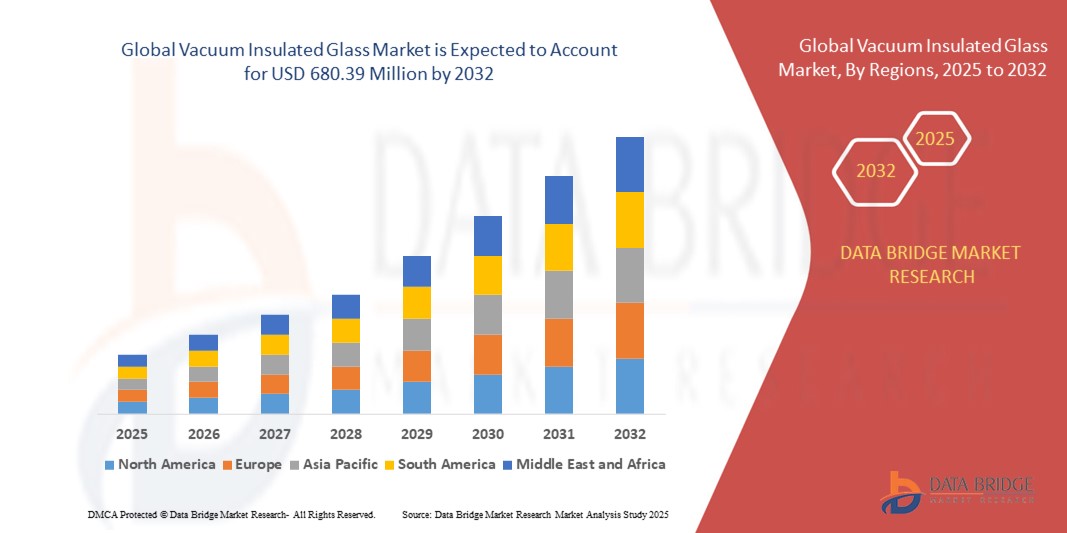
What is the Global Vacuum Insulated Glass Market Size and Growth Rate?
- The global vacuum insulated glass market size was valued at USD 414.21 million in 2024 and is expected to reach USD 680.39 million by 2032, at a CAGR of 6.40% during the forecast period
- The essential factors contributing to the growth of the market include the increasing demand for energy-efficient building materials, stringent regulations promoting sustainability, and ongoing technological advancements in glass manufacturing. These factors collectively contribute to the growing adoption of vacuum-insulated glass worldwide in residential, commercial, and automotive sectors
What are the Major Takeaways of Vacuum Insulated Glass Market?
- The demand for construction materials that prioritize thermal efficiency is expanding. Vacuum insulated glass (VIG) has emerged as a solution, addressing the substantial heat transfer that often occurs through windows. By utilizing a vacuum-sealed space between multiple panes of glass, vacuum insulated glass minimizes thermal conduction, thereby significantly reducing heating and cooling losses in buildings. This enhanced insulation translates into tangible energy savings for occupants and reduces reliance on heating and cooling systems powered by fossil fuels
- Consequently, vacuum insulated glass contributes to cost savings and aligns with efforts to mitigate carbon emissions and combat climate change, making it a preferred choice for environmentally conscious construction projects globally
- Asia-Pacific dominated the vacuum insulated glass market with the largest revenue share of 32.71% in 2024, driven by rapid urbanization, rising disposable incomes, and a growing focus on energy-efficient building solutions
- Europe vacuum insulated glass market is expected to grow at the fastest CAGR of 6.74% during 2025 to 2032, driven by stringent energy-efficiency regulations, rising renovation activities, and growing demand for sustainable construction materials
- The dual glaze vacuum insulated glass segment dominated the market with the largest market revenue share of 64.3% in 2024, driven by its cost-effectiveness, lightweight structure, and widespread adoption in both residential and commercial projects
Report Scope and Vacuum Insulated Glass Market Segmentation
|
Attributes |
Vacuum Insulated Glass Key Market Insights |
|
Segments Covered |
|
|
Countries Covered |
North America
Europe
Asia-Pacific
Middle East and Africa
South America
|
|
Key Market Players |
|
|
Market Opportunities |
|
|
Value Added Data Infosets |
In addition to the insights on market scenarios such as market value, growth rate, segmentation, geographical coverage, and major players, the market reports curated by the Data Bridge Market Research also include in-depth expert analysis, pricing analysis, brand share analysis, consumer survey, demography analysis, supply chain analysis, value chain analysis, raw material/consumables overview, vendor selection criteria, PESTLE Analysis, Porter Analysis, and regulatory framework. |
What is the Key Trend in the Vacuum Insulated Glass Market?
Energy Efficiency and Smart Building Integration
- A significant trend in the global vacuum insulated glass (VIG) market is the increasing focus on energy efficiency and seamless integration with smart building technologies. VIG provides superior thermal insulation compared to conventional double- or triple-glazing, making it highly attractive for green buildings and net-zero energy targets
- For instance, AGC Inc. and Panasonic Corporation have collaborated to develop next-generation vacuum glazing solutions tailored for smart cities and sustainable infrastructure projects. Such innovations are aligning with global energy-efficiency standards and regulatory frameworks
- VIG also integrates with IoT-enabled building management systems (BMS) to optimize heating, cooling, and lighting loads. These systems analyze occupancy and external weather conditions to enhance building performance
- The growing adoption of smart glass technologies such as electrochromic and low-E coatings, combined with vacuum insulation, is reshaping expectations for modern architectural glass solutions
- Companies such as Nippon Sheet Glass Co., Ltd. are investing in advanced vacuum glazing that supports sustainable urban development, while Guardian Glass is expanding its portfolio for both commercial and residential energy-efficient buildings
- This trend highlights how smart, eco-friendly, and high-performance glazing is becoming central to modern construction, accelerating vacuum insulated glass’s role in the global transition toward sustainable and intelligent infrastructure
What are the Key Drivers of Vacuum Insulated Glass Market?
- The rising demand for energy-efficient buildings, coupled with stringent global regulations on carbon emissions and energy conservation, is driving growth in the vacuum insulated glass market
- For instance, in March 2024, LandGlass Technologies Co., Ltd. introduced advanced vacuum insulated glass solutions for commercial projects in China, targeting smart building integration and stricter national energy-efficiency codes
- Growing awareness among builders and homeowners about reducing heating and cooling costs is positioning vacuum insulated glass as a superior alternative to traditional insulating glass
- The surge in green building certifications (LEED, BREEAM, WELL) is also fueling demand, as vacuum insulated glass enables compliance with high-performance insulation standards
- In addition, urbanization and smart city initiatives are increasing the adoption of vacuum insulated glass in skyscrapers, hospitals, and commercial complexes where energy savings and acoustic insulation are critical
- With its thin profile, lightweight design, and superior insulation properties, vacuum insulated glass is emerging as a preferred choice in both residential and non-residential applications, contributing significantly to the global energy transition agenda
Which Factor is Challenging the Growth of the Vacuum Insulated Glass Market?
- A major challenge in the vacuum insulated glass market is its high manufacturing cost and limited large-scale availability compared to conventional glazing solutions. The complex production process, which involves maintaining a precise vacuum between glass panes, adds to cost pressures
- For instance, although companies such as Qinhuangdao Yiwo Glass Co., Ltd. in China are expanding VIG production, scalability and cost competitiveness remain critical hurdles for widespread adoption
- Another concern is the durability and long-term reliability of vacuum seals. Any seal failure can compromise insulation performance, leading to customer concerns about lifecycle value
- Similar to other advanced building materials, market awareness and adoption barriers persist among cost-sensitive builders and residential consumers, particularly in developing economies
- While governments are offering subsidies and incentives for energy-efficient construction, the premium pricing of VIG compared to standard double-glazing continues to hinder mass-market penetration
- Overcoming these barriers through technological advancements, improved manufacturing efficiency, and broader consumer education will be vital for unlocking the full growth potential of the vacuum insulated glass market in the coming decade
How is the Vacuum Insulated Glass Market Segmented?
The market is segmented on the basis of product, application, and end-use.
- By Product
On the basis of product, the vacuum insulated glass market is segmented into dual glaze vacuum insulated glass and triple glaze vacuum insulated glass. The dual glaze vacuum insulated glass segment dominated the market with the largest market revenue share of 64.3% in 2024, driven by its cost-effectiveness, lightweight structure, and widespread adoption in both residential and commercial projects. It is often preferred in retrofit applications due to easier installation and compatibility with standard window frames.
The triple glaze segment, however, is expected to witness the fastest CAGR from 2025 to 2032, fueled by rising demand for higher energy efficiency standards in colder regions and premium infrastructure projects.
- By Application
On the basis of application, the vacuum insulated glass market is segmented into roof lights, windows, doors, roof glazing, glass façade, and others. The windows segment accounted for the largest market revenue share of 48.7% in 2024, driven by rising residential and commercial window replacements aimed at improving energy efficiency and thermal comfort. Increasing urbanization and government initiatives promoting green buildings also contribute to strong adoption.
The glass façade segment is expected to witness the fastest CAGR during 2025–2032, as modern architectural designs emphasize aesthetics, natural lighting, and sustainability, particularly in large-scale commercial and office buildings.
- By End-Use
On the basis of end-use, the vacuum insulated glass market is segmented into residential, commercial, and industrial. The residential segment held the largest market revenue share of 55.2% in 2024, supported by growing demand for smart, energy-efficient homes and rising disposable incomes in urban areas. Adoption is further strengthened by government subsidies for energy-saving retrofits.
The commercial segment is projected to grow at the fastest CAGR from 2025 to 2032, driven by the expansion of office spaces, retail outlets, and institutional infrastructure requiring superior insulation and noise reduction solutions.
Which Region Holds the Largest Share of the Vacuum Insulated Glass Market?
- Asia-Pacific dominated the vacuum insulated glass market with the largest revenue share of 32.71% in 2024, driven by rapid urbanization, rising disposable incomes, and a growing focus on energy-efficient building solutions
- Consumers in the region highly value the thermal insulation, sustainability benefits, and integration of VIG into modern smart building projects, making it a preferred choice for both residential and commercial applications
- Government initiatives promoting green buildings and smart city developments further enhance adoption, alongside a booming construction sector across China, Japan, and India
China Vacuum Insulated Glass Market Insight
China vacuum insulated glass market captured the largest revenue share in 2024 within Asia-Pacific, supported by strong domestic manufacturing, rapid urban development, and the rising adoption of smart and energy-efficient building solutions. Consumers increasingly prioritize eco-friendly construction materials, while government-driven smart city initiatives further stimulate market demand. The availability of affordable local VIG products, along with technological advancements, solidifies China’s position as a global leader.
Japan Vacuum Insulated Glass Market Insight
Japan vacuum insulated glass market is growing steadily, fueled by the country’s tech-savvy culture, aging population, and emphasis on sustainability. Japan’s demand for advanced insulation and integration of VIG with smart home technologies is expanding across urban housing and commercial buildings. Strong innovation and adoption of eco-conscious building practices position Japan as a critical contributor to regional market growth.
India Vacuum Insulated Glass Market Insight
India vacuum insulated glass market is projected to expand at a notable CAGR during the forecast period, backed by rapid construction activity, increasing disposable incomes, and government-driven smart city initiatives. Rising awareness of energy savings and thermal comfort is prompting adoption across both residential and commercial projects. In addition, a surge in urban housing projects and infrastructure developments strengthens India’s growth outlook in the VIG industry.
Which Region is the Fastest Growing Region in the Vacuum Insulated Glass Market?
Europe vacuum insulated glass market is expected to grow at the fastest CAGR of 6.74% during 2025 to 2032, driven by stringent energy-efficiency regulations, rising renovation activities, and growing demand for sustainable construction materials. Europe’s commitment to carbon reduction and green buildings is positioning VIG as a key solution for the future of residential and commercial infrastructure.
Germany Vacuum Insulated Glass Market Insight
Germany vacuum insulated glass market is projected to witness strong growth, driven by the country’s innovation-driven construction sector and regulatory focus on eco-friendly solutions. The integration of VIG into smart homes and modern offices is expanding, supported by consumer demand for energy-efficient, durable, and sustainable insulation solutions.
U.K. Vacuum Insulated Glass Market Insight
U.K. vacuum insulated glass market is anticipated to grow at a robust CAGR, fueled by rising awareness of energy savings, modernization of old housing infrastructure, and a preference for smart and connected building solutions. In addition, government-backed energy efficiency policies are accelerating the replacement of conventional glazing with advanced VIG solutions across residential and commercial sectors.
France Vacuum Insulated Glass Market Insight
France vacuum insulated glass market is witnessing increasing adoption, supported by the country’s focus on sustainable urban development, energy-efficient renovations, and strict regulatory frameworks. The integration of VIG into public infrastructure and housing projects is gaining traction, as consumers and developers embrace long-term energy savings and improved building performance.
Which are the Top Companies in Vacuum Insulated Glass Market?
The vacuum insulated glass industry is primarily led by well-established companies, including:
- Assa Abloy (Sweden)
- Allegion (Ireland)
- Kwikset (U.S.)
- Yale (Sweden)
- August Home (U.S.)
- Schlage (U.S.)
- Level Lock (U.S.)
- Lockly (U.S.)
- U-tec (U.S.)
- TP-Link (China)
- Eufy Security (China)
- Aqara (China)
- Nuki (Austria)
- Danalock (Denmark)
- Samsung SmartThings (South Korea)
- Honeywell (U.S.)
- Brinks Home (U.S.)
- Vivint (U.S.)
- ZKTeco (China)
- Tesa (Spain)
What are the Recent Developments in Global Vacuum Insulated Glass Market?
- In September 2024, Vitro Architectural Glass’s VacuMax Vacuum Insulating Glass (VIG) received the 2024 Best of Products Award from The Architect’s Newspaper, recognized for its innovation, aesthetics, performance, and value, highlighting the company’s strong leadership in advanced glass solutions
- In April 2024, AGC Inc. obtained its first Environmental Product Declaration (EPD) for domestically manufactured and sold architectural glass at its Kashima plant, marking a pivotal milestone that strengthens its commitment to sustainability and transparency in production
- In March 2024, Şişecam completed the construction of its largest glass production complex in Eskişehir, Turkey, with a consolidated capacity of around 1 million tons following an investment of USD 174 million, reinforcing its global production capabilities and market presence
- In September 2022, Schüco introduced the AWS 75.SI+ Optimized aluminum window system, allowing for moderate temperatures at home or in offices by meeting passive house standards with Uf values at 0.94 W/(m²K)
- In July 2020, Guardian Glass launched a new glass coater in Czestochowa, Poland, using advanced technology to convert standard float glass into high-performance, value-added glass, thereby boosting the production of low-emissivity (low-E) solar control glass for residential and commercial use

- Interactive Data Analysis Dashboard
- Company Analysis Dashboard for high growth potential opportunities
- Research Analyst Access for customization & queries
- Competitor Analysis with Interactive dashboard
- Latest News, Updates & Trend analysis
- Harness the Power of Benchmark Analysis for Comprehensive Competitor Tracking
Global Vacuum Insulated Glass Market, Supply Chain Analysis and Ecosystem Framework
To support market growth and help clients navigate the impact of geopolitical shifts, DBMR has integrated in-depth supply chain analysis into its Global Vacuum Insulated Glass Market research reports. This addition empowers clients to respond effectively to global changes affecting their industries. The supply chain analysis section includes detailed insights such as Global Vacuum Insulated Glass Market consumption and production by country, price trend analysis, the impact of tariffs and geopolitical developments, and import and export trends by country and HSN code. It also highlights major suppliers with data on production capacity and company profiles, as well as key importers and exporters. In addition to research, DBMR offers specialized supply chain consulting services backed by over a decade of experience, providing solutions like supplier discovery, supplier risk assessment, price trend analysis, impact evaluation of inflation and trade route changes, and comprehensive market trend analysis.
Data collection and base year analysis are done using data collection modules with large sample sizes. The stage includes obtaining market information or related data through various sources and strategies. It includes examining and planning all the data acquired from the past in advance. It likewise envelops the examination of information inconsistencies seen across different information sources. The market data is analysed and estimated using market statistical and coherent models. Also, market share analysis and key trend analysis are the major success factors in the market report. To know more, please request an analyst call or drop down your inquiry.
The key research methodology used by DBMR research team is data triangulation which involves data mining, analysis of the impact of data variables on the market and primary (industry expert) validation. Data models include Vendor Positioning Grid, Market Time Line Analysis, Market Overview and Guide, Company Positioning Grid, Patent Analysis, Pricing Analysis, Company Market Share Analysis, Standards of Measurement, Global versus Regional and Vendor Share Analysis. To know more about the research methodology, drop in an inquiry to speak to our industry experts.
Data Bridge Market Research is a leader in advanced formative research. We take pride in servicing our existing and new customers with data and analysis that match and suits their goal. The report can be customized to include price trend analysis of target brands understanding the market for additional countries (ask for the list of countries), clinical trial results data, literature review, refurbished market and product base analysis. Market analysis of target competitors can be analyzed from technology-based analysis to market portfolio strategies. We can add as many competitors that you require data about in the format and data style you are looking for. Our team of analysts can also provide you data in crude raw excel files pivot tables (Fact book) or can assist you in creating presentations from the data sets available in the report.













