What is the Video Door Phones Market Size and Growth Rate?
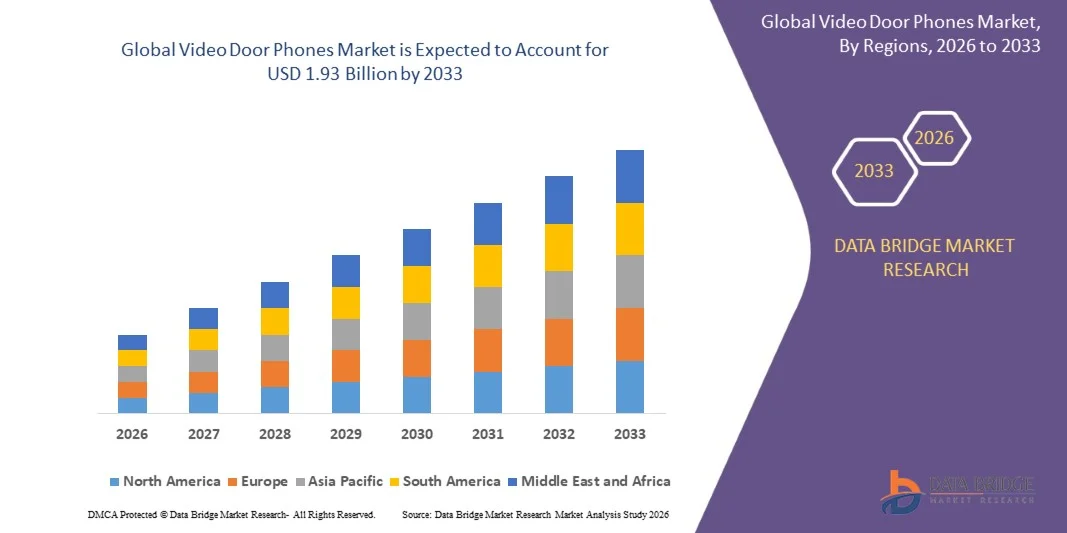
- As per Data Bridge Market Research analysis, the video door phones market was valued at USD 1.18 billion in 2025 and is projected to reach USD 1.93 billion by 2033, growing at a CAGR of 6.40% from 2026 to 2033.
- The market is experiencing consistent growth driven by rising demand for advanced residential and commercial security solutions, increasing adoption of smart home technologies, and growing integration of video door phones with connected access control and surveillance systems.
- The increasing focus on property security, combined with the rapid expansion of smart homes and connected buildings, is compelling homeowners, businesses, and institutions to adopt advanced video door phone systems. Wired and wireless systems are increasingly being integrated with mobile applications, high-definition cameras, and remote access technologies, offering convenient, real-time visitor monitoring and enhanced security.
Market Size & Forecast
- Global Market Value (2025): USD 1.18 Billion
- Expected Market Value (2033): USD 1.93 Billion
- Forecast CAGR (2026–2033): 6.40%
- Leading Region in 2025: North America
- Fastest Growing Region: Asia Pacific
What are the Major Takeaways of the Video Door Phones Market?
- North America dominated the video door phones market with the largest revenue share of 35.4% in 2025, supported by high adoption of smart-home security systems, advanced technological infrastructure, and increasing demand for integrated access-control solutions.
- Asia-Pacific is expected to be the fastest-growing region at a CAGR of 7.6% from 2026 to 2033, fueled by rapid urbanization, expanding residential construction, rising security concerns, and growing adoption of smart-home technologies across China, India, and Japan.
- The wired door phones segment led the market with a 58.1% share in 2025, driven by its reliable connectivity, stable video transmission, and suitability for permanent residential and commercial installations.
- Wireless door phones are the fastest-growing type, projected to register a CAGR of 9.2%, reflecting the surge in adoption of smart homes and demand for flexible, easy-to-install security systems.
- The proximity cards segment dominated the access control category with a 55% revenue share in 2025, led by the broader dominance of card-based authentication within the access-control industry
- Digital/IP accounted for 40% of the market share in 2025, preferred by its ability to transmit high-quality audio and video through IP networks and integrate with other security systems.
- The sensors segment is the fastest-growing component category, with a CAGR of 10%, driven by increasing adoption of motion detection, proximity sensing, and intelligent security features
Report Scope and Video Door Phones Market Segmentation
|
Attributes |
Video Door Phones Key Market Insights |
|
Segments Covered |
|
|
Countries Covered |
North America
Europe
Asia-Pacific
Middle East and Africa
South America
|
|
Key Market Players |
|
|
Market Opportunities |
|
|
Value Added Data Infosets |
In addition to the insights on market scenarios such as market value, growth rate, segmentation, geographical coverage, and major players, the market reports curated by the Data Bridge Market Research also include in-depth expert analysis, pricing analysis, brand share analysis, consumer survey, demography analysis, supply chain analysis, value chain analysis, raw material/consumables overview, vendor selection criteria, PESTLE Analysis, Porter Analysis, and regulatory framework. |
What is the Key Trend in the Video Door Phones Market?
- AI-powered and connected video door phones are increasingly evolving into intelligent entry-management systems, combining video communication with facial recognition, smart alerts, remote monitoring, and integration with broader smart-home ecosystems.
- For instance, in April 2025, Panasonic unveiled its Smart Home Experience Centre in India, showcasing its Video Door Phone alongside smart cameras and smart door locks as part of a connected-home security ecosystem. This demonstrates the integration of video door phones with broader IoT-based home-security solutions.
- Manufacturers are increasingly integrating AI, cloud connectivity, and multiple wireless protocols to enable real-time visitor identification, remote access management, and communication between video door phones and other connected security devices.
- Smart-home integration is further expanding the functionality of video door phones, allowing doorbells and intercom systems to communicate with smart locks, lighting, cameras, mobile applications, and other connected devices.
- For instance, in March 2026, Hikvision launched its TalkVu IP Video Intercom series with multimodal access control supporting facial recognition, access cards, PIN codes, Bluetooth, QR codes, and mobile-app authorization, demonstrating the industry's shift toward AI-enabled, connected video door phones that combine visitor communication with intelligent access management.
- As residential complexes, gated communities, and commercial buildings increasingly prioritize connected security and remote access management, the adoption of AI-enabled and IoT-integrated video door phones is expected to accelerate, reinforcing intelligent entry management as a core market trend
What are the Key Drivers of the Video Door Phones Market?
- The rapid expansion of smart homes, connected buildings, and integrated security systems is significantly increasing demand for video door phones that provide real-time visitor identification, two-way communication, remote monitoring, and controlled access.
- For instance, in July 2024, Panasonic Life Solutions India launched a new range of video door phones for residential buildings and standalone homes, including IP-integrated models with Wi-Fi, mobile-app access, motion-detection alerts, CCTV integration, and electric-lock integration. The launch directly reflects rising demand for connected and integrated home-security solution
- Residential developers, homeowners, and commercial property operators are increasingly integrating video door phones with smart locks, surveillance cameras, mobile applications, and cloud-based platforms to improve security while enabling centralized access management.
- For instance, in July 2025, Aqara announced global availability of its Doorbell Camera Hub G410, combining 2K video, on-device facial recognition, mmWave presence detection, and Matter, Thread, Zigbee, and Wi-Fi connectivity, while supporting more than 50 types of third-party Matter-compatible devices. This demonstrates the increasing convergence of video door phones with smart-home ecosystems.
- With smart-home penetration and connected-building infrastructure continuing to expand, video door phones will remain an important component of modern access-control and residential security ecosystems, supporting sustained market adoption.
Which Factors are Challenging the Growth of the Video Door Phones Market?
- Advanced video door phones require higher upfront investment because of high-resolution cameras, AI-based recognition, cloud connectivity, smart displays, wireless communication modules, and integration with other security systems.
- For instance, in July 2025, TechRadar highlighted that advanced video doorbells can involve ongoing subscription costs for cloud storage and premium features, making the total cost of ownership higher for users who require advanced monitoring capabilities
- These higher costs can limit adoption among price-sensitive residential consumers, small property developers, and smaller commercial facilities, particularly in emerging markets where basic access-control systems remain more affordable.
- The increasing dependence on network connectivity and cloud-based services also adds installation, maintenance, cybersecurity, and data-management requirements, which can increase the total cost of ownership for users and building operators.
- For instance, in January 2025, Arlo updated its Arlo Secure subscription plans and introduced expanded cloud-storage and AI-powered security capabilities; its current plans include features such as person and vehicle recognition, package and animal detection, and cloud video history.
- The combination of higher equipment costs, installation requirements, network dependency, and ongoing software or cloud-service expenses continues to restrict adoption among cost-sensitive users, slowing penetration of advanced video door phone technologies despite increasing security demand.
How is the Video Door Phones Market Segmented?
The video door phones market is segmented on the basis of type, access control, technology, component, and end users
- By Type
On the basis of type, the video door phones market is segmented into wired door phones and wireless door phones. The wired door phones segment dominated the market with 58.1% share in 2025, owing to reliable connectivity, stable video transmission, and suitability for permanent residential and commercial installations. These systems are widely deployed in apartment complexes, offices, hospitals, and institutional buildings where dependable communication is essential. Wired systems generally provide consistent performance without dependence on wireless signal strength or battery availability. They can also be integrated with electric locks, CCTV systems, and centralized access-control infrastructure. Their established installation base and reliability continue to support their strong position in the global market.
The wireless door phones segment is projected to register the fastest growth at a CAGR of 9.2% during forecast period, driven by increasing adoption of smart homes and demand for flexible, easy-to-install security systems. Wireless systems reduce the need for extensive cabling, making them attractive for existing buildings and residential properties undergoing security upgrades. Wi-Fi and Bluetooth connectivity enables users to receive visitor notifications and communicate remotely through smartphones. Integration with smart locks, cameras, cloud platforms, and other connected-home devices is further expanding their functionality. Improvements in wireless reliability and video quality are supporting wider adoption. Growing preference for connected and remotely managed security solutions is expected to accelerate segment growth.
- By Access Control
On the basis of access control, the video door phones market is segmented into fingerprint readers, proximity cards, keypad for secret numbers, and bluetooth triggered by mobile phone. The proximity cards segment dominated the market with 55% share in 2025, reflecting the broader dominance of card-based authentication within the access-control industry. Proximity-based access provides convenient authentication without requiring physical keys. These systems are widely applicable across residential complexes, offices, hotels, healthcare facilities, and institutional buildings. Property managers can issue, deactivate, and manage credentials according to individual access requirements. Their established infrastructure and straightforward operation continue to support widespread deployment.
The bluetooth triggered by mobile phone segment is expected to witness the fastest growth at a CAGR of 9.0% during forecast period, supported by increasing smartphone penetration and the expansion of mobile-based access control. Mobile credentials eliminate the need for users to carry separate physical access cards. Bluetooth connectivity also enables integration between video door phones, smart locks, mobile applications, and building-management systems. The technology is particularly suitable for smart residential buildings, offices, hotels, and gated communities. Growing preference for touchless and convenient access is further supporting adoption. The broader shift toward mobile credentials and connected access-control ecosystems is expected to accelerate this segment.
- By Technology
On the basis of technology, the video door phones market is segmented into analog, digital/IP, smart/IoT-enabled, cloud-connected, and AI-enabled systems. The digital/IP segment dominated the market with 40% share in 2025, supported by its ability to transmit high-quality audio and video through IP networks and integrate with other security systems. IP-based systems can connect video door phones with CCTV cameras, access-control platforms, computers, and mobile devices. They are particularly suitable for large residential complexes, commercial buildings, and multi-tenant properties requiring centralized management. Power-over-Ethernet capabilities can also simplify installation in suitable buildings. Increasing modernization of building-security infrastructure continues to support demand for digital/IP systems.
The AI-enabled segment is projected to register the fastest growth at a CAGR of 12% during forecast period, driven by increasing demand for intelligent visitor identification and automated security functions. AI-enabled systems can incorporate facial recognition, person detection, intelligent alerts, and automated visitor classification. These capabilities allow users and property managers to distinguish recognized visitors from unknown individuals more efficiently. Integration of AI with high-definition cameras and edge processing is improving the speed of visitor identification. AI-based video analytics are also creating opportunities for more proactive residential and commercial security management. Increasing investment in intelligent access-control technologies is expected to accelerate adoption of AI-enabled video door phones.
- By Component
On the basis of component, the video door phones market is segmented into cameras, sensors, LED/LCD, microphones/speech unit, and others. The cameras segment dominated the market with 35% share in 2025, owing to the essential role of video capture in visitor identification and property surveillance. High-definition and wide-angle cameras are increasingly being incorporated to improve visibility around entrances and access points. Advanced cameras can support low-light imaging, motion detection, recording, and integration with video-management systems. The transition from basic audio intercoms toward video-based security solutions is increasing demand for camera components. Integration with AI analytics is further enhancing their functionality. Their fundamental role in visual verification makes cameras a core component of video door phone systems.
The sensors segment is projected to register the fastest growth at a CAGR of 10% during forecast period, driven by increasing adoption of motion detection, proximity sensing, and intelligent security features. Sensors enable systems to detect movement around entrances and activate alerts or recording functions when activity is identified. Integration with AI-enabled video analytics can improve the ability to distinguish people from other movements. Sensors also support smart-home automation by triggering connected lighting, locks, cameras, or other security devices. Increasing demand for energy-efficient and automated security systems is encouraging manufacturers to incorporate sophisticated sensing capabilities. Growing deployment of connected access-control systems is expected to further accelerate sensor adoption.
- By End Users
On the basis of end users, the video door phones market is segmented into education, government, residential, commercial, healthcare, and others. The residential segment dominated the market with 64% share in 2025, supported by increasing adoption of smart-home security systems and connected residential automation technologies. Homeowners and residential developers are increasingly using video door phones for visitor management, burglary prevention, and controlled access. Integration with smartphones enables remote communication and access management when occupants are away. Residential complexes and gated communities are increasingly combining video door phones with CCTV, smart locks, and centralized security systems. Rising urbanization and expansion of smart housing projects are further supporting demand. Growing consumer preference for convenient and technologically advanced home-security solutions continues to strengthen residential dominance.
The commercial segment is projected to register the fastest growth at a CAGR of 8.4% during forecast period, driven by increasing security requirements across offices, hotels, retail properties, corporate facilities, and other commercial buildings. Commercial users require reliable visitor identification and controlled access to protect employees, customers, assets, and sensitive areas. IP-based video door phones can be integrated with existing CCTV, access-control, and building-management systems. Mobile and cloud connectivity also enables centralized monitoring across multiple entrances and locations. Increasing adoption of smart-building technologies is encouraging businesses to upgrade conventional intercom systems. Rising security investments and demand for efficient visitor-management solutions are expected to accelerate commercial adoption.
Which Region Holds the Largest Share of the Video Door Phones Market?
- North America dominated the video door phones market with the largest revenue share of 35.4% in 2025, supported by high adoption of smart-home security systems, advanced technological infrastructure, and increasing demand for integrated access-control solutions.
- The region also benefits from widespread adoption of wireless connectivity, mobile-based monitoring, cloud-enabled security systems, and AI-powered surveillance technologies, allowing video door phones to provide remote visitor verification and integrated access management. Rising residential development, growing security awareness, and increasing integration of video door phones with smart locks, cameras, and other connected devices are further supporting regional demand.
U.S. Video Door Phones Market Insight
The U.S. video door phones market is witnessing strong growth due to rising investments in smart-home security, connected access-control systems, and residential surveillance technologies. The country’s mature home-automation ecosystem, along with increasing adoption of AI-powered, wireless, cloud-connected, and mobile-enabled video door phones, is driving demand across residential and commercial applications. In addition, growing emphasis on property security, remote visitor monitoring, and integration with smart locks and security cameras is accelerating video door phone adoption across households, offices, and multi-family properties.
Asia-Pacific Video Door Phones Market Insight
The Asia-Pacific video door phones market is expected to witness rapid growth, driven by increasing urbanization, expanding residential construction, and rising investments in smart-building and security infrastructure across countries such as China, India, and Japan. Growing awareness regarding residential security, rising adoption of connected-home technologies, and increasing demand for affordable and scalable access-control solutions are supporting regional market expansion. In addition, the growing development of gated communities, apartment complexes, and commercial buildings is accelerating video door phone adoption across residential and institutional sectors.
Japan Video Door Phones Market Insight
The Japan video door phones market is witnessing consistent growth due to rising investments in advanced residential security technologies, smart-home systems, and integrated access-control solutions. Homeowners, apartment developers, commercial facilities, and security-conscious consumers are increasingly adopting video door phones for visitor identification, remote monitoring, and controlled entry. Moreover, increasing integration of high-definition cameras, mobile connectivity, sensors, and smart-home technologies, together with Japan’s focus on advanced and convenient living environments, is further contributing to market growth.
China Video Door Phones Market Insight
The China video door phones market is growing rapidly, driven by increasing urbanization, expanding residential construction, and rising demand for smart-home and intelligent building technologies. Growing adoption of AI-enabled, IP-based, and wireless video door phone systems across residential, commercial, and institutional sectors is significantly boosting market demand. In addition, rising investments in smart cities, property security, and connected-building infrastructure, along with rapid technological advancements, are positioning China as one of the fastest-growing markets for video door phones globally.
U.K. Video Door Phones Market Insight
The U.K. video door phones market is experiencing steady growth, supported by rising adoption of smart-home security technologies, connected access-control systems, and video surveillance solutions. Increasing investments in advanced video door phone infrastructure and growing demand for convenient, remote, and contactless visitor-management solutions are contributing to market growth. Furthermore, integration of AI, cloud connectivity, mobile applications, and smart locks is improving system functionality and security, positioning the U.K. as an important market for advanced video door phone technologies.
Germany Video Door Phones Market Insight
The Germany video door phones market is expanding steadily due to the country’s strong building-security infrastructure, increasing smart-building adoption, and growing demand for advanced access-control technologies. Residential developers, commercial facilities, offices, and institutional organizations are increasingly utilizing video door phones for visitor identification, controlled access, and security monitoring. Continuous advancements in IP connectivity, AI integration, mobile access, and smart-home technologies, along with strong emphasis on building security and digitalization, are further driving market growth in Germany.
Which are the Top Companies in Video Door Phones Market?
The video door phones industry is primarily led by well-established companies, including:
- Aiphone Corporation (Japan)
- Panasonic (Japan)
- Hangzhou Hikvision Digital Technology Co., Ltd. (China)
- Akuvox (China)
- FERMAX (Spain)
- URMET S.p.A. (Italy)
- Comelit Group S.p.A. (Italy)
- S. Siedle & Söhne OHG (Germany)
- ABB (Switzerland)
- Legrand (France)
- Vimar SpA (Italy)
- Golmar Sistemas de Comunicación S.A. (Spain)
- KOCOM Co., Ltd. (South Korea)
- Fanvil Technology Co., Ltd. (China)
- DNAKE (XIAMEN) INTELLIGENT TECHNOLOGY CO., LTD. (China)
- ZKTECO CO., LTD. (China)
- Axis Communications AB (Sweden)
- Alpha Communications (U.S.)
- Commend International GmbH (Austria)
What are Latest Developments in Video Door Phones Market?
- In July 2025, Aqara announced the global availability of its Doorbell Camera Hub G410, combining 2K video, on-device facial recognition, a built-in presence sensor, and Matter smart-home hub functionality. The device supports dual-band Wi-Fi, Thread, Zigbee, and Bluetooth and can connect with more than 50 types of third-party Matter-compatible devices. The launch highlights the growing convergence of video door phones with AI-powered security and connected-home ecosystems.
- In April 2025, Panasonic India launched a Smart Home Experience Centre in New Delhi, featuring video door phones alongside surveillance cameras, smart door locks, and other connected-home technologies. Panasonic positioned its video door phone solutions as part of a multi-tier residential security ecosystem, including guard stations, lobby stations, door stations, and indoor video displays. The initiative demonstrates the increasing integration of video door phones with broader smart-home and security infrastructure
- In July 2024, Panasonic Life Solutions India launched a new range of video door phones for Indian real-estate developers and standalone households, comprising analog, hybrid, and IP-integrated models. The new products included 2MP high-definition cameras, Wi-Fi and mobile-app access, motion-detection alerts, RFID card unlocking, CCTV integration, and electric-lock integration. The launch strengthened Panasonic's portfolio for connected residential security and remote visitor monitoring.
- In October 2023, Hikvision announced a new 2-wire HD intercom solution designed specifically for apartment buildings, providing a retrofit-oriented solution for residential access and communication. The system was developed to support apartment-building security while simplifying deployment through 2-wire infrastructure. The launch reflects continuing product development toward modernizing existing residential intercom installations and improving video-based access management.
- In November 2021, Axis Communications showcased the 2N IP Style Door Intercom with a digital touchscreen at its new Axis Experience Center in New York, highlighting the company's expansion of advanced access-control and intercom technologies. The IP Style incorporates a modern digital interface and forms part of Axis's broader portfolio combining intercom, access control, and security technologies. The development demonstrated the industry's movement toward sophisticated IP-based video intercom solutions for modern buildings.

- Interactive Data Analysis Dashboard
- Company Analysis Dashboard for high growth potential opportunities
- Research Analyst Access for customization & queries
- Competitor Analysis with Interactive dashboard
- Latest News, Updates & Trend analysis
- Harness the Power of Benchmark Analysis for Comprehensive Competitor Tracking
Data collection and base year analysis are done using data collection modules with large sample sizes. The stage includes obtaining market information or related data through various sources and strategies. It includes examining and planning all the data acquired from the past in advance. It likewise envelops the examination of information inconsistencies seen across different information sources. The market data is analysed and estimated using market statistical and coherent models. Also, market share analysis and key trend analysis are the major success factors in the market report. To know more, please request an analyst call or drop down your inquiry.
The key research methodology used by DBMR research team is data triangulation which involves data mining, analysis of the impact of data variables on the market and primary (industry expert) validation. Data models include Vendor Positioning Grid, Market Time Line Analysis, Market Overview and Guide, Company Positioning Grid, Patent Analysis, Pricing Analysis, Company Market Share Analysis, Standards of Measurement, Global versus Regional and Vendor Share Analysis. To know more about the research methodology, drop in an inquiry to speak to our industry experts.
Data Bridge Market Research is a leader in advanced formative research. We take pride in servicing our existing and new customers with data and analysis that match and suits their goal. The report can be customized to include price trend analysis of target brands understanding the market for additional countries (ask for the list of countries), clinical trial results data, literature review, refurbished market and product base analysis. Market analysis of target competitors can be analyzed from technology-based analysis to market portfolio strategies. We can add as many competitors that you require data about in the format and data style you are looking for. Our team of analysts can also provide you data in crude raw excel files pivot tables (Fact book) or can assist you in creating presentations from the data sets available in the report.