


What is the Viral Vector Analytical Testing Market Size and Growth Rate?
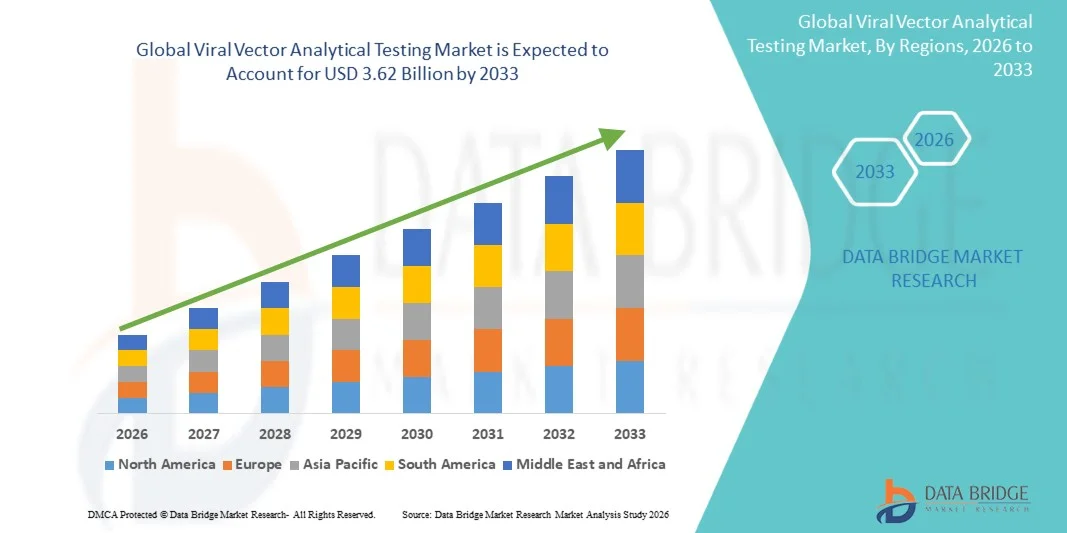
- As per Data Bridge Market Research analysis, the viral vector analytical testing market was valued at USD 1.28 billion in 2025 and is projected to reach USD 3.62 billion by 2033, growing at a CAGR of 13.90% from 2026 to 2033.
- The market is experiencing consistent growth driven by the rising number of gene and cell therapy programs, stringent regulatory expectations for vector quality, and increasing outsourcing of release and characterization testing to specialized laboratories and contract development and manufacturing organizations across pharmaceutical, biotechnology, and academic sectors.
- The increasing approvals of AAV-based gene therapies, expanding clinical pipelines, and growing need for standardized assays for capsid content, potency, purity, and safety, combined with adoption of orthogonal and high-resolution analytical technologies, is supporting market adoption. Analytical testing is being applied across viral vector manufacturing, gene therapy development, and genome editing programs, offering developers reliable data to support release, comparability, and regulatory submissions.
Market Size & Forecast
- Global Market Value (2025): USD 1.28 Billion
- Expected Market Value (2033): USD 3.62 Billion
- Forecast CAGR (2026–2033): 13.90%
What are the Major Takeaways of the Viral Vector Analytical Testing Market?
- North America dominated the viral vector analytical testing market with the largest revenue share of 42.62% in 2025, supported by a large concentration of gene and cell therapy developers, specialized CDMOs, and contract testing laboratories.
- Asia-Pacific is expected to be the fastest-growing region at a CAGR of 16.93% from 2026 to 2033, fueled by expanding cell and gene therapy pipelines, rising biomanufacturing investment, and growing outsourcing of testing.
- The adeno-associated virus (AAV) segment led the market with a 52.71% share in 2025, driven by its position as the leading platform for in vivo gene therapy and a growing list of approved products.
- Lentivirus is the fastest-growing vector type, projected to register a CAGR of 16.28%, reflecting expansion of CAR-T and other gene-modified cell therapy programs.
- The purity and impurity segment dominated the test type category with a 33.66% share in 2025, led by regulatory focus on empty capsids, residual DNA, and other product- and process-related impurities.
- Gene therapy accounted for 58.92% of the market share in 2025, preferred by the rising number of approved and clinical-stage vector-based therapies for rare and genetic diseases.
- The cell therapy segment is the fastest-growing application category, with a CAGR of 16.58%, driven by increasing use of lentiviral vectors in transduction of CAR-T and other engineered cells.
Report Scope and Viral Vector Analytical Testing Market Segmentation
|
Attributes |
Viral Vector Analytical Testing Key Market Insights |
|
Segments Covered |
|
|
Countries Covered |
North America
Europe
Asia-Pacific
Middle East and Africa
South America
|
|
Key Market Players |
|
|
Market Opportunities |
|
|
Value Added Data Infosets |
In addition to the insights on market scenarios such as market value, growth rate, segmentation, geographical coverage, and major players, the market reports curated by the Data Bridge Market Research also include in-depth expert analysis, patient epidemiology, pipeline analysis, pricing analysis, and regulatory framework. |
What is the Key Trend in the Viral Vector Analytical Testing Market?
- Viral vector analytical testing is increasingly evolving from single-assay release testing toward orthogonal, platform-based analytical packages that combine capsid content, genome integrity, potency, impurity, and safety assessments, supported by technologies such as charge detection mass spectrometry, mass photometry, droplet digital PCR, and next-generation sequencing.
- For instance, in May 2024, according to Charles River Laboratories, the company launched AAV and lentiviral vector reference materials with supporting case study data to streamline the transition of cell and gene therapy programs to GMP, enabling developers to compare analytical methods and demonstrate comparability using common materials
- Qualified reference materials and harmonized methods are becoming central to analytical strategy, as developers and laboratories seek to reduce variability between sites and between techniques.
- Outsourced testing providers are expanding capacity, automation, and method portfolios, while CDMOs integrate analytical development with manufacturing to shorten timelines from process development to GMP release.
- For instance, in October 2025, according to Waters Corporation, charge detection mass spectrometry measured empty and full AAV capsids across serotypes with average masses of 3.73 MDa and 5.08 MDa respectively and a mass excess below 1.1%, illustrating the move toward high-resolution direct particle measurement for capsid content analysis
- As gene therapy approvals increase and regulators expect well-characterized vector products, viral vector analytical testing is expected to expand from basic release testing into comprehensive characterization, comparability, and lifecycle support.
What are the Key Drivers of the Viral Vector Analytical Testing Market?
- The growing number of approved and late-stage viral vector-based therapies has significantly increased demand for validated analytical methods that confirm identity, strength, purity, potency, and safety of each vector batch.
- For instance, in April 2026, according to the U.S. Food and Drug Administration (FDA), Otarmeni (lunsotogene parvec-cwha), described as the first dual AAV vector-based gene therapy, was approved for OTOF gene-associated hearing loss, with approval granted 61 days after biologics license application submission under the Commissioner’s National Priority Voucher pilot program, highlighting the need for analytical packages that can support rapid review of complex vector products.
- Gene therapy developers, cell therapy companies, and CDMOs are investing in comprehensive analytical packages to support release, comparability after process changes, stability studies, and regulatory submissions.
- For instance, in September 2026, according to the U.S. FDA, Fayuvi, a one-time intravenous AAV9-based gene therapy delivering a working copy of the SGSH gene, was approved as the first gene therapy for pediatric patients with Sanfilippo syndrome type A, adding to the growing list of commercial AAV products that require validated release testing.
- With regulators expecting product- and process-related impurities to be identified and reported, developers are increasingly relying on specialized laboratories and advanced analytical technologies to meet quality requirements.
What Factors Are Challenging the Growth of the Viral Vector Analytical Testing Market?
- Viral vector analytical testing requires specialized instrumentation, qualified reference materials, and highly trained scientists, and assays for potency, capsid content, and infectivity are complex to develop, qualify, and transfer between laboratories.
- For instance, in December 2024, according to Human Gene Therapy, an interlaboratory study conducted by the National Institute of Standards and Technology with industry and pharmacopeial partners found that analytical ultracentrifugation showed about 25% standard deviation between laboratories for 50:50 mixtures of full and empty AAV capsids, while optical methods such as UV spectroscopy and SEC-MALS showed less than 10%, highlighting the need for standardized methods.
- Lack of harmonized methods and limited availability of universally accepted reference standards can lead to different results across laboratories, complicating comparability and regulatory discussions.
- Limited sample volumes, short timelines for clinical programs, and capacity constraints at specialized testing laboratories can also delay release testing and increase costs, particularly for small developers.
- For instance, in February 2024, according to Gene Therapy, researchers reported that AAV preparations contain full, intermediate, and empty capsids, and evaluated the impact of intermediate capsids, which can contain sub-genomic species, plasmid fragments, or residual host-cell DNA, on potency, indicating that additional orthogonal methods are needed to characterize them.
- The combination of method variability, specialized skill requirements, long validation timelines, and capacity limits can constrain adoption among cost-sensitive developers and slow the introduction of new analytical technologies.
How is the Viral Vector Analytical Testing Market Segmented?
The viral vector analytical testing market is segmented on the basis of vector type, test type, application, and end user.
- By Vector Type
On the basis of vector type, the viral vector analytical testing market is segmented into adeno-associated virus (AAV), lentivirus, adenovirus, and others. The AAV segment dominated the market with 52.71% share in 2025, supported by its position as the leading platform for in vivo gene therapy and a growing list of approved products. AAV programs require extensive testing of genome titer, capsid content, purity, potency, and replication-competent virus, creating high analytical demand per batch. Product-related impurities such as empty and intermediate capsids must be quantified, and regulators expect these to be reported as ratios. Rising numbers of clinical programs and commercial products continue to expand testing volumes.
The lentivirus segment is projected to register the fastest growth at a CAGR of 16.28% from 2026 to 2033, driven by its use in ex vivo gene-modified cell therapies, including CAR-T. Lentiviral vectors are enveloped and prone to losing infectivity, requiring careful infectious titer, integration, and replication-competent lentivirus testing. Growing CAR-T pipelines and the launch of standardized lentiviral manufacturing platforms by CDMOs are increasing demand for associated analytical services. Vector copy number, transgene expression, and potency assays are central to release of the final cell product, creating demand across development stages.
- By Test Type
On the basis of test type, the viral vector analytical testing market is segmented into titer and capsid characterization, potency, purity and impurity, safety, and others. The purity and impurity segment dominated the test type category with 33.66% share in 2025, supported by regulatory focus on process- and product-related impurities, including empty capsids, residual host-cell DNA and protein, plasmid DNA, and helper virus. Methods such as chromatography, analytical ultracentrifugation, electron microscopy, mass photometry, and mass spectrometry are used to profile impurities. The need to demonstrate batch-to-batch consistency and provide orthogonal confirmation leads to repeated testing across process development, release, and stability studies.
The potency segment is projected to register the fastest growth at a CAGR of 15.80% from 2026 to 2033, driven by regulatory expectations that potency assays reflect biological activity, such as transduction, transgene expression, and functional effect. Development of matrix approaches combining infectivity and activity-based assays is increasing analytical complexity. Cell-based assays require specialized expertise, qualified reference materials, and validation, encouraging outsourcing to specialized laboratories. As products approach commercialization, demand for validated, release-ready potency assays rises sharply, supporting growth of this segment.
- By Application
On the basis of application, the viral vector analytical testing market is segmented into gene therapy, cell therapy, vaccinology, and others. The gene therapy segment dominated the application category with 58.92% share in 2025, supported by the growing number of approved AAV-based products for rare and genetic diseases and a large pipeline of clinical programs. Systemic and local delivery programs use high vector doses, increasing emphasis on purity, genome integrity, and safety testing. Regulatory approvals and accelerated review programs encourage sponsors to invest early in robust analytical packages. Long-term follow-up and comparability requirements after manufacturing changes also drive repeated testing.
The cell therapy segment is projected to register the fastest growth at a CAGR of 16.58% from 2026 to 2033, driven by growth of CAR-T and other gene-modified cell therapy programs that rely on lentiviral and retroviral vectors for transduction. Vector quality directly influences transduction efficiency and safety of the final cell product, so developers require infectivity, copy number, and replication-competent virus testing. Expansion of autologous and allogeneic programs, including those using gene-editing steps, is increasing testing needs across clinical stages. Outsourced analytical support allows developers to shorten timelines without building specialized laboratories.
- By End User
On the basis of end user, the viral vector analytical testing market is segmented into pharmaceutical & biotechnology companies, contract development and manufacturing organizations, academic & research institutes, and others. The pharmaceutical & biotechnology companies segment dominated the end-user category with 49.44% share in 2025, supported by growing internal and partnered gene therapy pipelines and the need for validated release assays to support regulatory submissions. Companies increasingly combine in-house quality control with outsourced specialty testing to manage capacity and technical complexity. Comparability studies after process changes, stability programs, and lot-release testing generate recurring demand.
The contract development and manufacturing organizations segment is projected to register the fastest growth at a CAGR of 16.01% from 2026 to 2033, driven by integration of analytical development and quality control testing within manufacturing offerings to shorten timelines. CDMOs are investing in platform assays, reference materials, and expanded laboratory capacity so clients can move from process development to GMP release under a single quality system. Demand from small and mid-sized developers without internal analytical infrastructure is rising, and fast-track offerings that compress development timelines depend on in-house accelerated analytical development and qualification.
Which Region Holds the Largest Share of the Viral Vector Analytical Testing Market?
- North America dominated the viral vector analytical testing market with the largest revenue share of 42.62% in 2025, supported by a large concentration of gene and cell therapy developers, specialized CDMOs, and contract testing laboratories.
- The region also benefits from active regulatory guidance on vector characterization, participation of national measurement and standards organizations in method harmonization, strong venture and public funding, and a steady flow of product approvals. Increasing use of advanced analytical technologies and outsourced testing continues to strengthen North America’s position in the global market.
U.S. Viral Vector Analytical Testing Market Insight
The U.S. viral vector analytical testing market is witnessing strong growth due to the presence of a large number of gene and cell therapy developers, specialized CDMOs, and contract testing laboratories. FDA approvals of AAV-based therapies, together with guidance expecting characterization of impurities such as empty capsids, are encouraging investment in analytical capabilities. In addition, participation of national standards and measurement organizations in method harmonization and wide availability of venture and public funding are accelerating adoption of advanced vector testing services.
Asia-Pacific Viral Vector Analytical Testing Market Insight
The Asia-Pacific viral vector analytical testing market is expected to witness rapid growth, driven by expanding cell and gene therapy pipelines, rising biomanufacturing investment, and growing outsourcing of testing in countries such as China, Japan, and India. Increasing regulatory convergence with international guidelines and development of local CDMOs and testing laboratories are improving access to GMP-grade analytical services. In addition, rising clinical trials of CAR-T and AAV-based therapies in the region are creating sustained demand for titer, potency, purity, and safety testing.
Japan Viral Vector Analytical Testing Market Insight
The Japan viral vector analytical testing market is witnessing consistent growth due to supportive regulatory frameworks for regenerative medicine, active gene therapy research, and a strong analytical instrumentation industry. Pharmaceutical companies, academic institutions, and CDMOs are increasingly investing in capsid characterization, potency, and safety testing capabilities. Moreover, emphasis on quality, precision, and reliability, along with rising domestic and international collaborations, is contributing to growth of viral vector analytical testing in Japan.
China Viral Vector Analytical Testing Market Insight
The China viral vector analytical testing market is growing rapidly, driven by a fast-expanding pipeline of AAV and lentiviral therapies, strong government support for biotechnology, and growth of domestic CDMOs. Developers are building in-house analytical laboratories while outsourcing specialized assays to qualified service providers. In addition, increasing clinical trials of CAR-T therapies and rising investment in gene therapy manufacturing are positioning China as a key growth market for viral vector analytical testing across Asia-Pacific.
U.K. Viral Vector Analytical Testing Market Insight
The U.K. viral vector analytical testing market is experiencing steady growth, supported by established viral vector manufacturers, cell and gene therapy innovation centers, and strong academic research. Companies in the country offer integrated development, manufacturing, and analytical services, including accelerated development programs for AAV and lentiviral vectors. Furthermore, participation in international consortia and growing interest in analytical platforms such as mass photometry are supporting wider adoption of viral vector testing in the U.K.
Germany Viral Vector Analytical Testing Market Insight
The Germany viral vector analytical testing market is expanding steadily due to the country’s strong biopharmaceutical manufacturing base, advanced analytical instrumentation sector, and established life science suppliers. Gene therapy developers, CDMOs, and research institutes are increasingly using orthogonal methods for capsid content, genome integrity, and impurity profiling. Continuous advancements in chromatography, mass spectrometry, and sequencing, along with Germany’s emphasis on quality and regulatory compliance, are further driving growth of viral vector analytical testing.
Which are the Top Companies in Viral Vector Analytical Testing Market?
The viral vector analytical testing industry is primarily led by well-established companies, including:
- Charles River Laboratories International, Inc. (U.S.)
- Eurofins Scientific SE (Luxembourg)
- Lonza Group AG (Switzerland)
- OXB plc (U.K.)
- Andelyn Biosciences (U.S.)
- Minaris (U.S.)
- SGS SA (Switzerland)
- WuXi AppTec Co., Ltd. (China)
- Thermo Fisher Scientific Inc. (U.S.)
- Merck KGaA (Germany)
- Catalent, Inc. (U.S.)
- uBriGene (U.S.)
- Bio-Rad Laboratories, Inc. (U.S.)
- Waters Corporation (U.S.)
- Agilent Technologies, Inc. (U.S.)
- Refeyn Ltd (U.K.)
- Sartorius AG (Germany)
- Revvity, Inc. (U.S.)
- SK pharmteco (South Korea)
- Danaher Corporation (U.S.)
What are Latest Developments in Viral Vector Analytical Testing Market?
- In September 2026, Minaris announced the addition of a dedicated Viral Vectors business unit, restructuring its operations into three units, Cell Therapies, Viral Vectors, and Advanced Testing, effective October 1, 2026, to bring greater focus to viral vector process and analytical development and testing services for cell and gene therapy developers.
- In May 2026, Andelyn Biosciences announced the launch of its LVV Curator platform, a standardized lentiviral vector manufacturing solution built on the modular approach that has supported more than 100 AAV programs, designed to help cell therapy developers transition from research-grade methods to GMP manufacturing.
- In April 2026, OXB launched a fast-track development and manufacturing offering for AAV and lentiviral vectors that can shorten the pathway to GMP manufacture of AAV vectors from an industry standard of about 15 months to as little as seven months, supported by in-house accelerated analytical development and qualification.
- In November 2025, the U.S. FDA approved Itvisma, an adeno-associated virus vector-based gene therapy for spinal muscular atrophy manufactured by Novartis Gene Therapies, expanding treatment across a broader range of ages and motor function levels and sustaining demand for validated AAV release testing.
- In January 2025, Bio-Rad Laboratories introduced Vericheck ddPCR Empty-Full Capsid Kits for AAV serotypes 2 and 8, adding to its existing kits for serotypes 5 and 9 and enabling determination of capsid titer, genome titer, and percentage of full capsids in purified or unpurified samples.

- Interactive Data Analysis Dashboard
- Company Analysis Dashboard for high growth potential opportunities
- Research Analyst Access for customization & queries
- Competitor Analysis with Interactive dashboard
- Latest News, Updates & Trend analysis
- Harness the Power of Benchmark Analysis for Comprehensive Competitor Tracking
Data collection and base year analysis are done using data collection modules with large sample sizes. The stage includes obtaining market information or related data through various sources and strategies. It includes examining and planning all the data acquired from the past in advance. It likewise envelops the examination of information inconsistencies seen across different information sources. The market data is analysed and estimated using market statistical and coherent models. Also, market share analysis and key trend analysis are the major success factors in the market report. To know more, please request an analyst call or drop down your inquiry.
The key research methodology used by DBMR research team is data triangulation which involves data mining, analysis of the impact of data variables on the market and primary (industry expert) validation. Data models include Vendor Positioning Grid, Market Time Line Analysis, Market Overview and Guide, Company Positioning Grid, Patent Analysis, Pricing Analysis, Company Market Share Analysis, Standards of Measurement, Global versus Regional and Vendor Share Analysis. To know more about the research methodology, drop in an inquiry to speak to our industry experts.
Data Bridge Market Research is a leader in advanced formative research. We take pride in servicing our existing and new customers with data and analysis that match and suits their goal. The report can be customized to include price trend analysis of target brands understanding the market for additional countries (ask for the list of countries), clinical trial results data, literature review, refurbished market and product base analysis. Market analysis of target competitors can be analyzed from technology-based analysis to market portfolio strategies. We can add as many competitors that you require data about in the format and data style you are looking for. Our team of analysts can also provide you data in crude raw excel files pivot tables (Fact book) or can assist you in creating presentations from the data sets available in the report.













