


Virtual Extensible LAN (VXLAN) Market Size
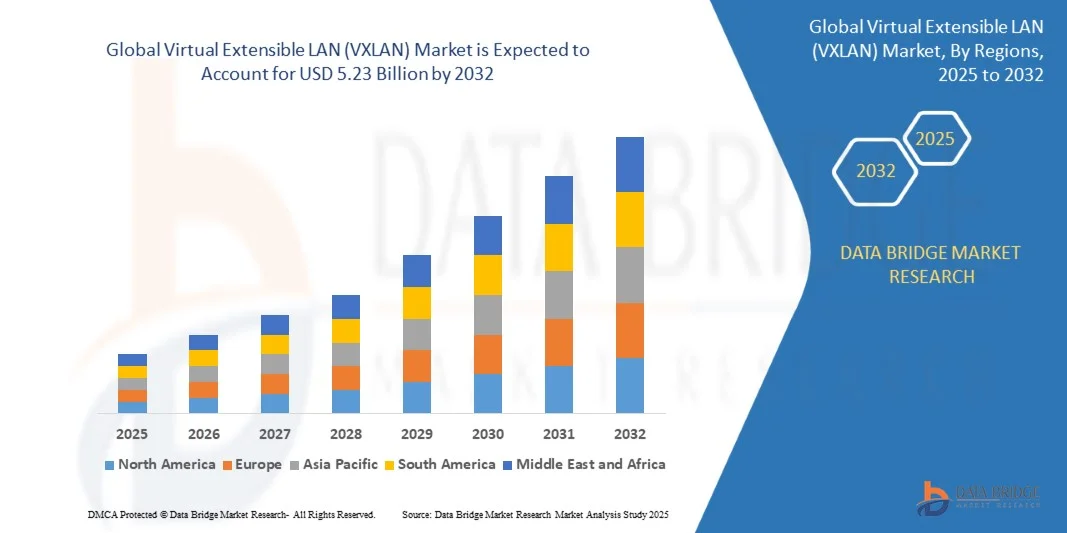
- The global Virtual Extensible LAN (VXLAN) market size was valued at USD 1.69 billion in 2024 and is expected to reach USD 5.23 billion by 2032, at a CAGR of 15.17% during the forecast period
- The market growth is largely fueled by the increasing adoption of cloud computing, virtualization, and software-defined networking (SDN) technologies across enterprises, leading to enhanced network scalability, segmentation, and efficiency in data centers, campus networks, and service-provider environments
- Furthermore, rising demand for secure, high-performance, and easily manageable network infrastructures is driving the adoption of VXLAN solutions. Organizations are increasingly prioritizing network automation, multi-tenant capabilities, and hybrid/edge connectivity, which are accelerating VXLAN deployment and significantly boosting market growth
Virtual Extensible LAN (VXLAN) Market Analysis
- VXLAN, providing overlay networking capabilities for large-scale Layer 2 and Layer 3 network virtualization, is becoming a critical component in modern enterprise, campus, and cloud networks due to its ability to simplify network management, optimize traffic, and enable seamless connectivity across distributed environments
- The escalating demand for VXLAN solutions is primarily fueled by the widespread adoption of virtualized infrastructures, the need for network segmentation and micro-segmentation, and growing enterprise focus on secure, flexible, and cost-efficient networking solutions that support cloud, hybrid, and edge deployments
- North America dominated the Virtual Extensible LAN (VXLAN) market with a share of 34.82% in 2024, due to the rapid adoption of cloud computing, virtualization, and software-defined networking (SDN) technologies
- Asia-Pacific is expected to be the fastest growing region in the Virtual Extensible LAN (VXLAN) market during the forecast period due to rapid digitalization, urbanization, and the increasing adoption of cloud computing and virtualization technologies in countries such as China, Japan, and India
- Data center segment dominated the market with a market share of 65.09% in 2024, due to the growing need for network virtualization, large-scale traffic management, and multi-tenant cloud infrastructure. VXLAN facilitates efficient network segmentation, enhanced bandwidth utilization, and simplified deployment of virtual networks, making it a core technology for modern data centers. Increasing migration toward hybrid and private cloud data centers also drives demand in this segment
Report Scope and Virtual Extensible LAN (VXLAN) Market Segmentation
|
Attributes |
Virtual Extensible LAN (VXLAN) Key Market Insights |
|
Segments Covered |
|
|
Countries Covered |
North America
Europe
Asia-Pacific
Middle East and Africa
South America
|
|
Key Market Players |
|
|
Market Opportunities |
|
|
Value Added Data Infosets |
In addition to the market insights such as market value, growth rate, market segments, geographical coverage, market players, and market scenario, the market report curated by the Data Bridge Market Research team includes in-depth expert analysis, import/export analysis, pricing analysis, production consumption analysis, and pestle analysis. |
Virtual Extensible LAN (VXLAN) Market Trends
“Growth of Hybrid and Multi-Cloud Network Adoption”
- The Virtual Extensible LAN (VXLAN) market is expanding rapidly as enterprises accelerate the adoption of hybrid and multi-cloud environments to improve scalability, flexibility, and connectivity between diverse IT infrastructures. VXLAN enables seamless communication across on-premises and cloud networks by overcoming the limitations of traditional VLAN architectures through enhanced network segmentation and overlay capabilities
- For instance, Cisco Systems and VMware have integrated VXLAN technology into their network virtualization platforms, such as Cisco ACI and VMware NSX, to optimize multi-cloud data center operations. These solutions allow organizations to link workloads across public and private clouds securely, ensuring reliable performance and simplified management
- The growing reliance on hybrid architectures is driving the need for VXLAN-based solutions that support virtualized workloads, containerized applications, and distributed edge environments. VXLAN’s encapsulation functionality facilitates scalable Layer 2 communication across IP-based networks, ensuring efficient traffic routing and isolation in complex topologies
- Enterprises are increasingly implementing VXLAN to streamline workload mobility and achieve consistent network configurations across hybrid data centers. This supports seamless resource allocation and policy enforcement while ensuring high availability in geographically dispersed infrastructures
- The rising trend of network automation and software-defined networking (SDN) is enhancing the adoption of VXLAN-enabled frameworks. These solutions empower organizations to dynamically provision network resources and optimize performance for modern applications reliant on hybrid and multi-cloud systems
- The continuous expansion of hybrid and multi-cloud deployments has positioned VXLAN as a key enabler of next-generation network architectures. Its ability to enhance scalability, interoperability, and agility ensures its central role in facilitating cloud convergence and digital transformation across enterprise and service provider ecosystems
Virtual Extensible LAN (VXLAN) Market Dynamics
Driver
“Increasing Enterprise Focus on Network Efficiency and Performance”
- The growing emphasis on achieving high network efficiency and performance is a primary driver influencing VXLAN market growth. Organizations are prioritizing network virtualization technologies that can support diverse workloads, optimize bandwidth utilization, and ensure low-latency connectivity across distributed applications
- For instance, Juniper Networks incorporates VXLAN technology into its Contrail Networking platform to enhance data center agility and improve traffic management efficiency. This integration enables enterprises to scale their network infrastructure seamlessly while maintaining consistent performance across hybrid environments
- VXLAN offers significant advantages by extending Layer 2 networks over Layer 3 infrastructure, allowing administrators to eliminate the limitations of traditional VLAN scalability. It enhances network utilization through efficient segmentation and encapsulation, enabling better load distribution and simplified management in virtualized architectures
- With increasing adoption of cloud-native and microservices-based applications, VXLAN provides the flexibility to interconnect numerous virtual machines and containers while maintaining operational security and isolation. This functionality meets enterprise needs for high-performance, multi-tenant data center environments
- The pursuit of optimized network performance combined with operational automation continues to drive enterprise investment in VXLAN-enabled solutions. These technologies reduce latency and bandwidth congestion and also ensure stable connectivity across modern IT ecosystems, solidifying VXLAN’s importance in advanced network design strategies
Restraint/Challenge
“Integration Complexity with Legacy Networks”
- The integration complexity associated with legacy network systems is a major challenge hindering widespread VXLAN adoption. Traditional infrastructure often lacks the compatibility and orchestration capabilities needed to support virtual network overlays, leading to implementation difficulties and higher integration costs
- For instance, enterprises migrating from traditional VLAN-based architectures to VXLAN face challenges related to interoperability and configuration management, especially in multivendor environments involving equipment from Cisco, Dell, and Huawei. These issues require advanced expertise and additional investment in network modernization initiatives
- Legacy systems often have limited support for automation, SDN controllers, and programmable network interfaces, making VXLAN deployment challenging. Organizations must reconfigure network architectures, retrain staff, and deploy new management tools to ensure functional coherence between old and new infrastructures
- The complexity of maintaining consistent network policies, monitoring virtual tunnels, and troubleshooting data flow across hybrid systems can slow deployment timelines. This impacts scalability and can increase operational risks if not managed effectively through advanced orchestration platforms
- Overcoming integration challenges will depend on embracing interoperable solutions, standardized network protocols, and comprehensive automation frameworks. Simplifying deployment through unified management tools and vendor collaboration will be essential to ensure seamless coexistence between traditional and virtualized network environments in the VXLAN ecosystem
Virtual Extensible LAN (VXLAN) Market Scope
The market is segmented on the basis of component, deployment mode, organization size, application, and end-user vertical.
• By Component
On the basis of component, the VXLAN market is segmented into hardware, software, and services. The software segment dominated the market with the largest revenue share of 55.18% in 2024, driven by the increasing reliance on software-defined networking solutions and virtualized infrastructure across enterprises. VXLAN software provides enhanced network scalability, seamless integration with existing data center and cloud architectures, and simplified network management. Enterprises increasingly prefer software solutions due to their flexibility, cost-effectiveness, and support for multi-tenant environments, which are crucial for modern data center operations. The adoption of network automation and orchestration tools further reinforces the demand for VXLAN software solutions.
The services segment is expected to witness the fastest growth from 2025 to 2032, fueled by rising demand for professional implementation, consulting, and managed VXLAN services. Organizations seek expert support for deployment, monitoring, and optimization of VXLAN networks, particularly in complex, large-scale cloud and hybrid environments. Managed services also provide continuous security, compliance, and performance monitoring, making them attractive for enterprises that lack extensive in-house networking expertise.
• By Deployment Mode
On the basis of deployment mode, the VXLAN market is segmented into on-premises and cloud-based. The cloud-based segment dominated the market in 2024 due to the accelerated adoption of cloud computing, hybrid architectures, and virtualization in enterprise networks. Cloud-based VXLAN offers scalability, centralized management, and simplified integration with virtual machines and containers, enabling organizations to optimize network performance without significant upfront infrastructure investment. The increasing adoption of multi-cloud and hybrid cloud strategies also supports the demand for cloud-deployed VXLAN solutions.
The on-premises segment is anticipated to witness the fastest growth from 2025 to 2032, driven by organizations seeking greater control, security, and customization for their internal networks. On-premises VXLAN deployment is preferred by enterprises with stringent data privacy requirements, sensitive workloads, or regulatory compliance mandates. The flexibility to design bespoke network topologies and directly manage hardware resources makes this segment appealing for large-scale IT and telecom networks.
• By Organization Size
On the basis of organization size, the VXLAN market is segmented into large enterprises and SMEs. The large enterprises segment dominated the market in 2024, owing to their extensive data center infrastructures, complex network requirements, and high adoption of advanced virtualization technologies. Large enterprises leverage VXLAN to enhance network scalability, reduce operational costs, and achieve seamless connectivity across geographically dispersed sites. The growing integration of AI and analytics into enterprise networks further reinforces VXLAN deployment for large organizations.
The SMEs segment is expected to witness the fastest growth from 2025 to 2032, driven by the increasing virtualization of IT infrastructure and adoption of cloud networking solutions among small and mid-sized enterprises. SMEs are focusing on cost-efficient, scalable, and easily deployable VXLAN solutions to enhance connectivity, optimize resource utilization, and support remote work environments. Managed VXLAN services and simplified deployment models further accelerate adoption among SMEs.
• By Application
On the basis of application, the VXLAN market is segmented into data center, campus networks, service-provider networks, and remote/edge sites. The data center segment dominated the market with a share of 65.09% in 2024, fueled by the growing need for network virtualization, large-scale traffic management, and multi-tenant cloud infrastructure. VXLAN facilitates efficient network segmentation, enhanced bandwidth utilization, and simplified deployment of virtual networks, making it a core technology for modern data centers. Increasing migration toward hybrid and private cloud data centers also drives demand in this segment.
The remote/edge sites segment is anticipated to witness the fastest growth from 2025 to 2032, driven by the expansion of edge computing, IoT deployments, and distributed enterprise networks. VXLAN enables secure and scalable connectivity between edge sites and centralized data centers, allowing organizations to manage workloads efficiently and reduce latency. The growth of Industry 4.0 and remote operational requirements further accelerates VXLAN adoption in edge deployments.
• By End-User Vertical
On the basis of end-user vertical, the VXLAN market is segmented into IT and telecom, BFSI, government and defense, healthcare, retail and e-commerce, and manufacturing. The IT and telecom segment dominated the market in 2024 due to the high demand for network virtualization, cloud adoption, and large-scale enterprise network deployments. Telecom providers and IT service organizations implement VXLAN to manage multi-tenant environments, enhance network efficiency, and support growing data traffic. Continuous investment in network modernization and cloud-native solutions reinforces the segment’s market dominance.
The BFSI segment is expected to witness the fastest growth from 2025 to 2032, driven by the need for secure, scalable, and reliable virtual networks to support digital banking, mobile transactions, and remote financial services. VXLAN enables BFSI organizations to segment networks, ensure high availability, and maintain compliance with strict regulatory standards. The increasing reliance on cloud-based financial platforms and disaster recovery solutions further accelerates VXLAN adoption in this sector.
Virtual Extensible LAN (VXLAN) Market Regional Analysis
- North America dominated the Virtual Extensible LAN (VXLAN) market with the largest revenue share of 34.82% in 2024, driven by the rapid adoption of cloud computing, virtualization, and software-defined networking (SDN) technologies
- Enterprises in the region prioritize scalable, high-performance, and secure network solutions to support growing data traffic and digital transformation initiatives. The presence of major data center operators, cloud service providers, and advanced IT infrastructure fosters extensive VXLAN deployment
- In addition, strong investment in network modernization and growing demand for multi-tenant environments in large enterprises are contributing to the market’s leadership in the region
U.S. Virtual Extensible LAN (VXLAN) Market Insight
The U.S. Virtual Extensible LAN (VXLAN) market captured the largest revenue share in 2024 within North America, fueled by increasing virtualization of enterprise networks and adoption of cloud-based services. Organizations are deploying VXLAN to achieve better network segmentation, scalability, and operational efficiency across data centers and campus networks. The growing integration of SDN and network automation tools, along with demand for remote access and edge connectivity, further drives market expansion. U.S. enterprises are also focusing on minimizing downtime and enhancing network security, supporting VXLAN adoption across both IT and telecom sectors.
Europe Virtual Extensible LAN (VXLAN) Market Insight
The Europe Virtual Extensible LAN (VXLAN) market is projected to expand at a substantial CAGR throughout the forecast period, driven by the increasing adoption of cloud computing, virtualized infrastructure, and data center modernization initiatives. Stringent data security regulations and the rising need for high-performance networks in enterprises and government sectors are further accelerating demand. European organizations are also focusing on network scalability and operational efficiency, leading to widespread VXLAN integration across IT, telecom, and BFSI verticals.
U.K. Virtual Extensible LAN (VXLAN) Market Insight
The U.K. Virtual Extensible LAN (VXLAN) market is anticipated to grow at a noteworthy CAGR during the forecast period, fueled by the growing trend of network virtualization and demand for high-speed, secure connectivity solutions. Businesses and service providers are increasingly adopting VXLAN to optimize multi-site network performance and support hybrid cloud deployments. Strong IT infrastructure, the presence of leading network solution providers, and increasing awareness of network security and automation are expected to drive the market in the U.K.
Germany Virtual Extensible LAN (VXLAN) Market Insight
The Germany Virtual Extensible LAN (VXLAN) market is expected to expand at a considerable CAGR during the forecast period, driven by the country’s advanced IT and telecom infrastructure and the increasing adoption of cloud-based and hybrid networking solutions. German enterprises are focused on operational efficiency, network scalability, and secure multi-tenant environments, encouraging VXLAN deployment. Furthermore, Germany’s emphasis on technological innovation and digital transformation across enterprises and government organizations is fueling market growth.
Asia-Pacific Virtual Extensible LAN (VXLAN) Market Insight
The Asia-Pacific Virtual Extensible LAN (VXLAN) market is poised to grow at the fastest CAGR of 16.07% during the forecast period of 2025 to 2032, driven by rapid digitalization, urbanization, and the increasing adoption of cloud computing and virtualization technologies in countries such as China, Japan, and India. Enterprises across APAC are deploying VXLAN to enhance network scalability, reduce complexity, and support edge computing and IoT implementations. Government initiatives promoting smart cities and digital infrastructure development further boost VXLAN adoption.
Japan Virtual Extensible LAN (VXLAN) Market Insight
The Japan Virtual Extensible LAN (VXLAN) market is gaining momentum due to the country’s advanced IT landscape, high demand for efficient enterprise networking, and emphasis on secure and scalable virtual networks. Japanese enterprises are increasingly adopting VXLAN for data center and campus network virtualization, along with integration into cloud and edge environments. The focus on digital transformation, high network reliability, and automation solutions is driving growth in both corporate and government sectors.
China Virtual Extensible LAN (VXLAN) Market Insight
The China Virtual Extensible LAN (VXLAN) market accounted for the largest market revenue share in Asia-Pacific in 2024, attributed to rapid urbanization, growth of large-scale data centers, and extensive cloud adoption. Enterprises and service providers are implementing VXLAN to achieve efficient network segmentation, reduce operational costs, and enhance multi-tenant network performance. Government-backed initiatives for smart cities and digital infrastructure expansion, combined with the presence of domestic technology providers, are significant factors propelling the Virtual Extensible LAN (VXLAN) market in China.
Virtual Extensible LAN (VXLAN) Market Share
The Virtual Extensible LAN (VXLAN) industry is primarily led by well-established companies, including:
- Accenture plc (Ireland)
- Arista Networks (U.S.)
- Cisco Systems, Inc. (U.S.)
- Extreme Networks, Inc. (U.S.)
- Fortinet, Inc. (U.S.)
- Hewlett Packard Enterprise (HPE) (U.S.)
- Huawei Technologies Co., Ltd. (China)
- Juniper Networks (U.S.)
- Nokia Corporation (Finland)
- Palo Alto Networks, Inc. (U.S.)
Latest Developments in Virtual Extensible LAN (VXLAN) Market
- In September 2025, Cato Networks announced an extension of its Series G funding round, raising an additional $50 million, bringing the total to $409 million. This funding underscores investor confidence in Cato's Secure Access Service Edge (SASE) platform, particularly its VXLAN-based segmentation capabilities at enterprise edge sites. The enhanced financial backing is expected to accelerate the development and deployment of advanced network security solutions, positioning Cato Networks as a formidable player in the VXLAN market
- In August 2025, Juniper Networks finalized the integration of 128 Technology’s SD-WAN stack with VXLAN capabilities, enabling session-aware overlays across campus and branch environments. This strategic move enhances Juniper's ability to deliver scalable and secure networking solutions, catering to the growing demand for efficient data center and campus network architectures. The integration is anticipated to bolster Juniper's position in the VXLAN market by offering comprehensive solutions that address the complexities of modern network infrastructures
- In June 2025, Cato Networks secured $359 million in Series G funding, led by new investors as well as existing investors. This substantial investment reflects the growing confidence in Cato's SASE platform, which incorporates VXLAN-based segmentation to enhance network security and performance at enterprise edge sites. The influx of capital is expected to accelerate the development of innovative networking solutions, further solidifying Cato Networks' presence in the VXLAN market
- In May 2025, Motorola Solutions completed its acquisition of Silvus Technologies, a defense wireless-radio firm, for $4.4 billion. This acquisition aims to infuse VXLAN micro-segmentation into tactical communications for defense customers, enhancing the security and efficiency of mission-critical networks. By integrating Silvus Technologies' advanced solutions, Motorola Solutions seeks to expand its portfolio and address the evolving needs of defense and public safety sectors, thereby impacting the broader VXLAN market
- In April 2025, FatPipe Networks completed its initial public offering (IPO), raising $4 million by offering shares at $5.75 each. The IPO proceeds are intended to scale FatPipe's SD-WAN offerings, which embed VXLAN tunneling for hybrid-cloud workloads. This move positions FatPipe Networks to capitalize on the growing demand for secure and scalable networking solutions, particularly in hybrid-cloud environments, thereby contributing to the expansion of the VXLAN market

- Interactive Data Analysis Dashboard
- Company Analysis Dashboard for high growth potential opportunities
- Research Analyst Access for customization & queries
- Competitor Analysis with Interactive dashboard
- Latest News, Updates & Trend analysis
- Harness the Power of Benchmark Analysis for Comprehensive Competitor Tracking
Data collection and base year analysis are done using data collection modules with large sample sizes. The stage includes obtaining market information or related data through various sources and strategies. It includes examining and planning all the data acquired from the past in advance. It likewise envelops the examination of information inconsistencies seen across different information sources. The market data is analysed and estimated using market statistical and coherent models. Also, market share analysis and key trend analysis are the major success factors in the market report. To know more, please request an analyst call or drop down your inquiry.
The key research methodology used by DBMR research team is data triangulation which involves data mining, analysis of the impact of data variables on the market and primary (industry expert) validation. Data models include Vendor Positioning Grid, Market Time Line Analysis, Market Overview and Guide, Company Positioning Grid, Patent Analysis, Pricing Analysis, Company Market Share Analysis, Standards of Measurement, Global versus Regional and Vendor Share Analysis. To know more about the research methodology, drop in an inquiry to speak to our industry experts.
Data Bridge Market Research is a leader in advanced formative research. We take pride in servicing our existing and new customers with data and analysis that match and suits their goal. The report can be customized to include price trend analysis of target brands understanding the market for additional countries (ask for the list of countries), clinical trial results data, literature review, refurbished market and product base analysis. Market analysis of target competitors can be analyzed from technology-based analysis to market portfolio strategies. We can add as many competitors that you require data about in the format and data style you are looking for. Our team of analysts can also provide you data in crude raw excel files pivot tables (Fact book) or can assist you in creating presentations from the data sets available in the report.













