


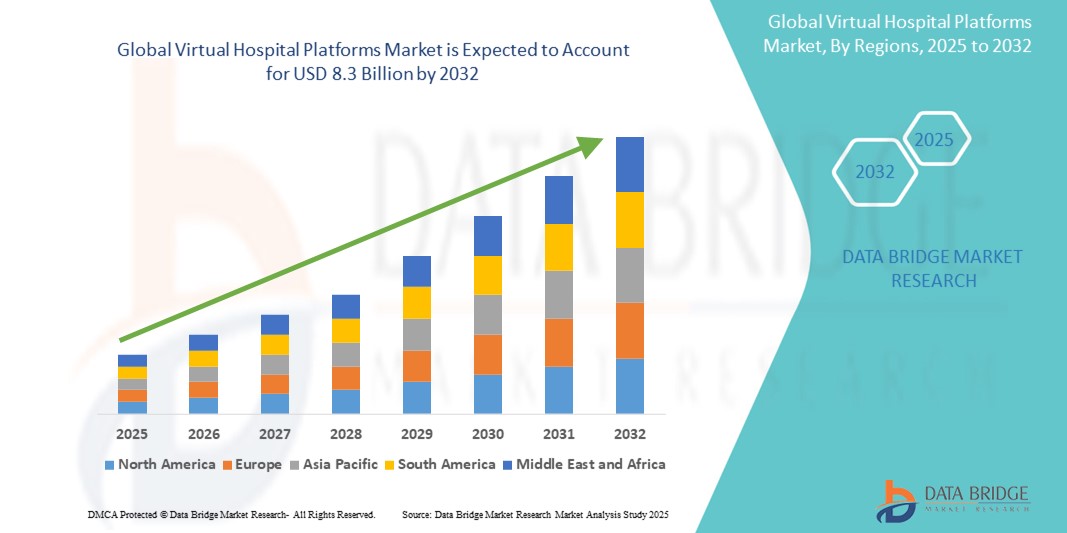
Virtual Hospital Platforms Market Size
- The global virtual hospital platforms market size was valued at USD 1.3 billion in 2024 and is expected to reach USD 8.3 billion by 2032, at a CAGR of 25.40% during the forecast period
- This growth is driven by factors such as rising adoption of telehealth services, increasing prevalence of chronic diseases, and expansion of digital infrastructure by healthcare providers, with major players launching AI-enabled platforms, remote monitoring tools, and integrated virtual care ecosystems to improve patient outcomes and reduce costs
Virtual Hospital Platforms Market Analysis
- Virtual hospital platforms are digital healthcare ecosystems that offer remote consultations, diagnostics, monitoring, and treatment through telehealth technologies. These platforms have become essential in modern healthcare, enabling continuous patient care beyond traditional hospital settings and enhancing accessibility, especially in remote or underserved regions
- The demand for virtual hospital platforms is significantly driven by the rising global burden of chronic diseases, growing geriatric population, and an increased need for remote patient monitoring and digital health tools. The COVID-19 pandemic further accelerated the adoption of these platforms by emphasizing the importance of virtual care and minimizing hospital overcrowding
- North America dominates the virtual hospital platforms market, accounting for approximately 41.2% of the market share. This leadership is fueled by advanced digital infrastructure, strong presence of key health tech companies, favorable government policies supporting telemedicine, and growing investments in healthcare innovation
- The Asia-Pacific region is expected to witness the highest growth rate in the virtual hospital platforms market, with a projected CAGR of 28.6% from 2025 to 2032. Growth in this region is driven by rapid digitalization, expanding healthcare access, increased smartphone and internet penetration, and government initiatives to strengthen telehealth services
- The software & services segment is projected to account for the largest market share of 58.4% due to the high demand for customizable, scalable virtual care platforms, integration with electronic health records (EHRs), and continuous innovation in remote diagnostics and care management tools. This segment plays a critical role in enabling seamless virtual consultations, AI-driven decision support, and remote patient engagement
Report Scope and Virtual Hospital Platforms Market Segmentation
|
Attributes |
Virtual Hospital Platforms Key Market Insights |
|
Segments Covered |
|
|
Countries Covered |
North America
Europe
Asia-Pacific
Middle East and Africa
South America
|
|
Key Market Players |
|
|
Market Opportunities |
|
|
Value Added Data Infosets |
In addition to the insights on market scenarios such as market value, growth rate, segmentation, geographical coverage, and major players, the market reports curated by the Data Bridge Market Research also include import export analysis, production capacity overview, production consumption analysis, price trend analysis, climate change scenario, supply chain analysis, value chain analysis, raw material/consumables overview, vendor selection criteria, PESTLE Analysis, Porter Analysis, and regulatory framework. |
Virtual Hospital Platforms Market Trends
“Expansion of Remote Patient Monitoring and AI-Driven Care Delivery”
- A key trend in the virtual hospital platforms market is the rapid expansion of remote patient monitoring (RPM) solutions and AI-driven care delivery, enabling healthcare providers to offer continuous, personalized care outside traditional hospital settings
- There is growing adoption of integrated digital tools—including wearable devices, AI algorithms for predictive analytics, and teleconsultation systems—that allow clinicians to monitor patient vitals, detect early warning signs, and intervene remotely
- For instance, In October 2024, Mayo Clinic expanded its advanced care at home (ACH) program by integrating AI-powered patient triage and real-time monitoring technologies to enhance virtual hospital services, especially for chronic and post-acute care management
- This shift toward tech-enabled, home-based care is transforming the traditional hospital model, improving patient outcomes, reducing readmissions, and lowering healthcare costs—particularly for aging populations and patients with chronic conditions—thereby accelerating the growth of virtual hospital platforms globally
Virtual Hospital Platforms Market Dynamics
Driver
“Growing Demand for Accessible and Convenient Healthcare Services”
- The increasing demand for accessible, convenient, and timely healthcare services is a significant driver for the virtual hospital platforms market. As patients and providers seek to overcome barriers like geographic distance and hospital overcrowding, virtual hospitals offer an effective solution for remote consultations, monitoring, and treatment
- The rising prevalence of chronic diseases and aging populations worldwide is accelerating the need for continuous, home-based care solutions, which virtual hospital platforms facilitate by enabling real-time patient monitoring and virtual clinical interventions
For instance,
- In August 2024, Teladoc Health reported a significant increase in virtual hospital admissions and remote monitoring usage, driven by patient preference for care from home and healthcare providers’ efforts to reduce hospital readmissions and costs
- As healthcare systems globally continue to embrace digital transformation and telehealth integration, the demand for virtual hospital platforms is expected to grow substantially, ensuring wider access to quality care while optimizing healthcare resources
Opportunity
“Expanding Adoption in Emerging Markets with Growing Digital Healthcare Infrastructure”
- A key opportunity for the global virtual hospital platforms market lies in expanding adoption across emerging markets where investments in digital healthcare infrastructure and telemedicine are rapidly increasing. As governments and private sectors enhance connectivity and healthcare access, virtual hospital solutions become more feasible and attractive
- Regions such as Asia-Pacific, Latin America, and the Middle East are witnessing accelerated digital transformation in healthcare, driven by increasing smartphone penetration, rising healthcare expenditure, and growing awareness of telehealth benefits
For instance,
- In September 2024, a report by Frost & Sullivan projected that the virtual hospital market in Asia-Pacific would grow at a compound annual growth rate (CAGR) of over 20% through 2030, fueled by government initiatives promoting telemedicine and rising demand for remote patient monitoring in countries like India, China, and Brazil
- Expanding strategic partnerships, localized platform customization, and targeted marketing in these high-growth regions present significant growth opportunities, enabling virtual hospital providers to reach underserved populations and improve healthcare delivery on a global scale
Restraint/Challenge
“Regulatory Complexities and Data Privacy Concerns”
- A significant challenge in the global virtual hospital platforms market is navigating the complex and evolving regulatory landscape, which varies widely across regions and can slow down market entry and expansion. Compliance with healthcare regulations, telemedicine laws, and licensing requirements is often cumbersome and costly for providers.
- In addition, data privacy and security concerns present a major hurdle, as virtual hospital platforms handle sensitive patient health information. Ensuring compliance with regulations such as HIPAA in the U.S., GDPR in Europe, and similar laws worldwide requires robust cybersecurity measures, which can increase operational costs
For instance,
- In November 2024, the European Data Protection Board (EDPB) issued updated guidelines emphasizing stricter controls on patient data usage in telehealth services, prompting virtual hospital providers in the EU to enhance their data governance frameworks
- These regulatory and privacy challenges can delay product launches, limit cross-border service offerings, and increase compliance costs, potentially slowing the adoption rate of virtual hospital platforms, especially among smaller providers or new market entrants
Virtual Hospital Platforms Market Scope
The market is segmented on the basis of component, mode, indication, application, and end user.
|
Segmentation |
Sub-Segmentation |
|
By Component |
|
|
By Mode |
|
|
By Indication |
|
|
By Application |
|
|
By End User |
|
In 2025, the software & services segment is projected to dominate the industrial machine vision market with the largest share in the component segment
In 2025, the Software & Services segment is projected to account for the largest market share of 58.4% due to the increasing demand for customizable and scalable virtual care solutions. These services enable seamless remote consultations, AI-powered diagnostics, and integrated patient management, which are critical for improving healthcare outcomes. Moreover, continuous innovation in telehealth software and remote monitoring tools is driving widespread adoption among healthcare providers. In addition, the growing need for interoperability with electronic health records (EHRs) and the rising focus on patient engagement and data security further reinforce the dominance of the software & services segment in the virtual hospital platforms market
The video consultation on-trade segment is expected to dominate the market during the forecast period in mode segments
In 2025, the video consultation on-trade category is expected to account for the largest market share of 62.1% due to the growing preference for real-time, face-to-face virtual consultations between patients and healthcare providers within hospital and clinical settings. This segment offers immediate access to specialist care, reduces patient wait times, and improves clinical decision-making through direct interaction. Moreover, the rising integration of advanced video technologies and secure communication platforms enhances the quality and reliability of these consultations. In addition, the increasing focus on patient-centered care and hospital-driven telemedicine initiatives is driving the widespread adoption of video consultation on-trade services, further solidifying its market dominance
Virtual Hospital Platforms Market Regional Analysis
“North America Holds the Largest Share in the Virtual Hospital Platforms Market”
- North America dominates the virtual hospital platforms market, accounting for approximately 41.2% of the market share. This dominance is driven by advanced digital infrastructure, widespread adoption of telehealth services, and supportive government policies encouraging virtual healthcare delivery
- The U.S. holds a significant share within North America, with approximately 35% of the global virtual hospital platforms market. This is due to the strong presence of key healthcare technology providers, increasing investments in digital health innovations, and high consumer acceptance of remote medical consultations
- The availability of well-established healthcare networks and integration with electronic health records (EHR) systems further strengthens the market. In addition, rising demand for remote patient monitoring and AI-powered diagnostics accelerates the adoption of virtual hospital platforms
- Furthermore, increasing emphasis on value-based care, patient-centered services, and healthcare cost optimization, along with regulatory support for telemedicine reimbursement, is driving demand for virtual hospital platforms across the region
“Asia-Pacific is Projected to Register the Highest CAGR in the Virtual Hospital Platforms Market”
- The Asia-Pacific region is expected to witness the highest growth rate in the virtual hospital platforms market, with a projected CAGR of 27.3% from 2025 to 2030, driven by increasing digital healthcare adoption, expanding healthcare infrastructure, and rising government initiatives to promote telemedicine and remote patient monitoring
- Countries such as China, India, and Japan are emerging as key markets for virtual hospital platforms. The region is expected to capture around 28% of the global virtual hospital platforms market share by 2025, with significant growth potential due to rapidly growing populations, increasing healthcare spending, and expanding access to internet and mobile technologies
- Japan, with its advanced healthcare system and strong focus on digital innovation, remains a crucial market for virtual hospital platforms, contributing approximately 8% of the market share within the Asia-Pacific region. The country continues to lead in the adoption of cutting-edge telehealth solutions and integrated healthcare services
- China and India, with their large populations and evolving healthcare ecosystems, are expected to contribute 15% of the global virtual hospital platforms market share by 2025. Growing investments from international technology providers and government support for digital health programs in these countries are key factors driving market growth
Virtual Hospital Platforms Market Share
The market competitive landscape provides details by competitor. Details included are company overview, company financials, revenue generated, market potential, investment in research and development, new market initiatives, global presence, production sites and facilities, production capacities, company strengths and weaknesses, product launch, product width and breadth, application dominance. The above data points provided are only related to the companies' focus related to market.
The Major Market Leaders Operating in the Market Are:
- Teladoc Health (U.S.)
- American Well (Amwell) (U.S.)
- MDLive (U.S.)
- Philips (Netherlands)
- Cerner Corporation (U.S.)
- Epic Systems Corporation (U.S.)
- McKesson Corporation (U.S.)
- Abbott Laboratories (U.S.)
- Medtronic (Ireland)
- Omron Corporation (Japan)
- Seha Virtual Hospital (Saudi Arabia)
- Cleveland Clinic (U.S.)
- Mayo Clinic (U.S.)
- Babylon Health (U.K.)
- Ping An Good Doctor (China)
Latest Developments in Global Virtual Hospital Platforms Market
- In February 2024, GE HealthCare partnered with Biofourmis to enhance patient monitoring beyond hospital settings through virtual care-at-home solutions. This collaboration integrates GE HealthCare’s patient care and monitoring technologies with Biofourmis’ AI-driven remote care solutions, aiming to improve continuity of care and reduce hospital readmission rates. By leveraging FDA-cleared algorithms and clinical-grade wearable devices, the partnership seeks to provide high-quality, personalized care in home environments, supporting patient recovery and safety
- In December 2022, the World Medical Association (WMA) highlighted that the prevalence and cost of managing chronic diseases are expected to rise in the coming years. This trend is likely to drive patients toward more affordable healthcare solutions, including virtual hospitals for chronic disease management. The shift toward digital and remote healthcare is anticipated to boost market growth during the forecast period, as healthcare providers and policymakers focus on cost-effective, accessible treatment options
- In November 2022, Veta Health, a U.S.-based company, partnered with Parkview Health, an Indiana-based network of 10 hospitals and 100 clinics, to provide virtual care programs aimed at supporting patient recovery and self-management at home. This collaboration integrates telehealth monitoring and remote patient engagement tools, helping patients manage their health outside traditional hospital settings. The initiative reflects a broader industry trend where key players’ strategic efforts are expected to drive segment growth in the coming years
- In July 2022, Thumbay Group unveiled its ambitious plan to establish the world’s first virtual hospital in the metaverse. This groundbreaking initiative aims to enable patients to consult with doctors using augmented reality (AR) and virtual reality (VR) technologies. The virtual hospital will provide teleconsultations, second opinions from multiple doctors, and immersive patient experience centers. In addition, the platform will support avatars in multiple languages, enhancing accessibility for medical tourism and preventive healthcare programs
- In July 2021, FUJIFILM Holdings America Corporation launched the Fujifilm Virtual Hospital, an interactive platform designed to showcase the company’s comprehensive portfolio of diagnostic, treatment, and research technologies. This virtual hospital allows healthcare professionals and patients to explore Fujifilm’s medical solutions, including CT, MRI, fluoroscopy, digital radiography, ultrasound, endoscopy, and enterprise imaging. The initiative aims to enhance awareness and accessibility of Fujifilm’s advanced healthcare innovations while providing an immersive learning experience for users

- Interactive Data Analysis Dashboard
- Company Analysis Dashboard for high growth potential opportunities
- Research Analyst Access for customization & queries
- Competitor Analysis with Interactive dashboard
- Latest News, Updates & Trend analysis
- Harness the Power of Benchmark Analysis for Comprehensive Competitor Tracking
Data collection and base year analysis are done using data collection modules with large sample sizes. The stage includes obtaining market information or related data through various sources and strategies. It includes examining and planning all the data acquired from the past in advance. It likewise envelops the examination of information inconsistencies seen across different information sources. The market data is analysed and estimated using market statistical and coherent models. Also, market share analysis and key trend analysis are the major success factors in the market report. To know more, please request an analyst call or drop down your inquiry.
The key research methodology used by DBMR research team is data triangulation which involves data mining, analysis of the impact of data variables on the market and primary (industry expert) validation. Data models include Vendor Positioning Grid, Market Time Line Analysis, Market Overview and Guide, Company Positioning Grid, Patent Analysis, Pricing Analysis, Company Market Share Analysis, Standards of Measurement, Global versus Regional and Vendor Share Analysis. To know more about the research methodology, drop in an inquiry to speak to our industry experts.
Data Bridge Market Research is a leader in advanced formative research. We take pride in servicing our existing and new customers with data and analysis that match and suits their goal. The report can be customized to include price trend analysis of target brands understanding the market for additional countries (ask for the list of countries), clinical trial results data, literature review, refurbished market and product base analysis. Market analysis of target competitors can be analyzed from technology-based analysis to market portfolio strategies. We can add as many competitors that you require data about in the format and data style you are looking for. Our team of analysts can also provide you data in crude raw excel files pivot tables (Fact book) or can assist you in creating presentations from the data sets available in the report.













