What is the Virtual Payment (POS) Terminals Market Size and Growth Rate?
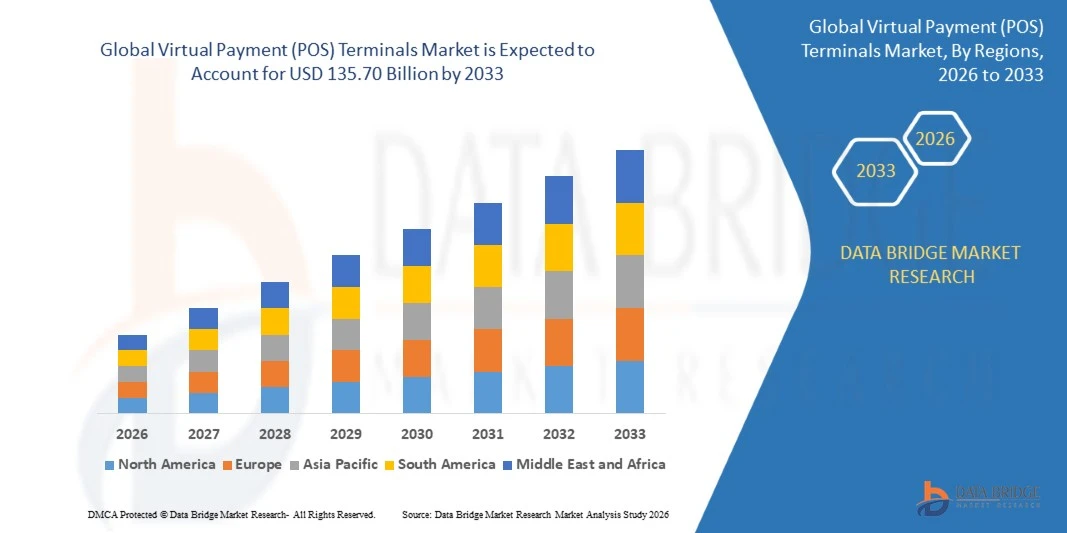
- As per Data Bridge Market Research analysis, the virtual payment (POS) terminals market was valued at USD 17.16 billion in 2025 and is projected to reach USD 135.70 billion by 2033, growing at a CAGR of 29.5% from 2026 to 2033.
- The market is experiencing rapid growth driven by rising adoption of digital and contactless payments, increasing demand for hardware-free payment acceptance, and expanding use across retail, hospitality, BFSI, healthcare, and transportation and logistics sectors.
- The increasing shift from cash to digital payments, growing smartphone penetration, and rising preference for cloud-based commerce platforms are supporting market adoption. Contactless payment technology is being applied across in-store checkout, mobile point-of-sale deployments, delivery, and field service, offering merchants greater flexibility in accepting digital payments without dedicated terminals.
Market Size & Forecast
- Global Market Value (2025): USD 17.16 Billion
- Expected Market Value (2033): USD 135.70 Billion
- Forecast CAGR (2026–2033): 29.5%
- Leading Region in 2025: North America
- Fastest Growing Region: Asia Pacific
What are the Major Takeaways of the Virtual Payment (POS) Terminals Market?
- North America dominated the virtual payment (POS) terminals market with the largest revenue share of 36.12% in 2025, supported by early adoption of contactless payments, Tap to Pay technologies, and strong merchant digitalization across retail and hospitality.
- Asia-Pacific is expected to be the fastest-growing region at a CAGR of 33.8% from 2026 to 2033, fueled by real-time payment networks, rapid smartphone penetration, and a large base of small merchants moving from cash to digital acceptance.
- The software platform segment led the market with a 68.74% share in 2025, driven by growing demand for cloud-based payment acceptance, integrated commerce, and subscription-based merchant software.
- Services are the fastest-growing component, projected to register a CAGR of 32.1%, reflecting rising demand for integration, compliance, managed payments, and merchant onboarding support.
- The cloud-based POS segment dominated the type category with a 47.31% revenue share in 2025, led by scalable deployment and easy integration with e-commerce and inventory systems.
- Payment processing accounted for 54.18% of the market share in 2025, preferred for its central role in enabling card, wallet, and QR transactions across channels.
- The customer engagement and loyalty segment is the fastest-growing application category, with a CAGR of 33.2%, driven by increasing use of payment data for personalization and retention.
Report Scope and Virtual Payment (POS) Terminals Market Segmentation
|
Attributes |
Virtual Payment (POS) Terminals Market Key Market Insights |
|
Segments Covered |
|
|
Countries Covered |
North America
Europe
Asia-Pacific
Middle East and Africa
South America
|
|
Key Market Players |
|
|
Market Opportunities |
|
|
Value Added Data Infosets |
In addition to the market insights such as market value, growth rate, market segments, geographical coverage, market players, and market scenario, the market report curated by the Data Bridge Market Research team includes in-depth expert analysis, import/export analysis, pricing analysis, production consumption analysis, and pestle analysis. |
What is the Key Trend in the Virtual Payment (POS) Terminals Market?
- Virtual payment terminals are shifting from dedicated, hardware-based card readers to software-defined acceptance, where NFC-enabled smartphones, tablets, and cloud platforms act as certified payment terminals for in-person and remote transactions.
- For instance, in September 2026, according to Reuters, India's National Payments Corporation of India (NPCI) launched a tap-and-pay option on the Unified Payments Interface (UPI) that works at point-of-sale terminals without opening the app, while UPI processed 24.51 billion transactions worth INR 29.82 trillion in August 2026, underscoring the scale of mobile-led payments.
- Contactless-first checkout is becoming the default consumer behavior, encouraging merchants of every size to adopt tap-to-pay software that works on devices they already own.
- Cloud-based virtual terminals are increasingly integrated with inventory, order management, loyalty, and analytics tools, turning payment acceptance into a unified commerce platform for retailers, restaurants, and service businesses.
- For instance, in December 2024, according to Magnati, over 95% of in-person transactions in the United Arab Emirates were already conducted through contactless methods as the company introduced Tap to Pay on iPhone, enabling merchants to accept payments using only an iPhone and a payment app.
- As SoftPOS certification, biometric authentication, and embedded financial services mature, virtual payment (POS) terminals are expected to extend beyond card acceptance into omnichannel commerce, subscriptions, and merchant financing.
What are the Key Drivers of the Virtual Payment (POS) Terminals Market?
- The migration from cash to digital payments is raising demand for flexible acceptance infrastructure that allows merchants to take card, wallet, and QR payments without investing in costly dedicated terminals.
- For instance, in July 2025, according to the World Bank, 79% of adults worldwide held a financial account in 2024, up from 74% in 2021, while 42% of adults in low- and middle-income economies paid merchants digitally, indicating a large base of consumers ready for digital acceptance.
- Small merchants, pop-up retailers, delivery fleets, and service providers increasingly prefer low-cost, software-based terminals that onboard quickly, scale on demand, and integrate with existing point-of-sale, accounting, and e-commerce systems.
- For instance, in October 2020, according to Visa, fewer than 10% of the world's 180 million micro and small merchants in many emerging markets accepted digital payments, while 63% of surveyed merchants said they would likely adopt Tap to Phone, and up to two billion Android devices could become softPOS terminals.
- As payment networks and platforms continue to certify software-based acceptance, virtual payment (POS) terminals are gaining traction among enterprises that previously relied on proprietary hardware.
What Factors Are Challenging the Growth of the Virtual Payment (POS) Terminals Market?
- Virtual payment (POS) terminals depend on secure software, device integrity, and continuous connectivity, increasing exposure to cyber threats, card-not-present fraud, and compliance obligations compared with traditional offline terminals.
- For instance, in June 2026, according to UK Finance, remote card-not-present purchase fraud in the U.K. rose 13% in cases to 3.2 million in 2025, with losses of £423.5 million, highlighting the fraud pressure facing digital payment acceptance.
- Device fragmentation, certification requirements, and differing national rules for software-based PIN entry and contactless acceptance can slow rollouts, particularly for multinational merchants and payment service providers operating across regions.
- Cash continues to dominate small-value transactions in many markets, and merchants with unreliable connectivity or limited digital literacy may hesitate to depend on virtual terminals for daily operations.
- For instance, in December 2024, according to the European Central Bank (ECB), cash was still used in 52% of point-of-sale transactions in the euro area in 2024, down from 59% in 2022, and 62% of consumers considered it important to have cash as a payment option, showing that cash dependence continues to moderate digital acceptance.
- The combination of cybersecurity risk, regulatory complexity, intense price competition among payment platforms, and persistent cash preference can constrain adoption and margins, particularly among cost-sensitive merchants in emerging markets.
How is the Virtual Payment (POS) Terminals Market Segmented?
The virtual payment (POS) terminals market is segmented on the basis of component, type, application, and end user.
- By Component
On the basis of component, the virtual payment (POS) terminals market is segmented into software platform and services. The software platform segment dominated the market with 68.74% share in 2025, supported by increasing adoption of cloud-based payment acceptance, integrated commerce tools, and subscription-based merchant software. Software platforms allow merchants to accept card, wallet, and QR payments on smartphones, tablets, and browsers without dedicated hardware. They are increasingly used across retail, hospitality, healthcare, and field-service environments. Continuous updates, API-based integrations, and support for multiple payment methods are strengthening demand. Integration with accounting, inventory, and customer-management systems also enables merchants to run payments and operations from a single platform.
The services segment is projected to register the fastest growth at a CAGR of 32.1% from 2026 to 2033, driven by rising demand for implementation, integration, compliance, and managed payment support. Merchants and enterprises often require help with onboarding, device certification, fraud controls, reconciliation, and multi-country rollouts. Managed services reduce the technical burden on small businesses while giving large retailers a faster path to omnichannel acceptance. Growing regulatory requirements, including security standards for software-based acceptance, are creating additional demand for advisory and support services. Ongoing optimization, analytics, and customer support further extend recurring revenue opportunities for providers.
- By Type
On the basis of type, the virtual payment (POS) terminals market is segmented into cloud-based POS, online POS, and mobile (SoftPOS) POS. The cloud-based POS segment dominated the type category with 47.31% share in 2025, supported by scalable deployment, lower upfront investment, and easy integration with e-commerce, inventory, and loyalty systems. Cloud-based platforms enable centralized management of multiple outlets, real-time reporting, and rapid feature updates. They are widely used by retailers, restaurants, and service businesses seeking flexible and remotely managed payment acceptance. Subscription pricing models also make cloud-based solutions attractive for small and mid-sized merchants.
The mobile (SoftPOS) POS segment is projected to register the fastest growth at a CAGR of 36.4% from 2026 to 2033, supported by the rollout of Tap to Pay on iPhone and Android-based contactless acceptance across many countries. SoftPOS removes the need for external card readers, allowing merchants to begin accepting payments within minutes using devices they already own. It is particularly useful for micro merchants, mobile vendors, delivery services, and pop-up stores. Growing certification of software-based solutions by payment networks and increasing acquirer support are further strengthening adoption across developed and emerging markets.
- By Application
On the basis of application, the virtual payment (POS) terminals market is segmented into payment processing, inventory and order management, customer engagement and loyalty, and others. The payment processing segment dominated the application category with 54.18% share in 2025, supported by the central role of card, wallet, and QR acceptance in every merchant workflow. Virtual terminals provide secure authorization, settlement, refunds, and reconciliation across in-store, online, and remote channels. Support for multiple currencies and payment methods enables merchants to serve diverse customers. Integration with acquirers, gateways, and tokenization services also strengthens security and reliability.
The customer engagement and loyalty segment is projected to register the fastest growth at a CAGR of 33.2% from 2026 to 2033, driven by increasing use of payment data for personalization, promotions, and retention. Merchants are connecting transactions with loyalty programs, digital receipts, and customer profiles to improve repeat purchases. Unified commerce platforms enable consistent customer experiences across stores, apps, and online channels. Analytics derived from payment behavior help retailers and restaurants optimize pricing, inventory, and marketing. Growing competition for customer loyalty is encouraging wider adoption of these capabilities.
- By End User
On the basis of end user, the virtual payment (POS) terminals market is segmented into retail and e-commerce, hospitality, BFSI, healthcare, transportation and logistics, and others. The retail and e-commerce segment dominated the end-user category with 42.63% share in 2025, supported by the need for flexible checkout across stores, pop-ups, marketplaces, and online channels. Retailers use virtual terminals to reduce queues, enable assisted selling, and unify in-store and online payments. Integration with inventory and customer systems improves operational efficiency. Growth of omnichannel retail and social commerce continues to increase demand for software-based acceptance.
The hospitality segment is projected to register the fastest growth at a CAGR of 33.1% from 2026 to 2033, driven by demand for tableside payments, mobile ordering, and faster checkout in restaurants, hotels, and entertainment venues. Handheld and smartphone-based terminals reduce wait times and improve staff productivity. Integration with reservation, ordering, and tipping workflows enhances the guest experience. Seasonal and event-driven businesses benefit from scalable, hardware-light solutions. Rising customer expectations for contactless and split payments are further accelerating adoption across the sector.
Which Region Holds the Largest Share of the Virtual Payment (POS) Terminals Market?
- North America dominated the virtual payment (POS) terminals market with the largest revenue share of 36.12% in 2025, supported by early adoption of contactless payments, Tap to Pay technologies, and strong merchant digitalization across retail and hospitality.
- The region also benefits from high card and mobile wallet penetration, the presence of leading payment networks and technology providers, and strong demand for cloud-based commerce platforms. Increasing use of virtual terminals among small businesses, field-service providers, and delivery operators continues to strengthen North America's position in the global market.
U.S. Virtual Payment (POS) Terminals Market Insight
The U.S. virtual payment (POS) terminals market is witnessing strong growth due to rising adoption of contactless payments, mobile wallets, and software-based acceptance across retail, hospitality, healthcare, and field-service businesses. The country's mature payments ecosystem, along with the availability of Tap to Pay solutions from major technology and payment companies, is driving demand for hardware-free terminals. In addition, growing small-business formation, e-commerce expansion, and integration of payments with business software are accelerating adoption of virtual terminals across commercial applications.
Asia-Pacific Virtual Payment (POS) Terminals Market Insight
The Asia-Pacific virtual payment (POS) terminals market is expected to witness rapid growth, driven by real-time payment networks, rising smartphone penetration, and the digitization of small and micro merchants across countries such as China, India, and Japan. Growing demand for QR and tap-based payments, affordable acceptance solutions, and super-app commerce is supporting regional market expansion. In addition, government-led financial inclusion programs and increasing investments in digital infrastructure are accelerating demand for virtual payment terminals across retail, transportation, and services.
Japan Virtual Payment (POS) Terminals Market Insight
The Japan virtual payment (POS) terminals market is witnessing consistent growth due to government efforts to promote cashless payments, rising contactless card and mobile wallet usage, and the need to address labor shortages in retail and hospitality. Merchants are adopting smartphone and tablet-based terminals for mobile ordering, delivery, and events. Moreover, strong demand for reliability, security, and integration with existing point-of-sale systems is further contributing to market growth in Japan.
China Virtual Payment (POS) Terminals Market Insight
The China virtual payment (POS) terminals market is growing rapidly, driven by widespread use of QR code and mobile wallet payments, large-scale smartphone adoption, and a vast base of small merchants. Growing use of cloud-based point-of-sale software across retail, catering, and services is significantly boosting market demand. In addition, strong domestic payment technology capabilities, rapid innovation in terminal software, and expanding cross-border commerce are positioning China as a key growth market for virtual payment solutions across Asia-Pacific.
U.K. Virtual Payment (POS) Terminals Market Insight
The U.K. virtual payment (POS) terminals market is experiencing steady growth, supported by high contactless payment usage, a vibrant fintech ecosystem, and increasing adoption of SoftPOS among small businesses. Retailers, restaurants, tradespeople, and market vendors are increasingly using smartphones as payment terminals to reduce hardware costs. Furthermore, growing integration of payments with accounting and e-commerce tools, along with strong regulatory focus on fraud prevention, is supporting wider adoption of virtual payment solutions in the U.K.
Germany Virtual Payment (POS) Terminals Market Insight
The Germany virtual payment (POS) terminals market is expanding steadily due to the country's strong retail and hospitality base, growing acceptance of card and mobile payments, and rising interest in hardware-light solutions. Merchants are adopting SoftPOS and cloud-based platforms to complement traditional terminals and to serve mobile use cases. Continuous advancements in payment security, increasing contactless usage, and Germany's focus on data protection and compliance are further driving market growth in the country.
Which are the Top Companies in Virtual Payment (POS) Terminals Market?
The virtual payment (POS) terminals market industry is primarily led by well-established companies, including:
- PayPal Holdings, Inc. (U.S.)
- Block, Inc. (U.S.)
- Stripe, Inc. (U.S.)
- Adyen N.V. (Netherlands)
- Fiserv, Inc. (U.S.)
- Global Payments Inc. (U.S.)
- Worldline SA (France)
- Shopify Inc. (Canada)
- Apple Inc. (U.S.)
- Visa Inc. (U.S.)
- Mastercard Incorporated (U.S.)
- Toast, Inc. (U.S.)
- Lightspeed Commerce Inc. (Canada)
- Verifone, Inc. (U.S.)
- PAX Technology Limited (China)
- Nexi S.p.A. (Italy)
- Fujian Newland Payment Technology Co., Ltd. (China)
- Castles Technology Co., Ltd. (Taiwan)
- Samsung Electronics Co., Ltd. (South Korea)
- One 97 Communications Limited (Paytm) (India)
What are Latest Developments in Virtual Payment (POS) Terminals Market
- In September 2026, the Saudi Central Bank (SAMA) announced at Money20/20 Middle East in Riyadh that Tap to Pay on iPhone will soon be available in Saudi Arabia, enabling merchants to accept mada cards, other contactless cards, and digital wallets directly on compatible iPhones using NFC technology without additional hardware, building on the SoftPOS service introduced in the country in 2021.
- In July 2026, Datacap Systems launched SureTap, a SoftPOS bring-your-own-device solution that lets point-of-sale providers and their merchants accept contactless tap payments on NFC-enabled Android devices without dedicated payment hardware, using the same payments gateway integration already employed for countertop, mobile, and unattended devices.
- In March 2026, London-based fintech payabl. launched a SoftPOS Tap to Pay solution that turns NFC-enabled Android smartphones into payment terminals for SME merchants, supporting PIN entry, e-receipts, refunds, reversals, and tips, and integrating with its payabl.one dashboard so merchants can manage online and in-person transactions from a single platform.
- In June 2025, Westpay AB announced the official launch of its SoftPOS solution, a Tap-to-Pay application that turns any Android device into a certified contactless payment terminal accepting Visa, Mastercard, American Express, and Swish payments, positioned as an extension of the company's SaaS transformation.
- In March 2025, Apple announced the launch of Tap to Pay on iPhone in Bulgaria, Finland, Hungary, Liechtenstein, Poland, Portugal, Slovakia, Slovenia, and Switzerland, allowing merchants to accept in-person contactless payments from cards, Apple Pay, and other digital wallets using only an iPhone and a partner's iOS app.
- Interactive Data Analysis Dashboard
- Company Analysis Dashboard for high growth potential opportunities
- Research Analyst Access for customization & queries
- Competitor Analysis with Interactive dashboard
- Latest News, Updates & Trend analysis
- Harness the Power of Benchmark Analysis for Comprehensive Competitor Tracking
Data collection and base year analysis are done using data collection modules with large sample sizes. The stage includes obtaining market information or related data through various sources and strategies. It includes examining and planning all the data acquired from the past in advance. It likewise envelops the examination of information inconsistencies seen across different information sources. The market data is analysed and estimated using market statistical and coherent models. Also, market share analysis and key trend analysis are the major success factors in the market report. To know more, please request an analyst call or drop down your inquiry.
The key research methodology used by DBMR research team is data triangulation which involves data mining, analysis of the impact of data variables on the market and primary (industry expert) validation. Data models include Vendor Positioning Grid, Market Time Line Analysis, Market Overview and Guide, Company Positioning Grid, Patent Analysis, Pricing Analysis, Company Market Share Analysis, Standards of Measurement, Global versus Regional and Vendor Share Analysis. To know more about the research methodology, drop in an inquiry to speak to our industry experts.
Data Bridge Market Research is a leader in advanced formative research. We take pride in servicing our existing and new customers with data and analysis that match and suits their goal. The report can be customized to include price trend analysis of target brands understanding the market for additional countries (ask for the list of countries), clinical trial results data, literature review, refurbished market and product base analysis. Market analysis of target competitors can be analyzed from technology-based analysis to market portfolio strategies. We can add as many competitors that you require data about in the format and data style you are looking for. Our team of analysts can also provide you data in crude raw excel files pivot tables (Fact book) or can assist you in creating presentations from the data sets available in the report.