


Virtual Ward Services Market Size
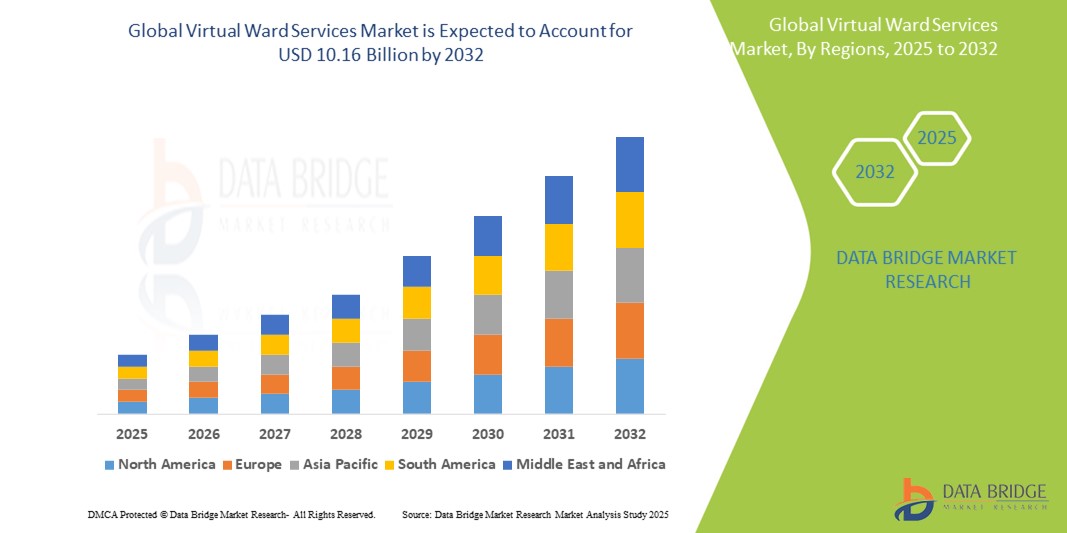
- The global virtual ward services market size was valued at USD 1.78 billion in 2024 and is expected to reach USD 10.16 billion by 2032, at a CAGR of 24.30% during the forecast period
- This growth is driven by factors such as rising demand for remote patient monitoring, aging population and chronic disease management, and technological advancements
Virtual Ward Services Market Analysis
- Virtual ward services provide comprehensive remote healthcare solutions, allowing patients to receive hospital-level care in the comfort of their homes, supported by digital health technologies and continuous monitoring systems
- The demand for virtual ward services is significantly driven by the increasing need for cost-effective healthcare, rising chronic disease burden, and growing emphasis on patient-centered care
- North America is expected to dominate the virtual ward services market, with 41.4% of the global market share, driven by advanced healthcare infrastructure, widespread adoption of telehealth technologies, and strong investments in digital health solutions
- Asia-Pacific is expected to be the fastest growing region in the virtual ward services market, with a CAGR of 12.2%, driven by rapid expansion in healthcare infrastructure, increasing awareness of digital health solutions, and rising healthcare expenditures
- The chronic diseases segment is expected to dominate the market with a market share of 65.1%, driven by the high prevalence of chronic conditions such as diabetes, hypertension, heart disease, and respiratory disorders that require continuous monitoring and personalized care solutions
Report Scope and Virtual Ward Services Market Segmentation
|
Attributes |
Virtual Ward Services Key Market Insights |
|
Segments Covered |
|
|
Countries Covered |
North America
Europe
Asia-Pacific
Middle East and Africa
South America
|
|
Key Market Players |
|
|
Market Opportunities |
|
|
Value Added Data Infosets |
In addition to the insights on market scenarios such as market value, growth rate, segmentation, geographical coverage, and major players, the market reports curated by the Data Bridge Market Research also include import export analysis, production capacity overview, production consumption analysis, price trend analysis, climate change scenario, supply chain analysis, value chain analysis, raw material/consumables overview, vendor selection criteria, PESTLE Analysis, Porter Analysis, and regulatory framework. |
Virtual Ward Services Market Trends
“Advancements in Remote Monitoring and Digital Health Technologies”
- One prominent trend in the evolution of virtual ward services is the increasing integration of advanced remote monitoring technologies and digital health platforms
- These innovations enable healthcare providers to remotely track patient vitals, monitor recovery progress, and provide timely interventions, significantly enhancing patient outcomes and reducing hospital readmission rates
- For instance, the use of wearable devices, such as smartwatches and biosensors, allows continuous monitoring of vital signs such as heart rate, oxygen saturation, and blood pressure, providing real-time insights into patient health and facilitating early detection of potential complications
- These advancements are transforming patient care, supporting the shift toward value-based healthcare, and driving the demand for next-generation virtual ward solutions
Virtual Ward Services Market Dynamics
Driver
“Increasing Demand for Remote Patient Monitoring and Home-Based Care”
- The rising demand for virtual ward services is significantly driven by the need for effective remote patient monitoring and home-based care, which reduces the burden on traditional healthcare systems and improves patient outcomes
- As healthcare costs continue to rise, virtual wards offer a cost-effective alternative by enabling continuous patient care outside of conventional hospital settings
- This approach reduces hospital readmission rates, lowers healthcare costs, and minimizes the risk of hospital-acquired infections, making it a preferred choice for patients and healthcare providers alike
For instance,
- In January 2025, according to an article published by the World Health Organization (WHO), the global demand for home-based care is expected to increase significantly over the next decade, driven by aging populations, rising chronic disease prevalence, and the growing need for personalized care. This trend is particularly strong in high-income countries with well-established healthcare systems, where the focus is shifting toward value-based care and patient-centric approaches
- As a result, the demand for virtual ward services is expected to surge, providing significant growth opportunities for healthcare technology providers and service providers
Opportunity
“Technological Innovations Driving Market Growth”
- Advancements in digital health technologies, including artificial intelligence (AI), machine learning (ML), and Internet of Things (IoT) devices, are creating new opportunities for virtual ward service providers to improve patient monitoring and personalized care
- These technologies enable real-time data collection, predictive analytics, and personalized treatment plans, enhancing the efficiency and effectiveness of virtual ward services
- In addition, the integration of telehealth platforms, remote monitoring devices, and electronic health records (EHR) systems allows healthcare providers to deliver comprehensive, data-driven care in a virtual environment
For instance,
- In February 2025, according to a report by the HealthTech Journal, the integration of AI and IoT in virtual ward services has led to a 30% reduction in hospital readmission rates for chronic disease patients, significantly improving patient outcomes and reducing healthcare costs. These technologies are expected to play a critical role in the future of virtual healthcare, transforming the way care is delivered globally
- The ongoing advancements in digital health technologies are expected to drive market growth, providing significant opportunities for technology developers and healthcare providers.
Restraint/Challenge
“Data Security and Privacy Concerns”
- The widespread adoption of virtual ward services has raised significant concerns about data security and patient privacy, which can pose a major barrier to market growth
- With sensitive patient information being transmitted and stored digitally, the risk of data breaches, unauthorized access, and cyberattacks has increased, making it essential for service providers to implement robust cybersecurity measures
- This challenge is further complicated by varying regulatory requirements and data protection laws across different regions, making compliance a complex task for global healthcare providers
For instance,
- In March 2025, according to a report by the Healthcare Information and Management Systems Society (HIMSS), the healthcare industry remains one of the most targeted sectors for cyberattacks, with data breaches costing an average of $10 million per incident. The report highlights the need for enhanced security measures to protect patient data and maintain trust in virtual care solutions
- Consequently, the need for robust data security protocols and privacy frameworks is critical for the widespread adoption of virtual ward services, creating both challenges and opportunities for the market
Virtual Ward Services Market Scope
The market is segmented on the basis of patient demographics, health conditions, technology readiness, service utilization and engagement and experience level.
|
Segmentation |
Sub-Segmentation |
|
By Patient Demographics |
|
|
By Health Conditions |
|
|
By Technology Readiness |
|
|
By Service Utilization
|
|
|
By Engagement and Experience level |
|
In 2025, the chronic diseases is projected to dominate the market with a largest share in health conditions segment
The chronic diseases segment is expected to dominate the virtual ward services market with the largest share of 65.1% in 2025 due to the high prevalence and growing burden of chronic conditions such as diabetes, hypertension, heart disease, and respiratory disorders. As the leading segment for virtual care, chronic disease management benefits significantly from advancements in remote monitoring technologies and personalized care plans, which improve patient outcomes and reduce hospital admissions. The increasing global incidence of chronic diseases and the need for continuous, long-term care further contribute to the dominance of this segment.
The adults is expected to account for the largest share during the forecast period in patients demographics market
In 2025, the adults segment is expected to dominate the market with the largest share of 60.9% due to the high prevalence of chronic diseases, increased healthcare awareness, and greater acceptance of digital health technologies. As the primary users of virtual ward services, adults benefit from personalized care, remote monitoring, and early intervention, reducing the need for hospital admissions and improving overall patient outcomes.
Virtual Ward Services Market Regional Analysis
“North America Holds the Largest Share in the Virtual Ward Services Market”
- North America is expected to dominate the virtual ward services market, accounting for 41.4% market share, driven by advanced healthcare infrastructure, widespread adoption of telehealth technologies, and strong investments in digital health solutions
- U.S. holds a significant share of 35.7%, due to the increasing demand for remote patient monitoring, the growing burden of chronic diseases, and the presence of major healthcare providers and technology companies
- The presence of supportive regulatory frameworks and substantial funding for digital healthcare innovation further strengthens the market in this region
- In addition, the rising elderly population and the emphasis on reducing hospital readmissions are fueling the demand for virtual ward services across the region
“Asia-Pacific is Projected to Register the Highest CAGR in the Virtual Ward Services Market”
- Asia-Pacific is expected to witness the highest growth rate in the virtual ward services market, with a projected CAGR of 12.2%, driven by rapid expansion in healthcare infrastructure, increasing awareness of digital health solutions, and rising healthcare expenditures
- Countries such as China, India, and Japan are emerging as key markets due to their large aging populations and increasing prevalence of chronic diseases
- Japan, known for its advanced healthcare technology and aging population, remains a crucial market for virtual ward services, focusing on reducing hospital stays and enhancing elderly care
- India is projected to register the highest CAGR in the virtual ward services market, driven by the rapid adoption of digital health platforms, expanding healthcare infrastructure, and a growing focus on patient-centric care
Virtual Ward Services Market Share
The market competitive landscape provides details by competitor. Details included are company overview, company financials, revenue generated, market potential, investment in research and development, new market initiatives, global presence, production sites and facilities, production capacities, company strengths and weaknesses, product launch, product width and breadth, application dominance. The above data points provided are only related to the companies' focus related to market.
The Major Market Leaders Operating in the Market Are:
- Current Health (U.K.)
- Doccla (U.K.)
- Huma Therapeutics (U.K.)
- Vita Health Group (U.K.)
- Biofourmis (U.S.)
- Tunstall Group (U.K.)
- Health Recovery Solutions (U.S.)
- VitalConnect (U.S.)
- Lumeon (U.S.)
- PHL Digital (U.K.)
- Graphnet Health Limited (U.K.)
- Medoma AB (Sweden)
- Dignio (Norway)
Latest Developments in Global Virtual Ward Services Market
- In March 2025, Current Health, a leading provider of virtual ward services, announced the expansion of its remote patient monitoring platform across Europe, enhancing its capabilities with AI-driven analytics to improve patient outcomes and reduce hospital readmissions. This move follows successful pilot programs demonstrating reduced costs and improved patient satisfaction
- In December 2024, Biofourmis unveiled its latest AI-powered virtual ward solution integrating wearable devices and predictive analytics to proactively manage chronic disease patients. The solution aims to enable early intervention, minimizing emergency visits and improving overall care coordination
- In November 2024, Huma Therapeutics launched an advanced virtual ward platform featuring enhanced telehealth capabilities and real-time biometric monitoring to support post-surgical recovery patients. The platform is designed to improve care continuity and reduce the length of hospital stays
- In October 2024, Doccla expanded its virtual ward services to include mental health disorder management, incorporating behavioral health tracking and remote counseling sessions. This initiative targets improved access to care and personalized support for mental health patients

- Interactive Data Analysis Dashboard
- Company Analysis Dashboard for high growth potential opportunities
- Research Analyst Access for customization & queries
- Competitor Analysis with Interactive dashboard
- Latest News, Updates & Trend analysis
- Harness the Power of Benchmark Analysis for Comprehensive Competitor Tracking
Data collection and base year analysis are done using data collection modules with large sample sizes. The stage includes obtaining market information or related data through various sources and strategies. It includes examining and planning all the data acquired from the past in advance. It likewise envelops the examination of information inconsistencies seen across different information sources. The market data is analysed and estimated using market statistical and coherent models. Also, market share analysis and key trend analysis are the major success factors in the market report. To know more, please request an analyst call or drop down your inquiry.
The key research methodology used by DBMR research team is data triangulation which involves data mining, analysis of the impact of data variables on the market and primary (industry expert) validation. Data models include Vendor Positioning Grid, Market Time Line Analysis, Market Overview and Guide, Company Positioning Grid, Patent Analysis, Pricing Analysis, Company Market Share Analysis, Standards of Measurement, Global versus Regional and Vendor Share Analysis. To know more about the research methodology, drop in an inquiry to speak to our industry experts.
Data Bridge Market Research is a leader in advanced formative research. We take pride in servicing our existing and new customers with data and analysis that match and suits their goal. The report can be customized to include price trend analysis of target brands understanding the market for additional countries (ask for the list of countries), clinical trial results data, literature review, refurbished market and product base analysis. Market analysis of target competitors can be analyzed from technology-based analysis to market portfolio strategies. We can add as many competitors that you require data about in the format and data style you are looking for. Our team of analysts can also provide you data in crude raw excel files pivot tables (Fact book) or can assist you in creating presentations from the data sets available in the report.













