


Warburg Micro Syndrome Market Size
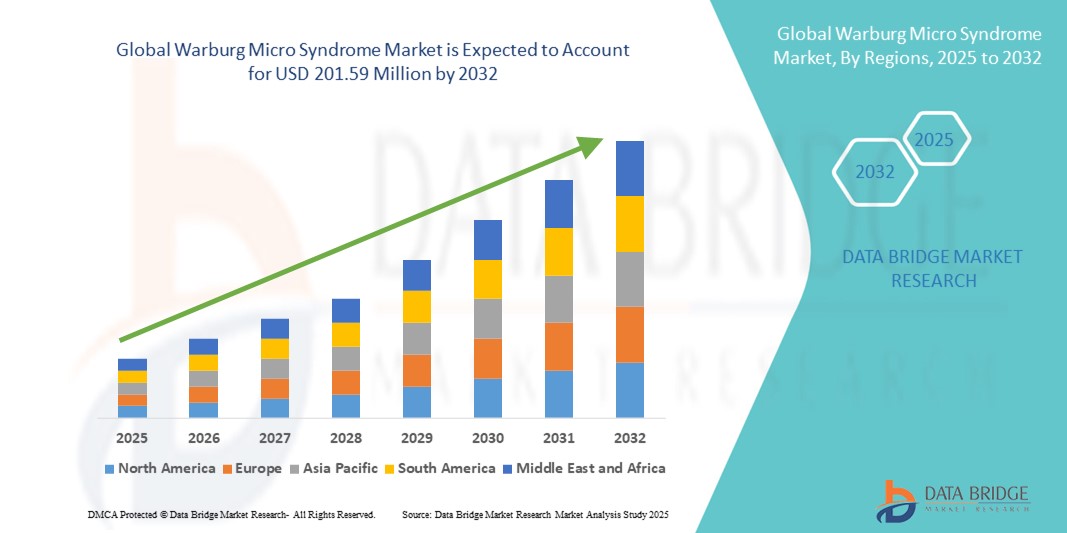
- The global Warburg micro syndrome market size was valued at USD 104.57 million in 2024 and is expected to reach USD 201.59 million by 2032, at a CAGR of 8.55% during the forecast period
- The market growth is largely fueled by the increasing awareness, early diagnosis, and advancements in genetic testing for rare disorders, which have significantly improved the identification of warburg micro syndrome cases across both developed and emerging regions. The rise in specialized research initiatives and expanding access to molecular diagnostics are also supporting timely detection and management of the condition
- Furthermore, rising investment in orphan drug development, growing patient advocacy, and enhanced government support for rare disease treatment are establishing warburg micro syndrome as a priority within the rare genetic disorders segment. These converging factors are accelerating the development and commercialization of targeted therapies and supportive care solutions, thereby significantly boosting the industry’s growth
Warburg Micro Syndrome Market Analysis
- Warburg Micro Syndrome, a rare autosomal recessive neurodevelopmental disorder, is increasingly being recognized due to advances in next-generation sequencing, improved clinical awareness, and the availability of more specialized diagnostic centers, especially in both pediatric and genetic medicine settings
- The rising demand for targeted therapies and genetic counseling services is primarily fueled by increasing research funding, growing patient advocacy initiatives, and improvements in global rare disease registries that are enabling better patient identification and follow-up care
- North America dominated the Warburg micro syndrome market with the largest revenue share of 41.8% in 2024, driven by high healthcare spending, a robust rare disease diagnostic infrastructure, and the presence of key biopharmaceutical players investing in orphan drug development. The U.S. accounts for the majority share due to strong NIH-backed research programs and a growing focus on pediatric neurological disorders
- Asia-Pacific is expected to be the fastest-growing region in the Warburg micro syndrome market with a projected CAGR of 17.2% from 2025 to 2032, owing to increasing investments in genomic medicine, improved healthcare access in emerging economies, and growing partnerships for rare disease awareness
- The molecular genetic testing segment dominated the Warburg micro syndrome market with a market share of 47.5% in 2024, driven by the widespread adoption of next-generation sequencing (NGS), whole-exome sequencing (WES), and targeted rare disease gene panels. These advanced diagnostic tools facilitate early and precise identification of causative gene mutations, significantly improving diagnostic accuracy and patient management
Report Scope and Warburg Micro Syndrome Market Segmentation
|
Attributes |
Warburg Micro Syndrome Key Market Insights |
|
Segments Covered |
|
|
Countries Covered |
North America
Europe
Asia-Pacific
Middle East and Africa
South America
|
|
Key Market Players |
|
|
Market Opportunities |
|
|
Value Added Data Infosets |
In addition to the insights on market scenarios such as market value, growth rate, segmentation, geographical coverage, and major players, the market reports curated by the Data Bridge Market Research also include in-depth expert analysis, pricing analysis, brand share analysis, consumer survey, demography analysis, supply chain analysis, value chain analysis, raw material/consumables overview, vendor selection criteria, PESTLE Analysis, Porter Analysis, and regulatory framework. |
Warburg Micro Syndrome Market Trends
“Increasing Adoption of Advanced Genomic Sequencing Technologies and AI-Driven Bioinformatics Platforms”
- A significant and emerging trend in the global Warburg Micro Syndrome market is the increasing adoption of advanced genomic sequencing technologies and AI-driven bioinformatics platforms for early and accurate diagnosis. This approach is transforming how rare genetic disorders are detected, enabling clinicians to pinpoint pathogenic mutations with greater precision and speed
- For instance, leading diagnostic companies such as Centogene and GeneDx have incorporated AI-based variant interpretation tools into their whole-exome and gene panel sequencing services, allowing for the rapid identification of disease-causing mutations associated with Warburg Micro Syndrome, including those in the RAB3GAP1 and RAB18 genes
- AI-powered genomic analysis facilitates the interpretation of large-scale genetic data, improving diagnostic yield in ultra-rare disorders. Platforms like Fabric Genomics and Deep Genomics utilize machine learning algorithms to prioritize likely pathogenic variants, even in complex cases where traditional diagnostic methods have failed. In the context of Warburg Micro Syndrome, this has significantly shortened the diagnostic odyssey for affected children and their families
- The integration of next-generation sequencing with AI-enhanced analytics not only supports faster diagnosis but also aids in personalized care planning. By understanding the exact gene variant involved, clinicians can better anticipate disease progression and tailor supportive interventions accordingly. This is especially critical in managing neurodevelopmental outcomes, ocular complications, and associated systemic manifestations of Warburg Micro Syndrome
- This trend toward precision diagnostics powered by genomics and artificial intelligence is redefining the landscape for rare disease management. As more countries expand their newborn screening programs and rare disease registries, demand for such advanced diagnostic capabilities is expected to rise. Companies at the forefront of this trend are investing in scalable genomic infrastructure and cross-border data-sharing collaborations to meet growing clinical needs in the Warburg Micro Syndrome segment
- • The global push for earlier diagnosis through AI-assisted genomics is accelerating innovation in the rare disease space, and Warburg Micro Syndrome is becoming a focal point in initiatives aimed at leveraging technology to improve outcomes in underserved patient populations
Warburg Micro Syndrome Market Dynamics
Driver
“Growing Need Due to Advancements in Genetic Diagnostics and Rare Disease Research”
- The increasing recognition of rare diseases, along with progress in genomic diagnostics, is a significant driver for the heightened demand for early identification and management of Warburg Micro Syndrome
- For instance, in June 2024, Genomics England expanded its rare disease program to include Warburg Micro Syndrome in its next-generation sequencing panel, aiming to improve diagnosis rates through whole-genome analysis. Such strategic initiatives by government bodies and research institutions are expected to drive the Warburg Micro Syndrome market growth in the forecast period
- As healthcare systems focus more on early diagnosis and personalized medicine, demand for genetic testing tools like [DS1] MRI and molecular diagnostics is rising, enabling earlier intervention and supportive care for affected patients
- Furthermore, increasing awareness about inherited neurodevelopmental disorders among pediatricians and genetic counselors is supporting greater clinical attention toward syndromes such as Warburg Micro Syndrome
- Collaboration between academia and biotech firms, along with patient advocacy organizations, is fostering research initiatives, natural history studies, and registry development, contributing to long-term market sustainability
Restraint/Challenge
“Limited Therapeutic Options and High Diagnostic Costs”
- The absence of curative treatments and reliance on supportive therapies continue to hinder broader clinical advancement in Warburg Micro Syndrome care. The rarity of the disorder also leads to a lack of commercial incentives for biopharma investment
- For instance, fewer than 100 cases of Warburg Micro Syndrome have been reported globally, making it difficult to design and recruit for clinical trials aimed at therapeutic development
- Moreover, molecular genetic testing and MRI—though essential for diagnosis—are often expensive and not widely accessible in low- and middle-income countries, limiting equitable diagnosis
- Limited awareness among general practitioners and pediatricians, combined with diagnostic delays and lack of standardized treatment protocols, pose ongoing challenges in care delivery
- Overcoming these barriers will require investment in rare disease education, expansion of genetic counseling services, inclusion in national screening programs, and incentives for orphan drug development aimed at Warburg Micro Syndrome
Warburg Micro Syndrome Market Scope
The market is segmented on the basis of symptoms, affected genes, and diagnosis.
• By Symptoms
On the basis of symptoms, the Warburg micro syndrome market is segmented into microcephaly, microphthalmia, micro cornea, congenital cataracts, corpus callosum hypoplasia, intellectual disability, and hypogonadism. The microcephaly segment dominated the largest market revenue share of 28.5% in 2024, as it is one of the most recognizable and earliest clinical indicators of Warburg Micro Syndrome. Early diagnosis based on cranial measurements and developmental milestones contributes significantly to the segment’s dominance.
The congenital cataracts segment is expected to witness the fastest CAGR from 2025 to 2032, supported by increasing early diagnosis efforts through neonatal vision screening and improved surgical interventions in pediatric ophthalmology.
• By Affected Genes
On the basis of affected genes, the Warburg micro syndrome market is segmented into RAB18, RAB3GAP1, RAB3GAP2, and TBC1D20. The RAB3GAP1 segment dominated the largest market revenue share of 39.3% in 2024, owing to its frequent association with severe Warburg Micro Syndrome phenotypes. The gene is well-researched and often included in diagnostic panels.
The RAB18 segment is projected to witness the fastest CAGR from 2025 to 2032 due to its emerging role in newer genetic screening and precision medicine approaches.
• By Diagnosis
On the basis of diagnosis, the Warburg micro syndrome market is segmented into magnetic resonance imaging (MRI), molecular genetic testing, and others. The molecular genetic testing segment captured the largest market revenue share of 47.5% in 2024, driven by the widespread adoption of next-generation sequencing (NGS), whole-exome sequencing (WES), and targeted rare disease gene panels. These tools offer precise and early diagnosis.
The magnetic resonance imaging (MRI) segment is expected to witness the fastest CAGR from 2025 to 2032, supported by its critical role in identifying brain structure anomalies such as corpus callosum hypoplasia and cerebral atrophy—both key indicators of Warburg Micro Syndrome.
Warburg Micro Syndrome Market Regional Analysis
- North America dominated the warburg micro syndrome market with the largest revenue share of 41.8% in 2024, driven by the strong presence of advanced genetic research institutions, specialized pediatric hospitals, and rare disease registries
- The region benefits from early adoption of molecular diagnostics, robust funding for orphan disease research, and supportive regulatory frameworks like the U.S. Orphan Drug Act
- Public and private initiatives to raise awareness about rare diseases, alongside strong collaboration between academia and biotech firms, are accelerating diagnosis and ongoing research in the region
U.S. Warburg Micro Syndrome Market Insight
The U.S. Warburg micro syndrome market captured the largest revenue share of 81.3% within North America in 2024, attributed to the country's leadership in genomic technologies, rare disease policy infrastructure, and availability of next-generation sequencing (NGS) services
Institutions like the NIH and advocacy groups such as NORD have been instrumental in pushing for rare disease registries and patient support. Ongoing clinical studies and grant funding for ultra-rare syndromes such as Warburg Micro Syndrome help drive innovation in diagnostics and long-term care strategies
Europe Warburg Micro Syndrome Market Insight
The Europe Warburg micro syndrome market is projected to grow at a CAGR of 7.2% from 2025 to 2032, driven by national rare disease plans, advanced healthcare infrastructure, and expanding access to genetic counseling. Countries like Germany, the U.K., and France are investing in early diagnostics and patient tracking systems, enhancing disease surveillance and early intervention
Strong collaboration between rare disease research networks and pharmaceutical firms is fostering innovation across diagnostics and data collection
U.K. Warburg Micro Syndrome Market Insight
The U.K. Warburg micro syndrome market is expected to grow at a CAGR of 7.8%, supported by initiatives like Genomics England and the NHS’s 100,000 Genomes Project. These efforts have improved early detection and enabled better understanding of rare congenital disorders, including Warburg Micro Syndrome
Germany Warburg Micro Syndrome Market Insight
The Germany Warburg Micro Syndrome market is projected to expand at a CAGR of 7.4% due to the country's investment in healthcare digitization, pediatric neurology services, and centralized genetic testing centers. Efforts to integrate rare disease data into national electronic health records also contribute to faster diagnosis and patient support
Asia-Pacific Warburg Micro Syndrome Market Insight
The Asia-Pacific Warburg micro syndrome market is poised to grow at the fastest CAGR of 17.2% during the forecast period (2025–2032), due to rising awareness of rare disorders, expanding access to genomic technologies, and improving healthcare infrastructure in countries like India, China, and Japan. Government support for pediatric healthcare and rare disease drug development is increasing, alongside collaboration with international genetic research bodies
Japan Warburg Micro Syndrome Market Insight
The Japan Warburg micro syndrome market is witnessing growth driven by high adoption of precision medicine, a rapidly aging population, and public investment in neurological and rare disorder research. Japan’s Rare Disease Act and support from organizations like RIKEN help identify and manage ultra-rare disorders more efficiently
China Warburg Micro Syndrome Market Insight
The China Warburg micro syndrome market accounted for the largest share in the Asia-Pacific region in 2024, supported by strong government backing for rare disease research and an expanding network of genetic testing centers. China's National Rare Diseases Registry and collaborations with universities for pediatric neurology research are improving diagnostics and patient outreach
Warburg Micro Syndrome Market Share
The Warburg Micro Syndrome industry is primarily led by well-established companies, including:
- UCL (U.K.)
- PreventionGenetics (U.S.)
- Quest Diagnostics Incorporated (U.S.)
- GeneDx, LLC (U.S.)
- Labcorp (U.S.)
- CENTOGENE GmbH (Germany)

- Interactive Data Analysis Dashboard
- Company Analysis Dashboard for high growth potential opportunities
- Research Analyst Access for customization & queries
- Competitor Analysis with Interactive dashboard
- Latest News, Updates & Trend analysis
- Harness the Power of Benchmark Analysis for Comprehensive Competitor Tracking
Data collection and base year analysis are done using data collection modules with large sample sizes. The stage includes obtaining market information or related data through various sources and strategies. It includes examining and planning all the data acquired from the past in advance. It likewise envelops the examination of information inconsistencies seen across different information sources. The market data is analysed and estimated using market statistical and coherent models. Also, market share analysis and key trend analysis are the major success factors in the market report. To know more, please request an analyst call or drop down your inquiry.
The key research methodology used by DBMR research team is data triangulation which involves data mining, analysis of the impact of data variables on the market and primary (industry expert) validation. Data models include Vendor Positioning Grid, Market Time Line Analysis, Market Overview and Guide, Company Positioning Grid, Patent Analysis, Pricing Analysis, Company Market Share Analysis, Standards of Measurement, Global versus Regional and Vendor Share Analysis. To know more about the research methodology, drop in an inquiry to speak to our industry experts.
Data Bridge Market Research is a leader in advanced formative research. We take pride in servicing our existing and new customers with data and analysis that match and suits their goal. The report can be customized to include price trend analysis of target brands understanding the market for additional countries (ask for the list of countries), clinical trial results data, literature review, refurbished market and product base analysis. Market analysis of target competitors can be analyzed from technology-based analysis to market portfolio strategies. We can add as many competitors that you require data about in the format and data style you are looking for. Our team of analysts can also provide you data in crude raw excel files pivot tables (Fact book) or can assist you in creating presentations from the data sets available in the report.












