


What is the Weak Affinity Chromatography Technology Market Size and Growth Rate?
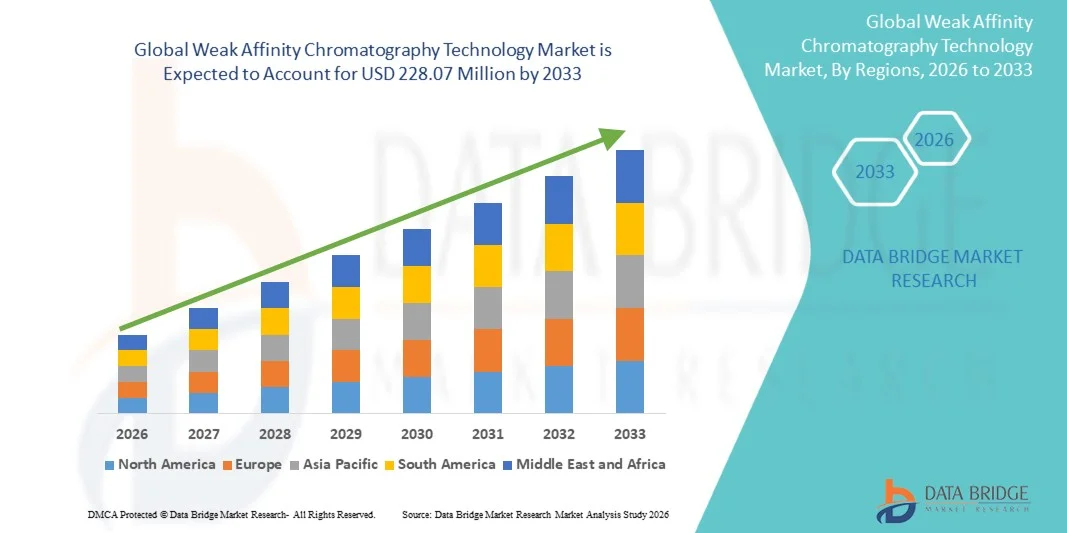
- As per Data Bridge Market Research analysis, the weak affinity chromatography technology market was valued at USD 123.22 million in 2025 and is projected to reach USD 228.07 million by 2033, growing at a CAGR of 8.0% from 2026 to 2033.
- The market is experiencing consistent growth driven by rising investments in research and development, increasing adoption of weak affinity chromatography for characterizing weak and transient biomolecular interactions, and growing demand for advanced separation and purification technologies across life sciences research.
- The increasing use of weak affinity chromatography for fragment-based drug discovery and screening, combined with technological advancements in analytical systems, is encouraging pharmaceutical, biotechnology, academic, and research organizations to adopt these technologies. WAC enables the detection and characterization of weak or transient interactions between small-molecule fragments and biological targets, creating opportunities for more efficient drug discovery and biomolecular research.
Market Size & Forecast
- Global Market Value (2025): USD 123.22 Million
- Expected Market Value (2033): USD 228.07 Million
- Forecast CAGR (2026–2033): 8.0%
- Leading Region in 2025: North America
- Fastest Growing Region: Asia Pacific
What are the Major Takeaways of the Weak Affinity Chromatography Technology Market?
- North America dominated the weak affinity chromatography technology market with the largest revenue share of 38.4% in 2025, supported by advanced biopharmaceutical research, strong healthcare infrastructure, high R&D investment, and early adoption of analytical technologies.
- Asia-Pacific is expected to be the fastest-growing region at a CAGR of 9.0% from 2026 to 2033, fueled by expanding pharmaceutical and biotechnology research, rising healthcare infrastructure investments, and increasing adoption of advanced chromatography technologies across China, India, Japan, and South Korea.
- The system segment led the market with a 58% share in 2025, driven by the established use of chromatography systems for weak and transient interaction analysis
- Consumable are the fastest-growing type, projected to register a CAGR of 9.0%, reflecting the surge in demand for specialized columns, affinity ligands, and other recurring assay components.
- The HPLC-based weak affinity chromatography segment dominated the technology category with a 38% revenue share in 2025, led by the widespread availability of HPLC infrastructure across analytical and research laboratories.
- Fragment screening accounted for 35% of the market share in 2025, preferred by the strong suitability of WAC for detecting weak interactions between small fragments and biological targets.
- The protein–ligand interaction analysis segment is the fastest-growing application category, with a CAGR of 9.5%, driven by increasing demand for detailed characterization of weak and transient molecular interactions.
Report Scope and Weak Affinity Chromatography Technology Market Segmentation
|
Attributes |
Weak Affinity Chromatography Technology Key Market Insights |
|
Segments Covered |
|
|
Countries Covered |
North America
Europe
Asia-Pacific
Middle East and Africa
South America
|
|
Key Market Players |
|
|
Market Opportunities |
|
|
Value Added Data Infosets |
In addition to the insights on market scenarios such as market value, growth rate, segmentation, geographical coverage, and major players, the market reports curated by the Data Bridge Market Research also include in-depth expert analysis, patient epidemiology, pipeline analysis, pricing analysis, and regulatory framework. |
What is the Key Trend in the Weak Affinity Chromatography Technology Market?
- Weak affinity chromatography is increasingly being miniaturized and coupled with mass spectrometry to improve throughput, reduce protein consumption, and enable efficient screening of weak protein–ligand interactions in fragment-based drug discovery.
- For instance, in June 2025, according to Analytical Biochemistry, researchers developed an ultra-miniaturized nano-WAC-MS method for rapid fragment screening, demonstrating how miniaturized weak affinity chromatography coupled with mass spectrometry can increase screening throughput while reducing protein consumption.
- The integration of nanodiscs and improved chromatographic supports is expanding WAC applications toward difficult-to-study membrane proteins, including GPCRs, while providing more stable and biologically relevant environments for interaction analysis.
- Researchers are increasingly developing advanced control-column strategies to distinguish specific binding from non-specific interactions, improving hit identification and reducing false-positive and false-negative results during fragment screening.
- For instance, in October 2023, according to Molecules, researchers demonstrated nano-WAC for screening fragments against membrane proteins incorporated into nanodiscs, highlighting the growing use of weak affinity chromatography for challenging membrane-protein targets in fragment-based drug discovery.
- As pharmaceutical and biotechnology researchers increasingly seek high-throughput methods for detecting weak and transient molecular interactions, miniaturized WAC-MS and membrane-protein screening are expected to strengthen the role of WAC in next-generation fragment-based drug discovery.
What are the Key Drivers of the Weak Affinity Chromatography Technology Market?
- The growing adoption of fragment-based drug discovery is increasing demand for analytical techniques capable of detecting weak protein–ligand interactions that are difficult to characterize using conventional screening approaches.
- For instance, in October 2023, according to Molecules, researchers investigated strategies to extend the affinity range of weak affinity chromatography toward low-affinity interactions by increasing target-protein density and optimizing chromatographic conditions, supporting the use of WAC for challenging fragment-screening applications.
- Increasing pharmaceutical R&D activities are encouraging researchers to adopt WAC because immobilized protein targets can be reused, reducing protein consumption while enabling multiplexed screening of fragment mixtures and complex biological samples.
- For instance, in September 2025, according to Analytical Biochemistry, researchers reported the development of an ultra-miniaturized weak affinity chromatography–mass spectrometry (nano-WAC-MS) approach, demonstrating a more efficient platform for fragment screening while substantially reducing protein and sample requirements.
- With growing demand for rapid, quantitative, and resource-efficient characterization of weak molecular interactions, continued advances in WAC miniaturization, mass-spectrometric detection, and membrane-protein analysis are expected to support broader adoption across pharmaceutical and biotechnology research.
Which Factors are Challenging the Growth of the Weak Affinity Chromatography Technology Market?
- Non-specific interactions between fragments and chromatographic supports or membrane components can interfere with retention measurements, making it difficult to distinguish genuine target binding from background interactions.
- For instance, in October 2023, according to Molecules, researchers found that non-specific hydrophobic interactions between fragments and the chromatographic support could become too strong relative to specific protein–ligand interactions, limiting the detection of very weak ligands. The study reported that the maximum detectable Kd was around 100 µM or lower when non-specific interactions were significant
- These interactions can generate false-positive or false-negative results, requiring researchers to develop control columns and additional confirmation experiments, which can increase assay complexity and extend screening workflows.
- For instance, in June 2024, according to Molecules, researchers demonstrated that non-specific electrostatic and hydrophobic interactions involving nanodiscs could distort fragment retention in WAC and create potential false positives or false negatives. The study therefore required control columns to distinguish specific target interactions from non-specific binding.
- The technical challenges of maintaining sufficient target-protein density, preserving native membrane-protein structure, controlling non-specific binding, and accurately detecting very weak interactions continue to restrict WAC deployment across complex biological targets, particularly membrane proteins.
How is the Weak Affinity Chromatography Technology Market Segmented?
The weak affinity chromatography technology market is segmented on the basis of type, technology, application, end-user.
- By Type
On the basis of type, the weak affinity chromatography technology market is segmented into system and consumable. The system segment dominated the market with 58% share in 2025, owing to the established use of chromatography systems for weak and transient interaction analysis. These systems provide the essential infrastructure required for performing WAC separations and retention-based binding measurements. Pharmaceutical and biotechnology laboratories widely utilize chromatography systems for fragment screening and biomolecular interaction studies. Their compatibility with established laboratory workflows also supports adoption among academic and research institutions. Increasing demand for reproducible analytical separation and characterization is further strengthening the segment.
The consumable segment is projected to register the fastest growth at CAGR of 9.0% from 2026 to 2033, driven by increasing demand for specialized columns, affinity ligands, and other recurring assay components. Consumables are essential for maintaining consistent performance across repeated WAC experiments. Rising fragment-screening activities are increasing the requirement for replaceable and application-specific chromatography materials. Advances in ligand immobilization and stationary-phase technologies are also improving the suitability of consumables for weak-interaction analysis. Growing pharmaceutical and biotechnology research is expected to generate recurring demand for these products. Increasing adoption of high-throughput screening workflows is further supporting consumable utilization.
- By Technology
On the basis of technology, the weak affinity chromatography technology market is segmented into HPLC-based weak affinity chromatography, LC-UV-based weak affinity chromatography, LC-MS-based weak affinity chromatography, HPLC-MS-based weak affinity chromatography, and other analytical platforms. The HPLC-based weak affinity chromatography segment dominated the market with 38% share in 2025, supported by the widespread availability of HPLC infrastructure across analytical and research laboratories. HPLC provides reliable flow control, reproducible separation, and compatibility with different stationary phases used in WAC applications. Its established laboratory presence reduces the need for substantial additional infrastructure investment. Pharmaceutical and biotechnology organizations can integrate WAC workflows with existing chromatographic systems. The technology is also suitable for retention-based assessment of weak and transient molecular interactions.
The HPLC-MS-based weak affinity chromatography segment is projected to register the fastest growth at a CAGR of 10.0% from 2026 to 2033, driven by increasing demand for sensitive detection and molecular identification of weak interactions. Combining chromatographic separation with mass spectrometry provides additional structural and molecular information during screening. This combination is particularly valuable for fragment-based drug discovery and protein–ligand interaction analysis. Increasing adoption of WAC-MS approaches is improving the ability to screen complex fragment mixtures efficiently. Technological advances are also reducing sample and protein requirements while improving analytical sensitivity. Pharmaceutical and biotechnology researchers are increasingly adopting integrated analytical platforms for advanced screening workflows.
- By Application
On the basis of application, the weak affinity chromatography technology market is segmented into fragment screening, protein–ligand interaction analysis, protein purification, drug discovery, biomarker discovery, clinical diagnostics, and other applications. The fragment screening segment dominated the market with 35% share in 2025, owing to the strong suitability of WAC for detecting weak interactions between small fragments and biological targets. Fragment-based screening requires sensitive analytical approaches capable of identifying low-affinity interactions at an early stage of drug discovery. WAC can analyze fragment mixtures while measuring changes in chromatographic retention. Integration with mass spectrometry further supports identification and characterization of detected compounds. Pharmaceutical and biotechnology companies are increasingly using fragment-based approaches to identify starting points for drug development.
The protein–ligand interaction analysis segment is projected to register the fastest growth at a CAGR of 9.5% from 2026 to 2033, driven by increasing demand for detailed characterization of weak and transient molecular interactions. WAC enables researchers to investigate binding behavior while simultaneously separating interacting molecules. This capability is particularly valuable for studying interactions that are difficult to characterize using conventional techniques. Growing research involving membrane proteins and other challenging biological targets is creating additional opportunities for WAC-based interaction analysis. Integration with mass spectrometry is further enhancing molecular identification and analytical sensitivity. Increasing pharmaceutical research into target validation and molecular recognition is expected to support adoption.
- By End-User
On the basis of end-user, the weak affinity chromatography technology market is segmented into hospitals, diagnostic centers, and others. The hospitals segment dominated the market with 45% share in 2025, owing to increasing adoption of advanced chromatography technologies for biomolecular analysis, clinical research, and diagnostic applications. Hospitals are increasingly investing in sophisticated laboratory infrastructure to support complex analytical testing. WAC can assist in the characterization of protein–ligand interactions and other biomolecular processes relevant to healthcare research. Growing emphasis on precision medicine and advanced molecular diagnostics is further supporting adoption within hospital laboratories. Increasing integration of advanced analytical platforms into centralized laboratory facilities is also strengthening demand.
The diagnostic centers segment is projected to register the fastest growth at a CAGR of 8.5% from 2026 to 2033, supported by increasing demand for advanced analytical technologies in diagnostic and biomolecular testing. Diagnostic centers are increasingly adopting sophisticated laboratory technologies to improve analytical sensitivity and testing capabilities. WAC can support applications involving biomolecular interactions, separation, and characterization of analytes. Growing emphasis on precision diagnostics and molecular testing is creating additional opportunities for advanced chromatography technologies. Increasing laboratory automation is also improving the feasibility of incorporating sophisticated analytical workflows. Expansion of diagnostic infrastructure in emerging markets is expected to further support adoption
Which Region Holds the Largest Share of the Weak Affinity Chromatography Technology Market?
- North America dominated the weak affinity chromatography technology market with the largest revenue share of 38.4% in 2025, supported by advanced biopharmaceutical research, strong healthcare infrastructure, high R&D investment, and early adoption of analytical technologies.
- The region also benefits from strong adoption of advanced chromatography technologies, extensive academic and pharmaceutical research capabilities, and increasing demand for analytical tools used in drug discovery and biomolecular interaction studies. Growing investment in biopharmaceutical development and laboratory infrastructure continues to strengthen North America's leadership position in the global market
U.S. Weak Affinity Chromatography Technology Market Insight
The U.S. weak affinity chromatography technology market is witnessing strong growth due to rising demand for advanced protein purification technologies, increasing biopharmaceutical research, and expanding pharmaceutical manufacturing activities. The country’s mature biotechnology ecosystem, along with increasing adoption of high-performance chromatography systems, is driving demand across pharmaceutical, biotechnology, and academic research applications. In addition, growing emphasis on efficient biomolecule purification and increasing development of biologics are accelerating adoption of weak affinity chromatography technologies across research and manufacturing facilities.
Asia-Pacific Weak Affinity Chromatography Technology Market Insight
The Asia-Pacific weak affinity chromatography technology market is expected to witness rapid growth, driven by increasing biopharmaceutical production, expanding biotechnology research, and rising investments in pharmaceutical manufacturing infrastructure across countries such as China, Japan, and India. Growing adoption of advanced protein purification technologies, increasing demand for biologics, and rising research activities are supporting regional market expansion. In addition, the growing presence of biotechnology companies and academic research centers is accelerating adoption of chromatography technologies across pharmaceutical and research applications.
Japan Weak Affinity Chromatography Technology Market Insight
The Japan weak affinity chromatography technology market is witnessing consistent growth due to rising investments in biopharmaceutical research, advanced purification technologies, and pharmaceutical innovation. Pharmaceutical companies, biotechnology firms, and research institutes are increasingly adopting chromatography technologies for protein purification, biomolecule analysis, and drug development activities. Moreover, increasing development of biologics and the country’s focus on advanced life sciences research are further contributing to market growth.
China Weak Affinity Chromatography Technology Market Insight
The China weak affinity chromatography technology market is growing rapidly, driven by increasing biopharmaceutical manufacturing, expanding biotechnology research, and rising investments in pharmaceutical infrastructure. Growing adoption of advanced protein purification technologies across pharmaceutical, biotechnology, and academic sectors is significantly boosting market demand. In addition, increasing biologics development, rising research activities, and rapid expansion of domestic biotechnology capabilities are positioning China as one of the fastest-growing markets for weak affinity chromatography technology globally.
U.K. Weak Affinity Chromatography Technology Market Insight
The U.K. weak affinity chromatography technology market is experiencing steady growth, supported by rising adoption of advanced purification technologies in pharmaceutical research, biotechnology, and biopharmaceutical manufacturing applications. Increasing investments in life sciences research and growing demand for efficient protein purification solutions are contributing to market growth. Furthermore, integration of advanced chromatography techniques and increasing development of biologics are improving purification efficiency and supporting the adoption of weak affinity chromatography technologies in the U.K.
Germany Weak Affinity Chromatography Technology Market Insight
The Germany weak affinity chromatography technology market is expanding steadily due to the country’s strong pharmaceutical and biotechnology base, advanced research capabilities, and increasing adoption of next-generation purification technologies. Pharmaceutical companies, biotechnology organizations, and research institutes are increasingly utilizing chromatography technologies for protein purification, drug development, and biomolecule research activities. Continuous advancements in purification technologies, increasing biologics production, and strong investment in life sciences research are further driving market growth in Germany.
Which are the Top Companies in Weak Affinity Chromatography Technology Market?
The weak affinity chromatography technology industry is primarily led by well-established companies, including:
- Cytiva (U.S.)
- Thermo Fisher Scientific Inc. (U.S.)
- Merck KGaA (Germany)
- Sartorius AG (Germany)
- Repligen Corporation (U.S.)
- Bio-Rad Laboratories, Inc. (U.S.)
- Tosoh Corporation (Japan)
- Purolite, an Ecolab Company (U.S.)
- Avantor, Inc. (U.S.)
- Waters Corporation (U.S.)
- Mitsubishi Chemical Corporation (Japan)
- JSR Corporation (Japan)
- Bio-Works Technologies AB (Sweden)
- Kaneka Corporation (Japan)
- Takara Bio Inc. (Japan)
- Agilent Technologies, Inc. (U.S.)
- Shimadzu Corporation (Japan)
- KNAUER Wissenschaftliche Geräte GmbH (Germany)
- YMC CO., LTD. (Japan)
- Abcam plc (U.K.)
What are Latest Developments in Weak Affinity Chromatography Technology Market?
- In February 2025, Repligen reported the launch of its AVIPure® dsRNA affinity resin, described as an affinity resin designed for the removal of double-stranded RNA impurities. The company highlighted the product as a new addition to its chromatography portfolio for emerging bioprocessing applications, supporting more efficient purification of RNA-based therapeutics. This development reflects continued advancement of affinity-based purification materials toward more selective biomolecule separation and next-generation bioprocessing applications.
- In May 2024, Thermo Fisher Scientific introduced GoPure 96-Well Screening Plates for Gene Therapy, incorporating affinity resins that enable single-step chromatographic purification with high purity and yield at increased flow rates. The 96-well format supports parallel screening and process-development activities, helping researchers evaluate purification conditions more efficiently for gene-therapy applications. The development demonstrates the increasing integration of affinity chromatography into high-throughput purification and screening workflows.
- In May 2024, researchers published a detailed protocol for affinity purification mass spectrometry (AP-MS) to map differential protein–protein interaction networks. The workflow uses affinity-tagged proteins followed by affinity purification and mass spectrometry to identify and quantify protein complexes under different biological conditions. The development demonstrates continued advances in affinity-based purification workflows for high-throughput proteomics and protein-interaction research.
- In October 2023, researchers published a standardized recombinant-protein production approach combining Golden Gate cloning with Ni-NTA affinity chromatography and size-exclusion chromatography. The workflow was designed to simplify protein-expression and purification procedures by combining modular cloning, standardized tags, and established affinity-purification steps. The development supports broader adoption of streamlined affinity-based purification workflows in academic and biotechnology laboratories.
- In December 2022, researchers from Imperial College London and collaborators published a model-based approach for accelerating chromatography process development. The study demonstrated how mathematical modeling could be used to identify suitable operating conditions and process-design spaces for Protein A chromatography, helping reduce the time and experimental effort required during biopharmaceutical purification development. This development highlights the increasing use of modeling and process optimization to improve the efficiency and scalability of affinity-based chromatography.

- Interactive Data Analysis Dashboard
- Company Analysis Dashboard for high growth potential opportunities
- Research Analyst Access for customization & queries
- Competitor Analysis with Interactive dashboard
- Latest News, Updates & Trend analysis
- Harness the Power of Benchmark Analysis for Comprehensive Competitor Tracking
Data collection and base year analysis are done using data collection modules with large sample sizes. The stage includes obtaining market information or related data through various sources and strategies. It includes examining and planning all the data acquired from the past in advance. It likewise envelops the examination of information inconsistencies seen across different information sources. The market data is analysed and estimated using market statistical and coherent models. Also, market share analysis and key trend analysis are the major success factors in the market report. To know more, please request an analyst call or drop down your inquiry.
The key research methodology used by DBMR research team is data triangulation which involves data mining, analysis of the impact of data variables on the market and primary (industry expert) validation. Data models include Vendor Positioning Grid, Market Time Line Analysis, Market Overview and Guide, Company Positioning Grid, Patent Analysis, Pricing Analysis, Company Market Share Analysis, Standards of Measurement, Global versus Regional and Vendor Share Analysis. To know more about the research methodology, drop in an inquiry to speak to our industry experts.
Data Bridge Market Research is a leader in advanced formative research. We take pride in servicing our existing and new customers with data and analysis that match and suits their goal. The report can be customized to include price trend analysis of target brands understanding the market for additional countries (ask for the list of countries), clinical trial results data, literature review, refurbished market and product base analysis. Market analysis of target competitors can be analyzed from technology-based analysis to market portfolio strategies. We can add as many competitors that you require data about in the format and data style you are looking for. Our team of analysts can also provide you data in crude raw excel files pivot tables (Fact book) or can assist you in creating presentations from the data sets available in the report.













