


Wearable Player Tracking System Market Size
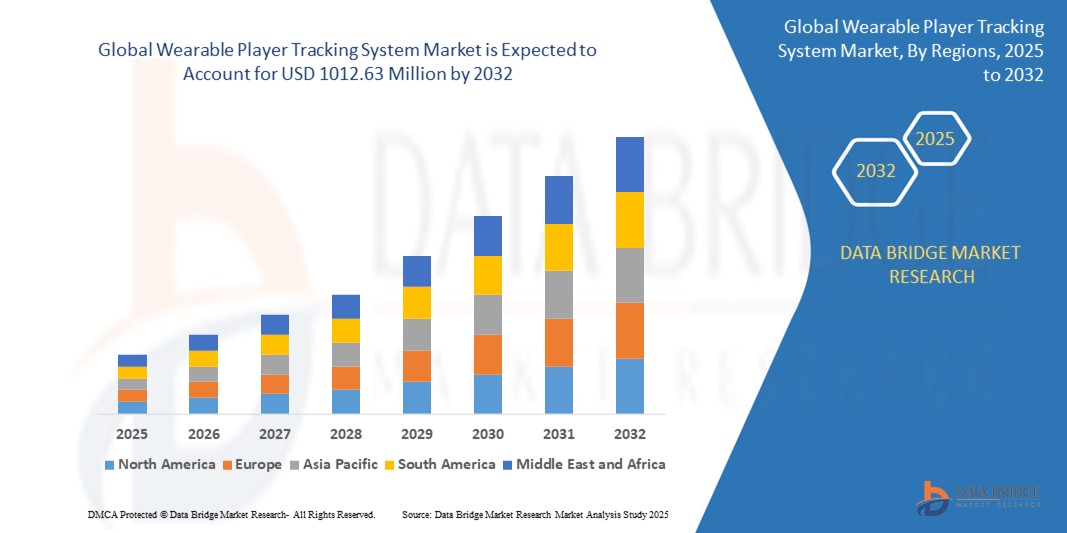
- The global wearable player tracking system market size was valued at USD 664.85 million in 2024 and is expected to reach USD 1012.63 million by 2032, at a CAGR of 5.4% during the forecast period
- The market growth is primarily driven by the increasing adoption of wearable technologies in sports, advancements in sensor technology, and the growing demand for real-time performance analytics to enhance athlete performance and prevent injuries
- The rising popularity of data-driven decision-making in sports, coupled with the integration of advanced technologies such as GPS, Bluetooth, and AI, is accelerating the adoption of wearable player tracking systems across individual and team sports
Wearable Player Tracking System Market Analysis
- Wearable player tracking systems, utilizing sensors such as GPS, RFID, and accelerometers, are critical tools in modern sports for monitoring athletes’ movements, performance metrics, and health parameters during training and competitions
- The surge in demand is fueled by the need for real-time data access, enhanced athlete performance monitoring, and injury prevention, with applications in fitness tracking, performance analytics, and player safety
- North America dominated the wearable player tracking system market with a revenue share of over 28% in 2024, driven by early adoption of advanced technologies, a strong sports culture, and the presence of major market players
- Asia-Pacific is expected to be the fastest-growing region during the forecast period, propelled by increasing disposable incomes, rising interest in fitness and sports, and growing technological infrastructure in countries such as China, Japan, and India
- The solutions segment dominated the largest market revenue share of 65% in 2024, driven by the increasing adoption of wearable technologies, such as smartwatches, fitness bands, and GPS-enabled devices, which provide precise monitoring of athletes' movements, biometrics, and performance metrics.
Report Scope and Wearable Player Tracking System Market Segmentation
|
Attributes |
Wearable Player Tracking System Key Market Insights |
|
Segments Covered |
|
|
Countries Covered |
North America
Europe
Asia-Pacific
Middle East and Africa
South America
|
|
Key Market Players |
|
|
Market Opportunities |
|
|
Value Added Data Infosets |
In addition to the market insights such as market value, growth rate, market segments, geographical coverage, market players, and market scenario, the market report curated by the Data Bridge Market Research team includes in-depth expert analysis, import/export analysis, pricing analysis, production consumption analysis, and pestle analysis. |
Wearable Player Tracking System Market Trends
“Increasing Integration of AI and Big Data Analytics”
- The global wearable player tracking system market is experiencing a significant trend toward integrating Artificial Intelligence (AI) and Big Data analytics
- These technologies enable advanced data processing and analysis, providing deeper insights into athlete performance, training optimization, and injury prevention
- AI-powered wearable tracking solutions facilitate proactive decision-making, identifying potential performance issues or injury risks before they impact athletes or teams
- For instances, companies are developing AI-driven platforms that analyze player movement patterns to offer personalized training programs or optimize team strategies based on real-time game data
- This trend enhances the value of wearable tracking systems, making them more appealing to both individual athletes and professional sports teams
- AI algorithms can analyze a wide range of player metrics, including speed, acceleration, heart rate, fatigue levels, and biomechanical efficiency, to improve performance and reduce injury risks
Wearable Player Tracking System Market Dynamics
Driver
“Rising Demand for Performance Optimization and Athlete Safety”
- Increasing demand for data-driven performance analytics in sports, such as real-time tracking of player movements, biometrics, and in-game events, is a major driver for the wearable player tracking system market
- Wearable tracking systems enhance athlete safety by providing features such as injury risk assessment, fatigue monitoring, and workload management
- Regulatory bodies and sports associations, particularly in North America, are promoting the adoption of wearable technologies to ensure player welfare and improve performance metrics
- The proliferation of IoT and advancements in 5G technology are enabling faster data transmission and lower latency, supporting more sophisticated tracking applications for both individual and team sports
- Sports organizations and manufacturers are increasingly integrating wearable tracking systems as standard tools to meet the expectations of coaches, athletes, and fans, thereby enhancing competitive advantage
Restraint/Challenge
“High Implementation Costs and Data Privacy Concerns”
- The high initial investment required for wearable devices, sensors, software, and system integration can be a significant barrier to adoption, particularly for amateur athletes or smaller sports organizations in emerging markets
- Integrating wearable tracking systems into existing training or game environments can be complex and costly, requiring specialized infrastructure and technical expertise
- Data security and privacy concerns present a major challenge, as wearable systems collect and transmit sensitive athlete data, raising risks of breaches, misuse, or non-compliance with data protection regulations
- The fragmented regulatory landscape across countries regarding data collection, storage, and usage complicates operations for manufacturers and service providers in the global market
- These factors may deter adoption in regions with high cost sensitivity or strong awareness of data privacy issues, potentially limiting market growth
Wearable Player Tracking System market Scope
The market is segmented on the basis of offering and end use.
- By Offering
On the basis of offering, the global wearable player tracking system market is segmented into solutions and services. The solutions segment dominated the largest market revenue share of 65% in 2024, driven by the increasing adoption of wearable technologies, such as smartwatches, fitness bands, and GPS-enabled devices, which provide precise monitoring of athletes' movements, biometrics, and performance metrics.
The services segment is expected to witness the fastest growth rate of 18.7% from 2025 to 2032. The rising demand for actionable insights derived from player tracking data, coupled with the need for customized training programs and real-time analytics, is driving the adoption of services. Sports organizations are increasingly leveraging these services to enhance athlete performance and fan engagement through advanced data-driven strategies.
- By End Use
On the basis of end use, the global wearable player tracking System Market is segmented into individual sports and team sports. The team sports segment accounted for the largest market revenue share of 72% in 2024, attributed to the widespread use of wearable tracking systems in professional leagues and collegiate sports to monitor team strategies, player performance, and injury prevention.
The individual sports segment is anticipated to experience rapid growth at a CAGR of 20.1% from 2025 to 2032. The increasing adoption of wearable devices by individual athletes for personalized performance tracking, fitness monitoring, and injury prevention is fueling this growth.
Wearable Player Tracking System Market Regional Analysis
- North America dominated the wearable player tracking system market with a revenue share of over 28% in 2024, driven by early adoption of advanced technologies, a strong sports culture, and the presence of major market players
- Consumers prioritize wearable player tracking systems for real-time performance analytics, health monitoring, and enhanced training outcomes, particularly in regions with strong sports cultures and professional leagues
- Growth is supported by advancements in wearable technology, including GPS, accelerometers, and AI-driven analytics, alongside rising adoption in both individual and team sports segments
U.S. Wearable Player Tracking System Market Insight
The U.S. wearable player tracking system market captured the largest revenue share of 73.7% in 2024 within North America, fueled by strong demand from professional sports leagues such as the NFL, NBA, and MLB, and growing consumer awareness of performance and health monitoring benefits. The trend towards data-driven athlete training and increasing regulations promoting player safety further boost market expansion. The integration of wearable tracking systems in both professional and amateur sports creates a diverse product ecosystem.
Europe Wearable Player Tracking System Market Insight
The Europe wearable player tracking system market is expected to witness significant growth, supported by regulatory emphasis on athlete safety and performance optimization. Consumers seek systems that provide precise performance metrics while ensuring injury prevention. The growth is prominent in both professional team sports and individual athlete applications, with countries such as Germany and the U.K. showing significant uptake due to rising investments in sports technology and analytics.
U.K. Wearable Player Tracking System Market Insight
The U.K. market for wearable player tracking systems is expected to witness rapid growth, driven by demand for enhanced athlete performance and injury prevention in sports such as soccer and rugby. Increased interest in sports analytics and rising awareness of health monitoring benefits encourage adoption. Evolving regulations on player safety and performance standards influence consumer choices, balancing technology integration with compliance.
Germany Wearable Player Tracking System Market Insight
Germany is expected to witness rapid growth in wearable player tracking systems, attributed to its advanced sports technology sector and high consumer focus on performance efficiency and athlete well-being. German consumers prefer technologically advanced systems that provide real-time analytics and contribute to injury prevention. The integration of these systems in premium sports facilities and aftermarket applications supports sustained market growth.
Asia-Pacific Wearable Player Tracking System Market Insight
The Asia-Pacific region is expected to witness the fastest growth rate, driven by expanding sports participation and rising disposable incomes in countries such as China, India, and Japan. Increasing awareness of performance tracking, health monitoring, and athlete safety is boosting demand. Government initiatives promoting sports development and digital health further encourage the use of advanced wearable tracking systems.
Japan Wearable Player Tracking System Market Insight
Japan’s wearable player tracking system market is expected to witness rapid growth due to strong consumer preference for high-quality, technologically advanced systems that enhance athlete performance and safety. The presence of major sports technology companies and integration of tracking systems in professional sports accelerate market penetration. Rising interest in aftermarket sports analytics solutions also contributes to growth.
China Wearable Player Tracking System Market Insight
China holds the largest share of the Asia-Pacific wearable player tracking system market, propelled by rapid urbanization, rising sports participation, and increasing demand for performance and health monitoring solutions. The country’s growing middle class and focus on sports development support the adoption of advanced wearable systems. Strong domestic manufacturing capabilities and competitive pricing enhance market accessibility.
Wearable Player Tracking System Market Share
The wearable player tracking system industry is primarily led by well-established companies, including:
- Apple Inc. (U.S.)
- Huawei Technologies Co., Ltd. (China)
- Fitbit Inc. (U.K.)
- Nike, Inc. (U.S.)
- Under Armour, Inc (U.S.)
- Koninklijke Philips N.V. (Netherlands)
- Zepp Health corporation (China)
- Abbott (U.S.)
- Apple Inc. (U.S)
- Virtual-Realties, LLC (U.K.)
- Google LLC (U.S.)
- adidas India Marketing Pvt. Ltd (Germany)
- Xiaomi (China)
- Pebble Cart (U.S.)
- Huawei Technologies Co., Ltd. (China)
- Virtual-Realties, LLC (U.K.)
- Garmin Ltd. (U.S.)
What are the Recent Developments in Global Wearable Player Tracking System Market?
- In September 2024, South Korea’s Fitogether secured a USD 7.2 million investment to accelerate the expansion of its Electronic Performance Tracking System (EPTS) in the U.S. and Qatar. The funding supports the company’s mission to deliver high-precision player tracking solutions globally. Fitogether also entered a strategic partnership with Aspire Academy, Qatar’s premier sports training institution, to deploy its OHCOACH wearable-optical hybrid system. This collaboration aims to enhance player development and coaching strategies across European clubs and national teams by integrating advanced analytics and real-time performance data
- In January 2024, Sennheiser teamed up with Polar Electro to launch the MOMENTUM Sport earbuds, a groundbreaking fusion of premium audio and advanced fitness tracking. These true wireless earbuds integrate Polar’s biosensing technology—including photoplethysmography (PPG) heart rate and body temperature sensors—to deliver real-time performance insights during workouts. This collaboration marks the first time Polar’s ecosystem has extended beyond its own devices, allowing users to access Polar Flow’s training analytics, smart coaching, and hydration monitoring directly through a third-party product
- In January 2024, Garmin introduced the Lily 2 series, a refined line of petite, fashion-forward smartwatches designed to blend style with functionality. Available in standard and Classic editions, the Lily 2 features a sleek metal case, patterned lenses, and interchangeable bands. It offers enhanced health and wellness tracking, including heart rate monitoring, sleep score, stress tracking, and women’s health features. With added support for Garmin Pay (Classic only), connected GPS, and smartphone notifications, it caters to users seeking a compact yet capable fitness companion. The Lily 2 is ideal for those who value both aesthetics and performance
- In December 2023, GENEFIT, powered by 3X4 Genetics, publicly launched its patented modifier technology, marking a breakthrough in personalized fitness. This innovation integrates genetic data with real-time inputs from wearable fitness trackers to deliver individualized insights across six key areas: training, recovery, injury risk, body composition, energy levels, and nutrition. By combining genetic pathway analysis, exercise physiology, and AI, GENEFIT enables athletes to receive goal-based training plans and injury risk alerts, helping them optimize performance and recovery
- In November 2023, Catapult Group International Ltd. entered a strategic partnership with the Romanian Football Federation (FRF) to deploy its GPS-based wearable tracking systems across Romania’s national football teams. This collaboration focuses on enhancing player performance analysis, training optimization, and injury prevention by leveraging Catapult’s cutting-edge Vector technology. The system provides real-time data on player movement, workload, and physiological metrics, enabling coaches and performance staff to make data-driven decisions

- Interactive Data Analysis Dashboard
- Company Analysis Dashboard for high growth potential opportunities
- Research Analyst Access for customization & queries
- Competitor Analysis with Interactive dashboard
- Latest News, Updates & Trend analysis
- Harness the Power of Benchmark Analysis for Comprehensive Competitor Tracking
Data collection and base year analysis are done using data collection modules with large sample sizes. The stage includes obtaining market information or related data through various sources and strategies. It includes examining and planning all the data acquired from the past in advance. It likewise envelops the examination of information inconsistencies seen across different information sources. The market data is analysed and estimated using market statistical and coherent models. Also, market share analysis and key trend analysis are the major success factors in the market report. To know more, please request an analyst call or drop down your inquiry.
The key research methodology used by DBMR research team is data triangulation which involves data mining, analysis of the impact of data variables on the market and primary (industry expert) validation. Data models include Vendor Positioning Grid, Market Time Line Analysis, Market Overview and Guide, Company Positioning Grid, Patent Analysis, Pricing Analysis, Company Market Share Analysis, Standards of Measurement, Global versus Regional and Vendor Share Analysis. To know more about the research methodology, drop in an inquiry to speak to our industry experts.
Data Bridge Market Research is a leader in advanced formative research. We take pride in servicing our existing and new customers with data and analysis that match and suits their goal. The report can be customized to include price trend analysis of target brands understanding the market for additional countries (ask for the list of countries), clinical trial results data, literature review, refurbished market and product base analysis. Market analysis of target competitors can be analyzed from technology-based analysis to market portfolio strategies. We can add as many competitors that you require data about in the format and data style you are looking for. Our team of analysts can also provide you data in crude raw excel files pivot tables (Fact book) or can assist you in creating presentations from the data sets available in the report.













