Global Whole Genome Amplification Market
Market Size in USD Billion
CAGR :
% 
 USD
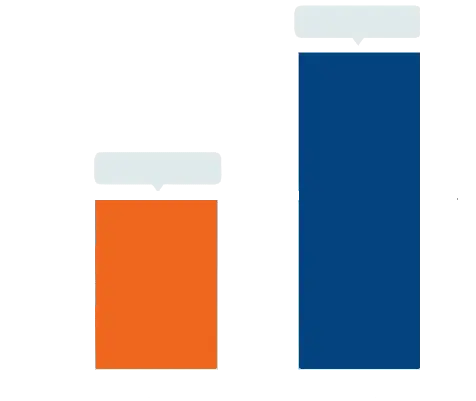
3.67 Billion
USD
6.25 Billion
2025
2033
USD
3.67 Billion
USD
6.25 Billion
2025
2033
 Forecast Period Forecast Period |
2026 –2033 |
 Market Size (Base Year) Market Size (Base Year) |
USD 3.67 Billion |
 Market Size (Forecast Year) Market Size (Forecast Year) |
USD 6.25 Billion |
 CAGR CAGR |
% |
| Major Markets Players |
|
Whole Genome Amplification Market Size
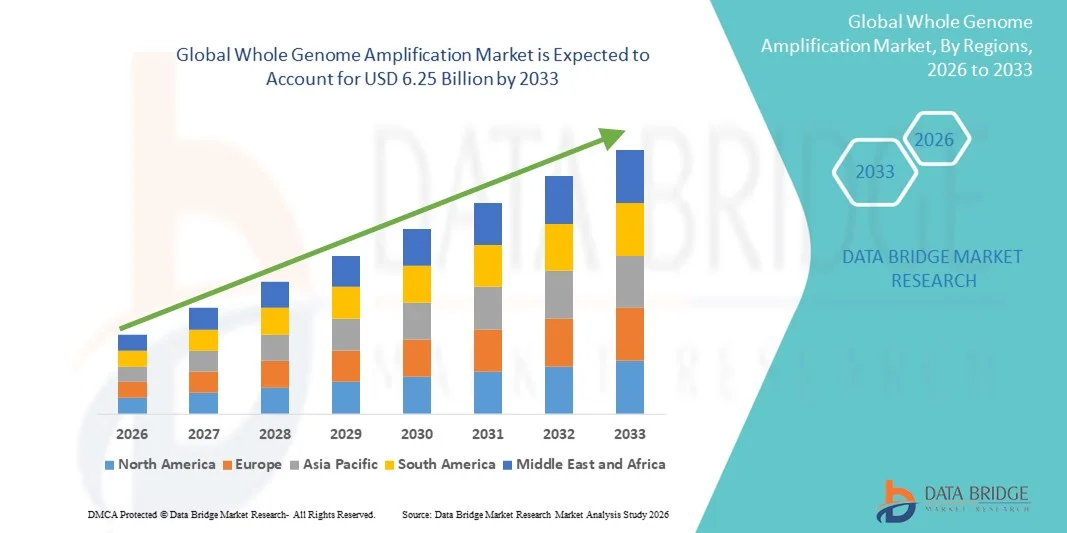
- The global whole genome amplification market size was valued at USD 3.67 billion in 2025 and is expected to reach USD 6.25 billion by 2033, at a CAGR of 6.90% during the forecast period
- The market growth is primarily driven by the increasing adoption of advanced genomic technologies in research and clinical diagnostics, along with continuous technological advancements in DNA amplification methods that enable analysis from minimal or degraded samples
- Furthermore, rising demand for precision medicine, expanding applications in oncology, prenatal testing, and rare disease research, and the growing need for accurate and scalable genomic data are positioning whole genome amplification as a critical enabling technology. These combined factors are accelerating the adoption of whole genome amplification solutions, thereby significantly supporting the market’s overall growth trajectory
Whole Genome Amplification Market Analysis
- Whole genome amplification, a molecular technique used to uniformly amplify entire genomes from limited DNA samples, is becoming an essential component of modern genomics workflows in both research and clinical settings due to its ability to enable comprehensive genetic analysis from scarce or degraded specimens
- The rising demand for whole genome amplification is primarily driven by the rapid expansion of genomics and precision medicine, increasing use in oncology, prenatal and preimplantation genetic testing, and the growing need for high-quality DNA inputs for next-generation sequencing and microarray applications
- North America dominated the whole genome amplification market with the largest revenue share of 42.5% in 2025, supported by advanced research infrastructure, strong funding for genomic research, and the presence of major biotechnology and genomics companies, with the U.S. witnessing substantial adoption in academic research, clinical diagnostics, and pharmaceutical R&D, driven by continuous innovations in amplification chemistries and sequencing technologies
- Asia-Pacific is expected to be the fastest growing region in the whole genome amplification market during the forecast period due to expanding biotechnology sectors, increasing government investments in genomics research, and rising adoption of advanced molecular diagnostics across countries such as China, India, and South Korea
- The single cell WGA kit segment dominated the whole genome amplification market with a share of 39.8% in 2025, driven by its critical role in single-cell genomics, early-stage disease research, and applications requiring amplification from minimal DNA inputs
Report Scope and Whole Genome Amplification Market Segmentation
|
Attributes |
Whole Genome Amplification Key Market Insights |
|
Segments Covered |
|
|
Countries Covered |
North America
Europe
Asia-Pacific
Middle East and Africa
South America
|
|
Key Market Players |
|
|
Market Opportunities |
|
|
Value Added Data Infosets |
In addition to the insights on market scenarios such as market value, growth rate, segmentation, geographical coverage, and major players, the market reports curated by the Data Bridge Market Research also include in-depth expert analysis, patient epidemiology, pipeline analysis, pricing analysis, and regulatory framework |
Whole Genome Amplification Market Trends
Advancements in Single-Cell and Low-Input Genomics
- A significant and accelerating trend in the global whole genome amplification market is the increasing focus on single-cell and low-input DNA applications, enabling researchers to generate comprehensive genomic data from minimal or degraded samples
- For instance, the REPLI-g Single Cell Kit allows amplification from a single cell, facilitating studies in cancer heterogeneity, prenatal diagnostics, and rare cell populations
- Integration with next-generation sequencing (NGS) workflows is enhancing data accuracy and throughput, allowing WGA products to support comprehensive genome analysis in research, clinical, and forensic applications
- Companies such as QIAGEN and Takara Bio are developing optimized kits for high-fidelity amplification compatible with multi-omics studies, ensuring better coverage and reproducibility
- This trend toward more precise, efficient, and scalable WGA solutions is reshaping expectations for genomic research capabilities, driving innovation in kit design, amplification chemistries, and workflow integration
- The demand for WGA solutions capable of supporting single-cell analysis, prenatal testing, and forensic genomics is growing rapidly across research and clinical sectors, as scientists increasingly prioritize sensitivity and reliability
- Rising integration of WGA kits with automation platforms and lab-on-chip technologies is further streamlining workflows and reducing hands-on time in high-throughput research settings
- Collaborative efforts between kit manufacturers and sequencing platform providers are driving the development of tailored WGA solutions optimized for specific NGS applications, expanding market opportunities
Whole Genome Amplification Market Dynamics
Driver
Increasing Adoption in Genomics and Precision Medicine
- The rising need for accurate and scalable DNA amplification in research, diagnostics, and drug development is a significant driver for the adoption of whole genome amplification technologies
- For instance, in March 2025, Illumina reported integration of WGA kits with its NGS platforms for enhanced single-cell and tumor DNA analysis, enabling more comprehensive genomic insights
- As precision medicine and personalized therapies gain traction, WGA allows generation of sufficient DNA from small clinical samples, supporting disease profiling and biomarker discovery
- Furthermore, growing use of WGA in prenatal diagnostics, oncology, and rare disease research is making it an essential step in genomic workflows, ensuring reliable downstream analyses
- The convenience of generating high-quality DNA from limited samples and compatibility with advanced sequencing and genotyping technologies are key factors propelling WGA adoption in both clinical and research applications
- Increasing investments in genomics research, expanding clinical testing, and rising awareness of genomic medicine continue to drive market growth globally
- Expanding applications in agriculture, veterinary genomics, and forensics are creating additional revenue streams for WGA kit manufacturers
- Rising partnerships between pharmaceutical companies and genomics solution providers are accelerating the adoption of WGA technologies for drug discovery and biomarker validation
Restraint/Challenge
Technical Limitations and Standardization Issues
- Challenges surrounding amplification bias, uneven genome coverage, and errors in low-input or degraded DNA samples pose significant hurdles to market adoption
- For instance, reports of amplification artifacts in forensic samples have made some laboratories cautious about relying solely on WGA for critical analyses
- Addressing these technical limitations through improved polymerases, optimized reaction conditions, and quality control protocols is crucial for ensuring reliable and reproducible results
- In addition, lack of standardized protocols across laboratories and varying performance among different WGA kits can hinder broader acceptance in clinical diagnostics and regulatory approval
- While kit accuracy and reliability are improving, the perceived risk of biased amplification or incomplete genome coverage can still limit adoption among conservative research and clinical users
- Overcoming these challenges through kit optimization, robust validation studies, and standardization initiatives will be vital for sustained growth in the WGA market
- High costs of premium WGA kits and reagents may limit accessibility for smaller research labs and institutions in emerging economies
- Regulatory complexities for clinical applications of WGA, including validation requirements for diagnostics, can slow market penetration and product adoption
Whole Genome Amplification Market Scope
The market is segmented on the basis of product, application, and end user
- By Product
On the basis of product, the whole genome amplification market is segmented into Single Cell WGA Kit, Complete WGA Kit, WGA Reamplification Kit, WGA and Chip DNA Kit, and Others. The Single Cell WGA Kit segment dominated the market with the largest revenue share of 39.8% in 2025, driven by its crucial role in enabling high-fidelity amplification from single cells. These kits are widely adopted in cancer research, prenatal diagnostics, and rare cell analysis due to their ability to generate sufficient DNA from minimal samples while maintaining genomic integrity. The increasing focus on single-cell genomics and precision medicine has strengthened the demand for this segment. Researchers also prefer single-cell WGA kits because they integrate seamlessly with next-generation sequencing (NGS) workflows, allowing detailed genomic analysis. Their high reproducibility and compatibility with automated laboratory systems further enhance adoption. Companies such as QIAGEN and Takara Bio have been innovating in this space, improving amplification fidelity and coverage to meet research demands.
The Complete WGA Kit segment is anticipated to witness the fastest growth rate of 22.5% from 2026 to 2033, fueled by increasing adoption in clinical diagnostics and large-scale genomic studies. Complete kits offer comprehensive genome coverage and streamlined workflows for applications requiring amplification from larger DNA inputs. Their compatibility with multiple downstream applications, such as sequencing, genotyping, and array-based analyses, makes them highly attractive for laboratories focusing on efficiency and scalability. Growing interest in multi-omics research and integrated genomic solutions further drives their adoption. These kits also reduce hands-on time, support automation, and enhance reproducibility, making them popular among academic and commercial laboratories. The rising investments in genomics R&D and demand for reliable, ready-to-use solutions are expected to sustain the growth of this segment.
- By Application
On the basis of application, the market is segmented into drug discovery and development, disease diagnosis, agriculture and veterinary, research, forensics, and others. The Research segment dominated the market with the largest revenue share of 41.2% in 2025, driven by extensive use in genomics studies, single-cell analysis, and molecular biology research. Academic institutions, government research centers, and biotech companies rely heavily on WGA techniques to generate sufficient DNA from limited or degraded samples. Research applications demand high accuracy, reproducibility, and compatibility with downstream technologies such as NGS and microarrays. The expansion of genomics, proteomics, and epigenetics studies has further strengthened this segment. Increasing funding for genomic research and the integration of WGA in advanced research workflows contribute to its dominance. Companies are also developing specialized kits tailored for research needs, enhancing convenience and performance for lab workflows.
The Drug Discovery and Development segment is expected to witness the fastest CAGR of 23.1% from 2026 to 2033, fueled by the growing reliance on genomics for target identification, biomarker discovery, and personalized medicine. WGA enables drug developers to analyze DNA from scarce clinical or preclinical samples efficiently. Integration with high-throughput screening, sequencing, and bioinformatics platforms makes WGA indispensable in modern drug discovery workflows. Pharmaceutical companies are increasingly adopting WGA to accelerate research timelines, reduce sample constraints, and improve accuracy. Rising demand for precision medicine and companion diagnostics is expected to sustain the growth of this segment during the forecast period.
- By End User
On the basis of end user, the market is segmented into pharma and biotech companies, hospitals and clinics, contract research organizations, research and academic institutes, and others. The Research and Academic Institutes segment dominated the market with the largest revenue share of 38.7% in 2025, driven by their extensive adoption of WGA for genomics, molecular biology, and single-cell studies. Universities, government laboratories, and private research institutes invest in high-throughput genomic technologies to support cutting-edge research. WGA kits are preferred for their reproducibility, ease of use, and compatibility with multiple downstream applications. The focus on genomics education, research funding, and collaborative projects further reinforces market dominance. Integration with automated systems and NGS platforms also enhances workflow efficiency, making this segment a critical consumer of WGA solutions.
The Pharma and Biotech Companies segment is anticipated to witness the fastest CAGR of 22.8% from 2026 to 2033, fueled by increasing use of WGA in drug discovery, biomarker validation, and personalized medicine initiatives. Companies are leveraging WGA to analyze small or degraded samples, enabling faster and more accurate R&D processes. The rising demand for precision therapeutics, integration with sequencing platforms, and the need for high-throughput and scalable solutions drive the adoption in this segment. Strategic partnerships between WGA kit manufacturers and pharmaceutical companies are further boosting market growth. Moreover, regulatory emphasis on genomic data-driven drug development is encouraging pharma adoption of advanced WGA technologies.
Whole Genome Amplification Market Regional Analysis
- North America dominated the whole genome amplification market with the largest revenue share of 42.5% in 2025, supported by advanced research infrastructure, strong funding for genomic research, and the presence of major biotechnology and genomics companies
- Researchers and clinical laboratories in the region highly value the high fidelity, reproducibility, and scalability offered by WGA kits, enabling comprehensive genomic analysis from limited or degraded DNA samples
- This widespread adoption is further supported by the presence of leading biotechnology and genomics companies, well-established academic and research institutions, and increasing integration of WGA with next-generation sequencing and multi-omics platforms, establishing WGA as a preferred solution for both research and clinical applications
U.S. Whole Genome Amplification Market Insight
The U.S. whole genome amplification market captured the largest revenue share of 78% in 2025 within North America, fueled by advanced genomics research, widespread adoption of precision medicine, and robust funding for molecular biology initiatives. Researchers and clinical laboratories increasingly prioritize WGA solutions for high-fidelity DNA amplification from limited or degraded samples. The growing preference for integration with next-generation sequencing (NGS) platforms and automated workflows further propels market growth. Moreover, collaborations between biotech companies and academic institutions are accelerating innovation in WGA technologies, expanding their applications in disease diagnostics, oncology, and prenatal testing.
Europe Whole Genome Amplification Market Insight
The Europe whole genome amplification market is projected to expand at a substantial CAGR throughout the forecast period, primarily driven by increasing investments in genomics research, rising adoption of personalized medicine, and the need for precise diagnostic solutions. Expansion in urbanized regions and the growing number of research laboratories are fostering WGA adoption. European researchers are also drawn to the high reproducibility and comprehensive genome coverage offered by WGA kits. The region is experiencing significant growth across academic, clinical, and pharmaceutical applications, with WGA being integrated into both basic research and translational genomics studies.
U.K. Whole Genome Amplification Market Insight
The U.K. whole genome amplification market is anticipated to grow at a noteworthy CAGR during the forecast period, driven by the rising focus on genomics research, drug discovery, and clinical diagnostics. In addition, increasing awareness of genetic diseases and the demand for high-quality DNA for sequencing applications are encouraging adoption among academic and clinical laboratories. The U.K.’s robust research infrastructure and strong government support for genomics initiatives are expected to continue stimulating market growth. The growing trend of personalized medicine further positions WGA technologies as essential tools in clinical and pharmaceutical applications.
Germany Whole Genome Amplification Market Insight
The Germany whole genome amplification market is expected to expand at a considerable CAGR during the forecast period, fueled by increasing awareness of genomics, precision medicine, and advanced molecular diagnostics. Germany’s well-developed research infrastructure, combined with its emphasis on innovation and technological excellence, promotes the adoption of high-fidelity WGA kits. Integration of WGA with sequencing platforms and bioinformatics workflows is becoming increasingly prevalent, supporting research in oncology, rare diseases, and single-cell genomics. There is also a strong preference for reliable and reproducible WGA solutions aligned with rigorous local research standards.
Asia-Pacific Whole Genome Amplification Market Insight
The Asia-Pacific whole genome amplification market is poised to grow at the fastest CAGR of 25% during the forecast period of 2026 to 2033, driven by increasing investments in biotechnology, genomics research, and rising adoption of molecular diagnostics in countries such as China, Japan, and India. The region's growing focus on precision medicine and large-scale genomics projects is driving the uptake of WGA technologies. Furthermore, as APAC emerges as a hub for biotech manufacturing and research, the affordability and accessibility of WGA kits are expanding to a wider research and clinical base.
Japan Whole Genome Amplification Market Insight
The Japan whole genome amplification market is gaining momentum due to the country’s high focus on precision medicine, cutting-edge research facilities, and strong government support for genomics initiatives. Adoption is driven by increasing single-cell genomics studies, disease diagnostics, and biopharmaceutical R&D. Integration with NGS platforms and automated laboratory systems is fueling market growth. Moreover, Japan’s aging population is expected to boost demand for genomic testing and molecular diagnostics, driving adoption of WGA kits in both clinical and research sectors.
India Whole Genome Amplification Market Insight
The India whole genome amplification market accounted for the largest market revenue share in Asia-Pacific in 2025, attributed to expanding biotechnology research, rising investments in genomics, and a growing focus on molecular diagnostics. India stands as one of the fastest-growing markets for genomics and precision medicine applications, and WGA technologies are increasingly adopted in research institutes, hospitals, and contract research organizations. Government initiatives supporting genomics research, availability of cost-effective WGA kits, and domestic manufacturing capabilities are key factors propelling market growth in India.
Whole Genome Amplification Market Share
The Whole Genome Amplification industry is primarily led by well-established companies, including:
- QIAGEN (Netherlands)
- Thermo Fisher Scientific Inc. (U.S.)
- Illumina, Inc. (U.S.)
- New England Biolabs (U.S.)
- BioSkryb Genomics (U.S.)
- Takara Bio (Japan)
- Bio‑Rad Laboratories, Inc. (U.S.)
- Merck KGaA (Germany)
- Agilent Technologies, Inc. (U.S.)
- LGC Biosearch Technologies (U.K.)
- Oxford Nanopore Technologies (U.K.)
- PerkinElmer (U.S.)
- Promega Corporation (U.S.)
- Enzo Life Sciences, Inc. (U.S.)
- Norgen Biotek Corp. (Canada)
- BGI Genomics Co., Ltd. (China)
- Pacific Biosciences of California, Inc. (U.S.)
- Myriad Genetics, Inc. (U.S.)
- Vazyme Biotech Co., Ltd. (China)
- Abbott (U.S.)
What are the Recent Developments in Global Whole Genome Amplification Market?
- In October 2025, BioSkryb Genomics launched the ResolveSEQ LongRead Early Access Program, marking a step forward in integrating long‑read sequencing with whole genome amplification for ultra‑high‑resolution single‑cell genomic analysis
- In August 2025, BioSkryb Genomics secured an exclusive license to a breakthrough methylation patent, enabling the development of methods for single‑cell, genome‑wide methylation analysis alongside variant detection, expanding the functional scope of WGA‑related technologies
- In April 2025, BioSkryb Genomics announced a strategic partnership with 1Cell.Ai to co‑develop next‑generation single‑cell multi‑omics solutions, aimed at advancing whole genome amplification capabilities and broadening applications in precision research and diagnostics
- In September 2024, Takara Bio Europe unveiled its Shasta™ Single‑Cell System along with an associated high‑throughput Whole‑Genome Amplification (WGA) Kit at the Human Cell Atlas General Meeting, enabling processing of up to 1,500 cells per run and enhancing biomarker discovery capabilities in oncology and single‑cell genomics
- In July 2023, researchers at the Qingdao Institute of Bioenergy and Bioprocess Technology (Chinese Academy of Sciences) developed an engineered phi29 DNA polymerase that significantly improves single‑cell whole‑genome amplification efficiency and coverage, reducing bias and lowering reagent costs an advancement poised to enhance WGA workflows across microbiology and genomics research
SKU-
Get online access to the report on the World's First Market Intelligence Cloud

- Interactive Data Analysis Dashboard
- Company Analysis Dashboard for high growth potential opportunities
- Research Analyst Access for customization & queries
- Competitor Analysis with Interactive dashboard
- Latest News, Updates & Trend analysis
- Harness the Power of Benchmark Analysis for Comprehensive Competitor Tracking
Research Methodology
Data collection and base year analysis are done using data collection modules with large sample sizes. The stage includes obtaining market information or related data through various sources and strategies. It includes examining and planning all the data acquired from the past in advance. It likewise envelops the examination of information inconsistencies seen across different information sources. The market data is analysed and estimated using market statistical and coherent models. Also, market share analysis and key trend analysis are the major success factors in the market report. To know more, please request an analyst call or drop down your inquiry.
The key research methodology used by DBMR research team is data triangulation which involves data mining, analysis of the impact of data variables on the market and primary (industry expert) validation. Data models include Vendor Positioning Grid, Market Time Line Analysis, Market Overview and Guide, Company Positioning Grid, Patent Analysis, Pricing Analysis, Company Market Share Analysis, Standards of Measurement, Global versus Regional and Vendor Share Analysis. To know more about the research methodology, drop in an inquiry to speak to our industry experts.
Customization Available
Data Bridge Market Research is a leader in advanced formative research. We take pride in servicing our existing and new customers with data and analysis that match and suits their goal. The report can be customized to include price trend analysis of target brands understanding the market for additional countries (ask for the list of countries), clinical trial results data, literature review, refurbished market and product base analysis. Market analysis of target competitors can be analyzed from technology-based analysis to market portfolio strategies. We can add as many competitors that you require data about in the format and data style you are looking for. Our team of analysts can also provide you data in crude raw excel files pivot tables (Fact book) or can assist you in creating presentations from the data sets available in the report.