


What is the WLAN IC Market Size and Growth Rate?
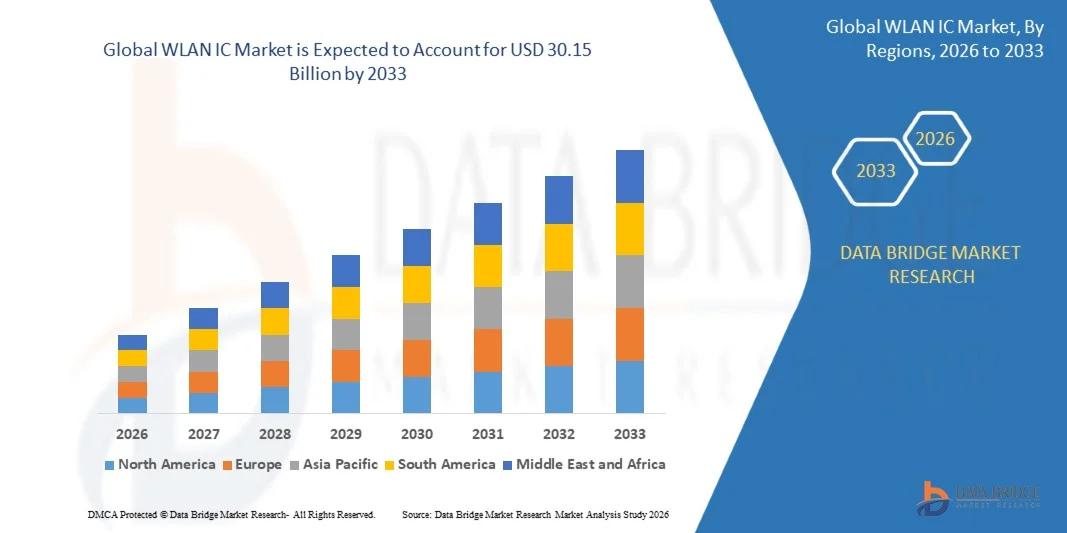
- As per Data Bridge Market Research analysis the WLAN IC market was valued at USD 15.70 billion in 2025 and is projected to reach USD 30.15 billion by 2033, growing at a CAGR of 8.50% from 2026 to 2033.
- The market is experiencing strong growth driven by the rising adoption of connected devices, increasing demand for high-speed wireless connectivity, and rapid expansion of Wi-Fi-enabled consumer electronics, smart home devices, and enterprise networking infrastructure.
- The growing deployment of advanced Wi-Fi technologies, including Wi-Fi 6, Wi-Fi 6E, and Wi-Fi 7, combined with increasing demand for reliable and low-latency wireless communication, is encouraging manufacturers to adopt advanced WLAN IC solutions across consumer, industrial, automotive, and telecommunications applications.
Market Size & Forecast
- Market Value (2025): USD 15.70 Billion
- Expected Market Value (2033): USD 30.15 Billion
- Forecast CAGR (2026–2033): 8.50%
- Leading Region in 2025: North America
- Fastest Growing Region: Asia-Pacific
What are the Major Takeaways of the WLAN IC Market?
- North America dominated the WLAN IC market with the largest revenue share of 45.5% in 2025, supported by the widespread adoption of connected consumer electronics, advanced wireless networking infrastructure, and increasing demand for high-speed connectivity.
- Asia-Pacific WLAN IC market is expected to witness the fastest growth rate from 2026 to 2033, supported by rapid digitalization, expanding consumer electronics manufacturing, rising smartphone penetration, and increasing adoption of connected devices in countries such as China, Japan, South Korea, and India.
- The WLAN segment held the largest market revenue share in 2025 driven by its widespread integration into smartphones, laptops, routers, smart home devices, and other connected consumer electronics. WLAN ICs are preferred due to their high-speed wireless connectivity, broad device compatibility, and increasing support for advanced Wi-Fi standards across connected applications.
- The LPWAN segment is projected to register the fastest growth from 2026 to 2033, driven by increasing demand for low-power and long-range connectivity in IoT applications, smart buildings, industrial monitoring, and connected infrastructure. Rising deployment of energy-efficient connected devices and large-scale IoT networks is accelerating segment expansion.
- The consumer electronics segment held the largest market revenue share in 2025 driven by the extensive adoption of wireless connectivity in smartphones, tablets, laptops, televisions, gaming devices, and smart home products. WLAN ICs are increasingly integrated into consumer devices to provide high-speed connectivity, seamless data transmission, and reliable wireless communication.
- The automotive and transportation segment is projected to register the fastest growth from 2026 to 2033, driven by increasing vehicle connectivity, the adoption of connected infotainment systems, and growing demand for wireless communication in next-generation vehicles. Rising integration of Wi-Fi-enabled systems and connected technologies in automobiles and transportation infrastructure is accelerating segment expansion.
Report Scope and WLAN IC Market Segmentation
|
Attributes |
WLAN IC Key Market Insights |
|
Segments Covered |
|
|
Countries Covered |
North America
Europe
Asia-Pacific
Middle East and Africa
South America
|
|
Key Market Players |
|
|
Market Opportunities |
|
|
Value Added Data Infosets |
In addition to the market insights such as market value, growth rate, market segments, geographical coverage, market players, and market scenario, the market report curated by the Data Bridge Market Research team includes in-depth expert analysis, import/export analysis, pricing analysis, production consumption analysis, and pestle analysis. |
What is the Key Trend in the WLAN IC Market?
- WLAN IC manufacturers are increasingly focusing on Wi-Fi 7 chipsets that deliver higher throughput, lower latency, improved reliability, and support for high-density connected environments across smartphones, PCs, routers, and other smart devices.
- For instance, in January 2025, Samsung Electronics launched the Galaxy Book5 Pro and Galaxy Book5 360 with Wi-Fi 7 connectivity, demonstrating the increasing integration of next-generation WLAN technologies into consumer computing devices.
- Multi-Link Operation and the use of the 6 GHz spectrum are enabling WLAN ICs to improve connection stability, reduce latency, and support bandwidth-intensive applications such as cloud gaming, augmented reality, and high-resolution video streaming.
- WLAN connectivity is also expanding across enterprise, industrial, and automotive applications as manufacturers seek reliable wireless communication for increasingly connected environments.
- For instance, Qualcomm's FastConnect 7800 Wi-Fi 7 Network Adapter received Wi-Fi CERTIFIED 7 certification, supporting 2.4 GHz, 5 GHz, and 6 GHz spectrum capabilities and demonstrating the industry's shift toward advanced multi-band WLAN solutions.
- As demand for faster and more reliable wireless connectivity continues to increase, the transition toward Wi-Fi 7-enabled WLAN ICs is expected to remain a key trend, supporting the expansion of next-generation connected devices and networking infrastructure.
What are the Key Drivers of the WLAN IC Market?
- The rapid expansion of smartphones, laptops, smart home devices, connected appliances, and enterprise networking equipment is significantly increasing demand for high-performance WLAN ICs capable of supporting greater data traffic and multiple connected devices.
- For instance, in January 2025, Samsung Electronics introduced its Galaxy Book5 Pro and Galaxy Book5 360 with Wi-Fi 7 connectivity, reflecting the growing adoption of advanced wireless standards in mainstream computing products.
- The increasing deployment of Wi-Fi 6, Wi-Fi 6E, and Wi-Fi 7 technologies is encouraging device manufacturers to upgrade wireless chipsets to support higher speeds, lower latency, improved capacity, and more efficient spectrum utilization.
- For instance, the Wi-Fi Alliance's certification database lists Qualcomm's FastConnect 7800 as Wi-Fi CERTIFIED 7, with support for 2.4 GHz, 5 GHz, and 6 GHz spectrum capabilities, demonstrating the commercial development of next-generation WLAN chipsets.
- With connected devices and bandwidth-intensive applications continuing to expand, the demand for advanced WLAN ICs will remain strong as manufacturers increasingly integrate high-speed wireless connectivity into consumer electronics, enterprise equipment, and connected infrastructure.
Which Factors are Challenging the Growth of the WLAN IC Market?
- Advanced WLAN ICs require significant research and development investment because manufacturers must integrate increasingly complex radio architectures, multi-band capabilities, power-management technologies, and support for evolving Wi-Fi standards.
- The transition to newer standards such as Wi-Fi 7 also increases design complexity and can raise component costs, creating challenges for manufacturers targeting cost-sensitive consumer electronics and mass-market connected devices.
- For instance, Samsung notes that Wi-Fi 7 availability in its Galaxy Book5 products depends on the operating system, market, location, network conditions, and availability of Wi-Fi 7 routers, demonstrating that adoption requires compatible infrastructure in addition to capable WLAN ICs.
- Compatibility requirements across different generations of Wi-Fi devices, regulatory variations in spectrum availability, and the need for supporting network infrastructure can further slow the adoption of advanced WLAN ICs.
- These technology, compatibility, and infrastructure challenges can increase development costs and lengthen product qualification cycles, particularly for manufacturers and device makers operating in price-sensitive markets, potentially limiting the pace of adoption of next-generation WLAN IC solutions.
How is the WLAN IC Market Segmented?
The market is segmented on the basis of product type and application.
- By Product Type
On the basis of product type, the WLAN IC market is segmented into WLAN, satellite, LPWAN, and cellular M2M. The WLAN segment held the largest market revenue share in 2025 driven by its widespread integration into smartphones, laptops, routers, smart home devices, and other connected consumer electronics. WLAN ICs are preferred due to their high-speed wireless connectivity, broad device compatibility, and increasing support for advanced Wi-Fi standards across connected applications.
The LPWAN segment is projected to register the fastest growth from 2026 to 2033, driven by increasing demand for low-power and long-range connectivity in IoT applications, smart buildings, industrial monitoring, and connected infrastructure. Rising deployment of energy-efficient connected devices and large-scale IoT networks is accelerating segment expansion.
- By Application
On the basis of application, the WLAN IC market is segmented into consumer electronics, building automation, automotive and transportation, and others. The consumer electronics segment held the largest market revenue share in 2025 driven by the extensive adoption of wireless connectivity in smartphones, tablets, laptops, televisions, gaming devices, and smart home products. WLAN ICs are increasingly integrated into consumer devices to provide high-speed connectivity, seamless data transmission, and reliable wireless communication.
The automotive and transportation segment is projected to register the fastest growth from 2026 to 2033, driven by increasing vehicle connectivity, the adoption of connected infotainment systems, and growing demand for wireless communication in next-generation vehicles. Rising integration of Wi-Fi-enabled systems and connected technologies in automobiles and transportation infrastructure is accelerating segment expansion.
Which Region Holds the Largest Share of the WLAN IC Market?
- North America dominated the WLAN IC market with the largest revenue share of 45.5% in 2025, supported by the widespread adoption of connected consumer electronics, advanced wireless networking infrastructure, and increasing demand for high-speed connectivity.
- Consumers and enterprises in the region are rapidly adopting Wi-Fi-enabled smartphones, laptops, smart home devices, and networking equipment. This widespread adoption is further supported by strong technological infrastructure, high spending on connected devices, and early deployment of advanced Wi-Fi standards, establishing WLAN ICs as an essential component across consumer and enterprise applications.
U.S. WLAN IC Market Insight
U.S. WLAN IC market captured the largest revenue share in 2025 within North America, fueled by the rapid adoption of connected devices, smart home technologies, and high-speed wireless networking solutions. Consumers are increasingly relying on Wi-Fi-enabled smartphones, computers, smart televisions, and connected appliances for seamless connectivity. The growing deployment of Wi-Fi 6, Wi-Fi 6E, and Wi-Fi 7 technologies, combined with strong demand for cloud services, streaming, gaming, and connected home applications, further propels the WLAN IC market.
Europe WLAN IC Market Insight
Europe WLAN IC market is expected to witness the fastest growth rate from 2026 to 2033, primarily driven by increasing digitalization, expanding IoT deployments, and growing demand for reliable wireless connectivity across residential, commercial, and industrial environments. The region's increasing adoption of smart buildings, connected appliances, and enterprise networking systems is fostering demand for advanced WLAN ICs. European industries are also investing in next-generation wireless infrastructure to support automation, energy management, and connected services, further contributing to market expansion.
U.K. WLAN IC Market Insight
U.K. WLAN IC market is expected to witness the fastest growth rate from 2026 to 2033, driven by the growing adoption of smart home technologies, connected consumer electronics, and advanced wireless networking infrastructure. Increasing demand for reliable high-speed connectivity across residential and commercial environments is encouraging the integration of WLAN ICs into routers, computers, smart appliances, and IoT devices. Moreover, the U.K.'s expanding digital infrastructure and strong adoption of connected technologies are expected to continue stimulating market growth.
Germany WLAN IC Market Insight
Germany WLAN IC market is expected to witness the fastest growth rate from 2026 to 2033, fueled by increasing industrial digitalization, smart manufacturing, and demand for reliable wireless communication systems. Germany's well-developed automotive and industrial sectors are increasingly adopting connected technologies that require high-performance wireless connectivity. The growing deployment of industrial IoT, smart factories, connected vehicles, and advanced enterprise networks is also supporting the integration of WLAN ICs across commercial and industrial applications.
Asia-Pacific WLAN IC Market Insight
The Asia-Pacific WLAN IC market is expected to witness the fastest growth rate from 2026 to 2033, supported by rapid digitalization, expanding consumer electronics manufacturing, rising smartphone penetration, and increasing adoption of connected devices in countries such as China, Japan, South Korea, and India. The region's strong electronics manufacturing ecosystem and growing demand for smart home, IoT, and wireless networking solutions are driving WLAN IC adoption. Furthermore, increasing investments in next-generation communication infrastructure and the rapid deployment of advanced Wi-Fi technologies are expanding opportunities for WLAN IC manufacturers across the region.
Japan WLAN IC Market Insight
Japan WLAN IC market is expected to witness the fastest growth rate from 2026 to 2033 due to the country's advanced electronics industry, high adoption of connected devices, and strong focus on technological innovation. Japanese consumers and businesses increasingly rely on wireless connectivity for smart appliances, consumer electronics, industrial equipment, and connected infrastructure. The integration of advanced Wi-Fi technologies with IoT devices, smart homes, and automated industrial systems is further fueling demand for high-performance WLAN IC solutions.
China WLAN IC Market Insight
The China WLAN IC market accounted for the largest market revenue share in Asia Pacific in 2025, attributed to the country's extensive consumer electronics manufacturing base, large connected-device population, and rapid adoption of wireless technologies. China represents one of the world's largest markets for smartphones, computers, smart home devices, and networking equipment, creating substantial demand for WLAN ICs. The expansion of smart cities, industrial IoT, connected infrastructure, and domestic electronics production, alongside the growing deployment of Wi-Fi 6 and Wi-Fi 7 technologies, is further propelling market growth in China.
Which are the Top Companies in WLAN IC Market?
The WLAN IC industry is primarily led by well-established companies, including:
- Broadcom Inc. (U.S.)
- Qualcomm Technologies, Inc. (U.S.)
- MediaTek Inc. (Taiwan)
- Realtek Semiconductor Corp. (Taiwan)
- Intel Corporation (U.S.)
- Marvell Technology, Inc. (U.S.)
- Texas Instruments Incorporated (U.S.)
- NXP Semiconductors N.V. (Netherlands)
- Infineon Technologies AG (Germany)
- Renesas Electronics Corporation (Japan)
- Samsung Electronics Co., Ltd. (South Korea)
- STMicroelectronics N.V. (Switzerland)
- Microchip Technology Incorporated (U.S.)
- Silicon Laboratories Inc. (U.S.)
- Nordic Semiconductor ASA (Norway)
What are Latest Developments in WLAN IC Market?
- In February 2026, Broadcom introduced an enterprise Wi-Fi 8 access point and switch solution designed specifically for AI-driven networking environments. The development demonstrates the increasing commercialization of next-generation Wi-Fi technologies and is expected to accelerate demand for advanced WLAN ICs across high-performance enterprise wireless infrastructure.
- In February 2026, Texas Instruments announced an agreement to acquire Silicon Labs in an all-cash transaction valued at approximately USD 7.5 billion. The acquisition aims to expand TI’s embedded wireless connectivity capabilities and strengthen its position in the wireless semiconductor market, supporting the growing demand for WLAN ICs and connected IoT applications.
- In October 2024, Qualcomm Technologies and STMicroelectronics announced a strategic collaboration to develop next-generation industrial and consumer IoT solutions by combining Qualcomm’s AI-enabled Wi-Fi, Bluetooth, and Thread combo SoC with STMicroelectronics’ STM32 microcontroller ecosystem. The collaboration is expected to simplify wireless integration, accelerate product development, and expand the adoption of WLAN-enabled IoT devices globally.
- In February 2024, Qualcomm Technologies introduced FastConnect 7900, an AI-optimized Wi-Fi 7 solution designed to deliver enhanced wireless performance through higher speeds, lower latency, and improved power efficiency. The launch strengthens Qualcomm’s next-generation WLAN connectivity portfolio and is expected to support increasing demand for advanced wireless connectivity in connected devices.

- Interactive Data Analysis Dashboard
- Company Analysis Dashboard for high growth potential opportunities
- Research Analyst Access for customization & queries
- Competitor Analysis with Interactive dashboard
- Latest News, Updates & Trend analysis
- Harness the Power of Benchmark Analysis for Comprehensive Competitor Tracking
Data collection and base year analysis are done using data collection modules with large sample sizes. The stage includes obtaining market information or related data through various sources and strategies. It includes examining and planning all the data acquired from the past in advance. It likewise envelops the examination of information inconsistencies seen across different information sources. The market data is analysed and estimated using market statistical and coherent models. Also, market share analysis and key trend analysis are the major success factors in the market report. To know more, please request an analyst call or drop down your inquiry.
The key research methodology used by DBMR research team is data triangulation which involves data mining, analysis of the impact of data variables on the market and primary (industry expert) validation. Data models include Vendor Positioning Grid, Market Time Line Analysis, Market Overview and Guide, Company Positioning Grid, Patent Analysis, Pricing Analysis, Company Market Share Analysis, Standards of Measurement, Global versus Regional and Vendor Share Analysis. To know more about the research methodology, drop in an inquiry to speak to our industry experts.
Data Bridge Market Research is a leader in advanced formative research. We take pride in servicing our existing and new customers with data and analysis that match and suits their goal. The report can be customized to include price trend analysis of target brands understanding the market for additional countries (ask for the list of countries), clinical trial results data, literature review, refurbished market and product base analysis. Market analysis of target competitors can be analyzed from technology-based analysis to market portfolio strategies. We can add as many competitors that you require data about in the format and data style you are looking for. Our team of analysts can also provide you data in crude raw excel files pivot tables (Fact book) or can assist you in creating presentations from the data sets available in the report.













