


X-Ray Photoelectron Spectroscopy Market Size
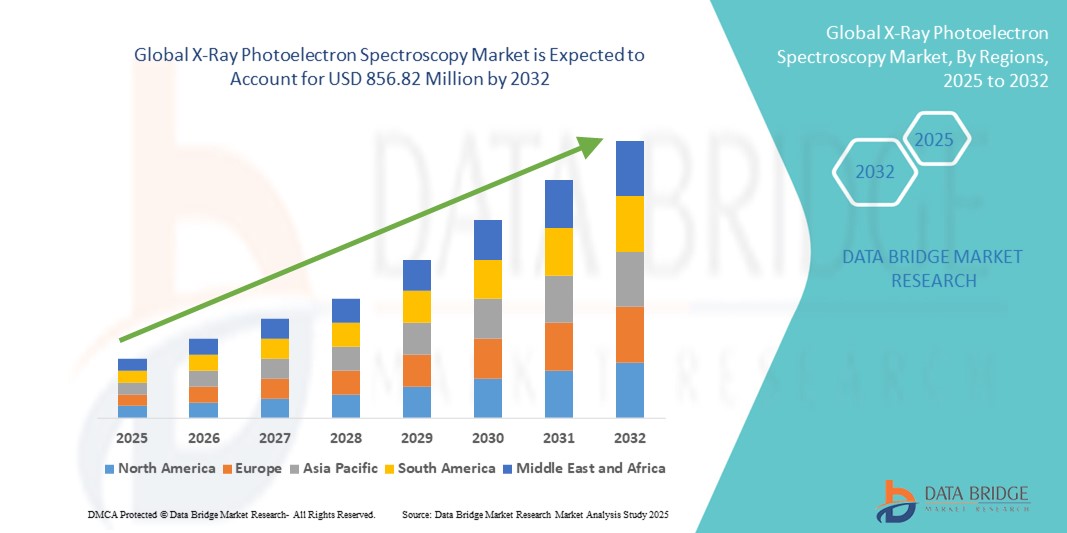
- The global X-ray photoelectron spectroscopy market size was valued at USD 558.30 million in 2024 and is expected to reach USD 856.82 million by 2032, at a CAGR of 5.50% during the forecast period
- The market growth is largely driven by rising investments in surface chemistry research, advancements in material science, and increasing demand across electronics, semiconductors, and healthcare sectors for accurate surface analysis
- Furthermore, the growing need for precise material characterization in nanotechnology, along with stringent regulatory requirements in pharmaceuticals and environmental monitoring, is reinforcing the adoption of XPS technology. These combined factors are accelerating demand for XPS systems, thereby significantly propelling the industry's growth
X-Ray Photoelectron Spectroscopy Market Analysis
- X-ray photoelectron spectroscopy (XPS), a surface-sensitive quantitative spectroscopic technique, is becoming increasingly vital in material characterization across various industries due to its ability to determine elemental composition, chemical state, and electronic state of the materials' surfaces
- The rising demand for XPS is primarily driven by expanding applications in nanotechnology, electronics, and pharmaceutical research, as well as the growing emphasis on regulatory compliance and precise surface analysis in material science
- North America dominated the X-ray photoelectron spectroscopy market with the largest revenue share of 39.6% in 2024, supported by robust research infrastructure, strong government funding for advanced materials research, and the presence of leading academic and industrial laboratories, particularly in the U.S., where innovation in nanomaterials and semiconductors is a key growth driver
- Asia-Pacific is expected to be the fastest growing region in the X-ray photoelectron spectroscopy market during the forecast period due to growing investments in R&D, rapid industrialization, and the increasing presence of manufacturing and electronics industries
- The electronics & semiconductor segment dominated the X-ray photoelectron spectroscopy market with a market share of 42.5% in 2024, driven by the technology's critical role in ensuring the integrity and quality of thin films, coatings, and advanced materials used in high-performance electronic devices
Report Scope and X-Ray Photoelectron Spectroscopy Market Segmentation
|
Attributes |
X-Ray Photoelectron Spectroscopy Key Market Insights |
|
Segments Covered |
|
|
Countries Covered |
North America
Europe
Asia-Pacific
Middle East and Africa
South America
|
|
Key Market Players |
|
|
Market Opportunities |
|
|
Value Added Data Infosets |
In addition to the insights on market scenarios such as market value, growth rate, segmentation, geographical coverage, and major players, the market reports curated by the Data Bridge Market Research also include in-depth expert analysis, pricing analysis, brand share analysis, consumer survey, demography analysis, supply chain analysis, value chain analysis, raw material/consumables overview, vendor selection criteria, PESTLE Analysis, Porter Analysis, and regulatory framework. |
X-Ray Photoelectron Spectroscopy Market Trends
“Automation and AI-Driven Data Analysis Enhancing Accuracy and Efficiency”
- A prominent trend shaping the global X-ray photoelectron spectroscopy (XPS) market is the integration of AI-powered analytics and automation tools to streamline data interpretation and improve analytical precision in surface chemistry and material analysis. These enhancements are particularly vital in high-throughput research environments, where efficiency and accuracy are paramount
- For instance, Thermo Fisher Scientific has introduced AI-supported software that enables automated peak identification and chemical state analysis, reducing human error and interpretation time. Similarly, Kratos Analytical offers systems with automation capabilities for sample handling and sequential analysis, significantly improving lab productivity
- AI-driven features in XPS systems can identify complex surface compositions, suggest optimal experimental parameters, and provide advanced predictive modeling based on accumulated data. This enables researchers to uncover deeper insights and make faster decisions, especially in multidisciplinary applications such as nanotechnology and biomedical device development
- Automation in XPS is also addressing challenges in repeatability and user dependency by standardizing measurement protocols and improving reproducibility. Modern XPS instruments are now equipped with robotic arms and advanced vacuum transfer systems to allow continuous and unattended operation ideal for large-scale industrial R&D workflows
- This evolution toward intelligent and automated XPS solutions is redefining the operational efficiency of laboratories and research institutions. As a result, leading companies such as ULVAC-PHI are enhancing their systems with intuitive interfaces and automated operation sequences that cater to both novice users and expert analysts
- The trend is gaining traction across academic institutions, industrial labs, and contract research organizations, driven by the need to reduce time-to-results, lower operational costs, and manage increasing data complexity, ultimately advancing the global adoption of next-generation XPS systems
X-Ray Photoelectron Spectroscopy Market Dynamics
Driver
“Growing Applications in Nanotechnology, Semiconductors, and Pharmaceuticals”
- The increasing utilization of advanced materials and nanotechnology across industries such as electronics, energy, and life sciences is a key driver for the XPS market, as the technique offers essential surface analysis capabilities required to understand and engineer material behavior at the atomic level
- For instance, in February 2024, PHI Europe launched an upgraded XPS platform optimized for the precise characterization of ultra-thin films in semiconductors, addressing the industry's growing need for quality control in next-generation chip fabrication
- XPS is also gaining importance in pharmaceutical applications, particularly in the development and quality control of drug delivery systems and medical implants, where surface chemistry critically impacts biocompatibility and performance
- The growing demand for miniaturized electronics and the rising complexity of material interfaces have amplified the necessity of precise, non-destructive surface analysis, making XPS a preferred solution across research and quality assurance settings
- In addition, the increased emphasis on regulatory compliance and material traceability in sectors such as aerospace and automotive is driving the adoption of XPS for failure analysis and surface contamination studies. The ability to provide accurate, quantitative data with minimal sample preparation is a compelling advantage supporting wider market growth
Restraint/Challenge
“High Equipment Cost and Skilled Operator Dependency”
- Despite its analytical precision, the adoption of XPS systems is often constrained by their high capital investment and operational costs, making them less accessible for small laboratories or institutions with limited budgets. Advanced systems with automation and high-resolution capabilities can be prohibitively expensive, limiting their market penetration
- In addition, the complexity of data interpretation and system operation requires highly skilled personnel, posing a challenge for organizations lacking trained analysts. This dependency can lead to inconsistencies in data quality and underutilization of the system's full capabilities
- For instance, smaller academic labs or contract testing facilities may face difficulty in justifying the expense and training overhead for XPS, especially when alternative, lower-cost surface analysis techniques can fulfill basic requirements
- Addressing these concerns through modular, cost-efficient systems, expanded training programs, and AI-driven user interfaces that reduce the learning curve will be essential. Companies such as JEOL and Thermo Fisher are working toward more accessible solutions through software innovations and compact systems tailored for entry-level users
- Overcoming these hurdles through technological simplification and affordability will be key to unlocking XPS adoption in broader markets and ensuring long-term industry expansion
X-Ray Photoelectron Spectroscopy Market Scope
The market is segmented on the basis of usage, application, X-ray spot size, method, and industry.
- By Usage
On the basis of usage, the X-ray photoelectron spectroscopy market is segmented into element detection, contamination detection, density estimation, and empirical formula determination. The element detection segment dominated the market with the largest market revenue share in 2024, driven by its crucial role in identifying elemental compositions in diverse materials. This function is essential in quality control, failure analysis, and research across various industries, especially semiconductors and material science.
The contamination detection segment is anticipated to witness the fastest growth rate from 2025 to 2032, fueled by increasing demand for ultra-clean surfaces in industries such as aerospace, medical devices, and electronics. XPS’s ability to detect minute surface contaminants makes it an indispensable tool in ensuring material purity and performance.
- By Application
On the basis of application, the X-ray photoelectron spectroscopy market is segmented into material science, surface chemistry, medical devices, thin films and coatings, microelectronic devices, medical and biological samples, geologic materials, and others. The material science segment dominated the market with the largest market revenue share in 2024, owing to the growing application of XPS in analyzing advanced materials and composite structures. Its ability to provide chemical state information and depth profiling makes it highly valuable for research and development.
The thin films and coatings segment is expected to witness the fastest growth rate from 2025 to 2032, driven by the expanding need for high-precision analysis in electronics, solar cells, and optical devices. XPS offers detailed characterization of thin layer interfaces, which is vital for performance optimization and reliability.
- By X-ray Spot Size
On the basis of X-ray spot size, the X-ray photoelectron spectroscopy market is segmented into up to 50 μm, 51–200 μm, and above 200 μm. The 51–200 μm segment dominated the market with the largest market revenue share in 2024, supported by its optimal balance between spatial resolution and analysis time, making it suitable for general applications in industrial and academic settings.
The up to 50 μm segment is anticipated to witness the fastest growth rate from 2025 to 2032, fueled by rising demand for high-resolution surface imaging in nanotechnology and microelectronics. This spot size enables precise analysis of microstructures and localized defects, contributing to advancements in miniaturized and complex device manufacturing.
- By Method
On the basis of method, the X-ray photoelectron spectroscopy market is segmented into qualitative method, quantitative method, and semi-quantitative method. The quantitative method segment dominated the market with the largest market revenue share in 2024, driven by its capability to deliver accurate elemental concentration data essential in quality control and regulatory applications across industries such as semiconductors and pharmaceuticals.
The semi-quantitative method segment is expected to witness the fastest growth rate from 2025 to 2032, driven by its application in rapid material assessments where detailed but faster analysis is required. This method offers a balance between precision and speed, making it attractive for high-throughput testing environments.
- By Industry
On the basis of industry, the X-ray photoelectron spectroscopy market is segmented into semiconductors & electronics, metal & energy, healthcare, chemical, automotive, aerospace & defense, packaging, printing, and others. The semiconductors & electronics segment dominated the market with the largest market revenue share of 42.5% in 2024, driven by the critical need for surface-level analysis in chip fabrication, failure analysis, and advanced packaging. XPS supports ongoing innovation in microelectronics by ensuring material consistency and reliability.
The healthcare segment is anticipated to witness the fastest growth rate from 2025 to 2032, fueled by the expanding use of XPS in analyzing implant coatings, drug delivery surfaces, and biocompatibility of medical devices. The growing emphasis on safety, efficacy, and regulatory standards in the medical industry is driving demand for advanced surface analysis technologies such as XPS.
X-Ray Photoelectron Spectroscopy Market Regional Analysis
- North America dominated the X-ray photoelectron spectroscopy market with the largest revenue share of 39.6% in 2024, supported by robust research infrastructure, strong government funding for advanced materials research, and the presence of leading academic and industrial laboratories, particularly in the U.S., where innovation in nanomaterials and semiconductors is a key growth driver
- The region’s robust research infrastructure, extensive academic collaborations, and widespread adoption of high-precision analytical instruments support the growing demand for XPS in applications such as semiconductors, nanotechnology, and biomedical device development
- This regional leadership is further reinforced by supportive government funding, a high concentration of R&D activities, and the presence of key market players offering technologically advanced and automated XPS systems, positioning North America as a global hub for surface analysis innovation across both industrial and academic sectors
U.S. X-Ray Photoelectron Spectroscopy Market Insight
The U.S. X-ray photoelectron spectroscopy (XPS) market captured the largest revenue share in North America in 2024, driven by robust investment in R&D and the country’s leadership in semiconductor, aerospace, and pharmaceutical innovation. The presence of advanced research institutions and a strong demand for precise material analysis tools has accelerated XPS adoption across both academic and industrial sectors. In addition, favorable government funding and the early incorporation of automation and AI technologies in analytical instrumentation continue to bolster market growth.
Europe X-Ray Photoelectron Spectroscopy Market Insight
The Europe X-ray photoelectron spectroscopy market is projected to expand at a substantial CAGR throughout the forecast period, primarily due to stringent environmental and material safety regulations that necessitate advanced surface analysis techniques. Increasing applications of XPS in automotive coatings, energy storage materials, and life sciences research are driving demand across the region. Europe’s strong focus on sustainability and innovation, along with collaborations between academia and industry, is further enhancing the market landscape for XPS systems.
U.K. X-Ray Photoelectron Spectroscopy Market Insight
The U.K. X-ray photoelectron spectroscopy market is anticipated to grow at a noteworthy CAGR during the forecast period, driven by the country’s active nanotechnology and life sciences research sectors. The demand for advanced surface analysis tools in drug development, biointerfaces, and electronics is fueling XPS adoption. Furthermore, government support for academic research and innovation hubs is enhancing the availability and utilization of high-end spectroscopy systems.
Germany X-Ray Photoelectron Spectroscopy Market Insight
The Germany X-ray photoelectron spectroscopy market is expected to expand at a considerable CAGR during the forecast period, supported by the country’s leadership in materials science, automotive engineering, and industrial innovation. German industries increasingly rely on XPS to ensure the performance and quality of components through detailed surface chemistry analysis. The country's emphasis on precision engineering, sustainability, and R&D investment is driving the integration of XPS in both commercial and academic settings.
Asia-Pacific X-Ray Photoelectron Spectroscopy Market Insight
The Asia-Pacific X-ray photoelectron spectroscopy market is poised to grow at the fastest CAGR of 25% during the forecast period of 2025 to 2032, driven by rapid industrialization, increasing R&D activities, and a growing focus on high-tech manufacturing in countries such as China, Japan, and India. Government-led initiatives to boost scientific research and technological advancement are promoting the adoption of sophisticated analytical tools such as XPS. In addition, APAC’s emergence as a production base for electronic and energy storage materials is further fueling market expansion.
Japan X-Ray Photoelectron Spectroscopy Market Insight
The Japan X-ray photoelectron spectroscopy market is gaining momentum due to the country's deep-rooted commitment to precision engineering and innovation in electronics and materials science. XPS is widely used in research institutions and industrial labs for characterizing surface modifications, coatings, and advanced materials. Japan’s highly developed infrastructure and emphasis on miniaturized technology contribute to the rising demand for surface-sensitive analysis solutions such as XPS.
India X-Ray Photoelectron Spectroscopy Market Insight
The India X-ray photoelectron spectroscopy market accounted for the largest market revenue share in Asia Pacific in 2024, attributed to the nation’s growing academic research output, burgeoning electronics manufacturing sector, and expanding pharmaceutical industry. With strong government backing for science and technology and increasing collaborations between universities and industry, demand for advanced material analysis tools such as XPS is accelerating. The country’s rising investment in nanotechnology and materials engineering continues to propel growth in the XPS segment.
X-Ray Photoelectron Spectroscopy Market Share
The X-Ray Photoelectron Spectroscopy industry is primarily led by well-established companies, including:
- Thermo Fisher Scientific Inc. (U.S.)
- Kratos Analytical Ltd. (U.K.)
- ULVAC-PHI, Inc. (Japan)
- JEOL Ltd. (Japan)
- Shimadzu Corporation (Japan)
- Physical Electronics USA, Inc. (PHI) (U.S.)
- Scienta Omicron (Germany)
- Prevac Sp. z o.o. (Poland)
- Hiden Analytical Ltd. (U.K.)
- STAIB Instruments GmbH (Germany)
- VG Scienta AB (Sweden)
- SPECS Surface Nano Analysis GmbH (Germany)
- OCI Vacuum Microengineering Inc. (Canada)
- RHK Technology, Inc. (U.S.)
- XPS Systems Inc. (U.S.)
- EAG Laboratories (U.S.)
- Leybold GmbH (Germany)
- Vacuum Generators Instruments (U.K.)
- IBS Co., Ltd. (South Korea)
- AIXTRON SE (Germany)
What are the Recent Developments in Global X-Ray Photoelectron Spectroscopy Market?
- In May 2024, Thermo Fisher Scientific Inc., a leading player in analytical instrumentation, introduced its next-generation XPS system featuring AI-enhanced data interpretation and fully automated sample handling. This advancement is designed to increase throughput and accuracy in surface chemistry analysis, particularly in semiconductor, materials science, and biomedical applications. The launch reflects Thermo Fisher’s continued investment in intelligent lab technologies, reinforcing its leadership in high-performance XPS solutions for research and industry
- In April 2024, ULVAC-PHI Inc., a prominent manufacturer of surface analysis tools, expanded its XPS instrument offerings with a compact benchtop system tailored for academic and mid-sized labs. The system combines affordability with high-resolution performance, enabling a broader range of institutions to adopt advanced surface analysis without the need for large-scale infrastructure. This development aligns with the company's strategy to democratize access to sophisticated XPS technologies and support global R&D capacity building
- In March 2024, Kratos Analytical Ltd., a UK-based XPS specialist under the Shimadzu Corporation, announced the integration of machine learning algorithms into its AXIS Supra+ platform to improve peak identification and spectral deconvolution. This upgrade enhances analytical accuracy and reduces manual processing time, benefiting users in fast-paced industrial and academic environments. The development underscores Kratos’s commitment to next-gen software innovation in XPS instrumentation
- In February 2024, JEOL Ltd. unveiled an enhanced version of its JPS-9030 XPS system with hybrid imaging capabilities that combine XPS and Auger Electron Spectroscopy (AES). This dual-functionality system allows comprehensive surface and subsurface analysis, expanding its applicability in corrosion studies, nanomaterials, and thin-film characterization. The new offering strengthens JEOL’s product portfolio and its value proposition for multi-disciplinary research users
- In January 2024, PHI Europe (Physical Electronics) announced the establishment of a technical support and training center in Germany to better serve its European customer base. The center is aimed at providing hands-on training, maintenance services, and live demonstrations of its advanced XPS and TOF-SIMS platforms. This initiative reflects PHI’s focus on enhancing customer experience, expanding its regional footprint, and responding to growing demand for expert support across Europe’s research and manufacturing sectors

- Interactive Data Analysis Dashboard
- Company Analysis Dashboard for high growth potential opportunities
- Research Analyst Access for customization & queries
- Competitor Analysis with Interactive dashboard
- Latest News, Updates & Trend analysis
- Harness the Power of Benchmark Analysis for Comprehensive Competitor Tracking
Data collection and base year analysis are done using data collection modules with large sample sizes. The stage includes obtaining market information or related data through various sources and strategies. It includes examining and planning all the data acquired from the past in advance. It likewise envelops the examination of information inconsistencies seen across different information sources. The market data is analysed and estimated using market statistical and coherent models. Also, market share analysis and key trend analysis are the major success factors in the market report. To know more, please request an analyst call or drop down your inquiry.
The key research methodology used by DBMR research team is data triangulation which involves data mining, analysis of the impact of data variables on the market and primary (industry expert) validation. Data models include Vendor Positioning Grid, Market Time Line Analysis, Market Overview and Guide, Company Positioning Grid, Patent Analysis, Pricing Analysis, Company Market Share Analysis, Standards of Measurement, Global versus Regional and Vendor Share Analysis. To know more about the research methodology, drop in an inquiry to speak to our industry experts.
Data Bridge Market Research is a leader in advanced formative research. We take pride in servicing our existing and new customers with data and analysis that match and suits their goal. The report can be customized to include price trend analysis of target brands understanding the market for additional countries (ask for the list of countries), clinical trial results data, literature review, refurbished market and product base analysis. Market analysis of target competitors can be analyzed from technology-based analysis to market portfolio strategies. We can add as many competitors that you require data about in the format and data style you are looking for. Our team of analysts can also provide you data in crude raw excel files pivot tables (Fact book) or can assist you in creating presentations from the data sets available in the report.













