What is the Global Zinc Fertilizers Market Size and Growth Rate?
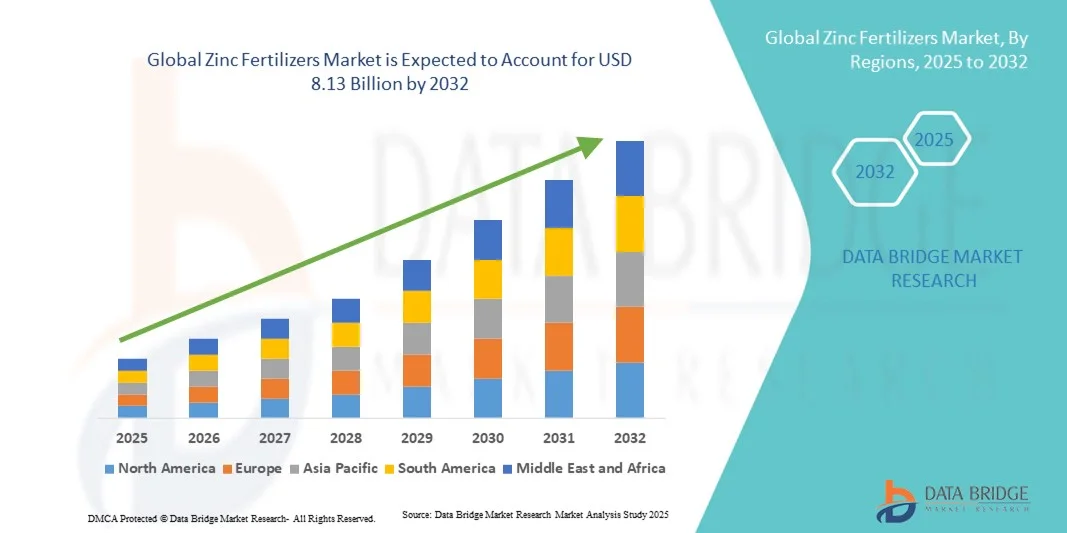
- The global zinc fertilizers market size was valued at USD 4.32 billion in 2024 and is expected to reach USD 8.13 billion by 2032, at a CAGR of 8.20% during the forecast period
- Rapid industrialization as well as urbanization across the globe, rising usages of the product to enhance the productivity of crops, rising awareness among the people over reducing the carbon footprints on the planet, rising number of government policies to increase green areas to improve environmental conditions are some of the major as well as important factors which will such asly to accelerate the growth of the zinc fertilizers market
What are the Major Takeaways of Zinc Fertilizers Market?
- Increasing preferences among the farmers to use environmentally friendly bio-fertilizers along with growing number of technological advancements which will further contribute by generating immense opportunities that will led to the growth of the zinc fertilizers market in the above mentioned projected timeframe
- Extensive use of fertilizers is prompt to contaminate the ground water to adverse levels along with stringent government policies which will likely to act as market restraints factor for the growth of the zinc fertilizers
- Asia-Pacific dominated the zinc fertilizers market with the largest revenue share of 32.5% in 2024, driven by increasing adoption of modern agricultural practices, high demand for crop yield enhancement, and growing awareness of micronutrient deficiencies in soil
- The North America zinc fertilizers market is projected to grow at the fastest CAGR of 7.36% from 2025 to 2032, driven by the adoption of precision farming techniques, government incentives for micronutrient-enriched crops, and growing awareness of soil health management
- The food crops segment dominated the market with a revenue share of 45.6% in 2024, driven by the high nutritional importance of zinc for cereals, pulses, and vegetables
Report Scope and Zinc Fertilizers Market Segmentation
|
Attributes |
Zinc Fertilizers Key Market Insights |
|
Segments Covered |
|
|
Countries Covered |
North America
Europe
Asia-Pacific
Middle East and Africa
South America
|
|
Key Market Players |
|
|
Market Opportunities |
|
|
Value Added Data Infosets |
In addition to the insights on market scenarios such as market value, growth rate, segmentation, geographical coverage, and major players, the market reports curated by the Data Bridge Market Research also include in-depth expert analysis, pricing analysis, brand share analysis, consumer survey, demography analysis, supply chain analysis, value chain analysis, raw material/consumables overview, vendor selection criteria, PESTLE Analysis, Porter Analysis, and regulatory framework. |
What is the Key Trend in the Zinc Fertilizers Market?
Rising Adoption of Precision Agriculture and Micronutrient Optimization
- A major trend in the global zinc fertilizers market is the growing integration of precision agriculture technologies and micronutrient management solutions. Farmers are increasingly relying on data-driven soil analysis, sensor-based monitoring, and GPS-enabled equipment to optimize zinc application, ensuring better crop yields and reduced nutrient wastage
- For instance, companies are developing smart zinc formulations compatible with automated spreaders and drone-based delivery systems, enabling accurate and uniform distribution across fields
- Precision application techniques allow for real-time monitoring of soil zinc levels, improving crop nutrition and reducing environmental impact. Farmers using these advanced solutions can track crop health, predict nutrient deficiencies, and adjust zinc inputs accordingly
- This shift toward technologically enhanced zinc application is transforming traditional fertilizer practices, promoting more efficient, sustainable, and profitable farming operations. Consequently, companies such as Yara and Nutrien are developing zinc fertilizers tailored for precision agriculture
- The rising emphasis on sustainability and productivity is driving demand for zinc fertilizers with improved solubility, targeted delivery, and compatibility with modern farming technologies
What are the Key Drivers of Zinc Fertilizers Market?
- Increasing global awareness of micronutrient deficiencies in crops and declining zinc levels in soils is a major factor fueling demand for zinc fertilizers. Zinc is critical for plant growth, yield improvement, and nutritional quality
- For instance, in 2024, Yara introduced specialized zinc foliar sprays for cereals and pulses, helping farmers enhance micronutrient uptake and boost productivity. Such initiatives are expected to accelerate market growth
- Rising adoption of high-yield crops and modern agricultural practices is encouraging the use of zinc fertilizers to optimize crop performance. Zinc supplementation ensures resistance against diseases and stress, improving overall output
- Government policies and programs promoting micronutrient fortification in staple crops are further stimulating demand, particularly in regions facing zinc-deficient soils
- The ability of zinc fertilizers to improve both yield and crop quality, combined with the push for sustainable and precision farming practices, is propelling market adoption across various agricultural sectors
Which Factor is Challenging the Growth of the Zinc Fertilizers Market?
- Fluctuating raw material prices and high production costs of specialty zinc fertilizers can hinder market expansion, particularly in price-sensitive regions. Small-scale farmers may find conventional alternatives more affordable
- Variability in zinc availability and soil compatibility can limit effectiveness, making adoption dependent on proper soil testing and agronomic knowledge
- Environmental concerns regarding overuse of fertilizers and improper application practices may raise regulatory scrutiny, affecting market dynamics. Companies such as ICL and Haifa Group are addressing these challenges through sustainable and controlled-release zinc products
- In addition, limited awareness among smallholder farmers in developing regions about the benefits of zinc supplementation can restrict market penetration. Educational campaigns and extension services are crucial for improving adoption
- Overcoming these challenges through cost-effective formulations, farmer training, and precision agriculture integration will be essential for sustained growth in the global zinc fertilizers market
How is the Zinc Fertilizers Market Segmented?
The market is segmented on the basis of crop type, form, and mode of application.
- By Crop Type
On the basis of crop type, the Zinc Fertilizers market is segmented into food crops, cash crops, plantation crops, horticulture crops, and grasslands. The food crops segment dominated the market with a revenue share of 45.6% in 2024, driven by the high nutritional importance of zinc for cereals, pulses, and vegetables. Farmers prioritize zinc supplementation in staple food crops to enhance yields, improve quality, and prevent micronutrient deficiencies. Horticulture crops and plantation crops are witnessing growing adoption due to increasing awareness of micronutrient-enriched produce, which enhances market value.
The grasslands segment is expected to witness the fastest CAGR of 19.8% from 2025 to 2032, fueled by rising demand for fortified fodder and improved livestock nutrition. Overall, zinc fertilizers across crop types are enabling higher productivity and sustainable soil management practices, making them an essential input in modern agriculture.
- By Method of Application
On the basis of application method, the Zinc Fertilizers market is segmented into foliar spraying, fertigation, sowing, broadcasting, spraying, drip method, and others. The foliar spraying segment dominated with a 42.3% market share in 2024, as it allows rapid absorption of zinc through leaves, offering immediate correction of deficiencies. Foliar application is highly effective for high-value crops and ensures uniform nutrient distribution. Fertigation is gaining popularity due to its integration with irrigation systems, enabling precise nutrient management.
The drip method segment is expected to witness the fastest CAGR of 20.1% from 2025 to 2032, driven by water-efficient farming practices and precision agriculture adoption. These advanced application methods reduce wastage, enhance nutrient use efficiency, and improve crop productivity, further propelling zinc fertilizer demand.
- By Form
On the basis of form, the Zinc Fertilizers market is segmented into solids, liquids, and gaseous. The solid form segment dominated with a 48.5% market share in 2024, attributed to its ease of handling, storage, and compatibility with conventional fertilizer equipment. Solids are widely used across cereals, pulses, and cash crops due to their cost-effectiveness and high zinc content. Liquid zinc fertilizers are gaining traction for foliar application and fertigation systems, enabling rapid uptake and uniform distribution.
The liquid form segment is expected to witness the fastest CAGR of 18.9% from 2025 to 2032, fueled by the rising adoption of precision agriculture and high-value horticultural crops. Overall, zinc fertilizers in all forms are driving productivity and soil micronutrient management, catering to both traditional and modern agricultural systems.
Which Region Holds the Largest Share of the Zinc Fertilizers Market?
- Asia-Pacific dominated the Zinc Fertilizers market with the largest revenue share of 32.5% in 2024, driven by increasing adoption of modern agricultural practices, high demand for crop yield enhancement, and growing awareness of micronutrient deficiencies in soil
- Farmers in the region prefer zinc fertilizers to improve food crop productivity and quality, particularly in countries such as China, India, and Japan
- Supportive government initiatives, rising disposable incomes, and the expansion of commercial farming operations are further driving the adoption of zinc fertilizers across APAC
China Zinc Fertilizers Market Insight
The China zinc fertilizers market accounted for the largest revenue share in APAC in 2024, fueled by rapid urbanization, expansion of commercial farming, and strong governmental support for soil health programs. Rising awareness of micronutrient enrichment in staple crops has driven widespread adoption of zinc fertilizers. Furthermore, domestic manufacturers are making fertilizers more accessible and affordable, helping increase penetration across food, plantation, and horticultural crops.
Japan Zinc Fertilizers Market Insight
The Japan zinc fertilizers market is gaining momentum due to its technologically advanced agriculture sector, rapid urbanization, and focus on high-value horticulture crops. Farmers prioritize zinc supplementation to enhance soil fertility, crop quality, and productivity. In addition, the adoption of precision agriculture and automated farming solutions is accelerating demand. Japan’s aging farmer population is also adopting user-friendly fertilizer products that reduce manual labor while maintaining high crop yields, contributing to steady market growth.
Which Region is the Fastest Growing Region in the Zinc Fertilizers Market?
The North America zinc fertilizers market is projected to grow at the fastest CAGR of 7.36% from 2025 to 2032, driven by the adoption of precision farming techniques, government incentives for micronutrient-enriched crops, and growing awareness of soil health management. Increasing investment in commercial farming and technological integration in agriculture, such as automated fertilizer application systems, is propelling demand. In addition, the market benefits from high disposable incomes, advanced farming infrastructure, and strong research in crop nutrition.
U.S. Zinc Fertilizers Market Insight
The U.S. zinc fertilizers market captured the largest revenue share within North America in 2024, fueled by technological advancements in crop monitoring and precision fertilization. Farmers are adopting zinc fertilizers to improve soil quality, optimize yields, and meet the demand for nutrient-rich crops. The integration of smart agriculture tools, IoT-enabled sensors, and automated delivery systems is further accelerating the market. Government programs supporting sustainable farming practices and micronutrient management are also contributing to market growth in the region.
Which are the Top Companies in Zinc Fertilizers Market?
The zinc fertilizers industry is primarily led by well-established companies, including:
- Yara International (Norway)
- The Mosaic Company (U.S.)
- Haifa Group (Israel)
- BASF SE (Germany)
- CF Industries Holdings, Inc. (U.S.)
- IFFCO (India)
- ICL Fertilizers (Israel)
- Nutrien Ltd. (Canada)
- K+S Aktiengesellschaft (Germany)
- OCP (Morocco)
- Changsha Latian Chemicals Co., Ltd (China)
- Coromandel International Corporation (India)
- Syngenta Crop Protection AG (Switzerland)
- SQM S.A. (Chile)
- Unikeyterra (Turkey)
- BAGFAS (Turkey)
- Nufarm Ltd (Australia)
- Zuari Agro Chemicals LTD (India)
- Kugler Company (U.S.)
- Valagro (Italy)

- Interactive Data Analysis Dashboard
- Company Analysis Dashboard for high growth potential opportunities
- Research Analyst Access for customization & queries
- Competitor Analysis with Interactive dashboard
- Latest News, Updates & Trend analysis
- Harness the Power of Benchmark Analysis for Comprehensive Competitor Tracking
Data collection and base year analysis are done using data collection modules with large sample sizes. The stage includes obtaining market information or related data through various sources and strategies. It includes examining and planning all the data acquired from the past in advance. It likewise envelops the examination of information inconsistencies seen across different information sources. The market data is analysed and estimated using market statistical and coherent models. Also, market share analysis and key trend analysis are the major success factors in the market report. To know more, please request an analyst call or drop down your inquiry.
The key research methodology used by DBMR research team is data triangulation which involves data mining, analysis of the impact of data variables on the market and primary (industry expert) validation. Data models include Vendor Positioning Grid, Market Time Line Analysis, Market Overview and Guide, Company Positioning Grid, Patent Analysis, Pricing Analysis, Company Market Share Analysis, Standards of Measurement, Global versus Regional and Vendor Share Analysis. To know more about the research methodology, drop in an inquiry to speak to our industry experts.
Data Bridge Market Research is a leader in advanced formative research. We take pride in servicing our existing and new customers with data and analysis that match and suits their goal. The report can be customized to include price trend analysis of target brands understanding the market for additional countries (ask for the list of countries), clinical trial results data, literature review, refurbished market and product base analysis. Market analysis of target competitors can be analyzed from technology-based analysis to market portfolio strategies. We can add as many competitors that you require data about in the format and data style you are looking for. Our team of analysts can also provide you data in crude raw excel files pivot tables (Fact book) or can assist you in creating presentations from the data sets available in the report.