


What is the India Gourmet and Medicinal Mushroom Market Size and Growth Rate?
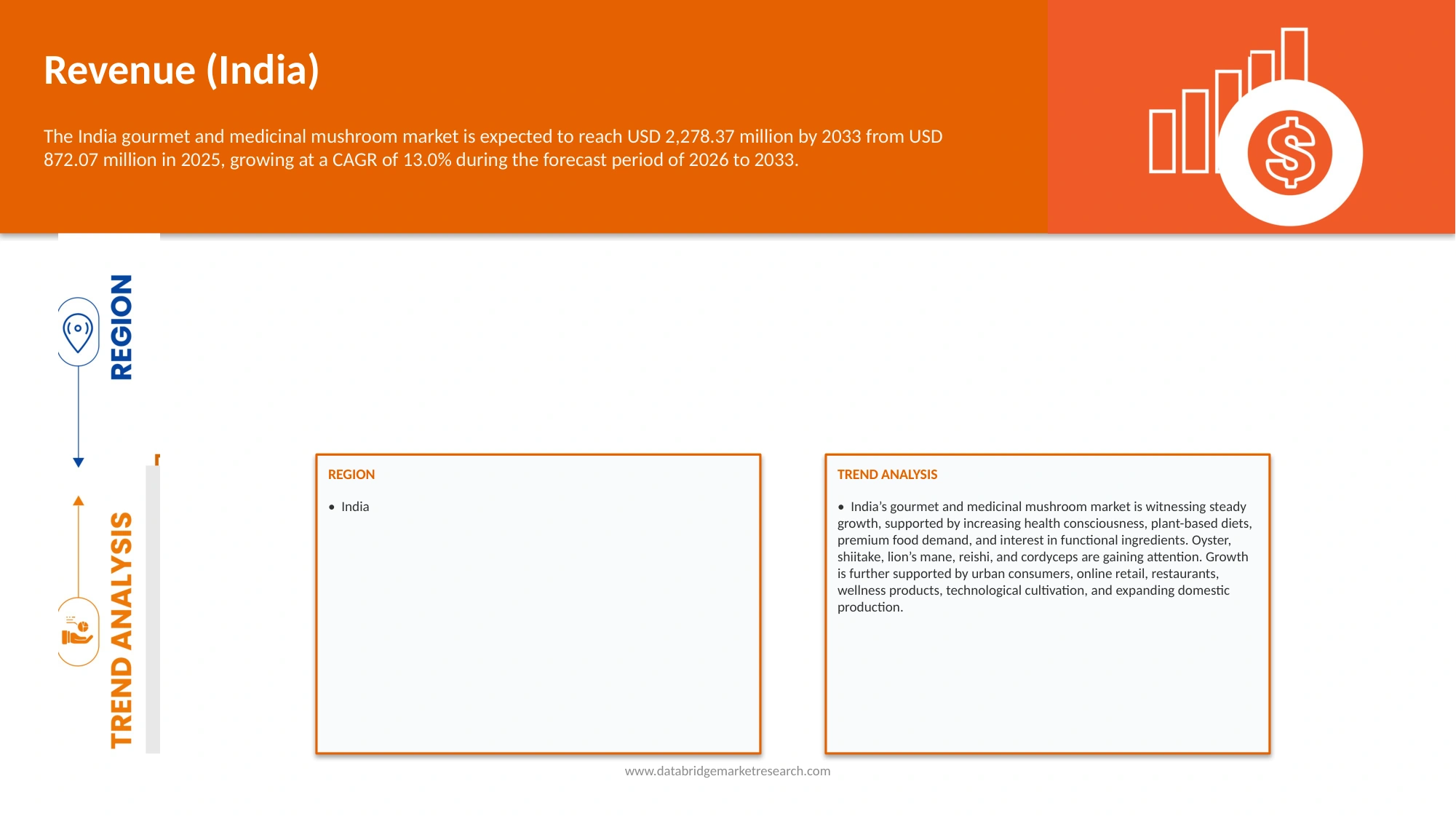
The India gourmet and medicinal mushroom market was valued at USD 872.07 million in 2025 and is projected to reach USD 2,278.37 million by 2033, growing at a CAGR of 13.0% from 2026 to 2033. The increasing demand for nutritious, functional, and health-oriented foods is a key factor driving market growth. Rising consumer awareness regarding the nutritional and potential wellness benefits of mushrooms is encouraging greater adoption of gourmet and medicinal varieties. Demand is also increasing from restaurants, hotels, food processors, nutraceutical manufacturers, and health-conscious consumers seeking natural ingredients and plant-based alternatives. Gourmet mushrooms such as shiitake, oyster, king oyster, and lion’s mane are gaining popularity due to their culinary applications and nutritional value, while medicinal varieties such as reishi, cordyceps, turkey tail, and tremella are increasingly incorporated into supplements, functional beverages, and wellness products.
Furthermore, expanding urbanization, improving cold-chain and distribution infrastructure, e-commerce penetration, and the emergence of controlled-environment cultivation are supporting market accessibility and supply consistency. Growing interest in immunity, preventive wellness, clean-label products, and sustainable food sources is expected to create additional opportunities. However, limited consumer awareness, perishability, inconsistent quality, higher production costs, and limited cultivation expertise remain important challenges for market participants.
Market Size & Forecast
- Market Value (2025): USD 872.07 Million
- Expected Market Value (2033): USD 2,278.37 Million
- Forecast CAGR (2026–2033): 13.0%
What are the Major Takeaways of India Gourmet and Medicinal Mushroom Market?
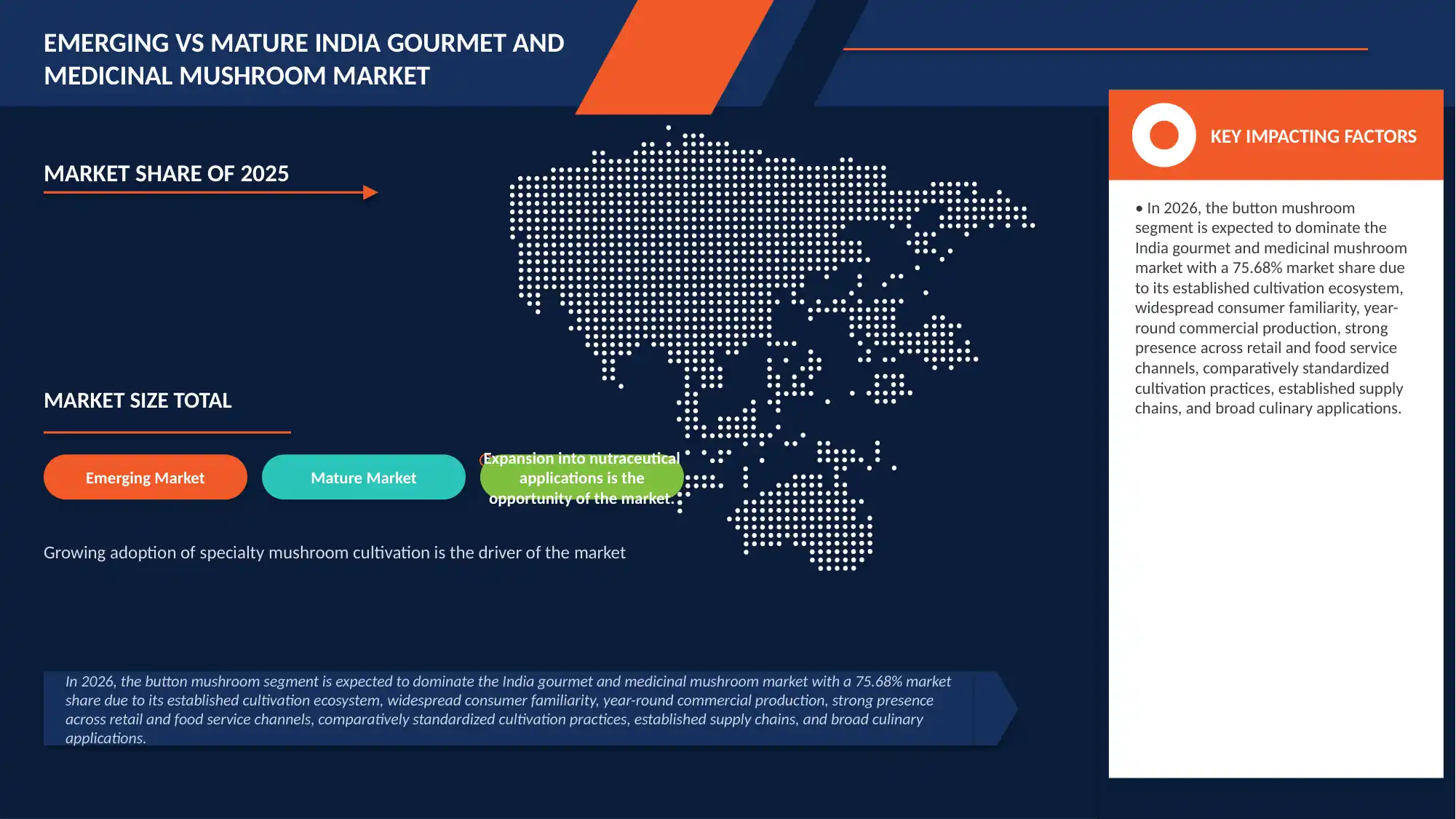
- The button mushroom segment led the market with a 75.86% share in 2025, owing to its widespread consumer acceptance, affordability, established cultivation practices, and extensive use across households, restaurants, hotels, foodservice establishments, and processed-food applications. Button mushrooms are readily available through established retail and wholesale networks and benefit from strong domestic production.
- The Reishi segment is projected to be the fastest-growing material type, with a CAGR of 14.6% during the forecast period, reflecting increasing consumer interest in medicinal mushrooms and functional wellness products.
- The wet / fresh segment dominated the market with a 65.54% revenue share in 2025, driven by its strong consumer preference, broad culinary applications, nutritional appeal, and extensive utilization across households and foodservice establishments. Fresh mushrooms are commonly consumed in everyday meals and are increasingly available through supermarkets, modern trade outlets, local retailers, and online grocery platforms.
- The extract segment is projected to be the fastest-growing material type, with a CAGR of 13.9% during the forecast period, owing to its increasing use in nutraceuticals, dietary supplements, functional foods, beverages, cosmetics, and wellness formulations. Mushroom extracts provide concentrated functional compounds and offer convenient incorporation into various products.
- The B2B segment dominated the market with a 68.14% revenue share in 2025, driven by strong demand from restaurants, hotels, food processors, wholesalers, retailers, institutional buyers, and nutraceutical manufacturers. Bulk procurement, recurring orders, established distribution networks, and long-term supplier relationships support the segment’s leading position. Commercial foodservice and processing applications require consistent mushroom supplies, further strengthening B2B demand across India.
- The B2C segment is projected to be the fastest-growing material type, with a CAGR of 13.6% during the forecast period, owing to increasing direct consumer purchases, rising health consciousness, expanding e-commerce adoption, and growing household consumption of gourmet and medicinal mushrooms.
- The online retailers segment is projected to be the fastest-growing material type, with a CAGR of 14.0% during the forecast period, owing to increasing internet penetration, convenience-oriented shopping behavior, wider product availability, and growing consumer acceptance of online grocery and wellness purchases.
Report Scope and India Gourmet and Medicinal Mushroom Segmentation
|
Attributes |
Gourmet and Medicinal Mushroom Key Market Insights |
|
Segments Covered |
|
|
Countries Covered |
|
|
Key Market Players |
|
|
Market Opportunities |
|
|
Value Added Data Infosets |
In addition to the insights on market scenarios such as market value, growth rate, segmentation, geographical coverage, and major players, the market reports curated by the Data Bridge Market Research also include in-depth expert analysis, pricing analysis, brand share analysis, consumer survey, demography analysis, supply chain analysis, value chain analysis, raw material/consumables overview, vendor selection criteria, PESTLE Analysis, Porter Analysis, and regulatory framework. |
What is the Key Trend in the India Gourmet and Medicinal Mushroom Market?
Trend: Rising Adoption of Medicinal and Functional Mushrooms
India’s gourmet and medicinal mushroom market is increasingly shifting toward medicinal and functional mushroom products, supported by growing consumer awareness of wellness, nutrition, immunity, and natural health ingredients. Reishi, Lion’s Mane, Cordyceps, and other specialty varieties are gaining attention across nutraceuticals, dietary supplements, functional beverages, and wellness formulations. This trend is encouraging growers and businesses to diversify beyond conventional button mushrooms and develop higher-value products.
For instance,
- In April 2026, ICAR-KVK Namsai inaugurated a mushroom spawn production laboratory in Arunachal Pradesh to improve farmers’ access to quality spawn and support organized mushroom cultivation.
- In June 2026, the XXVIII AICRP-Mushroom Workshop held in Guwahati emphasized specialty mushrooms, sustainable production technologies, quality spawn, and value-added mushroom products, highlighting the increasing focus on diversification and commercialization.
The growing emphasis on medicinal and specialty mushrooms is expected to encourage product innovation, advanced cultivation, and expansion of India’s functional mushroom industry.
India Gourmet and Medicinal Mushroom Market Dynamics
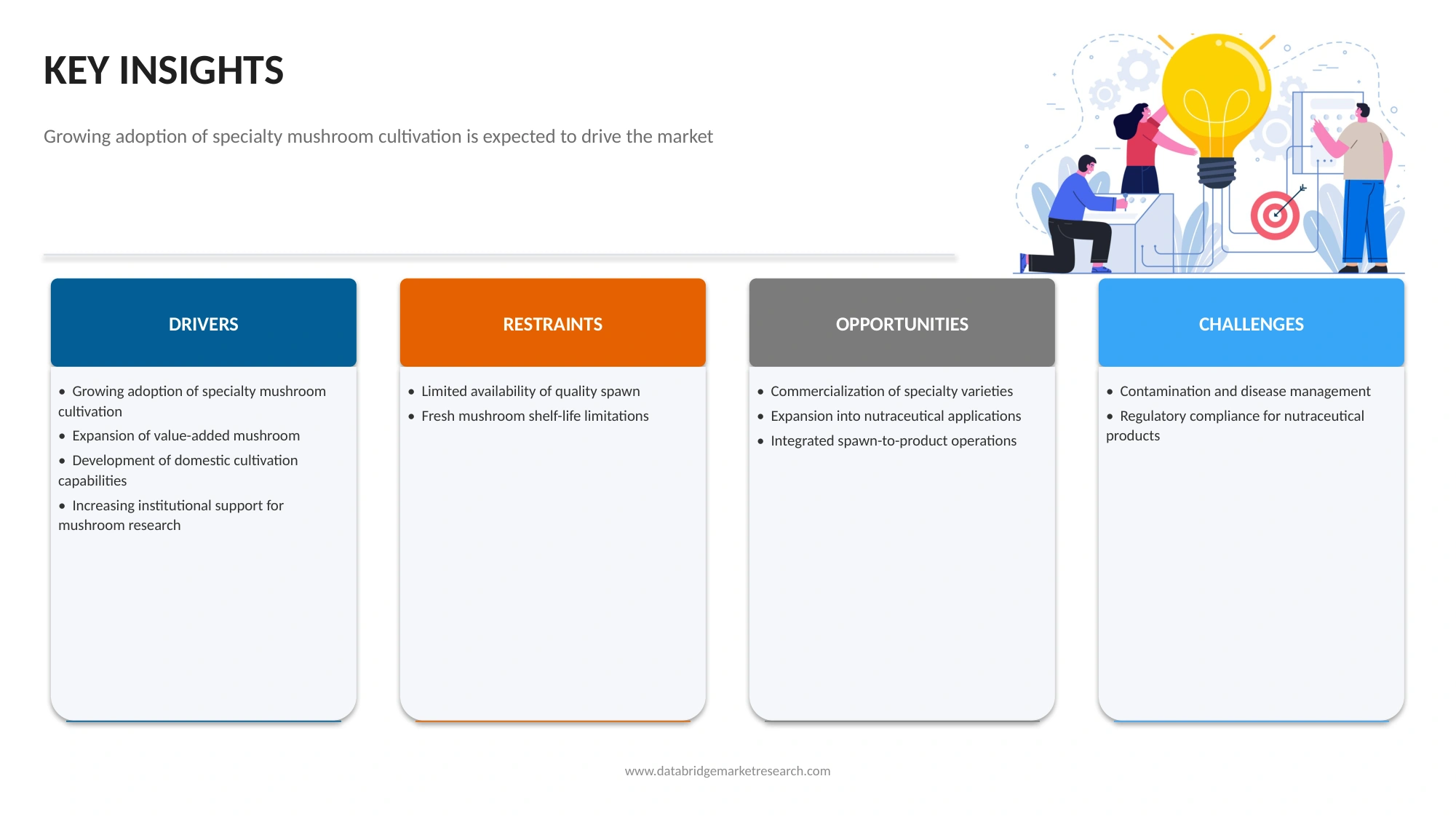
Key Market Driver: Growing Adoption of Specialty Mushroom Cultivation
The growing adoption of specialty mushrooms is emerging as an important driver of diversification within India’s mushroom cultivation industry. Traditionally, Indian mushroom production has been strongly associated with button mushrooms; however, increasing interest in oyster, shiitake, milky, king oyster, lion’s mane, Ganoderma, Cordyceps and other specialty varieties is expanding the addressable cultivation base. Specialty mushrooms provide growers with opportunities to differentiate their production based on local agro-climatic conditions, culinary applications, nutritional attributes and premium-market positioning. This is particularly relevant for small and marginal farmers because several specialty varieties can be cultivated using locally available agricultural residues and comparatively smaller production infrastructure. The development of region-specific cultivation technologies is also reducing the technical barriers associated with specialty mushroom production.
The institutional ecosystem is increasingly supporting this transition. ICAR's Directorate of Mushroom Research (DMR), Solan has historically worked on improved oyster and shiitake varieties, medicinal mushrooms and other specialty species. Its technology portfolio has included improved varieties of oyster and shiitake mushrooms as well as cultivation technologies for medicinal mushrooms such as Cordyceps militaris. This creates a stronger technological foundation for commercial growers to move beyond conventional button mushroom cultivation.
- A recent India-specific instance is Arunachal Pradesh, where ICAR reported successful cultivation of king oyster mushroom (Pleurotus eryngii) under mid-hill conditions in January 2026. The mushroom was cultivated on paddy straw under controlled environmental conditions and demonstrated healthy and uniform fruiting, indicating the potential for specialty mushroom diversification in the region.
- Another example comes from Uttarakhand, where an entrepreneur supported through the KVK ecosystem diversified from conventional mushroom cultivation into shiitake and Ganoderma, alongside developing a year round production operation. The enterprise subsequently developed value-added products including mushroom pickle, cookies, nuggets, soup, protein powder, tea and papad. The growing institutional emphasis on specialty mushrooms is also evident from the 2026 AICRP-Mushroom workshop in Guwahati, where ICAR specifically encouraged North-Eastern centres to promote specialty mushrooms because of the limited availability of wheat straw required for button mushroom cultivation.
Consequently, specialty mushroom cultivation is being driven by crop diversification, premium product opportunities, regional agro-climatic suitability, availability of alternative substrates, nutritional/functional-food positioning and technology transfer. These factors are expected to progressively broaden India's mushroom production portfolio beyond button mushrooms.
Key Restraint/Challenge: Limited Availability of Quality Spawn
Limited availability of quality, contamination-free and locally accessible mushroom spawn remains a structural restraint for the expansion of India's mushroom cultivation industry. Spawn is the critical biological input from which commercial mushroom production begins, and its quality directly influences colonization, yield, crop uniformity and contamination risk. Unlike conventional agricultural seeds, mushroom spawn requires controlled laboratory production and appropriate storage and handling. Consequently, farmers in regions without reliable spawn laboratories may need to procure spawn from distant suppliers, increasing procurement costs, transportation time and the risk of quality deterioration. This constraint is particularly significant for emerging mushroom-producing regions, where cultivation is expanding faster than local input infrastructure.
The issue is explicitly recognized by India's institutional mushroom ecosystem. ICAR has highlighted the need to strengthen spawn production and establish spawn certification mechanisms to ensure the availability of quality spawn for mushroom growers.
- At the XXVIII AICRP-Mushroom Workshop held in Guwahati in 2026, ICAR specifically called for strengthening spawn production across North-Eastern centres and establishing a robust certification mechanism. The Assam Government also highlighted the need to strengthen spawn availability and reported financial assistance for establishment of spawn laboratories.
- A clear India-specific example comes from Nalanda, Bihar. ICAR documented the experience of a mushroom entrepreneur who initially had to procure spawn from Delhi and Ranchi at high cost because there was no mushroom spawn laboratory in Nalanda district. This supply constraint subsequently became the motivation for establishing the Buddha Mushroom Spawn Laboratory at Rajgir with technical support from KVK Nalanda and ICAR-DMR, Solan. The laboratory eventually scaled its production to approximately 700 kg and supplied spawn across Bihar, Jharkhand, eastern Uttar Pradesh and Chhattisgarh.
- A similar challenge has been documented in Meghalaya, where ICAR identified the availability of quality spawn as a major constraint to sustainable oyster mushroom farming. An entrepreneur from Ri-Bhoi district specifically underwent training in spawn production after identifying the gap in quality spawn supply.
- The problem is also evident in Namsai, Arunachal Pradesh, where ICAR-KVK Namsai established a dedicated mushroom spawn laboratory in April 2026 specifically to address the long-standing need for timely, reliable and affordable quality spawn and reduce farmers' dependence on external sources.
Therefore, inadequate regional spawn infrastructure creates a chain of constraints involving higher input costs, delayed production cycles, contamination risk, inconsistent yields and geographic limitations on cultivation. Until decentralized spawn laboratories, quality standards, certification systems and efficient distribution networks become more widespread, spawn availability will remain a key bottleneck for India's mushroom industry.
Key Market Opportunity: Commercialization of Specialty Varieties
The commercialization of specialty mushroom varieties represents a significant opportunity for India to diversify beyond the traditionally dominant button and oyster mushroom segments and develop higher-value product categories. Specialty varieties such as lion’s mane, shiitake, king oyster, milky mushroom, reishi and Cordyceps can command differentiated pricing because of their distinctive culinary characteristics, nutritional profiles and, in some cases, functional or medicinal positioning. Commercialization can therefore shift the industry from a predominantly volume-oriented fresh-mushroom model toward a portfolio comprising premium fresh mushrooms, dried products, powders, extracts and functional-food ingredients. This opportunity is particularly relevant for India's diverse agro-climatic conditions, where different mushroom species can be matched with specific regional production environments.
India already possesses an institutional foundation for this opportunity. ICAR has developed and documented several specialty mushrooms, including Macrocybe gigantea, Pleurotus tuber-regium, Hericium erinaceus (lion's mane), Lentinula edodes (shiitake) and Ganoderma lucidum (reishi) using locally available substrates. ICAR's landmark-variety portfolio also includes Arka Lion's Mane, described as an edible and medicinal mushroom containing beta-glucan polysaccharides and minerals such as zinc, potassium and calcium.
- A particularly relevant recent instance is Arunachal Pradesh, where ICAR successfully demonstrated commercial cultivation of king oyster mushroom (Pleurotus eryngii) under mid-hill conditions. The crop cycle was completed within 30–35 days and achieved reported biological efficiency of 80–85%. ICAR also highlighted that the AICRP Mushroom centre at Basar provides training and quality spawn to interested growers, creating the foundation for scaling the variety beyond research trials.
- Another important commercialization opportunity is the development of region-specific specialty mushroom clusters. North-Eastern India, for example, possesses substantial agricultural residues that can potentially serve as cultivation substrates. ICAR has explicitly highlighted specialty mushrooms as an opportunity for the region, where conventional button mushroom cultivation can be constrained by substrate availability. The 2026 AICRP Mushroom workshop in Guwahati brought together researchers, policymakers, extension personnel and farmers to advance sustainable production and innovation in the sector.
Commercialization can also be supported by differentiated channels such as premium restaurants, modern retail, health-food stores, e-commerce and direct-to-consumer platforms. For producers, this creates opportunities to capture greater value through species differentiation, controlled-environment cultivation, premium packaging, branding and processed specialty-mushroom products.
Thus, India's specialty-mushroom opportunity extends beyond increasing cultivation volumes. It can create a new value chain encompassing specialty spawn, controlled cultivation, premium fresh products, dried/powdered products, functional foods, branded consumer products, thereby increasing value realization for growers and processors.
How is the India Gourmet and Medicinal Mushroom Market Segmented?
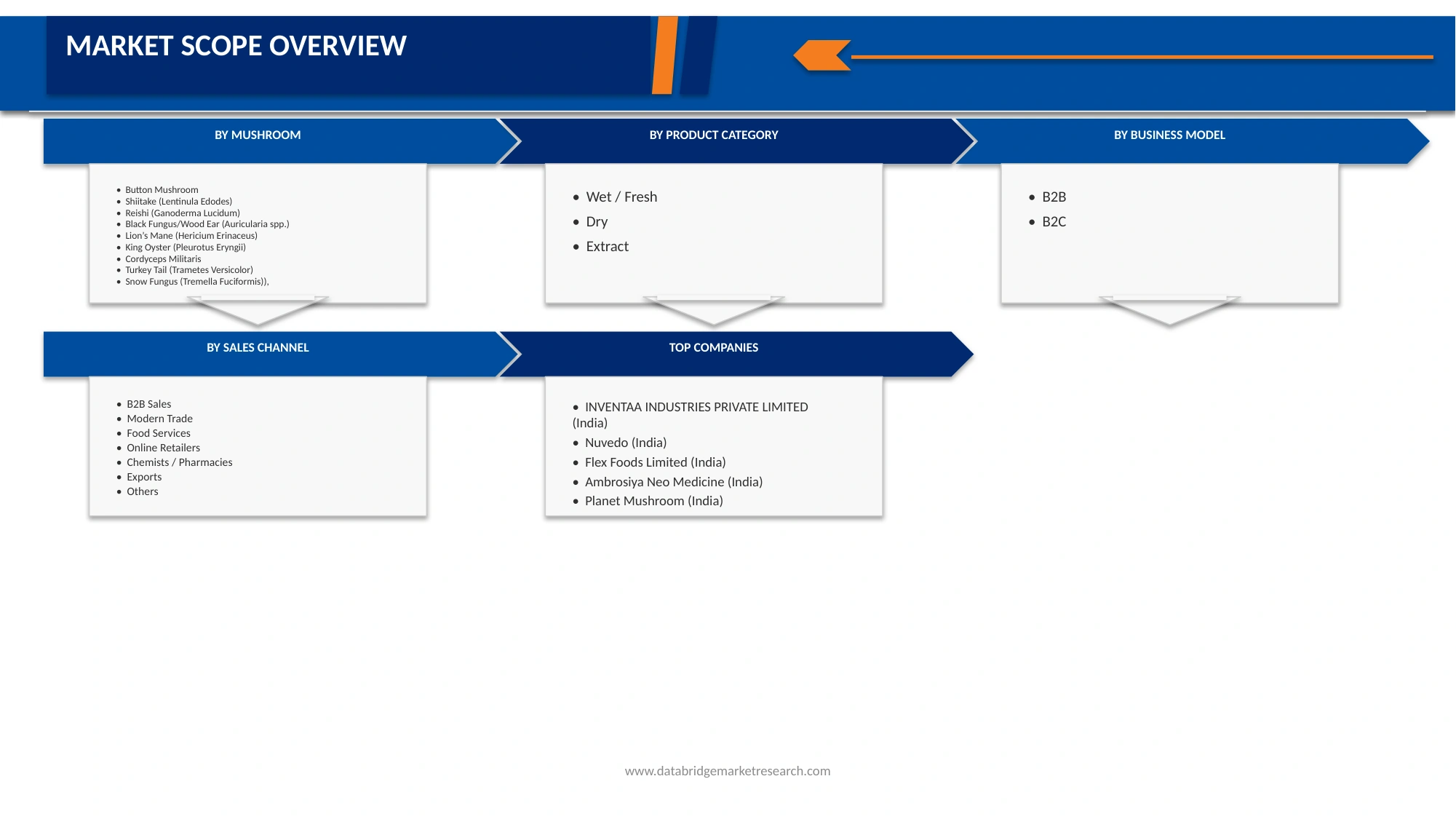
The gourmet and medicinal mushroom market is segmented into four notable segments based on mushroom, product category, business model, and sales channel.
- By Mushroom
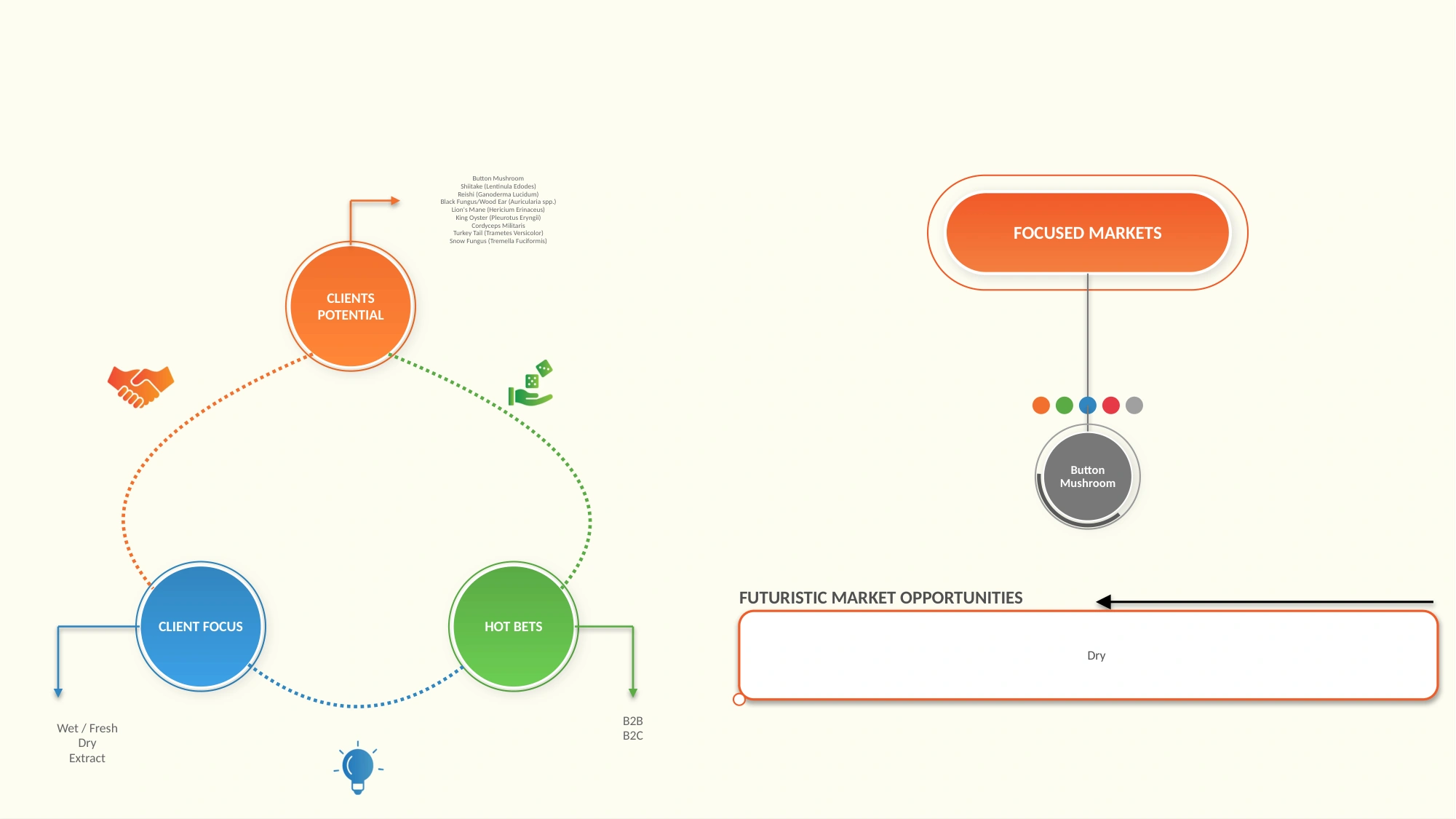
On the basis of mushroom, the market is segmented into Button Mushroom, Shiitake (Lentinula Edodes), Reishi (Ganoderma Lucidum) Black Fungus/Wood Ear (Auricularia spp.), Lion’s Mane (Hericium Erinaceus), King Oyster (Pleurotus Eryngii), Cordyceps Militaris, Turkey Tail (Trametes Versicolor), and Snow Fungus (Tremella Fuciformis). In 2025, the button mushroom segment is expected to dominate the India gourmet and medicinal mushroom market with a market share of 75.86% due to its widespread consumer acceptance, affordability, established cultivation practices, year-round availability, nutritional value, and extensive use across households, restaurants, hotels, foodservice, and processed-food applications. Strong domestic production and well-established distribution networks further contribute to its significant market presence across India.
The Reishi (Ganoderma Lucidum) segment is projected to register the fastest CAGR of 14.6% from 2026 to 2033. Growth is driven by widespread consumer acceptance, affordability, established cultivation practices, year-round availability, nutritional value, and extensive use across households, restaurants, hotels, foodservice, and processed-food applications. Strong domestic production and well-established distribution networks further contribute to its significant market presence across India.
- By Product Category
On the basis of product category, the market is segmented into wet / fresh, dry, and extract. In 2025, the wet / fresh segment is expected to dominate the market with a share of 65.54% due to its strong consumer preference for fresh produce, extensive culinary applications, nutritional benefits, and growing consumption among households and foodservice establishments. Increasing availability through supermarkets, modern retail, local stores, and online grocery platforms, along with rising demand for minimally processed foods, further supports segment growth.
The extract segment is projected to register the fastest CAGR of 13.9% from 2026 to 2033. The fast growth is mainly driven by increasing utilization of mushroom extracts in nutraceuticals, dietary supplements, functional beverages, wellness products, cosmetics, and health-focused formulations. Extracts provide concentrated functional compounds and convenient incorporation into various products. Rising consumer interest in natural ingredients, preventive wellness, immunity-focused products, and functional nutrition is expected to encourage manufacturers to expand mushroom-based extract offerings across India.
- By Business Model
On the basis of business model, the market is segmented into B2B, and B2C. In 2025, the B2B segment is expected to dominate the market with a share of 68.14% due to its substantial demand from restaurants, hotels, food processors, wholesalers, retailers, institutional buyers, and nutraceutical manufacturers. Bulk procurement, recurring orders, established distribution networks, and commercial-scale requirements support the segment. Increasing mushroom utilization in foodservice, processing, and ingredient applications further strengthens B2B demand across India.
The B2C segment is expected to experience the fastest CAGR of 13.6% from 2026 to 2033, driven by increasing consumer health awareness, rising household mushroom consumption, expanding e-commerce adoption, and greater availability of gourmet and medicinal mushroom products. Consumers are increasingly seeking convenient access to fresh, dried, powdered, and functional mushroom products. Direct-to-consumer platforms, digital marketing, home delivery, and changing preferences toward nutritious and plant-based foods are expected to further support B2C expansion.
- By Sales Channel
On the basis of sales channel, the market is segmented into B2B sales, modern trade, food services, online retailers, chemists / pharmacies, exports, and others. In 2025, the B2B sales segment is expected to dominate the market with a share of 28.36% due to the bulk procurement from wholesalers, distributors, restaurants, hotels, food processors, retailers, and institutional buyers. Recurring orders, established supplier relationships, larger transaction volumes, and efficient distribution networks contribute to strong commercial demand. Expanding foodservice and processing applications further strengthen B2B sales across India.
The online retailers segment is expected to experience the fastest CAGR of 14.0% from 2026 to 2033, supported by increasing internet and smartphone penetration, rising consumer preference for convenient shopping, expanding e-commerce platforms, and broader availability of gourmet and medicinal mushroom products. Online channels provide access to fresh, dried, powdered, and functional mushroom products while enabling home delivery and digital product discovery. Increasing digital marketing and changing purchasing habits are expected to accelerate online retail adoption.
Which are the Top Companies in India Gourmet and Medicinal Mushroom Market?
The India gourmet and medicinal mushroom industry is primarily led by well-established companies, including:
- INVENTAA INDUSTRIES PRIVATE LIMITED (India)
- Nuvedo (India)
- Flex Foods Limited (India)
- Ambrosiya Neo Medicine (India)
- Planet Mushroom (India)
- Himalaya Food International Ltd. (India)
- Ace Blend (India)
- Shroomery (India)
- Soma (India)
- Bombay Farming Co (India)
- Gourmet Mushroom Company (India)
- Octarine Organics Private Limited (India)
- Azoth Biotech (India)
- The Fungamental Co. (India)
- Green Apron Farms (India)
- AL Baraka Mushrooms (India)
- Mycelium India Biotech (India)
- BM Mushroom (India)
- Umbrella Agro Tech (India)
- Verma Mushroom House (India)
- Good Mushroom PVT LTD (India)
What are Latest Developments in India Gourmet and Medicinal Mushroom Market?
- In March 2026, Himalaya Food International expanded its international presence by launching Frozen Cinnamon French Toast Sticks in the UK and securing Regular Approved Vendor status with US Foods. The development strengthens the company’s access to European and North American foodservice markets, while supporting broader export diversification and future opportunities to expand its frozen food portfolio across international distribution networks.
- In February 2026, Himani Garg, founder of SomaShrooms, received the SIWAA “Outstanding Entrepreneur” Award for her contribution to India’s functional mushroom industry. The development highlights SomaShrooms’ focus on technology driven cultivation, product innovation, farmer empowerment, and sustainable agriculture. Garg also received the ICAR-IIHR products. “Best Farmer of India 2025” recognition, reinforcing her role in advancing mushroom farming and functional wellness
- In 2025, Planet Mushroom expanded its mushroom portfolio by diversifying beyond button mushrooms into exotic varieties including Shiitake, Cordyceps, Lion’s Mane, Reishi, and King Oyster. The company also achieved a significant cultivation milestone by commercially growing wild Gucchi mushrooms indoors in Uttarakhand, marking a notable development in India’s exotic mushroom industry and strengthening Planet Mushroom’s position in specialty mushroom cultivation.
- In April 2022, Mycelium Sona Biotech inaugurated its first laboratory in Salem to cultivate medicinal mushrooms and develop nutraceutical products. The facility planned to cultivate 16 medicinal mushroom strains, extract bioactive compounds, and produce food-grade and nutraceutical-grade products. The company also announced partnerships for research and global expansion, with plans to obtain certifications enabling exports to Australia, the U.S., and Europe.
- In February 2022, Ambrosiya Neo-Medicine highlighted India’s updated Food Safety and Standards regulations concerning mandatory fortification of vegetable oils and milk with essential micronutrients. The company emphasized its vegan Vitamin D3 as a domestic alternative for food manufacturers, particularly amid changing import conditions, positioning its plant-based solution to support regulatory compliance and the growing demand for sustainable vitamin fortification.

- Interactive Data Analysis Dashboard
- Company Analysis Dashboard for high growth potential opportunities
- Research Analyst Access for customization & queries
- Competitor Analysis with Interactive dashboard
- Latest News, Updates & Trend analysis
- Harness the Power of Benchmark Analysis for Comprehensive Competitor Tracking
Table of Content
1 INTRODUCTION
1.1 OBJECTIVES OF THE STUDY
1.2 MARKET DEFINITION
1.3 OVERVIEW OF GOURMET AND MEDICINAL MUSHROOM MARKET
1.4 CURRENCY AND PRICING
1.5 LIMITATIONS
1.6 MARKETS COVERED
2 MARKET SEGMENTATION
2.1 MARKETS COVERED
2.2 GEOGRAPHICAL SCOPE
2.3 YEARS CONSIDERED FOR THE STUDY
2.4 DBMR TRIPOD DATA VALIDATION MODEL
2.5 PRIMARY INTERVIEWS WITH KEY OPINION LEADERS
2.6 DBMR MARKET POSITION GRID
2.7 VENDOR SHARE ANALYSIS
2.8 MULTIVARIATE MODELING
2.9 SECONDARY SOURCES
2.1 ASSUMPTIONS
3 EXECUTIVE SUMMARY
4 PREMIUM INSIGHTS
4.1 PORTER’S FIVE FORCES
4.2 BRAND OUTLOOK
4.3 RAW MATERIAL COVERAGE
4.4 VALUE CHAIN ANALYSIS
4.5 CLIMATE CHANGE SCENARIO
4.5.1 ENVIRONMENTAL CONCERNS
4.5.2 INDUSTRY RESPONSE
4.5.3 GOVERNMENT'S ROLE
4.5.4 ANALYST RECOMMENDATIONS
4.6 CONSUMER BUYING BEHAVIOUR
4.7 CUSTOMER & CONSUMER ANALYSIS
4.7.1 OVERVIEW
4.7.2 INDIA GOURMET AND MEDICINAL MUSHROOM MARKET CUSTOMER ECOSYSTEM
4.7.2.1 GROWERS
4.7.2.2 PROCESSORS
4.7.2.3 INGREDIENT SUPPLIERS
4.7.2.4 DISTRIBUTORS
4.7.2.5 HORECA
4.7.2.6 RETAILERS
4.7.2.7 E-COMMERCE
4.7.2.8 END CONSUMERS
4.7.3 INDIA GOURMET AND MEDICINAL MUSHROOM MARKET B2B BUYER ANALYSIS
4.7.3.1 COMPETITION OVERVIEW
4.7.3.2 EVOLVING BUYING PREFERENCES
4.7.3.3 BUYERS MAPPING
4.7.4 OVERVIEW: B2B CUSTOMER CATEGORY ANALYSIS
4.7.4.1 FOOD & BEVERAGE MANUFACTURERS
4.7.4.2 NUTRACEUTICAL & SUPPLEMENT COMPANIES
4.7.4.3 PHARMACEUTICAL COMPANIES
4.7.4.4 COSMETIC & PERSONAL CARE MANUFACTURERS
4.7.4.5 HOTELS, RESTAURANTS & CAFES (HORECA)
4.7.4.6 INGREDIENT DISTRIBUTORS & TRADERS
4.7.4.7 EXPORTERS AND WHOLESALERS
4.7.4.8 OTHERS
4.7.5 OVERVIEW: B2C CONSUMER CATEGORIES
4.7.5.1 HEALTH-CONSCIOUS CONSUMERS
4.7.5.2 VEGANS AND VEGETARIANS
4.7.5.3 FITNESS ENTHUSIASTS
4.7.5.4 WORKING PROFESSIONALS
4.7.5.5 ELDERLY CONSUMERS SEEKING IMMUNITY SUPPORT
4.7.5.6 PREMIUM AND GOURMET FOOD CONSUMERS
4.7.5.7 MILLENNIALS AND GEN Z BUYERS
4.7.5.8 OTHERS
4.8 GO TO MARKET STRATEGIES
4.8.1 MARKET ENTRY STRATEGY
4.8.1.1 PREMIUM SPECIALTY MUSHROOM POSITIONING
4.8.1.2 METROPOLITAN AND URBAN MARKET FOCUS
4.8.1.3 B2B-LED MARKET ENTRY
4.8.1.4 D2C AND DIGITAL MARKET ENTRY
4.8.1.5 ANALYST RECOMMENDATION AND CONCLUSION
4.8.2 PRODUCT STRATEGY
4.8.2.1 FRESH GOURMET MUSHROOMS
4.8.2.2 DRIED MUSHROOMS
4.8.2.3 MUSHROOM POWDERS AND EXTRACTS
4.8.2.4 ANALYST RECOMMENDATION AND CONCLUSION
4.8.3 PRICING STRATEGY
4.8.3.1 PREMIUM PRICING
4.8.3.2 VALUE-BASED PRICING
4.8.3.3 VOLUME-BASED AND BULK PRICING
4.8.3.4 SUBSCRIPTION AND RECURRING-ORDER MODELS
4.8.3.5 ANALYST RECOMMENDATION AND CONCLUSION
4.8.4 DISTRIBUTION STRATEGY
4.8.4.1 DIRECT B2B DISTRIBUTION
4.8.4.2 HORECA DISTRIBUTION
4.8.4.3 MODERN RETAIL AND PREMIUM GROCERY
4.8.4.4 E-COMMERCE AND D2C DISTRIBUTION
4.8.4.5 SPECIALTY AND ORGANIC STORES
4.8.4.6 PHARMACY AND HEALTH-PRODUCT CHANNELS
4.8.4.7 EXPORT DISTRIBUTION
4.8.4.8 ANALYST RECOMMENDATION AND CONCLUSION
4.8.5 MARKETING STRATEGY
4.8.5.1 CONSUMER AND BUYER EDUCATION
4.8.5.2 DIGITAL MARKETING
4.8.5.3 CHEF AND EXPERT-LED PROMOTION
4.8.5.4 SCIENTIFIC AND QUALITY VALIDATION
4.8.5.5 SUSTAINABILITY POSITIONING
4.8.5.6 ANALYST RECOMMENDATION AND CONCLUSION
4.8.6 KEY MARKET ENTRY CHALLENGES
4.8.6.1 LIMITED AWARENESS OF SPECIALTY VARIETIES
4.8.6.2 HIGHER PRICE AND COST SENSITIVITY
4.8.6.3 REGULATORY AND CLAIMS COMPLIANCE
4.8.6.4 SUPPLY AND PRODUCTION CONSISTENCY
4.8.6.5 ANALYST RECOMMENDATION AND CONCLUSION
4.8.7 CUSTOMER ACQUISITION STRATEGY
4.8.7.1 HEALTH-CONSCIOUS CONSUMERS
4.8.7.2 FITNESS AND ACTIVE-LIFESTYLE CONSUMERS
4.8.7.3 GOURMET CONSUMERS
4.8.7.4 VEGETARIAN AND PLANT-BASED CONSUMERS
4.8.7.5 B2B INGREDIENT BUYERS
4.8.7.6 ANALYST RECOMMENDATION AND CONCLUSION
4.8.8 STRATEGIC RECOMMENDATIONS
4.8.8.1 ADOPT A FRESH PLUS VALUE-ADDED PORTFOLIO
4.8.8.2 BUILD B2B ANCHOR ACCOUNTS
4.8.8.3 DEVELOP REGIONAL DISTRIBUTION HUBS
4.8.8.4 STANDARDIZE PRODUCT SPECIFICATIONS
4.8.8.5 DEVELOP AN OMNICHANNEL PRESENCE
4.8.8.6 INVEST IN CULTIVATION, PROCESSING AND POST-HARVEST TECHNOLOGY
4.8.8.7 ANALYST RECOMMENDATION AND CONCLUSION
4.9 IMPACT OF WAR ON SUPPLY CHAIN, GEOGRAPHIC FOOTPRINT & STRUCTURAL SHIFTS AND ADAPTIVE STRATEGIES
4.9.1 HIGHER INTERNATIONAL FREIGHT COSTS AND LONGER LEAD TIMES
4.9.2 GREATER EXPOSURE OF IMPORTED SPECIALTY MUSHROOMS AND FUNCTIONAL INGREDIENTS
4.9.3 SHIFT TOWARD DOMESTIC CULTIVATION OF SPECIALTY MUSHROOMS
4.9.4 GEOGRAPHIC DIVERSIFICATION OF INDIAN MUSHROOM PRODUCTION
4.9.5 INCREASING IMPORTANCE OF DRIED MUSHROOMS, POWDERS AND EXTRACTS
4.9.6 GREATER IMPORTANCE OF REGIONAL DISTRIBUTION AND COLD-CHAIN INFRASTRUCTURE
4.9.7 SUPPLIER DIVERSIFICATION AND HIGHER DOMESTIC SOURCING
4.9.8 ENERGY COSTS AND CONTROLLED-ENVIRONMENT PRODUCTION
4.1 INNOVATION TRACKER AND STRATEGIC ANALYSIS
4.10.1 MAJOR DEALS AND STRATEGIC ALLIANCES ANALYSIS
4.10.2 JOINT VENTURES
4.10.3 LICENSING AND PARTNERSHIP
4.10.4 TECHNOLOGY COLLABORATIONS
4.10.5 NUMBER OF PRODUCTS IN DEVELOPMENT
4.10.6 STAGE OF DEVELOPMENT
4.10.7 TIMELINES AND MILESTONES
4.10.8 INNOVATION STRATEGIES AND METHODOLOGIES
4.10.9 RISK ASSESSMENT AND MITIGATION
4.10.10 FUTURE OUTLOOK
4.11 IMPORT & EXPORT ANALYSIS
4.12 PRODUCTION & PROCUREMENT, 2025
4.12.1 INDIA GOURMET AND MEDICINAL MUSHROOM MARKET – PRODUCTION CAPACITY
4.12.2 ESTIMATED PRODUCTION VOLUME
4.12.3 ESTIMATED ANNUAL PROCUREMENT VOLUME
4.12.4 PROCUREMENT SOURCES
4.12.5 IMPORT DEPENDENCY ANALYSIS
4.12.6 CAPACITY UTILIZATION ASSESSMENT
4.13 PRODUCT PRICING & BENCHMARKING ANALYSIS, 2025
4.13.1 PRICING OVERVIEW
4.13.1.1 PRICING OVERVIEW BY MUSHROOM TYPE
4.13.1.2 PRICING OVERVIEW BY PRODUCT CATEGORY
4.13.1.3 INDIA PRICING BENCHMARK BY MUSHROOM TYPE AND PRODUCT CATEGORY
4.13.2 INDIA VS. CHINA VS. GLOBAL MUSHROOM PRICING
4.13.2.1 INDIA VS. CHINA VS. GLOBAL PRICING BY PRODUCT TYPE AND CATEGORY
4.13.2.1.1 CORDYCEPS MILITARIS
4.13.2.1.2 SHIITAKE
4.13.2.1.3 TURKEY TAIL
4.13.2.1.4 BUTTON MUSHROOM
4.13.2.1.5 REISHI
4.13.2.1.6 LION'S MANE
4.13.2.1.7 KING OYSTER
4.13.2.1.8 SNOW FUNGUS
4.13.2.1.9 BLACK FUNGUS/WOOD EAR
4.13.3 PRODUCT & CATEGORY PRICE-POINT ANALYSIS: INDIA VS. CHINA VS. GLOBAL
4.13.4 PRICING ANALYSIS BY PRODUCT TYPE & CATEGORY PER REGION
4.13.4.1 NORTH AMERICA
4.13.4.2 EUROPE
4.13.4.3 ASIA-PACIFIC (APAC)
4.13.4.4 SOUTH AMERICA
4.13.4.5 MIDDLE EAST & AFRICA
4.14 IMPORTANT ACTIONABLE DATA
4.14.1 INDIAN IMPORTER DATABASE FOR GOURMET AND MEDICINAL MUSHROOMS
4.14.2 IMPORTER CONTACT DETAILS
4.14.3 PRODUCT-WISE IMPORT PRICING ANALYSIS
4.14.4 GLOBAL SOURCING LANDSCAPE
4.14.5 COUNTRY-WISE PRICING COMPARISON
4.14.6 KEY EXPORT DESTINATIONS AND SOURCING COUNTRIES
4.14.7 COMPANY-LEVEL IMPORT/EXPORT INTELLIGENCE
4.14.8 CERTIFICATIONS, COMPLIANCE, BIOACTIVE PROFILES REQUIRED BY B2B BUYERS
4.15 SUPPLY CHAIN ANALYSIS
4.15.1 OVERVIEW
4.15.2 LOGISTIC COST SCENARIO
4.15.3 IMPORTANCE OF LOGISTIC SERVICE PROVIDERS
4.16 TECHNOLOGICAL ADVANCEMENTS
4.16.1 CONTROLLED-ENVIRONMENT MUSHROOM CULTIVATION
4.16.2 ADVANCED SPAWN PRODUCTION TECHNOLOGY
4.16.3 ULTRASONICATION-ASSISTED MUSHROOM EXTRACTION
4.16.4 LIPOSOMAL MUSHROOM EXTRACT TECHNOLOGY
4.16.5 HPLC STANDARDIZATION AND BATCH TRACEABILITY
4.16.6 SHORT-DURATION SHIITAKE CULTIVATION TECHNOLOGY
4.16.7 CLIMATE-CONTROLLED AND COMPUTERIZED CULTIVATION SYSTEMS
4.16.8 INTEGRATED CULTIVATION-TO-EXTRACTION TECHNOLOGY
4.16.9 BIOFORTIFICATION AND FUNCTIONAL MUSHROOM DEVELOPMENT
4.16.10 POST-HARVEST AND COLD-CHAIN TECHNOLOGIES
4.16.11 AUTOMATION AND SMART MUSHROOM FARMING
4.16.12 RESEARCH AND BIOTECHNOLOGY PLATFORMS FOR MEDICINAL MUSHROOMS
4.17 VENDOR SELECTION CRITERIA
4.17.1 PRODUCT QUALITY AND MUSHROOM GRADE
4.17.2 CULTIVATION AND PRODUCTION CAPABILITIES
4.17.3 SUPPLY RELIABILITY AND PRODUCTION CONSISTENCY
4.17.4 PRODUCT SAFETY AND CONTAMINATION CONTROL
4.17.5 CERTIFICATIONS AND REGULATORY COMPLIANCE
4.17.6 PRICE AND TOTAL PROCUREMENT COST
4.17.7 VARIETY AND PRODUCT PORTFOLIO
4.17.8 TRACEABILITY AND BATCH CONSISTENCY
4.17.9 PROCESSING AND VALUE-ADDITION CAPABILITIES
4.17.10 DELIVERY CAPABILITY AND GEOGRAPHIC COVERAGE
4.17.11 R&D AND INNOVATION CAPABILITY
4.17.12 SCALABILITY AND FUTURE SUPPLY CAPACITY
5 TARIFFS & IMPACT ON THE MARKET
5.1 CURRENT TARIFF RATE(S) BY SELECTED SOURCE COUNTRY
5.2 OUTLOOK: LOCAL PRODUCTION VS. IMPORT RELIANCE
5.3 VENDOR SELECTION CRITERIA DYNAMICS
5.4 IMPACT ON SUPPLY CHAIN
5.5 RAW MATERIAL PROCUREMENT
5.6 MANUFACTURING AND PRODUCTION
5.7 LOGISTICS AND DISTRIBUTION
5.8 IMPACT ON PRICING AND MARKET POSITIONING
5.9 INDUSTRY RESPONSE AND STRATEGIC ADAPTATION
5.1 SUPPLY CHAIN OPTIMIZATION
5.11 STRATEGIC PARTNERSHIPS AND TECHNOLOGY COLLABORATION
5.12 IMPACT ON PRICES
5.13 REGULATORY ENVIRONMENT AND COMPLIANCE REQUIREMENTS
5.14 GEOPOLITICAL SITUATION
5.15 TRADE PARTNERSHIPS BETWEEN COUNTRIES
5.16 MFN STATUS AND PREFERENTIAL TARIFF ELIGIBILITY
5.17 DOMESTIC POLICY AND INFRASTRUCTURE SUPPORT
5.18 FOOD-PROCESSING AND VALUE-ADDITION INCENTIVES
5.19 AGRO-PROCESSING CLUSTERS AND INDUSTRIAL INFRASTRUCTURE
6 REGULATION COVERAGE
6.1 PRODUCT CODES AND CLASSIFICATION
6.2 REGULATORY STANDARDS AND CERTIFICATION
6.3 SAFETY STANDARDS
6.3.1 MATERIAL HANDLING & STORAGE
6.3.2 TRANSPORT & PRECAUTIONS
6.3.3 LABELLING, CLAIMS & PRODUCT CLASSIFICATION
6.3.4 HAZARD IDENTIFICATION
7 MARKET OVERVIEW
7.1 DRIVER
7.1.1 GROWING ADOPTION OF SPECIALTY MUSHROOM CULTIVATION
7.1.2 EXPANSION OF VALUE-ADDED MUSHROOM PRODUCTS
7.1.3 DEVELOPMENT OF DOMESTIC CULTIVATION CAPABILITIES
7.1.4 INCREASING INSTITUTIONAL SUPPORT FOR MUSHROOM RESEARCH
7.2 RESTRAINTS
7.2.1 LIMITED AVAILABILITY OF QUALITY SPAWN
7.2.2 FRESH MUSHROOM SHELF-LIFE LIMITATIONS
7.3 OPPORTUNITY
7.3.1 COMMERCIALIZATION OF SPECIALTY VARIETIES
7.3.2 EXPANSION INTO NUTRACEUTICAL APPLICATIONS
7.3.3 INTEGRATED SPAWN-TO-PRODUCT OPERATIONS
7.4 CHALLENGES
7.4.1 CONTAMINATION AND DISEASE MANAGEMENT
7.4.2 REGULATORY COMPLIANCE FOR NUTRACEUTICAL PRODUCTS
8 INDIA GOURMET AND MEDICINAL MUSHROOM MARKET, BY MUSHROOM
8.1 OVERVIEW
8.2 BUTTON MUSHROOM
8.3 CORDYCEPS MILITARIS
8.4 SHIITAKE
8.5 REISHI
8.6 LION’S MANE
8.7 KING OYSTER
8.8 BLACK FUNGUS / WOOD EAR
8.9 SNOW FUNGUS
8.1 TURKEY TAIL
9 INDIA GOURMET AND MEDICINAL MUSHROOM MARKET, BY PRODUCT CATEGORY
9.1 OVERVIEW
9.2 WET / FRESH
9.3 DRY
9.4 EXTRACT
10 INDIA GOURMET AND MEDICINAL MUSHROOM MARKET, BY BUSINESS MODEL
10.1 OVERVIEW
10.2 B2B
10.3 B2C
10.4 FOOD & BEVERAGE MANUFACTURERS
10.5 NUTRACEUTICAL & SUPPLEMENT COMPANIES
10.6 HOTELS, RESTAURANTS & CAFES (HORECA)
10.7 INGREDIENT DISTRIBUTORS & TRADERS
10.8 EXPORTERS & WHOLESALERS
10.9 PHARMACEUTICAL COMPANIES
10.1 COSMETIC & PERSONAL CARE MANUFACTURERS
10.11 OTHERS
10.12 HEALTH-CONSCIOUS CONSUMERS
10.13 VEGANS & VEGETARIANS
10.14 WORKING PROFESSIONALS
10.15 FITNESS ENTHUSIASTS
10.16 ELDERLY CONSUMERS SEEKING IMMUNITY SUPPORT
10.17 OTHERS
11 INDIA GOURMET AND MEDICINAL MUSHROOM MARKET, BY SALES CHANNEL
11.1 OVERVIEW
11.2 B2B SALES
11.3 MODERN TRADE
11.4 FOOD SERVICES
11.5 ONLINE RETAILERS
11.6 CHEMISTS / PHARMACIES
11.7 EXPORTS
11.8 OTHERS
12 SWOT ANALYSIS
13 COMPANY PROFILE
13.1 NUVEDO
13.1.1 COMPANY SNAPSHOT
13.1.2 PRODUCT PORTFOLIO
13.1.3 RECENT DEVELOPMENT
13.2 INVENTAA INDUSTRIES PRIVATE. LIMITED.
13.2.1 COMPANY SNAPSHOT
13.2.2 PRODUCT PORTFOLIO
13.2.3 RECENT DEVELOPMENT
13.3 FLEX FOODS LIMITED.
13.3.1 COMPANY SNAPSHOT
13.3.2 REVENUE ANALYSIS
13.3.3 PRODUCT PORTFOLIO
13.3.4 RECENT DEVELOPMENT/ NEWS
13.4 AMBROSIYA NEO MEDICINE
13.4.1 COMPANY SNAPSHOT
13.4.2 PRODUCT PORTFOLIO
13.4.3 RECENT DEVELOPMENT
13.5 PLANET MUSHROOM
13.5.1 COMPANY SNAPSHOT
13.5.2 PRODUCT PORTFOLIO
13.5.3 RECENT DEVELOPMENT
13.6 HIMALAYA FOOD INTERNATIONAL LTD.
13.6.1 COMPANY SNAPSHOT
13.6.2 REVENUE ANALYSIS
13.6.3 PRODUCT PORTFOLIO
13.6.4 RECENT DEVELOPMENT/ NEWS
13.7 THE FUNGAMENTAL CO.
13.7.1 COMPANY SNAPSHOT
13.7.2 PRODUCT PORTFOLIO
13.7.3 RECENT DEVELOPMENT
13.8 AZOTH BIOTECH
13.8.1 COMPANY SNAPSHOT
13.8.2 PRODUCT PORTFOLIO
13.8.3 RECENT DEVELOPMENT
13.9 UMBRELLA AGRO TECH
13.9.1 COMPANY SNAPSHOT
13.9.2 PRODUCT PORTFOLIO
13.9.3 RECENT DEVELOPMENT
13.1 OCTARINE ORGANICS PRIVATE LIMITED
13.10.1 COMPANY SNAPSHOT
13.10.2 PRODUCT PORTFOLIO
13.10.3 RECENT DEVELOPMENT
13.11 ACE BLEND
13.11.1 COMPANY SNAPSHOT
13.11.2 PRODUCT PORTFOLIO
13.11.3 RECENT DEVELOPMENT
13.12 SOMA
13.12.1 COMPANY SNAPSHOT
13.12.2 PRODUCT PORTFOLIO
13.12.3 RECENT DEVELOPMENT
13.13 VERMA MUSHROOM HOUSE
13.13.1 COMPANY SNAPSHOT
13.13.2 PRODUCT PORTFOLIO
13.13.3 RECENT DEVELOPMENT
13.14 SHROOMERY
13.14.1 COMPANY SNAPSHOT
13.14.2 PRODUCT PORTFOLIO
13.14.3 RECENT DEVELOPMENT
13.15 GREEN APRON FARMS
13.15.1 COMPANY SNAPSHOT
13.15.2 PRODUCT PORTFOLIO
13.15.3 RECENT DEVELOPMENT
13.16 BOMBAY FARMING CO
13.16.1 COMPANY SNAPSHOT
13.16.2 PRODUCT PORTFOLIO
13.16.3 RECENT DEVELOPMENT
13.17 AL BARAKA MUSHROOMS
13.17.1 COMPANY SNAPSHOT
13.17.2 PRODUCT PORTFOLIO
13.17.3 RECENT DEVELOPMENT
13.18 MYCELIUM INDIA BIOTECH
13.18.1 COMPANY SNAPSHOT
13.18.2 PRODUCT PORTFOLIO
13.18.3 RECENT DEVELOPMENT
13.19 BM MUSHROOM
13.19.1 COMPANY SNAPSHOT
13.19.2 PRODUCT PORTFOLIO
13.19.3 RECENT DEVELOPMENT
13.2 GOURMET MUSHROOM COMPANY
13.20.1 COMPANY SNAPSHOT
13.20.2 PRODUCT PORTFOLIO
13.20.3 RECENT DEVELOPMENT
13.21 GOOD MUSHROOM PVT LTD ·
13.21.1 COMPANY SNAPSHOT
13.21.2 PRODUCT PORTFOLIO
13.21.3 RECENT DEVELOPMENT
14 QUESTIONNAIRE
15 RELATED REPORTS
List of Table
TABLE 1 ESTIMATED PRODUCTION VOLUME
TABLE 2 MAJOR PROCUREMENT SOURCES BY MUSHROOM TYPE
TABLE 3 INDIAN IMPORTER DATABASE
TABLE 4 INDIAN GOURMET & MEDICINAL MUSHROOM CONTACT DATABASE
TABLE 5 INDICATIVE B2B PRICE STRUCTURE
TABLE 6 MAJOR GLOBAL SOURCING MARKETS
TABLE 7 COUNTRY-WISE PRICING POSITION
TABLE 8 PRINCIPAL EXPORT DESTINATIONS
TABLE 9 COMPANY INTELLIGENCE DATABASE
TABLE 10 COMPANY-WISE IMPORT/EXPORT AND COMMERCIAL INTELLIGENCE
TABLE 11 PRODUCT AND END-USE MAPPING
TABLE 12 BIOACTIVE PROFILE
TABLE 13 INDIA GOURMET AND MEDICINAL MUSHROOM MARKET, BY MUSHROOM, 2018-2033 (USD THOUSAND)
TABLE 14 INDIA GOURMET AND MEDICINAL MUSHROOM MARKET, BY PRODUCT CATEGORY, 2018-2033 (USD THOUSAND)
TABLE 15 INDIA GOURMET AND MEDICINAL MUSHROOM MARKET, BY BUSINESS MODEL, 2018-2033 (USD THOUSAND)
TABLE 16 INDIA B2B IN GOURMET AND MEDICINAL MUSHROOM MARKET, BY CUSTOMER CATEGORY, 2018-2033 (USD THOUSAND)
TABLE 17 INDIA B2C IN GOURMET AND MEDICINAL MUSHROOM MARKET, BY CONSUMER CATEGORY, 2018-2033 (USD THOUSAND)
TABLE 18 INDIA GOURMET AND MEDICINAL MUSHROOM MARKET, BY SALES CHANNEL, 2018-2033 (USD THOUSAND)
List of Figure
FIGURE 1 INDIA GOURMET AND MEDICINAL MUSHROOM MARKET: SEGMENTATION
FIGURE 2 INDIA GOURMET AND MEDICINAL MUSHROOM MARKET: DATA TRIANGULATION
FIGURE 3 INDIA GOURMET AND MEDICINAL MUSHROOM MARKET: DROC ANALYSIS
FIGURE 4 GOURMET AND MEDICINAL MUSHROOM MARKET: GLOBAL VS REGIONAL MARKET ANALYSIS
FIGURE 5 GOURMET AND MEDICINAL MUSHROOM MARKET: COMPANY RESEARCH ANALYSIS
FIGURE 6 GOURMET AND MEDICINAL MUSHROOM MARKET: INTERVIEW DEMOGRAPHICS
FIGURE 7 GOURMET AND MEDICINAL MUSHROOM MARKET: DBMR MARKET POSITION GRID
FIGURE 8 INDIA GOURMET AND MEDICINAL MUSHROOM MARKET: VENDOR SHARE ANALYSIS
FIGURE 9 GOURMET AND MEDICINAL MUSHROOM MARKET: MULTIVARIVATE MODELING
FIGURE 10 INDIA GOURMET AND MEDICINAL MUSHROOM MARKET: SEGMENTATION
FIGURE 11 NINE SEGMENTS COMPRISE THE INDIA GOURMET AND MEDICINAL MUSHROOM MARKET, BY MUSHROOM (2025)
FIGURE 12 INDIA GOURMET AND MEDICINAL MUSHROOM MARKET: EXECUTIVE SUMMARY
FIGURE 13 STRATEGIC DECISIONS
FIGURE 14 GROWING ADOPTION OF SPECIALTY MUSHROOM CULTIVATION IS EXPECTED TO DRIVE THE INDIA GOURMET AND MEDICINAL MUSHROOM MARKET DURING THE FORECAST PERIOD OF 2026 TO 2033
FIGURE 15 BUTTON MUSHROOM SEGMENT IS EXPECTED TO ACCOUNT FOR THE LARGEST SHARE OF THE INDIA GOURMET AND MEDICINAL MUSHROOM MARKET IN 2026 & 2033
FIGURE 16 INDIA GOURMET AND MEDICINAL MUSHROOM MARKET: B2B CUSTOMER CATEGORY SHARE, 2025
FIGURE 17 INDIA GOURMET AND MEDICINAL MUSHROOM IMPORT & EXPORT, 2018–2025
FIGURE 18 DROC ANALYSIS: INDIA GOURMET AND MEDICINAL MUSHROOM MARKET
FIGURE 19 INDIA GOURMET AND MEDICINAL MUSHROOM MARKET, BY MUSHROOM, 2025
FIGURE 20 INDIA GOURMET AND MEDICINAL MUSHROOM MARKET, BY PRODUCT CATEGORY, 2025
FIGURE 21 INDIA GOURMET AND MEDICINAL MUSHROOM MARKET, BY BUSINESS MODEL, 2025
FIGURE 22 INDIA GOURMET AND MEDICINAL MUSHROOM MARKET, BY SALES CHANNEL, 2025

India Gourmet And Medicinal Mushroom Market, Supply Chain Analysis and Ecosystem Framework
To support market growth and help clients navigate the impact of geopolitical shifts, DBMR has integrated in-depth supply chain analysis into its India Gourmet And Medicinal Mushroom Market research reports. This addition empowers clients to respond effectively to global changes affecting their industries. The supply chain analysis section includes detailed insights such as India Gourmet And Medicinal Mushroom Market consumption and production by country, price trend analysis, the impact of tariffs and geopolitical developments, and import and export trends by country and HSN code. It also highlights major suppliers with data on production capacity and company profiles, as well as key importers and exporters. In addition to research, DBMR offers specialized supply chain consulting services backed by over a decade of experience, providing solutions like supplier discovery, supplier risk assessment, price trend analysis, impact evaluation of inflation and trade route changes, and comprehensive market trend analysis.
Data collection and base year analysis are done using data collection modules with large sample sizes. The stage includes obtaining market information or related data through various sources and strategies. It includes examining and planning all the data acquired from the past in advance. It likewise envelops the examination of information inconsistencies seen across different information sources. The market data is analysed and estimated using market statistical and coherent models. Also, market share analysis and key trend analysis are the major success factors in the market report. To know more, please request an analyst call or drop down your inquiry.
The key research methodology used by DBMR research team is data triangulation which involves data mining, analysis of the impact of data variables on the market and primary (industry expert) validation. Data models include Vendor Positioning Grid, Market Time Line Analysis, Market Overview and Guide, Company Positioning Grid, Patent Analysis, Pricing Analysis, Company Market Share Analysis, Standards of Measurement, Global versus Regional and Vendor Share Analysis. To know more about the research methodology, drop in an inquiry to speak to our industry experts.
Data Bridge Market Research is a leader in advanced formative research. We take pride in servicing our existing and new customers with data and analysis that match and suits their goal. The report can be customized to include price trend analysis of target brands understanding the market for additional countries (ask for the list of countries), clinical trial results data, literature review, refurbished market and product base analysis. Market analysis of target competitors can be analyzed from technology-based analysis to market portfolio strategies. We can add as many competitors that you require data about in the format and data style you are looking for. Our team of analysts can also provide you data in crude raw excel files pivot tables (Fact book) or can assist you in creating presentations from the data sets available in the report.













