


Middle East and Africa Surgical Visualization Products Market Size
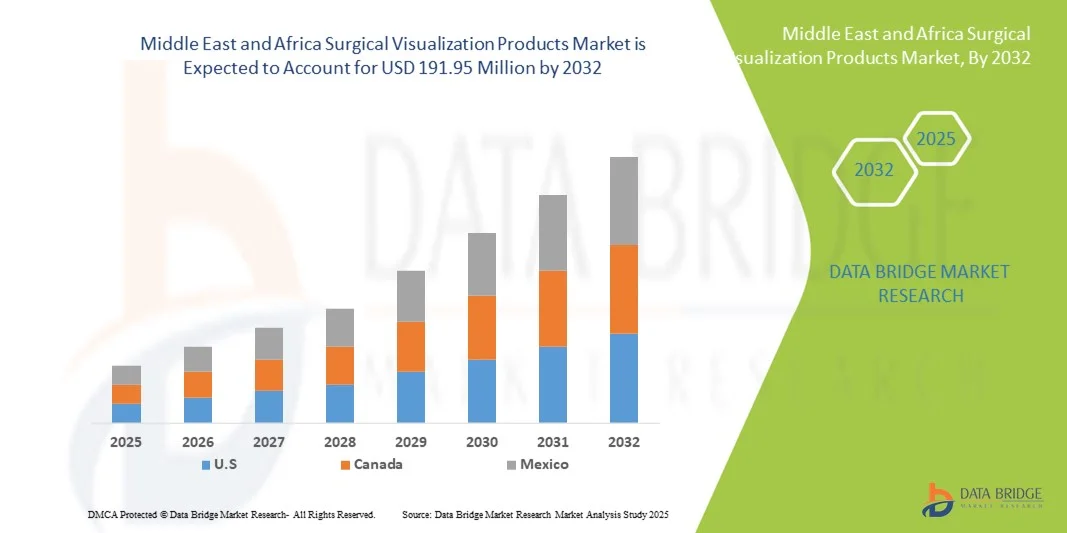
- The Middle East and Africa surgical visualization products market size was valued at USD 100.68 million in 2024 and is expected to reach USD 191.95 million by 2032, at a CAGR of 8.4% during the forecast period
- The market growth is largely fueled by increasing adoption of advanced surgical technologies and progress in minimally invasive procedures, leading to higher precision and efficiency in operating rooms across hospitals and surgical centers
- Furthermore, rising demand for accurate, real-time guidance during complex surgical procedures is driving the adoption of surgical visualization products. These converging factors are accelerating the uptake of these solutions, thereby significantly boosting the industry's growth
Middle East and Africa Surgical Visualization Products Market Analysis
- Surgical visualization products, including advanced imaging systems, endoscopes, and navigation-assisted surgical tools, are increasingly essential in modern operating rooms across hospitals and surgical centers in the MEA region due to their ability to enhance precision, improve patient outcomes, and support minimally invasive procedures
- The growing adoption of advanced surgical technologies is primarily fueled by the rising prevalence of complex surgical procedures, increasing awareness of patient safety, and demand for real-time intraoperative guidance
- Saudi Arabia dominated the MEA surgical visualization products market with the largest revenue share of 42.6% in 2024, characterized by early adoption of modern healthcare technologies, increasing hospital infrastructure investments, and the presence of key industry players, with substantial growth in surgical suite upgrades and equipment acquisitions driven by both established medical device companies and emerging suppliers
- The United Arab Emirates is expected to be the fastest-growing country in the MEA surgical visualization products market during the forecast period, due to expanding healthcare infrastructure, rising government healthcare spending, and increasing training and awareness programs for minimally invasive surgeries
- Laparoscopy dominates the MEA surgical visualization products market with a market share of 38.9% in 2024, driven by its critical role in minimally invasive procedures, versatility across multiple surgical specialties, and ease of integration into existing operating room setups
Report Scope and Middle East and Africa Surgical Visualization Products Market Segmentation
|
Attributes |
Middle East and Africa Surgical Visualization Products Key Market Insights |
|
Segments Covered |
|
|
Countries Covered |
Middle East and Africa
|
|
Key Market Players |
|
|
Market Opportunities |
|
|
Value Added Data Infosets |
In addition to the insights on market scenarios such as market value, growth rate, segmentation, geographical coverage, and major players, the market reports curated by the Data Bridge Market Research also include in-depth expert analysis, patient epidemiology, pipeline analysis, pricing analysis, and regulatory framework |
Middle East and Africa Surgical Visualization Products Market Trends
Advancements in Minimally Invasive Surgery Technologies
- A significant and accelerating trend in the MEA surgical visualization products market is the increasing adoption of minimally invasive surgical technologies, including high-definition endoscopes, 3D imaging systems, and navigation-assisted surgical tools, which enhance precision and reduce patient recovery times
- For instance, laparoscopy systems with integrated 3D imaging and high-definition cameras allow surgeons in leading hospitals in Saudi Arabia to perform complex procedures with greater accuracy and fewer complications
- Integration of augmented reality (AR) and real-time imaging with surgical visualization products enables surgeons to overlay critical anatomical data during procedures, improving intraoperative decision-making and reducing errors
- The growing availability of compact, mobile, and wireless surgical visualization devices allows hospitals in the UAE and Egypt to optimize operating room workflows and expand access to advanced surgical procedures in smaller medical centers
- This trend towards intelligent, minimally invasive, and image-guided surgical solutions is fundamentally transforming surgical practice in the MEA region, with companies such as Karl Storz and Stryker developing next-generation endoscopy and navigation platforms for enhanced clinical outcomes
- The demand for advanced, user-friendly, and integrated surgical visualization products is rising rapidly across both public and private healthcare sectors as hospitals focus on patient safety, precision, and operational efficiency
Middle East and Africa Surgical Visualization Products Market Dynamics
Driver
Rising Demand Due to Growing Surgical Volumes and Technological Adoption
- The increasing prevalence of complex surgical procedures, coupled with expanding hospital infrastructure and investments in advanced medical devices, is a key driver for the rising demand for surgical visualization products in the MEA region
- For instance, in 2024, King Faisal Specialist Hospital in Saudi Arabia adopted state-of-the-art 3D laparoscopic systems to improve surgical outcomes and reduce post-operative complications
- As hospitals and surgical centers aim to improve patient safety and precision, surgical visualization tools provide features such as real-time imaging, high-definition magnification, and navigation-assisted guidance, offering clear advantages over traditional surgical methods
- Furthermore, growing awareness among healthcare providers about the benefits of minimally invasive surgeries and the rising availability of trained surgical professionals are increasing adoption rates across both urban and semi-urban hospitals
- The need for operational efficiency, improved patient outcomes, and reduced surgical errors is propelling hospitals in countries such as the UAE, Saudi Arabia, and Egypt to invest heavily in integrated surgical visualization solutions and minimally invasive platforms
Restraint/Challenge
High Cost and Maintenance Complexity
- The relatively high cost of advanced surgical visualization products, including 3D imaging systems, robotic-assisted endoscopes, and navigation platforms, poses a challenge for broader adoption in budget-conscious hospitals and smaller clinics across the MEA region
- For instance, reports from private clinics in Nigeria indicate hesitation in adopting high-end laparoscopic systems due to the significant capital investment and recurring maintenance costs
- In addition, the need for specialized training and skilled personnel to operate these devices increases operational complexity, limiting adoption in regions with limited access to trained surgical staff
- Variability in regulatory standards and lengthy approval processes for medical devices in different MEA countries can delay deployment, creating hurdles for manufacturers seeking faster market penetration
- Overcoming these challenges through cost-effective solutions, leasing models, training programs, and standardization of regulatory requirements will be essential for sustained growth of the surgical visualization products market in the MEA region
Middle East and Africa Surgical Visualization Products Market Scope
The market is segmented on the basis of product type, application, end user, and distribution channel.
- By Product Type
On the basis of product type, the MEA surgical visualization products market is segmented into endoscopic cameras, accessories, light sources, displays and monitors, video recorders & processors, camera heads, and video converters. The endoscopic camera segment dominated the market with the largest revenue share of 36% in 2024, driven by its central role in minimally invasive procedures across multiple specialties. Endoscopic cameras provide high-definition visualization, enhancing precision and surgical outcomes. Hospitals and specialty clinics prefer these cameras for their versatility and compatibility with various surgical systems. The segment benefits from ongoing technological innovations, including 4K imaging and 3D visualization. Endoscopic cameras are also widely used in training and teaching hospitals due to their ability to provide real-time visualization for multiple viewers. Their critical importance in laparoscopic procedures ensures sustained demand across the MEA region.
The accessories segment is expected to witness the fastest growth rate of 12.8% from 2025 to 2032, fueled by the rising adoption of customized, modular surgical setups. Accessories such as insufflators, camera adapters, and sterile sheaths enhance the functionality and efficiency of endoscopic procedures. Hospitals and surgical centers are increasingly investing in accessory kits to support multiple applications without purchasing entirely new systems. The growth is also driven by emerging clinics in the UAE, Saudi Arabia, and Egypt adopting complete endoscopy packages for laparoscopic and ENT surgeries. Ease of integration and maintenance of accessories with existing systems further propels adoption.
- By Application
On the basis of application, the market is segmented into arthroscopy, laparoscopy, ENT endoscopy, obstetrics/gynecology endoscopy, urology endoscopy, gastroscopy, and others. The laparoscopy segment dominated the market with a revenue share of 38.9% in 2024, owing to its critical role in minimally invasive abdominal and gynecological surgeries. Laparoscopic procedures reduce patient recovery times, lower complication risks, and are increasingly preferred by hospitals for complex procedures. Hospitals in Saudi Arabia and the UAE have adopted advanced laparoscopic systems with integrated imaging and navigation technologies, driving market demand. The dominance is also supported by increasing surgical volumes and rising awareness of minimally invasive surgery benefits. Laparoscopy’s versatility across multiple specialties further reinforces its market leadership.
The ENT endoscopy segment is expected to witness the fastest CAGR of 11.5% from 2025 to 2032, driven by rising prevalence of ENT disorders and increasing outpatient procedures. Smaller, portable endoscopic systems are gaining popularity in specialty clinics, particularly in Egypt and Nigeria. Adoption is further boosted by technological enhancements such as high-definition imaging and LED light sources, improving procedural efficiency. Growth is supported by training initiatives in hospitals and specialty centers to increase procedural accuracy and patient throughput.
- By End User
On the basis of end user, the market is segmented into hospitals, specialty clinics, diagnostic imaging centers, ambulatory surgical centers, and others. The hospital segment dominated the market with a revenue share of 52% in 2024, as hospitals are the primary facilities performing high volumes of complex surgeries requiring advanced visualization systems. Hospitals prefer integrated systems that can be used across multiple specialties, from laparoscopy to urology and obstetrics. Large-scale adoption in government and private hospitals across Saudi Arabia and the UAE drives market leadership. Hospitals also invest in endoscopic training programs, further reinforcing demand. Advanced infrastructure and higher budgets allow hospitals to procure cutting-edge surgical visualization systems, maintaining their dominance.
The specialty clinics segment is expected to witness the fastest growth rate of 13.2% from 2025 to 2032, fueled by the increasing number of outpatient procedures and minimally invasive surgeries performed in focused healthcare settings. Clinics in urban centers of Egypt, Nigeria, and the UAE are adopting compact and modular visualization systems. Growth is supported by lower maintenance costs, ease of installation, and enhanced patient throughput in clinics. Rising awareness among patients and physicians regarding advanced surgical outcomes also drives adoption in specialty centers.
- By Distribution Channel
On the basis of distribution channel, the market is segmented into direct tender and third-party distributors. The direct tender segment dominated the market with a revenue share of 60% in 2024, as hospitals and government healthcare institutions often prefer direct procurement from manufacturers to ensure compliance, warranty support, and service agreements. Major medical device companies such as Karl Storz, Stryker, and Medtronic supply directly to leading hospitals in Saudi Arabia and the UAE. Direct tenders facilitate bulk purchases and installation of integrated surgical visualization solutions, reducing procurement delays. The preference for direct tenders also stems from the need for training and after-sales support. Long-term contracts with direct suppliers ensure reliability and continuity of service, reinforcing market dominance.
The third-party distributors segment is expected to witness the fastest CAGR of 10.6% from 2025 to 2032, driven by expanding access to smaller clinics, ambulatory surgical centers, and emerging hospitals in Africa. Distributors provide flexible procurement options, localized support, and access to multiple brands, making it easier for smaller healthcare facilities to adopt advanced surgical visualization products. Growth is fueled by increasing regional partnerships between manufacturers and distributors. Distributors also enable faster market penetration in remote or underserved areas, supporting overall market expansion.
Middle East and Africa Surgical Visualization Products Market Regional Analysis
- Saudi Arabia dominated the MEA surgical visualization products market with the largest revenue share of 42.6% in 2024, characterized by early adoption of modern healthcare technologies, increasing hospital infrastructure investments, and the presence of key industry players, with substantial growth in surgical suite upgrades and equipment acquisitions driven by both established medical device companies and emerging suppliers
- Hospitals and surgical centers in the country highly value precision, real-time imaging, and integrated surgical visualization systems, which improve patient outcomes and operational efficiency across multiple specialties
- This widespread adoption is further supported by government initiatives to upgrade healthcare facilities, high healthcare spending, and the presence of key medical device suppliers, establishing surgical visualization products as a preferred solution for hospitals and specialty clinics across the region
The Saudi Arabia Surgical Visualization Market Insight
The Saudi Arabia surgical visualization products market captured the largest revenue share of 42.6% in 2024 within the MEA region, fueled by extensive investments in healthcare infrastructure and modernization of surgical suites. Hospitals and specialty clinics are increasingly prioritizing minimally invasive procedures, supported by high-definition imaging and navigation-assisted systems. The growing number of complex surgeries, coupled with government initiatives to enhance healthcare quality, is further propelling market growth. Moreover, partnerships with leading medical device manufacturers ensure access to advanced surgical visualization technologies, strengthening adoption. The integration of these systems across multiple specialties, such as laparoscopy and urology, is enhancing procedural accuracy and patient outcomes.
United Arab Emirates Surgical Visualization Market Insight
The UAE surgical visualization products market is anticipated to grow at the fastest CAGR during the forecast period, driven by rapid expansion of healthcare facilities and rising demand for advanced surgical technologies. Private and public hospitals are increasingly adopting minimally invasive and image-guided surgery solutions to improve patient safety and operational efficiency. The UAE’s focus on medical tourism and specialized surgical centers is also boosting the adoption of high-end visualization systems. In addition, investments in surgeon training programs and integration of cutting-edge devices across multiple specialties support market expansion. Government initiatives promoting healthcare modernization and technology adoption further facilitate growth.
Egypt Surgical Visualization Market Insight
The Egypt surgical visualization products market is witnessing steady growth due to increasing surgical volumes and ongoing modernization of hospitals. Hospitals and specialty clinics are adopting advanced laparoscopic and endoscopic systems to enhance surgical precision and reduce recovery times. The demand for high-definition cameras, monitors, and light sources is rising in both public and private healthcare facilities. Furthermore, growing awareness of minimally invasive procedures among patients is driving hospital investments in state-of-the-art visualization equipment. Partnerships with regional distributors and manufacturers are improving accessibility to advanced technologies. The expansion of training programs for surgeons in laparoscopic and ENT procedures is also supporting adoption.
Nigeria Surgical Visualization Market Insight
The Nigeria surgical visualization products market is projected to grow significantly during the forecast period, fueled by increasing healthcare investments and rising prevalence of complex surgical procedures. Private hospitals and specialty clinics are focusing on upgrading surgical suites with high-definition endoscopic and imaging systems. Limited availability of advanced surgical technologies in regional hospitals is driving demand for mobile and modular visualization systems. Moreover, collaborations with global medical device companies are facilitating technology transfer and training. The growing awareness of minimally invasive surgeries and patient demand for faster recovery is accelerating adoption. Expansion of medical education and training programs further supports market growth.
Middle East and Africa Surgical Visualization Products Market Share
The Middle East and Africa Surgical Visualization Products industry is primarily led by well-established companies, including:
- Olympus Corporation (Japan)
- Stryker (U.S.)
- Smith & Nephew (U.K.)
- CONMED Corporation (U.S.)
- FUJIFILM Holdings Corporation (Japan)
- Richard Wolf GmbH (Germany)
- Medtronic (Ireland)
- Laborie (Canada)
- Happersberger otopront GmbH (Germany)
- Acutronic Holding AG. (Switzerland)
- WUZHOU AOKACE TECHNOLOGY CO., LTD. (China)
- Fude Technology Group Limited (China)
- Medicon eG. (Romania)
- Boston Scientific Corporation (U.S.)
- Alcon Laboratories Inc. (Switzerland)
- Medical Device Business Services, Inc. (U.S.)
- BD (U.S.)
- MEDICON (Germany)
What are the Recent Developments in Middle East and Africa Surgical Visualization Products Market?
- In January 2025, OptoMedic unveiled its innovative Stellar 4K3DNIR Endoscopic Imaging System and Spinlla ENT Power Shaver System at the Arab Health exhibition in Dubai. The Stellar system offers ultra-high-definition 4K 3D visualization combined with near-infrared imaging capabilities, enhancing precision in surgical procedures
- In January 2024, Activ Surgical announced the completion of its first international procedure using its ActivSight™ Intelligent Light at Abdali Hospital in Amman, Jordan. This marks a significant milestone in the adoption of advanced surgical visualization technologies in the Middle East
- In January 2023, Olympus launched the VISERA ELITE III surgical visualization platform across the Europe, Middle East, and Africa (EMEA) region. This platform offers enhanced imaging capabilities, aiming to improve surgical outcomes and efficiency in various medical procedures
- In September 2022, Olympus introduced the VISERA ELITE III surgical visualization platform across the Europe, Middle East, and Africa (EMEA) region. This platform offers enhanced imaging capabilities, aiming to improve surgical outcomes and efficiency in various medical procedures
- In March 2022, Endoluxe unveiled TowerTech, a high-definition, wireless endoscopic camera that integrates the functionality of legacy endoscopy video platforms into a single camera head. This innovation aims to enhance surgical visualization and streamline endoscopic procedures

- Interactive Data Analysis Dashboard
- Company Analysis Dashboard for high growth potential opportunities
- Research Analyst Access for customization & queries
- Competitor Analysis with Interactive dashboard
- Latest News, Updates & Trend analysis
- Harness the Power of Benchmark Analysis for Comprehensive Competitor Tracking
Data collection and base year analysis are done using data collection modules with large sample sizes. The stage includes obtaining market information or related data through various sources and strategies. It includes examining and planning all the data acquired from the past in advance. It likewise envelops the examination of information inconsistencies seen across different information sources. The market data is analysed and estimated using market statistical and coherent models. Also, market share analysis and key trend analysis are the major success factors in the market report. To know more, please request an analyst call or drop down your inquiry.
The key research methodology used by DBMR research team is data triangulation which involves data mining, analysis of the impact of data variables on the market and primary (industry expert) validation. Data models include Vendor Positioning Grid, Market Time Line Analysis, Market Overview and Guide, Company Positioning Grid, Patent Analysis, Pricing Analysis, Company Market Share Analysis, Standards of Measurement, Global versus Regional and Vendor Share Analysis. To know more about the research methodology, drop in an inquiry to speak to our industry experts.
Data Bridge Market Research is a leader in advanced formative research. We take pride in servicing our existing and new customers with data and analysis that match and suits their goal. The report can be customized to include price trend analysis of target brands understanding the market for additional countries (ask for the list of countries), clinical trial results data, literature review, refurbished market and product base analysis. Market analysis of target competitors can be analyzed from technology-based analysis to market portfolio strategies. We can add as many competitors that you require data about in the format and data style you are looking for. Our team of analysts can also provide you data in crude raw excel files pivot tables (Fact book) or can assist you in creating presentations from the data sets available in the report.













