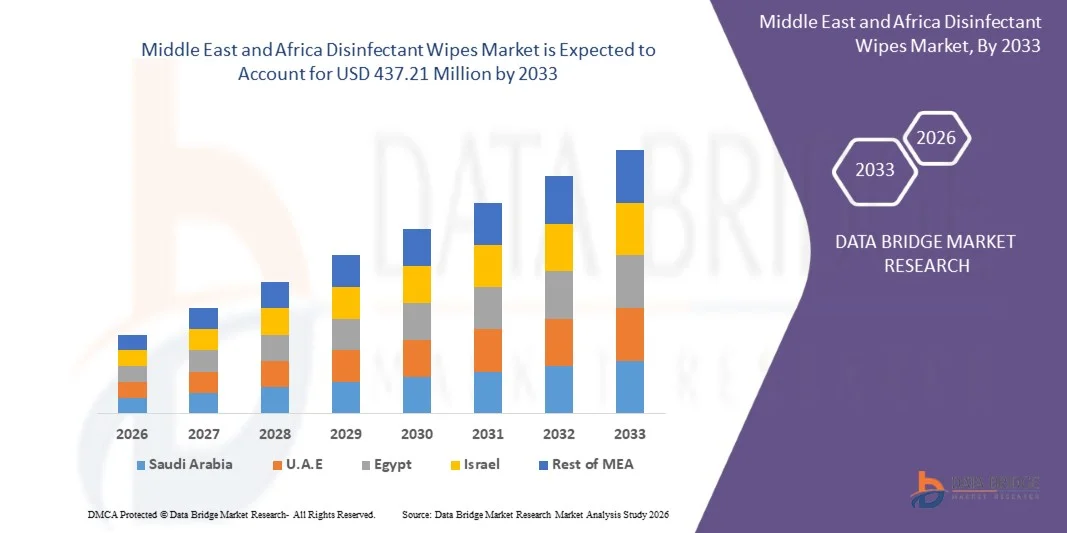
What is the Middle East and Africa Disinfectant Wipes Market Size and Growth Rate?
- The Middle East and Africa disinfectant wipes market size was valued at USD 319.46 million in 2025 and is expected to reach USD 437.21 million by 2033, at a CAGR of4.00% during the forecast period
- Growing awareness regarding hygiene, rising demand for surface disinfectants across households and commercial spaces, and increasing usage of convenient, ready-to-use sanitizing products are significant factors driving market growth
- In addition, expansion in the healthcare sector, increased focus on infection prevention, and growth in foodservice and hospitality hygiene protocols further accelerate the Middle East and Africa Disinfectant Wipes market
What are the Major Takeaways of Disinfectant Wipes Market?
- Rising adoption of antibacterial and antiviral wipes across residential, commercial, and medical settings continues to create strong growth opportunities for the Disinfectant Wipes market during the forecast period
- However, the presence of stringent chemical formulation regulations, increasing concerns about environmental impact of single-use wipes, and the availability of eco-friendly substitute solutions are major factors restraining market expansion
- Furthermore, challenges related to supply chain fluctuations, raw material availability, and rising emphasis on biodegradable alternatives will continue to impact market performance
- Saudi Arabia dominated the Middle East and Africa Disinfectant Wipes market with a 36.7% revenue share in 2025, supported by high demand from healthcare facilities, commercial establishments, and households
- The U.A.E. is projected to witness the fastest CAGR of 8.9% from 2026 to 2033, driven by growing adoption of disinfectant wipes in hospitals, offices, and residential settings
- The Quaternary ammonium compounds segment dominated the market with a revenue share of 44.8% in 2025, driven by its broad-spectrum antimicrobial efficacy, low toxicity, and widespread use in healthcare, hospitality, and household disinfecting applications
Report Scope and Disinfectant Wipes Market Segmentation
|
Attributes |
Disinfectant Wipes Key Market Insights |
|
Segments Covered |
|
|
Country Covered |
Middle East and Africa
|
|
Key Market Players |
|
|
Market Opportunities |
|
|
Value Added Data Infosets |
In addition to the insights on market scenarios such as market value, growth rate, segmentation, geographical coverage, and major players, the market reports curated by the Data Bridge Market Research also include in-depth expert analysis, pricing analysis, brand share analysis, consumer survey, demography analysis, supply chain analysis, value chain analysis, raw material/consumables overview, vendor selection criteria, PESTLE Analysis, Porter Analysis, and regulatory framework. |
What is the Key Trend in the Disinfectant Wipes Market?
“Growing Shift Toward Eco-Friendly, Biodegradable, and Plant-Based Disinfectant Wipes”
- The disinfectant wipes market is witnessing a significant shift toward biodegradable materials, natural disinfecting agents, and plastic-free packaging, driven by rising consumer awareness of sustainability and environmental impact
- For instance, in 2024, Reckitt Benckiser Group plc. (Middle East and Africa) and GAMA Healthcare Ltd. (Middle East and Africa) expanded their portfolios with eco-friendly disinfectant wipes using plant-based fibers and low-toxicity formulations to appeal to environmentally conscious consumers
- Increasing demand for compostable substrates, reduction of single-use plastics, and growing preference for non-alcohol, hypoallergenic wipes are accelerating the adoption of green disinfectant solutions
- Manufacturers are incorporating biodegradable cellulose fibers, plant-derived disinfectants, and recyclable packaging to meet consumer expectations for safer and greener sanitization products
- Rising regulatory pressure to reduce chemical load and improve environmental standards is further influencing innovation in sustainable wipe formulations
- As sustainability becomes a global priority, eco-friendly disinfectant wipes will continue to define future market development and competitive positioning
What are the Key Drivers of Disinfectant Wipes Market?
- Increasing focus on health, hygiene, and infection prevention across households, hospitals, and commercial facilities remains a primary driver for the disinfectant wipes market
- For instance, in 2025, STERIS (U.S.) and PDI, Inc. (U.S.) expanded their disinfectant wipe solutions for hospitals, offering fast-acting, broad-spectrum antimicrobial wipes to reduce healthcare-associated infections
- Rising demand for easy-to-use, portable cleaning products along with growing awareness of surface hygiene is boosting market penetration across residential and institutional settings
- Technological enhancements in wipe substrates, multi-surface compatibility, and rapid-kill disinfectant formulations are enabling better performance and wider adoption
- Growth in sectors such as foodservice, hospitality, education, and corporate facilities is increasing the use of disinfectant wipes for routine cleaning and sanitation
- As hygiene awareness strengthens across Middle East and Africa industries and public spaces, the disinfectant wipes market is expected to grow steadily, driven by safety compliance and product innovation
Which Factor is Challenging the Growth of the Disinfectant Wipes Market?
-
High production costs, fluctuating raw material prices, and strict chemical formulation regulations pose key challenges to the growth of the disinfectant wipes market
- For instance, during 2024–2025, several regional manufacturers faced delays due to increased costs of nonwoven fabrics, disinfecting agents, and sustainable packaging materials
- Rising concerns over the environmental impact of single-use wipes, especially non-biodegradable variants, are restricting large-scale usage in some regions
- Competition from traditional cleaning agents, low-cost substitutes, and refillable disinfectant solutions puts pricing pressure on wipe manufacturers
- Limited recycling infrastructure, along with growing scrutiny over chemical safety and skin sensitivity, presents operational and compliance challenges
- To address these constraints, companies are focusing on biodegradable materials, sustainable packaging, and cost-efficient production technologies to improve market accessibility and adoption
How is the Disinfectant Wipes Market Segmented?
The market is segmented on the basis of product type, usability, packaging, material type, levels of disinfection, flavoured, type, end use, and distribution channel.
• By Product Type
The disinfectant wipes market is segmented into Chlorine Compounds, Quaternary Ammonium Compounds, Oxidizing Agents, Phenol, Alcohol, Iodine Compounds, Aldehydes, Chlorhexidine Gluconate, and Others. The Quaternary Ammonium Compounds segment dominated the market with a revenue share of 44.8% in 2025, driven by its broad-spectrum antimicrobial efficacy, low toxicity, and widespread use in healthcare, hospitality, and household disinfecting applications. These wipes offer strong performance against bacteria, viruses, and fungi, making them ideal for high-touch surface sanitation.
The Alcohol-based wipes segment is projected to grow at the fastest CAGR during 2026–2033, supported by rising demand for rapid-action antimicrobial wipes, especially in hospitals, laboratories, and commercial facilities. Their fast drying time, high effectiveness against enveloped viruses, and suitability for medical equipment cleaning continue to drive adoption. Growing hygiene awareness Middle East and Africaly and preference for chemical-free or mild formulations are also expanding opportunities across natural and oxidizing agent categories.
• By Usability
Based on usability, the disinfectant wipes market is segmented into Disposable and Non-Disposable categories. The Disposable segment dominated the market with a 72.4% revenue share in 2025, attributed to its convenience, hygienic one-time use, and strong penetration across residential, clinical, and commercial cleaning applications. Disposable wipes eliminate the risk of cross-contamination, making them the preferred choice in hospitals, retail, and foodservice environments.
The Non-Disposable segment is anticipated to grow at the fastest CAGR from 2026–2033, fueled by rising sustainability awareness and increasing demand for refillable, washable, and eco-friendly wipe products. Growing regulatory pressure to minimize single-use plastics and reduce landfill waste is motivating manufacturers to develop reusable microfiber-based options. As consumers and institutions move toward greener cleaning practices across the Middle East and Africa, non-disposable disinfectant wipes are expected to gain significant traction, particularly across environmentally conscious households, hospitality, and premium commercial applications.
• By Packaging
On the basis of packaging, the disinfectant wipes market is segmented into Flatpack, Canister, and Others. The Canister segment dominated with a 49.6% revenue share in 2025, driven by its ease of use, moisture retention capability, and suitability for high-frequency cleaning in healthcare facilities, gyms, and public spaces. Canisters allow controlled dispensing and long-lasting freshness, making them ideal for commercial and institutional cleaning routines.
The Flatpack segment is expected to grow at the fastest CAGR during 2026–2033, powered by lightweight design, portability, and increasing consumer preference for travel-friendly disinfectant solutions. Flatpacks are widely adopted in households, automotive sanitation, and on-the-go cleaning applications. Rising demand for compact, refillable, and eco-friendly packaging solutions is further enhancing flatpack adoption. Manufacturers are increasingly innovating with biodegradable packaging films and resealable closures to reduce plastic consumption and support sustainability goals across the Middle East and Africa market.
• By Material Type
The disinfectant wipes market is segmented into Textile Fiber Wipes, Virgin Fiber Wipes, Advanced Fiber Wipes, and Others. Virgin Fiber Wipes dominated the market with a 41.2% revenue share in 2025, owing to their strong absorbency, durability, soft texture, and suitability for medical-grade disinfection applications. Their consistent fiber quality and excellent liquid retention make them ideal for alcohol- and chemical-based disinfectant formulations.
The Advanced Fiber Wipes segment is projected to grow at the fastest CAGR from 2026–2033, driven by increasing demand for biodegradable, compostable, and high-performance fibers developed from plant-based materials and engineered substrates. These wipes offer superior strength, low linting, and enhanced chemical compatibility, aligning with the rising preference for eco-friendly cleaning solutions. Growth in healthcare and foodservice applications, alongside sustainability mandates across the Middle East and Africa, is boosting market opportunity for advanced fiber innovations.
• By Levels of Disinfection
By disinfection level, the market is segmented into High, Intermediate, and Low. The Intermediate-level disinfectant wipes segment dominated the market with a 46.5% revenue share in 2025, favored for its balanced antimicrobial performance, safety, and suitability across both medical and non-medical environments. These wipes are effective against a wide range of pathogens while being compatible with most surfaces found in clinics, homes, and commercial facilities.
The High-level disinfectant wipes segment is expected to grow at the fastest CAGR during 2026–2033, fueled by increasing adoption in hospitals, laboratories, surgical centers, and high-risk contamination environments. Rising concerns over emerging infectious diseases and stricter infection prevention guidelines are pushing institutions toward hospital-grade, broad-spectrum disinfection solutions. Increasing investments in advanced disinfectant formulations and regulatory compliance standards across the Middle East and Africa further support segment growth.
• By Flavoured
The market based on flavored variants is segmented into Lavender and Jasmine, Citrus, Lemon, Coconut, and Others. The Citrus segment dominated the market with a 38.9% revenue share in 2025, driven by strong consumer preference for fresh, clean fragrances that complement routine disinfection practices in homes, offices, and retail settings. Citrus-based wipes are widely used due to their refreshing scent profile and ability to mask strong chemical odors.
The Lavender and Jasmine segment is projected to grow at the fastest CAGR from 2026–2033, supported by rising adoption of soothing, aromatherapeutic fragrances in household and premium hygiene products. Consumers increasingly prefer calming and natural scents, particularly in personal-use disinfectant wipes. This trend is driven by growing awareness of wellness-centric cleaning products and demand for fragrance-infused disinfectant solutions across the Middle East and Africa
• By Type
The disinfectant wipes market is segmented into Sporicidal, Bactericidal, Tuberculocidal, Virucidal, Fungicidal, Germicidal, and Others. The Bactericidal segment dominated the market with a 43.1% revenue share in 2025, reflecting its extensive usage across household cleaning, healthcare sanitation, foodservice hygiene, and public facility maintenance. Bactericidal wipes offer broad coverage against common pathogens and are essential for everyday disinfection routines.
The Virucidal segment is forecasted to grow at the fastest CAGR during 2026–2033, driven by heightened awareness of viral infection control in post-pandemic environments. Demand from hospitals, transportation hubs, schools, and corporate facilities continues to expand due to the need for rapid-action wipes with proven virus-kill claims. Rising regulatory emphasis on virus-specific efficacy across the Middle East and Africa is further accelerating virucidal wipe adoption.
• By End Use
The market is segmented based on end use into Healthcare, Commercial, Industrial Kitchen, Transportation Industry, Optical Industry, Electronic and Computer Industry, and Others. The Healthcare segment dominated the market with a 36.7% revenue share in 2025, driven by stringent infection control protocols, frequent surface disinfection requirements, and rising adoption of hospital-grade wipes in clinics, laboratories, and diagnostic centers.
The Commercial segment is projected to grow at the fastest CAGR from 2026–2033, due to expanding hygiene practices across offices, retail, hospitality, education, and public facilities. Increasing footfall in commercial establishments and demand for rapid, on-the-go cleaning solutions support sustained market growth. Growing hygiene expectations in industrial kitchens, transportation networks, and electronics sectors further diversify market adoption across the Middle East and Africa
• By Distribution Channel
By distribution channel, the disinfectant wipes market is segmented into Direct Tenders and Retail Sales. Retail Sales dominated the market with a 61.3% revenue share in 2025, supported by strong penetration across supermarkets, pharmacy chains, online marketplaces, and convenience stores. Consumer preference for accessible, ready-to-use disinfectant solutions continues to fuel retail growth.
The Direct Tenders segment is expected to grow at the fastest CAGR during 2026–2033, driven by bulk procurement from hospitals, government bodies, transportation authorities, and large commercial institutions. Increasing institutional demand for standardized, medical-grade disinfectant wipes further strengthens tender-based contracts across the Middle East and Africa
Which Region Holds the Largest Share of the Disinfectant Wipes Market?
- Saudi Arabia dominated the Middle East and Africa Disinfectant Wipes market with a 36.7% revenue share in 2025, supported by high demand from healthcare facilities, commercial establishments, and households
- Investments in local production, advanced formulations, and eco-friendly packaging are driving regional leadership, while rising hygiene awareness and disposable incomes further accelerate market adoption
U.A.E. Disinfectant Wipes Market Insight
The U.A.E. is projected to witness the fastest CAGR of 8.9% from 2026 to 2033, driven by growing adoption of disinfectant wipes in hospitals, offices, and residential settings. Manufacturers are focusing on alcohol-based, biodegradable, and multi-surface cleaning solutions to meet consumer preferences. Expanding retail networks, e-commerce penetration, and increasing institutional adoption in schools and workplaces further support market growth, making the UAE a key contributor in the region.
South Africa Disinfectant Wipes Market Insight
South Africa contributes steadily to regional growth, fueled by rising demand in healthcare, hospitality, and commercial sectors. Consumers prefer eco-friendly, alcohol-free, and convenient wipes, while companies invest in premium formulations and sustainable packaging. Urbanization, health awareness campaigns, and government regulations promoting sanitation strengthen adoption, reinforcing South Africa’s position in the Middle East and Africa Disinfectant Wipes market.
Egypt Disinfectant Wipes Market Insight
Egypt is growing steadily as a regional contributor, supported by increasing awareness of hygiene in households, offices, and healthcare facilities. Adoption of multi-surface, biodegradable, and alcohol-based wipes is rising, supported by retail expansion and e-commerce growth. Investments in R&D for gentle and effective formulations, along with rising urban population and institutional usage, boost market penetration and sustained growth.
Nigeria Disinfectant Wipes Market Insight
Nigeria is emerging as a key market in the Middle East and Africa region, driven by demand for disinfectant wipes in homes, hospitals, and commercial establishments. Consumers are increasingly seeking hypoallergenic, alcohol-free, and convenient cleaning solutions. Expansion of retail chains, e-commerce adoption, and awareness campaigns for infection control further support market growth, positioning Nigeria as a notable contributor to the regional market.
Which are the Top Companies in Disinfectant Wipes Market?
The disinfectant wipes industry is primarily led by well-established companies, including:
- GAMA Healthcare Ltd. (Middle East and Africa)
- Pal International (Netherlands)
- DrDeppe (Germany)
- PDI, Inc. (U.S.)
- STERIS (U.S.)
- Reckitt Benckiser Group plc. (Middle East and Africa)
- Codi Group BV (Netherlands)
- Dreumex B.V. (Netherlands)
- Pluswipes (Netherlands)
- RCP Ranstadt GmbH (Germany)
- The Hygiene Company (Middle East and Africa)
- Uniwipe Europe Ltd (Middle East and Africa)
What are the Recent Developments in Middle East and Africa Disinfectant Wipes Market?
- In July 2024, Ecolab launched the Disinfectant 1 Wipe, representing a major step forward in sustainable healthcare hygiene, as it became the first plastic-free disinfectant wipe to receive EPA registration while being fully degradable and made entirely from wood pulp fibers, delivering hospital-grade disinfection within one minute, ultimately setting a new benchmark for eco-friendly hygiene solutions
- In October 2022, Lysol Pro Solutions, a division of Reckitt, introduced its 800-count disinfecting wipes bucket along with refill packs to address high-volume cleaning demands for businesses, providing a format that boosts hygiene efficiency, reduces plastic use, and lowers operational costs, thereby reinforcing Lysol’s long-term commitment to supporting large-scale cleanliness initiatives
- In June 2021, PDI Healthcare launched a softpack version of its Super Sani-Cloth Germicidal Disposable Wipes to improve convenience and sustainability, featuring 80 wipes per pack and utilizing 80% less plastic compared to the traditional large canister, significantly reducing environmental impact and advancing sustainable infection prevention practices

- Interactive Data Analysis Dashboard
- Company Analysis Dashboard for high growth potential opportunities
- Research Analyst Access for customization & queries
- Competitor Analysis with Interactive dashboard
- Latest News, Updates & Trend analysis
- Harness the Power of Benchmark Analysis for Comprehensive Competitor Tracking
Data collection and base year analysis are done using data collection modules with large sample sizes. The stage includes obtaining market information or related data through various sources and strategies. It includes examining and planning all the data acquired from the past in advance. It likewise envelops the examination of information inconsistencies seen across different information sources. The market data is analysed and estimated using market statistical and coherent models. Also, market share analysis and key trend analysis are the major success factors in the market report. To know more, please request an analyst call or drop down your inquiry.
The key research methodology used by DBMR research team is data triangulation which involves data mining, analysis of the impact of data variables on the market and primary (industry expert) validation. Data models include Vendor Positioning Grid, Market Time Line Analysis, Market Overview and Guide, Company Positioning Grid, Patent Analysis, Pricing Analysis, Company Market Share Analysis, Standards of Measurement, Global versus Regional and Vendor Share Analysis. To know more about the research methodology, drop in an inquiry to speak to our industry experts.
Data Bridge Market Research is a leader in advanced formative research. We take pride in servicing our existing and new customers with data and analysis that match and suits their goal. The report can be customized to include price trend analysis of target brands understanding the market for additional countries (ask for the list of countries), clinical trial results data, literature review, refurbished market and product base analysis. Market analysis of target competitors can be analyzed from technology-based analysis to market portfolio strategies. We can add as many competitors that you require data about in the format and data style you are looking for. Our team of analysts can also provide you data in crude raw excel files pivot tables (Fact book) or can assist you in creating presentations from the data sets available in the report.