


Middle East and Africa Medical Device Sterilization Market Size
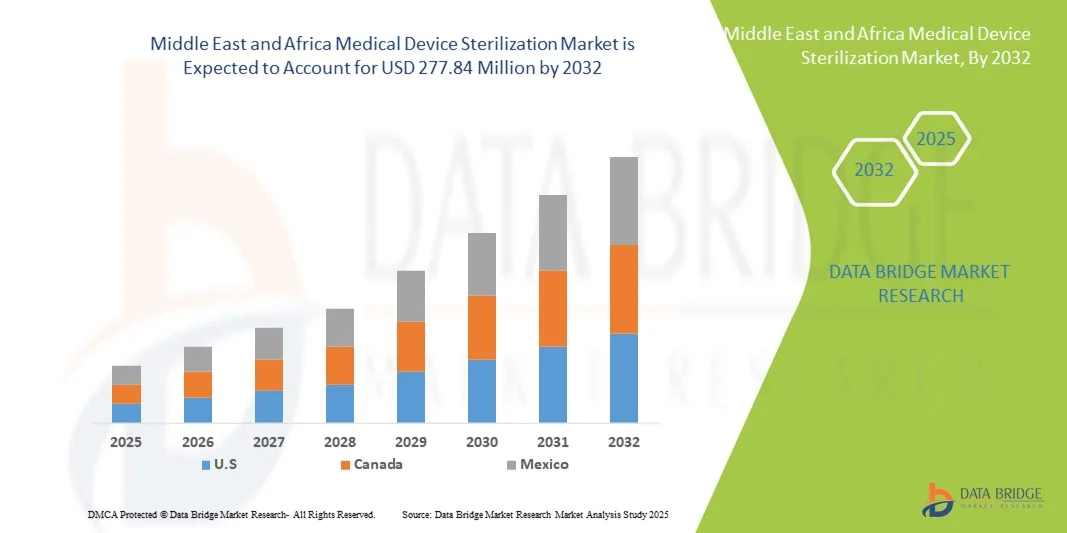
- The Middle East and Africa medical device sterilization market size was valued at USD 158.12 million in 2024 and is expected to reach USD 277.84 million by 2032, at a CAGR of 7.30% during the forecast period
- The market growth is largely fueled by increasing investments in healthcare infrastructure, rising adoption of advanced sterilization technologies, and growing regulatory requirements in hospitals and clinics across the region
- Furthermore, the rising prevalence of hospital-acquired infections, increasing surgical procedures, and demand for safe and efficient sterilization solutions are establishing medical device sterilization as a critical component of healthcare operations. These converging factors are accelerating the uptake of sterilization services, thereby significantly boosting the industry's growth
Middle East and Africa Medical Device Sterilization Market Analysis
- Medical device sterilization, including thermal sterilization, ionizing radiation sterilization, filtration sterilization, and gas & chemical sterilization, is increasingly vital for ensuring patient safety and regulatory compliance in hospitals, clinics, laboratories, and pharmaceutical companies across the Middle East & Africa due to rising healthcare standards and infection control requirements
- The escalating demand for sterilization services is primarily fueled by increasing healthcare infrastructure investments, growing awareness of hospital-acquired infections, and a rising need for high-quality, safe, and efficient medical procedures
- Saudi Arabia dominated the Middle East and Africa medical device sterilization market with the largest revenue share of 28.6% in 2024, characterized by expanding hospital networks, governmental initiatives for healthcare modernization, and the presence of international and regional sterilization service providers
- South Africa is expected to be the fastest-growing country in the MEA medical device sterilization market during the forecast period due to rising healthcare accessibility, donor-funded projects, and increasing awareness of infection prevention measures
- Thermal sterilization segment dominated the MEA medical device sterilization market with a market share of 41.2% in 2024, driven by its established reliability, cost-effectiveness, and widespread adoption across hospitals, clinics, and laboratories
Report Scope and Middle East and Africa Medical Device Sterilization Market Segmentation
|
Attributes |
Middle East and Africa Medical Device Sterilization Key Market Insights |
|
Segments Covered |
|
|
Countries Covered |
Middle East and Africa
|
|
Key Market Players |
|
|
Market Opportunities |
|
|
Value Added Data Infosets |
In addition to the insights on market scenarios such as market value, growth rate, segmentation, geographical coverage, and major players, the market reports curated by the Data Bridge Market Research also include in-depth expert analysis, pricing analysis, brand share analysis, consumer survey, demography analysis, supply chain analysis, value chain analysis, raw material/consumables overview, vendor selection criteria, PESTLE Analysis, Porter Analysis, and regulatory framework. |
Middle East and Africa Medical Device Sterilization Market Trends
Adoption of Advanced Sterilization Technologies
- A significant and accelerating trend in the MEA medical device sterilization market is the adoption of advanced sterilization technologies such as gas & chemical sterilization and ionizing radiation sterilization, which improve efficiency and reduce turnaround times for hospitals, clinics, and laboratories
- For instance, hospitals in Saudi Arabia are increasingly implementing hydrogen peroxide plasma sterilizers to handle high volumes of surgical instruments with faster cycle times and lower environmental impact
- Integration of sterilization systems with hospital management software allows for real-time tracking of sterilized instruments, automated alerts for maintenance, and reporting for regulatory compliance, enhancing operational efficiency
- The growing trend toward outsourcing sterilization services to specialized providers allows healthcare facilities to focus on patient care while ensuring strict adherence to sterilization protocols
- This shift towards more efficient, automated, and reliable sterilization methods is reshaping operational standards in healthcare facilities, prompting companies such as Steris and Matachana to develop advanced sterilization solutions compatible with diverse medical instruments
- The demand for innovative and automated sterilization solutions is growing rapidly across both hospitals and pharmaceutical manufacturing facilities, driven by the need for compliance, safety, and operational efficiency
Middle East and Africa Medical Device Sterilization Market Dynamics
Driver
Rising Healthcare Investments and Regulatory Compliance
- The increasing investments in healthcare infrastructure and stringent regulatory requirements across the MEA region are key drivers for the heightened demand for medical device sterilization services
- For instance, in April 2024, the UAE Ministry of Health announced an initiative to modernize sterilization facilities across government hospitals, aiming to standardize sterilization processes and improve patient safety
- As hospitals and clinics expand and upgrade their surgical and diagnostic capabilities, the need for reliable sterilization of medical devices becomes critical, supporting market growth
- Furthermore, growing awareness of hospital-acquired infections and the importance of sterile instruments in preventing infection is driving adoption of advanced sterilization technologies
- The increasing presence of pharmaceutical manufacturing and medical device companies in countries such as Saudi Arabia and South Africa also contributes to the rising demand for specialized sterilization services
- Rising government incentives and public-private partnerships in the healthcare sector are further encouraging the adoption of advanced sterilization technologies
- Technological collaborations between global and regional sterilization service providers are accelerating knowledge transfer and the deployment of innovative sterilization solutions
Restraint/Challenge
High Costs and Technical Complexity
- The high initial investment required for advanced sterilization equipment and the technical expertise needed to operate them pose significant challenges to market expansion in the MEA region
- For instance, small and medium-sized clinics in Egypt face difficulties in adopting high-end autoclaves or gamma irradiation systems due to budget constraints and lack of trained personnel
- Operational complexity and maintenance requirements can lead to downtime, reducing workflow efficiency and discouraging adoption among smaller healthcare providers
- While outsourcing sterilization to third-party providers mitigates some challenges, concerns about quality control and adherence to regulatory standards remain a barrier
- Limited awareness and training in advanced sterilization protocols among staff in emerging markets hinder widespread adoption
- Variability in regulatory enforcement across countries creates inconsistencies in sterilization standards, affecting market uniformity
- Overcoming these challenges through government incentives, training programs, and more cost-effective sterilization technologies will be vital for sustained market growth
Middle East and Africa Medical Device Sterilization Market Scope
The market is segmented on the basis of product, technology, end user, and distribution channel.
- By Product
On the basis of product, the MEA medical device sterilization market is segmented into instruments, reagents, and services. The services segment dominated the market with the largest revenue share of 42% in 2024, driven by the widespread adoption of outsourced sterilization in hospitals and clinics seeking to ensure regulatory compliance and reduce operational burden. Hospitals and clinics prioritize sterilization services to manage large volumes of instruments efficiently while maintaining high safety standards. The availability of specialized third-party service providers with advanced sterilization equipment enhances reliability and consistency, supporting the segment’s dominance. In addition, services are increasingly integrated with hospital management systems to provide tracking, reporting, and audit capabilities, further strengthening adoption. The segment also benefits from growing investments in healthcare infrastructure across Saudi Arabia and the UAE, which boosts demand for professional sterilization solutions.
The instruments segment is expected to witness the fastest growth rate of 9.8% from 2025 to 2032, fueled by rising demand for sterilizable surgical and diagnostic instruments in hospitals and medical device manufacturers. The growth is supported by advancements in instrument design, which allow compatibility with modern sterilization methods such as thermal and chemical sterilization. Emerging hospitals and clinics in South Africa and Egypt are increasingly purchasing sterilizable instruments to expand surgical capabilities. Growing awareness of hospital-acquired infections also drives the need for high-quality, sterilizable instruments. Furthermore, the adoption of automated sterilization monitoring systems ensures instruments meet safety standards, contributing to faster growth.
- By Technology
On the basis of technology, the MEA medical device sterilization market is segmented into thermal sterilization, ionizing radiation sterilization, filtration sterilization, and gas & chemical sterilization. The thermal sterilization segment dominated the market with a share of 41.2% in 2024, driven by its reliability, cost-effectiveness, and widespread adoption across hospitals, clinics, and laboratories. Thermal sterilization is highly compatible with a broad range of instruments and is well-established in standard operating procedures, particularly in Saudi Arabia. Hospitals favor thermal sterilization for its ability to ensure reproducible results, high throughput, and proven track record in infection control. The segment also benefits from lower operational costs and minimal environmental impact compared to some chemical methods.
The gas & chemical sterilization segment is expected to witness the fastest CAGR of 10.2% from 2025 to 2032, driven by increasing use in sensitive instruments, electronic devices, and heat-sensitive medical products. Countries such as South Africa are adopting chemical sterilization to maintain sterility in advanced medical instruments and pharmaceutical production. The flexibility of gas sterilization methods allows treatment of a wide variety of materials that cannot withstand high temperatures. In addition, regulatory encouragement for low-temperature sterilization solutions supports the segment’s rapid growth. Enhanced process automation and monitoring in gas sterilization further contribute to its adoption in both hospitals and pharmaceutical companies.
- By End User
On the basis of end user, the market is segmented into pharmaceutical companies, hospitals, clinics, laboratories, academic and research institutes, medical device manufacturers, and others. The hospitals and clinics segment dominated the market with a share of 45% in 2024, as healthcare facilities remain the largest consumers of sterilization services due to high surgical volumes and strict infection control requirements. Hospitals prioritize validated sterilization methods for surgical instruments, reusable devices, and laboratory equipment to meet patient safety and regulatory standards. The presence of government-funded hospitals in Saudi Arabia and the UAE, alongside private healthcare expansion, contributes to strong demand. Integrated sterilization solutions linked with hospital management systems also enhance operational efficiency, supporting the dominance of this segment.
The pharmaceutical companies segment is expected to witness the fastest growth rate of 11% from 2025 to 2032, fueled by increasing production of sterile injectable drugs, vaccines, and biologics. Pharmaceutical manufacturers require advanced sterilization technologies, including filtration and gas sterilization, to maintain product sterility. South Africa and Egypt are emerging as hubs for pharmaceutical manufacturing in the region, driving adoption. Stringent regulatory requirements for sterile products further accelerate the demand. Partnerships with specialized sterilization service providers ensure compliance and reduce in-house infrastructure costs. Automation and real-time monitoring capabilities also support the rapid growth of this segment.
- By Distribution Channel
On the basis of distribution channel, the MEA medical device sterilization market is segmented into direct tenders, retail sales, and third-party distributors. The direct tenders segment dominated the market with a share of 50% in 2024, driven by hospitals, government healthcare institutions, and large pharmaceutical companies procuring sterilization equipment and services through formal tendering processes. Direct tenders ensure compliance with procurement regulations, standardized quality, and access to post-sale support and training. Saudi Arabia’s and UAE’s government healthcare modernization programs often involve direct tendering for large-scale sterilization solutions, reinforcing market dominance.
The third-party distributor segment is expected to witness the fastest growth rate of 12% from 2025 to 2032, fueled by increasing adoption of outsourced sterilization solutions and smaller healthcare facilities in remote regions. Third-party distributors provide cost-effective access to advanced sterilization technologies without the need for high upfront investments. The segment also benefits from flexible service agreements, local technical support, and rapid deployment of equipment in emerging markets such as South Africa and Egypt. Partnerships between international sterilization equipment manufacturers and local distributors further drive growth and market penetration.
Middle East and Africa Medical Device Sterilization Market Regional Analysis
- Saudi Arabia dominated the Middle East and Africa medical device sterilization market with the largest revenue share of 28.6% in 2024, characterized by expanding hospital networks, governmental initiatives for healthcare modernization, and the presence of international and regional sterilization service providers
- Hospitals and clinics in the region prioritize the adoption of advanced sterilization technologies, including thermal, gas & chemical, and ionizing radiation methods, to ensure patient safety and compliance with international standards
- The widespread adoption is further supported by government initiatives, growing awareness of hospital-acquired infections, and the increasing presence of international and regional sterilization service providers, establishing sterilization as a critical component of healthcare operations in both public and private sectors
South Africa Medical Device Sterilization Market Insight
The South Africa medical device sterilization market is anticipated to grow at the fastest CAGR during the forecast period, driven by increasing healthcare accessibility and investments in modern medical facilities. Hospitals, clinics, and pharmaceutical manufacturers are adopting advanced sterilization methods to meet rising patient safety demands and regulatory requirements. The emergence of donor-funded healthcare projects and collaborations with international sterilization service providers is enhancing technology adoption. Moreover, the growing awareness of infection prevention and the need for efficient sterilization processes in both urban and remote areas are significantly propelling market growth.
UAE Medical Device Sterilization Market Insight
The UAE medical device sterilization market is expected to expand steadily due to rapid healthcare infrastructure development and strong government initiatives to standardize sterilization practices across hospitals and clinics. Healthcare providers are increasingly integrating sterilization solutions with hospital management systems for monitoring, compliance reporting, and operational efficiency. The market is further supported by the presence of global sterilization technology suppliers, high healthcare spending, and a focus on ensuring patient safety through advanced sterilization methods.
Egypt Medical Device Sterilization Market Insight
The Egypt medical device sterilization market is gaining momentum due to rising investments in private hospitals and diagnostic laboratories, alongside increasing awareness of hospital-acquired infections. The adoption of thermal sterilization, filtration sterilization, and chemical sterilization methods is expanding, particularly in urban centers. Collaborative programs with international service providers are helping healthcare facilities upgrade sterilization standards. Furthermore, government healthcare initiatives and training programs for staff in modern sterilization techniques are contributing to market growth.
Middle East and Africa Medical Device Sterilization Market Share
The Middle East and Africa Medical Device Sterilization industry is primarily led by well-established companies, including:
- Afri Medical (Egypt)
- STERIS (U.S.)
- ASP (U.S.)
- Priorclave Ltd. (U.K.)
- Sotera Health Company (U.S.)
- BMT Medical Technology s.r.o. (Czech Republic)
- Endomed Medical & Surgical Supplies (South Africa)
- Solsteo (France)
- Elektro Genesis (UAE)
- Surgimed Medical Supplies (UAE)
- Medi-Q (UAE)
- Getinge AB (Sweden)
- Fine Hygienic Holding (Jordan)
- East African Medical Vitals (Uganda)
- Meril Life Sciences (India)
- Magrabi Hospitals and Centers (Saudi Arabia)
- Stryker (U.S.)
- Johnson & Johnson Services, Inc. (U.S.)
What are the Recent Developments in Middle East and Africa Medical Device Sterilization Market?
- In October 2025, Saudi Arabia's Ministry of Health announced the launch of key biotech and pharmaceutical partnerships at the Global Health Exhibition 2025. These initiatives aim to boost investment, innovation, and healthcare capabilities, aligning with the nation's Vision 2030 objectives
- In January 2025, SGS received approval to extend the scope of its EU Medical Device Regulation (MDR) sterilization services in the UAE. The Federal Agency for Medicines and Health Products (FAMHP) accepted SGS's sterilization scope extension after verifying their training, qualification, and in-house competence. This extension enabled SGS to assess additional sterilization processes, enhancing their service offerings in the region
- In June 2024, the UAE expanded its sterilization services to accommodate the growing demand for medical device sterilization. This expansion includes the introduction of new sterilization technologies and increased capacity to serve healthcare providers more effectively
- In September 2023, Egypt adopted Ethylene Oxide (EtO) sterilization technology to improve the sterilization of medical devices. This technology is particularly effective for heat-sensitive devices, enhancing the safety and efficacy of medical treatments
- In February 2021, Kenya implemented gamma radiation sterilization for medical devices to meet international safety standards. This method is effective for sterilizing a wide range of medical products, ensuring their safety for patient use
- https://www.sgs.com/en-ae/news/2025/01/sgs-extends-scope-of-mdr-sterilization-services?ut
- https://pmc.ncbi.nlm.nih.gov/articles/PMC10756808/?ut
- https://www.moh.gov.sa/en/Ministry/MediaCenter/News/Pages/News-2025-10-08-001.aspx?ut

- Interactive Data Analysis Dashboard
- Company Analysis Dashboard for high growth potential opportunities
- Research Analyst Access for customization & queries
- Competitor Analysis with Interactive dashboard
- Latest News, Updates & Trend analysis
- Harness the Power of Benchmark Analysis for Comprehensive Competitor Tracking
Data collection and base year analysis are done using data collection modules with large sample sizes. The stage includes obtaining market information or related data through various sources and strategies. It includes examining and planning all the data acquired from the past in advance. It likewise envelops the examination of information inconsistencies seen across different information sources. The market data is analysed and estimated using market statistical and coherent models. Also, market share analysis and key trend analysis are the major success factors in the market report. To know more, please request an analyst call or drop down your inquiry.
The key research methodology used by DBMR research team is data triangulation which involves data mining, analysis of the impact of data variables on the market and primary (industry expert) validation. Data models include Vendor Positioning Grid, Market Time Line Analysis, Market Overview and Guide, Company Positioning Grid, Patent Analysis, Pricing Analysis, Company Market Share Analysis, Standards of Measurement, Global versus Regional and Vendor Share Analysis. To know more about the research methodology, drop in an inquiry to speak to our industry experts.
Data Bridge Market Research is a leader in advanced formative research. We take pride in servicing our existing and new customers with data and analysis that match and suits their goal. The report can be customized to include price trend analysis of target brands understanding the market for additional countries (ask for the list of countries), clinical trial results data, literature review, refurbished market and product base analysis. Market analysis of target competitors can be analyzed from technology-based analysis to market portfolio strategies. We can add as many competitors that you require data about in the format and data style you are looking for. Our team of analysts can also provide you data in crude raw excel files pivot tables (Fact book) or can assist you in creating presentations from the data sets available in the report.













