


What is the Middle East and Africa Paper Bags Market Size and Growth Rate?
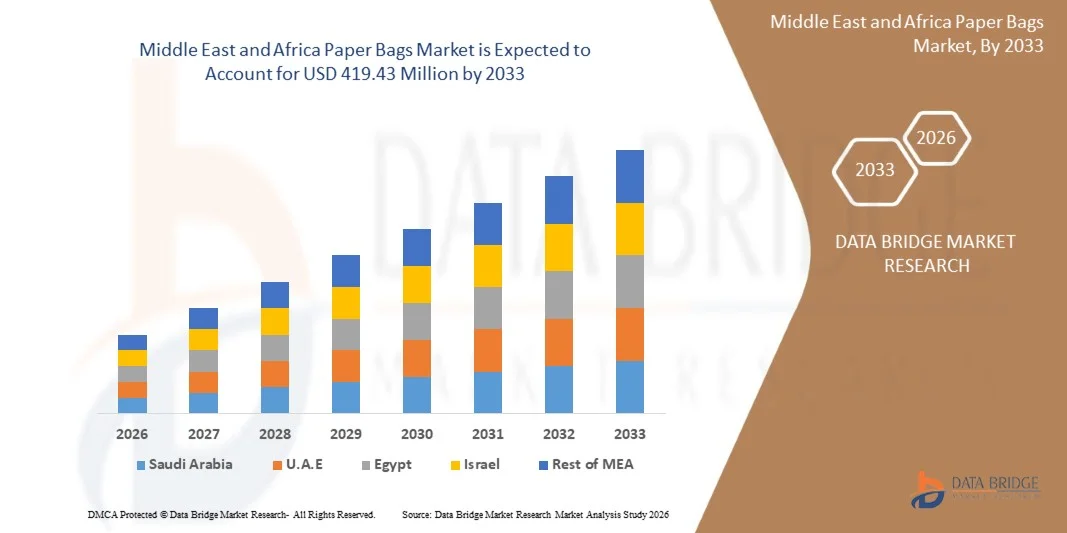
- As per Data Bridge Market Research analysis, the Middle East and Africa paper bags market was valued at USD 313.64 million in 2025 and is projected to reach USD 419.43 million by 2033, growing at a CAGR of 3.7% from 2026 to 2033.
- The market is experiencing consistent growth driven by increasing demand for sustainable packaging alternatives, expanding retail and food-service activities, growing e-commerce and grocery delivery, and rising environmental awareness across the region.
- The increasing implementation of restrictions on single-use plastics across Middle Eastern and African countries, combined with the expansion of modern retail, restaurants, hotels, cafes, and online food and grocery delivery, is encouraging businesses to adopt paper-based packaging solutions. Paper bags are gaining traction as a recyclable and environmentally preferable alternative to conventional plastic bags, while demand from retail, food, agriculture, construction, and chemical applications is supporting broader market expansion.
Market Size & Forecast
- Global Market Value (2025): USD 313.64 Million
- Expected Market Value (2033): USD 419.43 Million
- Forecast CAGR (2026–2033): 3.7%
- Leading Country in 2025: Saudi Arabia
- Fastest Growing Country: United Arab Emirates
What are the Major Takeaways of the Middle East and Africa Paper Bags Market?
- Saudi Arabia dominated the Middle East and Africa paper bags market with the largest revenue share of 42.76% in 2025, supported by strong demand from the cement, petrochemical, food-service, retail, and infrastructure sectors
- United Arab Emirates is expected to be the fastest-growing region at a CAGR of 10.08% from 2026 to 2033, fueled by plastic-reduction initiatives, expanding e-commerce, retail, and food-service activities.
- The open mouth segment led the market with a 35% share in 2025, driven by its widespread use for packaging food products, agricultural commodities, animal feed, chemicals, and construction materials.
- Pasted valve are the fastest-growing product type, projected to register a CAGR of 9.0%, reflecting the surge in suitability for automated filling and efficient closure of bulk products.
- The single-use segment dominated the usage category with a 63% revenue share in 2025, led by extensive consumption across grocery retail, food service, bakeries, takeaway restaurants, and convenience stores.
- Medium size accounted for 36% of the market share in 2025, preferred by extensive use in grocery, retail, food service, bakery, cosmetics, and general shopping applications
- The twisted handle segment is the fastest-growing sealing & handling category, with a CAGR of 6.8%, driven by increasing demand for premium, durable, and visually appealing retail packaging.
Report Scope and Middle East and Africa Paper Bags Market Segmentation
|
Attributes |
Middle East and Africa Paper Bags Key Market Insights |
|
Segments Covered |
|
|
Countries Covered |
Middle East and Africa
|
|
Key Market Players |
|
|
Market Opportunities |
|
|
Value Added Data Infosets |
In addition to the insights on market scenarios such as market value, growth rate, segmentation, geographical coverage, and major players, the market reports curated by the Data Bridge Market Research also include import export analysis, production capacity overview, production consumption analysis, price trend analysis, climate change scenario, supply chain analysis, value chain analysis, raw material/consumables overview, vendor selection criteria, PESTLE Analysis, Porter Analysis, and regulatory framework |
What is the Key Trend in the Middle East and Africa Paper Bags Market?
- The shift toward sustainable and recyclable packaging is accelerating across the Middle East and Africa as retailers, food-service operators, and manufacturers respond to plastic-reduction policies and changing consumer preferences for environmentally responsible packaging.
- For instance, in January 2024, the UAE implemented a nationwide ban on the import, production, and trade of single-use plastic shopping bags, supporting the transition toward reusable and alternative packaging solutions.
- Retailers and food-service businesses are increasingly adopting paper-based bags and customized packaging to reduce dependence on conventional plastic while maintaining convenient formats for shopping, takeaway, and delivery applications.
- The trend is further supported by investments in regional paper and packaging infrastructure, enabling manufacturers to improve local supply, develop recyclable solutions, and serve expanding retail and industrial packaging requirements.
- For instance, in January 2025, Smurfit Westrock inaugurated an innovation center in Morocco and launched a new high-quality printing production line following an investment of MAD 51.8 million, strengthening sustainable packaging capabilities in the African market.
- As governments strengthen environmental regulations and businesses increasingly prioritize recyclable packaging, the adoption of paper bags is expected to expand across retail, food service, e-commerce, and industrial applications throughout the Middle East and Africa.
What are the Key Drivers of the Middle East and Africa Paper Bags Market?
- The implementation of plastic-bag restrictions and sustainability policies across Middle Eastern and African countries is increasing demand for alternative packaging formats, including paper bags, particularly within retail, food service, and grocery applications.
- For instance, in December 2024, the Environment Agency – Abu Dhabi reported that its single-use plastic bag ban had prevented 364 million plastic bags from being used since June 2022, equivalent to approximately 2,400 tonnes of plastic, demonstrating the scale of plastic-reduction initiatives in the region.
- Rapid expansion of modern retail, restaurants, cafés, food delivery, e-commerce, and industrial sectors is creating additional demand for durable paper bags designed for shopping, takeaway, grocery, and bulk-product packaging applications.
- Growing sustainability commitments among packaging producers are also encouraging investment in kraft paper, recyclable materials, and higher-performance paper-bag solutions capable of replacing plastic in increasingly diverse applications.
- For instance, in January 2024, Saudi Arabia's Public Investment Fund completed a 23.08% investment in Middle East Paper Company (MEPCO) to expand production and operational efficiency in recyclable paper products used by rapidly growing packaging and building-material sectors.
- With plastic-reduction policies, expanding consumer-facing industries, and investments in recyclable paper infrastructure continuing across the region, demand for paper bags is expected to remain supported across both consumer and industrial applications.
Which Factors are Challenging the Growth of the Middle East and Africa Paper Bags Market?
- Paper bags generally involve higher material and production costs than conventional plastic bags, while fluctuations in kraft paper, pulp, energy, transportation, and other input costs can increase manufacturing expenses and place pressure on profit margins.
- For instance, in February 2024, Mondi announced price increases across its paper-grade products, while reporting that input costs remained elevated compared with historical levels, illustrating the continuing cost pressure affecting paper and packaging producers.
- These cost pressures can limit adoption among price-sensitive retailers, small businesses, food-service operators, and industrial users, particularly where inexpensive plastic or reusable alternatives remain readily available.
- Paper bags also face performance limitations in applications requiring high moisture resistance, extended durability, or heavy-load carrying capacity, requiring manufacturers to develop coatings and stronger kraft-paper structures that can increase production complexity and cost.
- Limited recycling infrastructure and uneven availability of high-quality recycled fiber across parts of Africa can further constrain the development of fully circular paper-bag supply chains and increase dependence on virgin fiber or imported paper materials.
- For instance, in March 2025, The Navigator Company announced a 4–7% increase in packaging-paper prices, effective April 1, citing significant increases in pulp and energy costs; such higher input costs can raise paper-bag production expenses and constrain adoption among price-sensitive customers.
- These cost, performance, and infrastructure constraints can slow paper-bag penetration in price-sensitive markets, although regulatory pressure against single-use plastics continues to create demand for alternative packaging solutions.
How is the Middle East and Africa Paper Bags Market Segmented?
The Middle East and Africa paper bags market is segmented on the basis of product, usage, capacity, size, sealing & handling, and end-user.
- By Product
On the basis of product, the Middle East and Africa paper bags market is segmented into flat paper bags, multi-wall paper sacks, open mouth, pasted valve, lock paper bag, self-opening-style (SOS) bags, stand up pouch, and others. The open mouth segment dominated the market with 35% share in 2025, owing to its widespread use for packaging food products, agricultural commodities, animal feed, chemicals, and construction materials. These bags provide convenient filling and handling characteristics for bulk and semi-bulk products. Their relatively simple construction supports cost-efficient manufacturing and filling operations. Growing demand for kraft-based industrial packaging across the region is strengthening their adoption. Increasing agricultural, food processing, and construction activities further support demand for open-mouth formats. Their versatility across consumer and industrial applications continues to support their leading position.
The pasted valve segment is projected to register the fastest growth at a CAGR of 9.0% from 2026 to 2033, driven by its suitability for automated filling and efficient closure of bulk products. These bags provide controlled filling through an integrated valve structure, reducing product spillage during packaging. They are increasingly used for cement, building materials, chemicals, agricultural products, and food ingredients. The growing construction and infrastructure sectors in the Middle East are supporting demand for durable industrial sacks. Their strong construction also makes them suitable for products requiring reliable transportation and storage. Increasing automation in industrial packaging is further accelerating adoption of pasted-valve formats.
- By Usage
On the basis of usage, the Middle East and Africa paper bags market is segmented into single-use and re-usable. The single-use segment dominated the market with 63% share in 2025, supported by extensive consumption across grocery retail, food service, bakeries, takeaway restaurants, and convenience stores. Single-use paper bags provide convenient packaging for businesses requiring efficient distribution and disposal. Their replacement of conventional plastic shopping bags is supported by regulations targeting single-use plastics across several regional markets. Food delivery and takeaway services are also generating recurring demand for lightweight paper bags. Retailers increasingly use these bags for branded packaging and customer purchases. Their affordability, convenience, and broad availability continue to support their leading position.
The re-usable segment is expected to witness the fastest growth at a CAGR of 6.0% from 2026 to 2033, driven by increasing environmental awareness and efforts to reduce packaging waste. Re-usable paper bags are gaining adoption among premium retailers and brands seeking more durable alternatives to disposable packaging. Their stronger construction allows consumers to use the same bag for multiple shopping trips. Government initiatives promoting sustainable packaging are also encouraging retailers to consider longer-lasting paper formats. Premium fashion, cosmetics, grocery, and hospitality businesses are increasingly using durable customized paper bags. Continued emphasis on circular packaging and responsible consumption is expected to accelerate adoption of reusable formats.
- By Capacity
On the basis of capacity, the Middle East and Africa paper bags market is segmented into less than 1 kg, 1 kg–5 kg, 5 kg–10 kg, and more than 10 kg. The 1 kg–5 kg segment dominated the market with 34% share in 2025, supported by its suitability for everyday retail, grocery, bakery, takeaway, and general shopping applications. This capacity provides a practical balance between carrying volume, portability, and material consumption. It is widely suitable for packaged food, apparel, cosmetics, and household purchases. Food-service businesses also use this capacity range for takeaway meals and grocery deliveries. Retailers benefit from the format because it accommodates common purchase quantities without excessive material usage. Its broad applicability across consumer-facing businesses supports its leading position.
The more than 10 kg segment is expected to witness the fastest growth at a CAGR of 6.5% from 2026 to 2033, supported by expanding industrial applications requiring high-load packaging. These bags are relevant to cement, construction materials, agricultural products, animal feed, and chemicals. Growth in infrastructure development and agricultural production is increasing requirements for durable bulk packaging. Multi-layer kraft structures provide the strength required for heavier products and transportation. Increasing industrialization across developing African economies is also expanding demand for large-capacity paper sacks. Growing substitution of conventional packaging with recyclable paper-based formats is further supporting this segment.
- By Size
On the basis of size, the Middle East and Africa paper bags market is segmented into small size, medium size, large size, extra large size, and others. The medium size segment dominated the market with 36% share in 2025, supported by extensive use in grocery, retail, food service, bakery, cosmetics, and general shopping applications. Medium-sized bags provide sufficient carrying capacity while remaining convenient for consumers to handle. They are widely used for everyday purchases across supermarkets, convenience stores, restaurants, and specialty retailers. Their versatility allows businesses to accommodate different product categories without maintaining excessive packaging inventories. Customized printing and branding can also be incorporated into medium-sized formats. The broad range of consumer and commercial applications supports continued demand for this size category.
The large size segment is expected to witness the fastest growth at a CAGR of 6.5% from 2026 to 2033, driven by increasing requirements for higher-volume retail and industrial packaging. Large bags are suitable for groceries, agricultural products, animal feed, construction materials, and other products requiring greater carrying capacity. Their use is supported by expanding supermarkets, wholesale retail, and industrial distribution networks. Stronger kraft-paper structures enable these bags to carry heavier loads while maintaining transport efficiency. Growth in construction and agriculture across several Middle Eastern and African economies is supporting demand for larger packaging formats. Increasing preference for recyclable bulk packaging is expected to further encourage adoption of large-size paper bags.
- By Sealing & Handling
On the basis of sealing and handling, the Middle East and Africa paper bags market is segmented into heat seal, hand length handle, ziplock, twisted handle, flat handle, and others. The hand length handle segment dominated the market with 31% share in 2025, supported by widespread adoption in retail, grocery, food service, fashion, and specialty-store applications. These handles provide convenient carrying and improve the usability of paper bags for consumers. They are particularly suitable for shopping bags that need to accommodate repeated handling during transportation. Retailers also favor handled paper bags because they provide additional space for branding and promotional printing. Increasing replacement of plastic shopping bags is supporting demand for convenient handled formats. Their combination of functionality, accessibility, and customization supports broad regional adoption.
The twisted handle segment is expected to witness the fastest growth at a CAGR of 6.8% from 2026 to 2033, supported by increasing demand for premium, durable, and visually appealing retail packaging. Twisted paper handles provide improved carrying comfort while maintaining the recyclable characteristics of paper-based packaging. Fashion, cosmetics, food service, and specialty retailers increasingly use this format for branded shopping bags. The handle design also provides a premium appearance suitable for customized packaging. Rising consumer preference for sustainable retail packaging is encouraging businesses to replace plastic-handled bags with paper alternatives. Expansion of organized retail and hospitality services across the region is expected to provide additional growth opportunities for twisted-handle bags.
- By End-User
On the basis of end-user, the Middle East and Africa paper bags market is segmented into food & beverages, animal feed, cosmetic products, agriculture, construction, pharmaceuticals, chemicals, and others. The food & beverages segment dominated the market with 29% share in 2025, supported by extensive use of paper bags across grocery, bakery, takeaway, restaurants, cafés, and food-delivery applications. Data Bridge Market Research identifies Food & Beverages as the prominent end-user segment in the regional market. The expansion of food-service and modern retail channels is increasing demand for convenient paper-based packaging. Growing consumer awareness of recyclable packaging is encouraging food businesses to reduce dependence on plastic. Paper bags can also be customized with branding and printing for restaurants and retailers. Continued expansion of food delivery and takeaway consumption is supporting sustained demand.
The construction segment is expected to witness the fastest growth at a CAGR of 6.5% from 2026 to 2033, driven by demand for high-strength paper sacks for cement, dry mortar, minerals, and other construction materials. Infrastructure development and large-scale construction projects across the Middle East are increasing requirements for durable industrial packaging. Multi-wall and valve-type paper sacks provide the strength and filling efficiency required for heavy construction products. Paper-based sacks also offer advantages in storage, transportation, and handling for powdered materials. Increasing investment in regional infrastructure and urban development is supporting industrial packaging consumption. The growing shift toward recyclable packaging materials is further strengthening the potential for paper sacks in construction applications.
Which Country Holds the Largest Share of the Middle East and Africa Paper Bags Market?
- Saudi Arabia dominated the Middle East and Africa paper bags market with the largest revenue share of 42.76% in 2025, supported by strong demand from the cement, petrochemical, food-service, retail, and infrastructure sectors
- The country also benefits from initiatives aimed at reducing single-use plastic consumption, growing modern retail and food-delivery activities, and increasing investments in sustainable packaging solutions. Saudi Arabia's strong retail infrastructure and expanding industrial base further support the adoption of paper-based packaging across multiple end-use sectors.
United Arab Emirates Middle East and Africa Paper Bags Market Insight
The UAE paper bags market is experiencing steady growth, supported by increasing environmental awareness, restrictions on single-use plastic products, and expanding retail and food-service activities. Growing adoption of sustainable packaging among supermarkets, restaurants, hospitality businesses, and e-commerce companies is contributing to market expansion. Furthermore, continued investments in environmentally responsible packaging solutions and the country's focus on sustainability are accelerating the replacement of conventional plastic bags with recyclable paper-based alternatives.
Qatar Middle East and Africa Paper Bags Market Insight
The Qatar paper bags market is expanding due to rising sustainability awareness, increasing retail activity, and growing demand for environmentally responsible packaging solutions. Supermarkets, restaurants, hospitality businesses, and food-service operators are increasingly adopting paper bags as alternatives to conventional plastic packaging. Moreover, sustainability initiatives, expanding tourism and hospitality activities, and the development of modern retail infrastructure are supporting wider adoption of paper bags across commercial and consumer applications.
Kuwait Middle East and Africa Paper Bags Market Insight
The Kuwait paper bags market is witnessing consistent growth due to increasing demand for sustainable packaging across retail, food and beverages, and hospitality applications. Growing awareness of plastic waste and the increasing preference for recyclable packaging solutions are encouraging businesses to adopt paper-based alternatives. In addition, expansion of organized retail, food-delivery services, and consumer-oriented businesses is supporting demand for paper bags across supermarkets, restaurants, cafes, and other commercial establishments.
Oman Middle East and Africa Paper Bags Market Insight
The Oman paper bags market is growing steadily, supported by increasing environmental awareness, expanding retail activities, and rising adoption of sustainable packaging solutions. Retailers, food-service businesses, and hospitality establishments are increasingly using paper bags to meet changing consumer preferences and sustainability requirements. Furthermore, growth in tourism, food and beverage services, and modern retail infrastructure is contributing to increased demand for recyclable and environmentally responsible paper-based packaging solutions.
Which are the Top Companies in Middle East and Africa Paper Bags Market?
The Middle East and Africa paper bags industry is primarily led by well-established companies, including:
- Mondi (U.K.)
- Napco National (Saudi Arabia)
- Hotpack Packaging Industries LLC (U.A.E.)
- Al Bayader International (U.A.E.)
- Gulf Paper Manufacturing Company (Kuwait)
- Cement Product Industry Co. Ltd. (Saudi Arabia)
- Paperbags Ltd (Kenya)
- Palm Tree (Kenya) Limited (Kenya)
- Dune Packaging (Kenya)
- Krafto Co. Printing & Packaging (Egypt)
- Modern Print Shop (Egypt)
- NaturePack Packaging Industries LLC (U.A.E.)
- Sharjah Cement Factory (U.A.E.)
- Arabian Packaging (U.A.E.)
- Nampak (South Africa)
- Huhtamaki (Finland)
- Smurfit Westrock (Ireland)
- Sappi (South Africa)
- Stora Enso (Finland)
- International Paper (U.S.)
What are Latest Developments in Middle East and Africa Paper Bags Market?
- In June 2025, Mondi launched its re/cycle PaperPlus Bag Advanced, a high-performance paper bag designed for humidity-sensitive products in the building and construction industry. The solution uses a thinner barrier film to reduce plastic content while maintaining moisture protection and recyclability, supporting the regional shift toward more sustainable industrial paper-bag solutions.
- In November 2024, Green Bags Saudi announced the opening of a new office in Riyadh and a dedicated production facility for eco-friendly bags and sustainable promotional products. The new facility expands the company’s manufacturing capabilities for sustainable bags and supports growing demand for environmentally responsible alternatives in Saudi Arabia.
- In January 2024, the Public Investment Fund (PIF) completed its investment in Middle East Paper Company (MEPCO), acquiring a 23.08% stake in the Saudi paper manufacturer. The investment is intended to support MEPCO’s production expansion, operational efficiency, recycling activities, and sustainable paper-based products, strengthening the local supply chain serving packaging and related industries in Saudi Arabia.
- In December 2022, Mondi started production at its new paper-bag plant in Tangier, Morocco, following a €16 million investment. The facility can produce 100 million paper bags annually and increased Mondi’s total paper-bag capacity in West Africa to more than 500 million bags per year, strengthening local supply for the region’s building industry.
- In September 2021, Mondi and Taurus Packaging developed a wet-strength paper shopping bag for SPAR and Food Lover’s Market in South Africa. The reusable paper bag was designed to withstand demanding retail conditions, including humidity and cold products, providing a recyclable alternative to conventional plastic shopping bags and supporting the retailers’ sustainability initiatives.

- Interactive Data Analysis Dashboard
- Company Analysis Dashboard for high growth potential opportunities
- Research Analyst Access for customization & queries
- Competitor Analysis with Interactive dashboard
- Latest News, Updates & Trend analysis
- Harness the Power of Benchmark Analysis for Comprehensive Competitor Tracking
Middle East And Africa Paper Bags Market, Supply Chain Analysis and Ecosystem Framework
To support market growth and help clients navigate the impact of geopolitical shifts, DBMR has integrated in-depth supply chain analysis into its Middle East And Africa Paper Bags Market research reports. This addition empowers clients to respond effectively to global changes affecting their industries. The supply chain analysis section includes detailed insights such as Middle East And Africa Paper Bags Market consumption and production by country, price trend analysis, the impact of tariffs and geopolitical developments, and import and export trends by country and HSN code. It also highlights major suppliers with data on production capacity and company profiles, as well as key importers and exporters. In addition to research, DBMR offers specialized supply chain consulting services backed by over a decade of experience, providing solutions like supplier discovery, supplier risk assessment, price trend analysis, impact evaluation of inflation and trade route changes, and comprehensive market trend analysis.
Data collection and base year analysis are done using data collection modules with large sample sizes. The stage includes obtaining market information or related data through various sources and strategies. It includes examining and planning all the data acquired from the past in advance. It likewise envelops the examination of information inconsistencies seen across different information sources. The market data is analysed and estimated using market statistical and coherent models. Also, market share analysis and key trend analysis are the major success factors in the market report. To know more, please request an analyst call or drop down your inquiry.
The key research methodology used by DBMR research team is data triangulation which involves data mining, analysis of the impact of data variables on the market and primary (industry expert) validation. Data models include Vendor Positioning Grid, Market Time Line Analysis, Market Overview and Guide, Company Positioning Grid, Patent Analysis, Pricing Analysis, Company Market Share Analysis, Standards of Measurement, Global versus Regional and Vendor Share Analysis. To know more about the research methodology, drop in an inquiry to speak to our industry experts.
Data Bridge Market Research is a leader in advanced formative research. We take pride in servicing our existing and new customers with data and analysis that match and suits their goal. The report can be customized to include price trend analysis of target brands understanding the market for additional countries (ask for the list of countries), clinical trial results data, literature review, refurbished market and product base analysis. Market analysis of target competitors can be analyzed from technology-based analysis to market portfolio strategies. We can add as many competitors that you require data about in the format and data style you are looking for. Our team of analysts can also provide you data in crude raw excel files pivot tables (Fact book) or can assist you in creating presentations from the data sets available in the report.













