


Middle East and Africa Psychedelic Drugs Market Overview
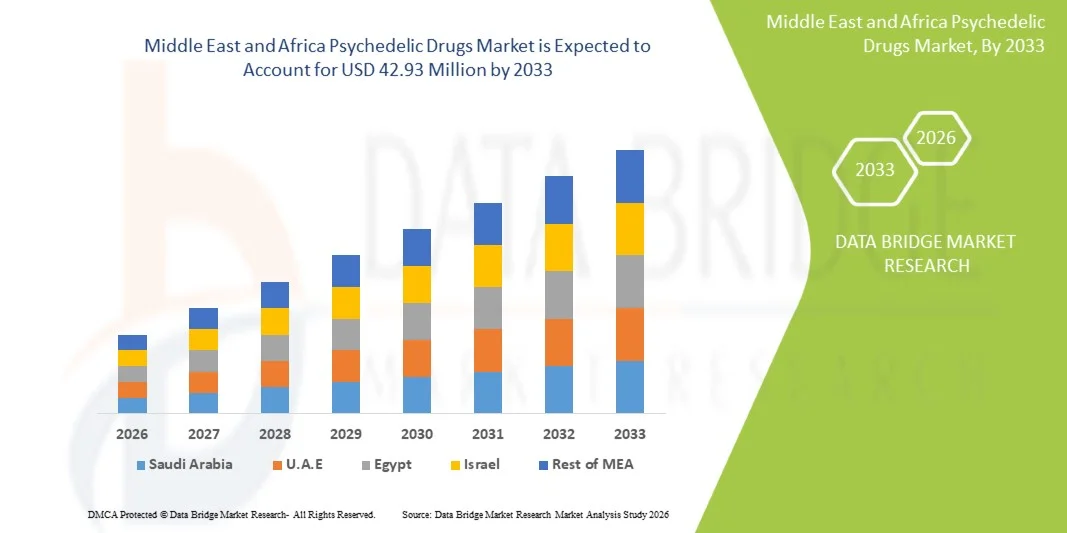
The Middle East and Africa psychedelic drugs market was valued at USD 18.49 million in 2025 and is projected to reach USD 42.93 million by 2033, growing at a CAGR of 11.10% from 2026 to 2033. Market growth is supported by increasing prevalence of mental health disorders, rising clinical research activities, and the growing demand for novel therapeutic approaches for treatment-resistant psychiatric conditions across the region.
The favorable safety profiles associated with psychedelic-assisted therapies, combined with the emphasis on addressing unmet mental health needs and expanding regulatory frameworks, are driving increased adoption among hospitals, specialty clinics, and research institutions. Ongoing technological advancements in drug formulation, including extended-release preparations, intranasal delivery systems, and standardized dosing protocols, are expanding the clinical applicability of psychedelic drugs across hospitals, specialty clinics, and homecare settings. In addition, growing healthcare expenditure in GCC countries and expanding mental health awareness initiatives are creating new opportunities for stakeholders across the forecast period.
Key Market Trends & Insights
- The GCC Countries (Saudi Arabia, Israel, UAE) dominated the Middle East and Africa psychedelic drugs market with the largest revenue share of 62.4% in 2025, supported by advanced healthcare infrastructure, high adoption rates of innovative psychiatric treatments, and significant government investments in mental health modernization.
- Sub-Saharan Africa is expected to be the fastest-growing region at a CAGR of 13.85% from 2026 to 2033, driven by expanding mental health infrastructure, rising awareness of psychiatric disorders, and increasing healthcare expenditure.
- The Synthetic segment led the market with a 68.2% market share in 2025, reflecting its established position as the primary source of psychedelic compounds used in clinical settings across hospitals and specialty clinics.
- The Ketamine segment is anticipated to be the leading drug category, driven by its established regulatory approval status, rapid-onset antidepressant effects, and widespread clinical utilization for treatment-resistant depression.
- The Hospitals segment dominated the end-user category with a 54.3% market share in 2025, supported by high patient volumes, comprehensive psychiatric programs, and the need for supervised psychedelic-assisted therapy protocols.
- The Online Pharmacy segment is expected to witness strong growth during the forecast period, driven by expanding digital health platforms, increasing patient preference for convenient medication access, and regulatory modernization enabling controlled substance distribution.
Market Size & Forecast
- Regional Market Value (2025): USD 18.49 Million
- Expected Market Value (2033): USD 42.93 Million
- Forecast CAGR (2026–2033): 11.10%
Report Scope and Middle East and Africa Psychedelic Drugs Market Segmentation
|
Attributes |
Middle East and Africa Psychedelic Drugs Key Market Insights |
|
Segments Covered |
|
|
Countries Covered |
Middle East and Africa · Saudi Arabia · U.A.E. · South Africa · Egypt · Israel · Rest of Middle East and Africa |
|
Key Market Players |
|
|
Market Opportunities |
· Expansion of mental health infrastructure in emerging African markets with growing psychiatric treatment volumes and regulatory modernization · Development of novel psychedelic formulations enabling adoption in controlled clinical settings and supervised therapeutic programs |
|
Value Added Data Infosets |
In addition to the insights on market scenarios such as market value, growth rate, segmentation, geographical coverage, and major players, the market reports curated by the Data Bridge Market Research also include depth expert analysis, patient epidemiology, pipeline analysis, pricing analysis, and regulatory framework. |
Middle East and Africa Psychedelic Drugs Market Trends
Trend: Integration of Psychedelic-Assisted Therapy Protocols in Mental Health Treatment Programs
Clinical adoption of psychedelic drugs continues to accelerate as therapeutic innovations improve treatment outcomes for psychiatric disorders. Psychedelic-assisted therapy protocols combining pharmacological intervention with structured psychotherapy are gaining significant traction across healthcare facilities in the Middle East and Africa. These integrated approaches enhance therapeutic efficacy, reduce treatment duration, and improve long-term remission rates for treatment-resistant conditions. In addition, standardized dosing protocols incorporating controlled substance monitoring, patient screening, and follow-up assessments are emerging as key differentiators in the regional market.
For instance,
The adoption of ketamine-assisted therapy protocols in psychiatric units across GCC hospitals has demonstrated significant improvements in treatment-resistant depression outcomes, supporting broader clinical adoption of psychedelic-based interventions.
In addition, research demonstrates that psychedelic-assisted therapy combined with cognitive behavioral therapy improves patient outcomes and reduces relapse rates in major depressive disorder and post-traumatic stress disorder. The integration of digital monitoring tools, including telehealth platforms and remote patient monitoring systems, aligns with growing emphasis on accessible mental health care and regulatory requirements in the region, further supporting the transition toward comprehensive psychedelic therapy solutions.
The growing adoption of integrated psychedelic-assisted therapy protocols is expected to strengthen market growth and expand clinical utilization across Middle East and Africa healthcare systems.
Middle East and Africa Psychedelic Drugs Market Dynamics
Key Market Driver: Rising Prevalence of Treatment-Resistant Mental Health Disorders
The growing prevalence of treatment-resistant psychiatric conditions is a primary driver of market growth. Psychedelic drugs provide essential therapeutic alternatives for patients who have not responded to conventional antidepressants, anxiolytics, and psychotherapy. The increasing burden of depression, anxiety disorders, post-traumatic stress disorder, and substance use disorders are expanding the demand for novel pharmacological interventions across the region.
For instance,
A 2025 regional mental health assessment indicated that healthcare facilities implementing psychedelic-assisted therapy programs experienced measurable improvements in treatment-resistant depression outcomes, demonstrating the clinical value of standardized psychedelic intervention protocols.
Rising demand for effective treatments for refractory psychiatric conditions is expected to strengthen adoption of psychedelic drug technologies across Middle East and Africa healthcare systems.
Key Restraint/Challenge: Regulatory Restrictions and Social Stigma Associated with Psychedelic Substances
The substantial regulatory barriers associated with controlled substance classification and the social stigma surrounding psychedelic drug use present significant obstacles to market growth, particularly in conservative societies across the Middle East and Africa. Additionally, the limited availability of trained healthcare professionals capable of administering psychedelic-assisted therapy raises implementation concerns. Regulatory uncertainties regarding clinical trial approvals, prescribing guidelines, and distribution protocols further constrain market expansion.
For instance,
Healthcare systems across the Middle East and Africa evaluating psychedelic drug adoption must navigate complex regulatory frameworks and address cultural sensitivities, with controlled substance classifications requiring extensive approval processes compared to conventional psychiatric medications.
Regulatory restrictions and social stigma may constrain adoption, particularly among healthcare providers in conservative regions with limited mental health infrastructure.
Key Market Opportunity: Regulatory Modernization and Expansion of Mental Health Infrastructure
The ongoing modernization of regulatory frameworks across the Middle East and Africa, including accelerated approval pathways for innovative psychiatric treatments, expanded clinical trial authorization, and mental health infrastructure development, is creating significant opportunities for psychedelic drug suppliers. Simultaneously, the increasing emphasis on mental health awareness has created more opportunities for psychedelic-assisted therapy programs. Investments in specialized psychiatric facilities and healthcare professional training programs are enabling market players to address both clinical and accessibility requirements.
For instance,
The Middle East and Africa mental health infrastructure market is projected to witness significant growth through 2033, driven by government mental health modernization initiatives, private sector investments, and expanding patient populations requiring psychiatric care.
The development of regulatory frameworks supporting psychedelic drug research and clinical utilization supports broader market accessibility and aligns with regional mental health goals, creating new growth opportunities for stakeholders.
Middle East and Africa Psychedelic Drugs Market Scope
The Middle East and Africa psychedelic drugs market is segmented on the basis of source, type, drugs, application, route of administration, end user, and distribution channel.
By Source
On the basis of source, the Middle East and Africa psychedelic drugs market is segmented into synthetic and natural. The Synthetic segment dominated the market with a 68.2% market share in 2025, reflecting its established position as the primary source of psychedelic compounds used in clinical settings across hospitals and specialty clinics. The high demand for synthetic psychedelics such as ketamine, MDMA analogs, and LSD derivatives among psychiatric professionals, combined with standardized manufacturing processes, quality control protocols, and regulatory compliance requirements across healthcare institutions, contributes to segment leadership. Strong adoption across GCC hospitals and expanding mental health programs in African markets support continued segment dominance.
The Natural segment is expected to witness steady growth at a CAGR of 12.45% from 2026 to 2033, driven by rising interest in psilocybin-based therapies, ayahuasca research programs, and traditional medicine integration. Increasing clinical trials evaluating natural psychedelic compounds and growing patient preference for plant-based therapeutic alternatives are expanding the natural psychedelics market. Regulatory developments enabling research access to natural compounds further support segment expansion.
By Type
On the basis of type, the Middle East and Africa psychedelic drugs market is segmented into empathogens, dissociatives, and others. The Dissociatives segment dominated the market with a market share of 58.6% in 2025, driven by the established clinical utilization of ketamine and its derivatives for treatment-resistant depression, chronic pain management, and anesthesia applications. Dissociative compounds offer rapid-onset therapeutic effects, well-characterized safety profiles, and existing regulatory approval pathways, contributing to segment leadership across hospital and specialty clinic settings.
The Empathogens segment is expected to witness the fastest growth at a CAGR of 13.20% from 2026 to 2033, supported by expanding clinical research into MDMA-assisted therapy for post-traumatic stress disorder and anxiety disorders. The promising results from late-stage clinical trials and growing regulatory acceptance of empathogen-based therapies are driving segment expansion. Academic research institutions and specialty psychiatric clinics are increasingly adopting empathogen protocols for therapeutic applications.
By Drugs
On the basis of drugs, the Middle East and Africa psychedelic drugs market is segmented into gamma-hydroxybutyric acid, ketamine, psilocybin, and others. The Ketamine segment dominated the market with a market share of 52.8% in 2025, supported by its established regulatory approval status, rapid-onset antidepressant effects, and widespread clinical utilization across psychiatric and pain management settings. Ketamine serves as a primary intervention for treatment-resistant depression, with intranasal and intravenous formulations enabling flexible administration protocols. The concentration of psychiatric professionals, multidisciplinary care teams, and standardized treatment protocols within hospital systems contributes to high segment volumes and drug utilization.
The Psilocybin segment is expected to witness the fastest growth at a CAGR of 14.85% from 2026 to 2033, driven by the expansion of clinical trials, breakthrough therapy designations, and increasing regulatory acceptance of psilocybin-assisted therapy. The development of psilocybin research programs across academic medical centers and specialty psychiatric facilities is enabling broader access to psilocybin-based treatments, supporting segment expansion.
By Application
On the basis of application, the Middle East and Africa psychedelic drugs market is segmented into narcolepsy, treatment resistant depression, major depressive disorder, opiate addiction, post-traumatic stress disorder, and others. The Treatment Resistant Depression segment dominated the market with a market share of 38.5% in 2025, reflecting the significant unmet medical need for effective interventions in patients who have not responded to conventional antidepressant therapies. The high clinical demand for ketamine infusions, esketamine nasal spray, and emerging psilocybin protocols among psychiatric professionals, combined with evidence-based treatment guidelines and structured therapy protocols across healthcare institutions, contributes to segment leadership.
The Post-Traumatic Stress Disorder segment is expected to witness the fastest growth at a CAGR of 14.20% from 2026 to 2033, driven by expanding MDMA-assisted therapy research, growing veteran and trauma survivor populations, and increasing regulatory support for psychedelic interventions.
By Route of Administration
On the basis of route of administration, the Middle East and Africa psychedelic drugs market is segmented into oral, inhalation, and injectable. The Oral segment dominated the market with a market share of 45.2% in 2025, driven by patient preference for non-invasive administration, established dosing protocols, and the availability of oral formulations for psilocybin, gamma-hydroxybutyric acid, and emerging psychedelic compounds. Oral administration offers convenient self-administration capabilities, extended-release formulations, and reduced healthcare facility dependency, contributing to segment leadership across hospital, specialty clinic, and homecare settings.
The Injectable segment held a market share of 38.6% in 2025, supported by the widespread utilization of intravenous ketamine infusions and intramuscular formulations in hospital and specialty clinic environments. Injectable administration enables precise dosing control, rapid therapeutic onset, and supervised administration protocols, contributing to strong segment performance.
The Inhalation segment accounted for 16.2% market share in 2025 and is expected to witness the fastest growth at a CAGR of 15.40% from 2026 to 2033, driven by the increasing adoption of intranasal esketamine formulations and emerging inhalation-based psychedelic delivery systems. The development of nebulized and nasal spray formulations is enabling broader access to psychedelic therapies with improved bioavailability and patient convenience.
By End User
On the basis of end user, the Middle East and Africa psychedelic drugs market is segmented into hospitals, specialty clinics, homecare, and others. The Hospitals segment dominated the market with a market share of 54.3% in 2025, supported by high patient volumes, comprehensive psychiatric programs, and the need for supervised psychedelic-assisted therapy protocols. Hospitals serve as primary centers for complex psychiatric interventions requiring extensive monitoring, medical oversight, and multidisciplinary care team coordination. The concentration of psychiatric professionals, emergency response capabilities, and structured therapy programs within hospital systems contributes to high segment volumes and drug utilization.
The Specialty Clinics segment is expected to witness the fastest growth at a CAGR of 13.65% from 2026 to 2033, driven by the expansion of dedicated psychedelic therapy centers, ketamine clinics, and psychiatric specialty practices across GCC countries and urban African markets. Specialty clinics offer focused expertise, streamlined treatment protocols, and personalized therapeutic approaches for psychedelic-assisted therapy.
By Distribution Channel
On the basis of distribution channel, the Middle East and Africa psychedelic drugs market is segmented into hospitals pharmacy, retail pharmacy, and online pharmacy. The Hospitals Pharmacy segment dominated the market with a market share of 58.8% in 2025, driven by institutional procurement programs, controlled substance management protocols, and comprehensive medication dispensing capabilities within hospital systems. Hospital pharmacies provide healthcare facilities with direct access to psychedelic drugs, secure storage facilities, and regulatory compliance support, enabling efficient medication distribution across psychiatric and pain management departments.
The Online Pharmacy segment is expected to witness the fastest growth at a CAGR of 16.20% from 2026 to 2033, driven by expanding digital health platforms, increasing patient preference for convenient medication access, and regulatory modernization enabling controlled substance distribution through verified online pharmacy networks. The development of telehealth-integrated prescription services and secure online ordering platforms is enabling broader access to psychedelic medications.
Middle East and Africa Psychedelic Drugs Market Regional Analysis
The GCC Countries dominated the Middle East and Africa psychedelic drugs market with a revenue share of 62.4% in 2025, supported by advanced healthcare infrastructure, high adoption rates of innovative psychiatric treatments, and significant government investments in mental health modernization. Favorable regulatory environments, comprehensive healthcare coverage programs, and expanding private hospital networks contribute to regional market leadership.
Israel Psychedelic Drugs Market Insight
The Israel psychedelic drugs market held the largest country-level market share of 28.6% in 2025, benefiting from substantial mental health research infrastructure, leading academic medical centers, and progressive regulatory frameworks supporting psychedelic research. Academic institutions, biotechnology companies, and government research programs continue to expand psychedelic drug development across therapeutic indications. Favorable research funding, clinical trial authorization processes, and regulatory emphasis on innovative psychiatric treatments support procurement volumes and technology adoption.
UAE Psychedelic Drugs Market Insight
The UAE psychedelic drugs market remains a significant contributor, with strong hospital-based psychiatric programs across Dubai, Abu Dhabi, and other emirates. Growing adoption of ketamine-based therapies is providing healthcare facilities with advanced treatment options, expanding access to psychedelic interventions in public and private healthcare systems. The introduction of Federal Decree-Law No. 38/2024 establishing accelerated approval pathways for innovative drugs has improved regulatory accessibility and standardization across therapeutic categories.
Middle East and Africa Psychedelic Drugs Market Share
The Middle East and Africa psychedelic drugs industry is primarily led by well-established companies, including:
- Johnson & Johnson and its affiliates (U.S.)
- Jazz Pharmaceuticals (Ireland)
- COMPASS Pathways (U.K.)
- MindMed Inc. (U.S.)
- Cybin Inc. (Canada)
- Atai Life Sciences (Germany)
- GH Research PLC (Ireland)
- Seelos Therapeutics (U.S.)
- Beckley Psytech (U.K.)
- Hikma Pharmaceuticals PLC (U.K.)
- Janssen Pharmaceuticals, Inc. (Belgium)
- Pfizer Inc. (U.S.)
- Fresenius Kabi (Germany)
- B. Braun Medical (Germany)
- Teva Pharmaceutical Industries (Israel)
Latest Developments in Middle East and Africa Psychedelic Drugs Market
- In April 2025, MindMed Inc. announced that the first patient had been dosed in its Phase III Emerge study of MM120 ODT, a proprietary orally disintegrating tablet formulation of lysergide D-tartrate being evaluated for major depressive disorder, building on positive Phase 2b results in generalized anxiety disorder that showed rapid and sustained anxiolytic and antidepressant-like effects.
- In March 2025, Beckley Psytech announced a strategic partnership with a Middle East-based pharmaceutical company to advance its 5-MeO-DMT candidate for mental health disorder treatment across GCC markets. The collaboration supports Beckley's strategy to expand market access and provide healthcare facilities with novel psychedelic therapeutic options.
- In January 2025, Janssen Pharmaceuticals, Inc. expanded its esketamine (Spravato) distribution network across the Middle East, establishing new partnerships with regional healthcare distributors in Saudi Arabia and the UAE. The expansion supports Janssen's strategy to increase market penetration and provide psychiatric facilities with comprehensive ketamine-based treatment solutions.
- In November 2024, COMPASS Pathways announced positive results from its Phase IIb clinical trial evaluating COMP360 psilocybin therapy for treatment-resistant depression, demonstrating significant improvements in depression severity scores compared to placebo. The data supports continued regulatory engagement and potential market authorization applications.
- In September 2024, Cybin Inc. announced the expansion of its clinical trial program to include sites in Israel, leveraging the country's advanced research infrastructure and regulatory framework for psychedelic drug development. The expansion supports Cybin's global development strategy for its proprietary psilocybin formulations.
- In July 2024, Atai Life Sciences announced a strategic investment in a South African mental health company to expand access to ketamine-assisted therapy across Sub-Saharan Africa. The partnership aims to establish treatment centers and training programs for healthcare professionals.

- Interactive Data Analysis Dashboard
- Company Analysis Dashboard for high growth potential opportunities
- Research Analyst Access for customization & queries
- Competitor Analysis with Interactive dashboard
- Latest News, Updates & Trend analysis
- Harness the Power of Benchmark Analysis for Comprehensive Competitor Tracking
Data collection and base year analysis are done using data collection modules with large sample sizes. The stage includes obtaining market information or related data through various sources and strategies. It includes examining and planning all the data acquired from the past in advance. It likewise envelops the examination of information inconsistencies seen across different information sources. The market data is analysed and estimated using market statistical and coherent models. Also, market share analysis and key trend analysis are the major success factors in the market report. To know more, please request an analyst call or drop down your inquiry.
The key research methodology used by DBMR research team is data triangulation which involves data mining, analysis of the impact of data variables on the market and primary (industry expert) validation. Data models include Vendor Positioning Grid, Market Time Line Analysis, Market Overview and Guide, Company Positioning Grid, Patent Analysis, Pricing Analysis, Company Market Share Analysis, Standards of Measurement, Global versus Regional and Vendor Share Analysis. To know more about the research methodology, drop in an inquiry to speak to our industry experts.
Data Bridge Market Research is a leader in advanced formative research. We take pride in servicing our existing and new customers with data and analysis that match and suits their goal. The report can be customized to include price trend analysis of target brands understanding the market for additional countries (ask for the list of countries), clinical trial results data, literature review, refurbished market and product base analysis. Market analysis of target competitors can be analyzed from technology-based analysis to market portfolio strategies. We can add as many competitors that you require data about in the format and data style you are looking for. Our team of analysts can also provide you data in crude raw excel files pivot tables (Fact book) or can assist you in creating presentations from the data sets available in the report.












