


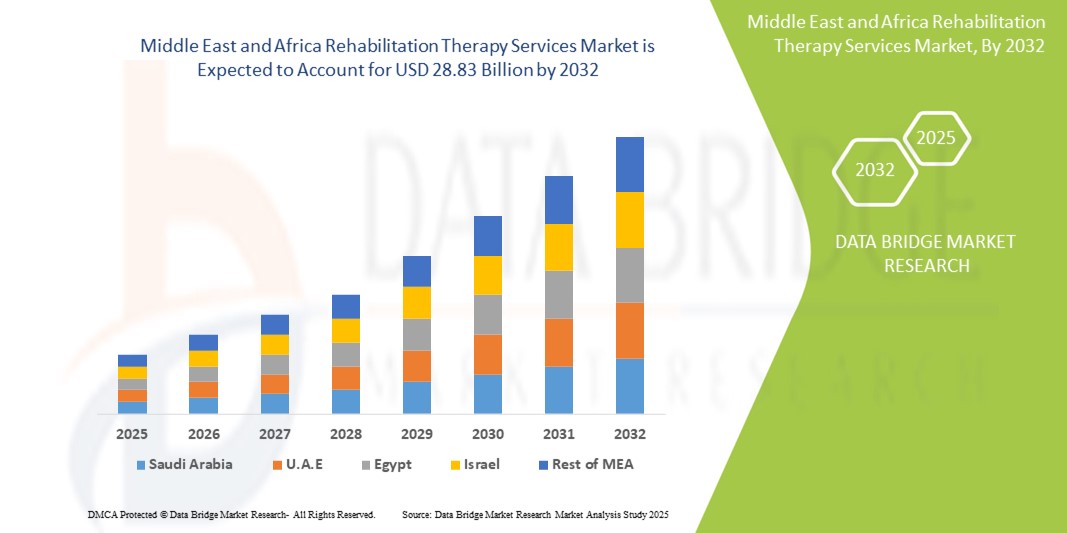
Middle East and Africa Rehabilitation Therapy Services Market Size
- The Middle East and Africa rehabilitation therapy services market size was valued at USD 10.47 billion in 2024 and is expected to reach USD 28.83 billion by 2032, at a CAGR of 13.50% during the forecast period
- The market growth is largely fueled by the rising prevalence of chronic diseases, increasing geriatric population, and expansion of healthcare infrastructure across the region, leading to higher demand for rehabilitation services in both residential and clinical settings
- Furthermore, growing awareness about the benefits of rehabilitation therapy, adoption of tele-rehabilitation, and technological integration in service delivery are establishing rehabilitation therapy as an essential component of healthcare. These converging factors are accelerating the uptake of rehabilitation services, thereby significantly boosting the industry's growth
Middle East and Africa Rehabilitation Therapy Services Market Analysis
- Rehabilitation therapy services, encompassing physiotherapy, occupational therapy, speech therapy, respiratory therapy, and cognitive behavioral therapy, are increasingly vital components of healthcare delivery in both hospital and home-care settings due to their role in improving patient outcomes, restoring functional independence, and enhancing quality of life
- The escalating demand for rehabilitation therapy services is primarily fueled by the rising prevalence of chronic diseases, increasing geriatric population, and growing awareness about the benefits of rehabilitation, alongside expanding healthcare infrastructure and adoption of tele-rehabilitation solutions
- Saudi Arabia dominated the MEA rehabilitation therapy services market with the largest revenue share in 2024, characterized by advanced healthcare facilities, government initiatives promoting rehabilitation care, and growing private sector investments, with hospitals and rehabilitation centers experiencing substantial growth
- South Africa is expected to be the fastest-growing country in the MEA rehabilitation therapy services market during the forecast period due to increasing healthcare spending, urbanization, and establishment of specialized rehabilitation centers providing orthopedic, neurological, and cardiological therapy
- Outpatient rehabilitation services segment dominated the market with a market share of 62.8% in 2024, reflecting a strong preference among patients and healthcare providers for treatment options that offer greater flexibility and cost efficiency
Report Scope and Middle East and Africa Rehabilitation Therapy Services Market Segmentation
|
Attributes |
Middle East and Africa Rehabilitation Therapy Services Key Market Insights |
|
Segments Covered |
|
|
Countries Covered |
Middle East and Africa
|
|
Key Market Players |
|
|
Market Opportunities |
|
|
Value Added Data Infosets |
In addition to the insights on market scenarios such as market value, growth rate, segmentation, geographical coverage, and major players, the market reports curated by the Data Bridge Market Research also include in-depth expert analysis, pricing analysis, brand share analysis, consumer survey, demography analysis, supply chain analysis, value chain analysis, raw material/consumables overview, vendor selection criteria, PESTLE Analysis, Porter Analysis, and regulatory framework. |
Middle East and Africa Rehabilitation Therapy Services Market Trends
Growing Integration of Tele-Rehabilitation and Digital Health Solutions
- A significant and accelerating trend in the MEA rehabilitation therapy services market is the increasing integration of tele-rehabilitation platforms, mobile health apps, and remote monitoring technologies, enhancing patient access and therapy adherence
- For Instance, The eRehab platform in Saudi Arabia enables patients to continue physiotherapy exercises at home while therapists monitor progress remotely, ensuring treatment continuity
- Digital health integration allows therapists to track patient activity, adjust treatment plans in real time, and offer virtual consultations, improving therapy outcomes and operational efficiency
- These technologies facilitate centralized management of patient records, exercise schedules, and remote assessments through a single digital interface, enabling more coordinated care across hospitals, outpatient centers, and home health services
- This trend toward more accessible, technology-driven, and patient-centric rehabilitation is reshaping expectations for therapy delivery, with companies such as PhysioTech developing AI-enabled platforms that provide automated reminders, progress tracking, and virtual guidance
- The demand for tele-rehabilitation and digital health integration is growing rapidly across both urban and rural areas, as patients and providers increasingly prioritize convenience, accessibility, and continuity of care
Middle East and Africa Rehabilitation Therapy Services Market Dynamics
Driver
Rising Demand Due to Aging Population and Chronic Disease Prevalence
- The increasing prevalence of chronic diseases and the growing geriatric population are significant drivers for heightened demand for rehabilitation therapy services in MEA
- For Instance, In 2024, Saudi Arabia launched expanded rehabilitation programs in major hospitals to address post-stroke and post-orthopedic surgery recovery, increasing therapy uptake
- Patients require consistent physiotherapy, occupational therapy, and speech therapy to restore functional independence and improve quality of life, boosting demand across inpatient and outpatient services
- Healthcare infrastructure expansion, government initiatives promoting rehabilitation, and private sector investment are strengthening service availability and capacity in both urban and semi-urban areas
- Rising awareness among patients, caregivers, and healthcare providers about rehabilitation benefits is encouraging earlier intervention, leading to increased service adoption across hospitals, skilled nursing facilities, and home health services
- The availability of technology-enabled therapy options, such as virtual consultations and tele-rehabilitation, further supports growth by improving access and adherence to treatment plans
Restraint/Challenge
Limited Accessibility and High Costs in Certain Areas
- Accessibility challenges and the high cost of rehabilitation services in some MEA countries pose a significant barrier to broader market penetration
- For Instance, Rural areas in Egypt and some Sub-Saharan regions have limited rehabilitation centers and qualified therapists, restricting patient access to consistent therapy
- High costs for specialized services, advanced equipment, and technology-enabled platforms can make rehabilitation unaffordable for price-sensitive patients, particularly in lower-income areas
- Workforce shortages and uneven distribution of trained therapists across countries create disparities in service availability and quality, affecting treatment outcomes
- While initiatives are underway to expand access and subsidize costs, patients in underserved regions may still face challenges obtaining timely care, limiting market growth
- Overcoming these challenges through infrastructure development, subsidized therapy programs, training of healthcare professionals, and affordable digital rehabilitation solutions will be vital for sustained market growth
Middle East and Africa Rehabilitation Therapy Services Market Scope
The market is segmented on the basis of service, age group, service type, application, service category, model, end user, and service channel.
- By Service
On the basis of service, the MEA rehabilitation therapy services market is segmented into rehabilitation therapy services, speech therapy, occupational therapy, respiratory therapy, cognitive behavioral therapy, and others. Rehabilitation Therapy Services dominated the market with the largest market revenue share of 37.36% in 2024, driven by high demand for musculoskeletal, post-operative, and neurological rehabilitation. Hospitals, outpatient centers, and home health services often prioritize comprehensive rehabilitation programs that integrate physiotherapy, occupational therapy, and speech therapy for patient recovery. The segment benefits from government initiatives promoting rehabilitation care and increased patient awareness about the benefits of early therapy. Technological integration, including tele-rehabilitation and remote monitoring, further enhances service delivery and patient adherence. Moreover, the rising prevalence of chronic diseases and the aging population are fueling consistent demand. Providers offering bundled rehabilitation services are also seeing strong adoption due to cost-effectiveness and improved treatment outcomes.
Speech Therapy is anticipated to witness the fastest growth rate during 2025–2032, driven by increasing recognition of its importance for pediatric and adult patients recovering from neurological conditions, strokes, and developmental disorders. Rising awareness among parents and caregivers about early intervention for speech disorders is fueling adoption. Hospitals and specialized centers are expanding speech therapy programs due to growing demand for tailored rehabilitation solutions. Tele-speech therapy is emerging as a convenient solution, particularly in urban and semi-urban areas. The segment is supported by advances in digital therapy tools and mobile applications that enhance engagement and treatment effectiveness. Increasing collaborations with schools and rehabilitation centers further contribute to its growth trajectory.
- By Age Group
On the basis of age group, the rehabilitation therapy services market is segmented into elderly, pediatric, and adults. Adults dominated the market with the largest share in 2024, accounting for 58.2% of the market, due to high incidence of chronic diseases, orthopedic surgeries, and post-accident rehabilitation. Adults frequently require physiotherapy, occupational therapy, and cardiological rehabilitation to maintain functional independence and return to work. Hospitals and outpatient centers prioritize adult rehabilitation programs due to higher patient volumes and recurring therapy needs. Tele-rehabilitation is increasingly adopted to improve accessibility and continuity of care for working adults. Government healthcare initiatives focusing on adult wellness and disease management further support market dominance. Awareness campaigns on injury prevention and post-operative care enhance adoption.
Pediatric is expected to witness the fastest growth during 2025–2032, driven by rising demand for early intervention programs, speech therapy, and occupational therapy for children with developmental disorders and congenital conditions. Parents and caregivers are increasingly investing in specialized pediatric rehabilitation services. Schools and specialized therapy centers are expanding programs to cater to growing awareness and early diagnosis. Tele-pediatric therapy solutions allow continuity of care, particularly in underserved areas. Integration of gaming and digital tools in pediatric therapy improves engagement and outcomes. Increasing government support for child health initiatives further fuels growth.
- By Service Type
On the basis of service type, the rehabilitation therapy services market is segmented into outpatient rehabilitation services and inpatient rehabilitation services. Outpatient Rehabilitation Services dominated the market with a share of 62.8% in 2024, driven by patient preference for flexible, cost-effective care and the convenience of attending sessions without hospitalization. Outpatient services often include physiotherapy, speech therapy, and post-operative rehabilitation, making them widely applicable across musculoskeletal, neurological, and cardiological conditions. The segment benefits from increasing adoption of tele-rehabilitation and home-based services, enhancing patient adherence. Hospitals and private rehabilitation centers are expanding outpatient facilities to accommodate growing patient volumes. Insurance coverage for outpatient therapy further incentivizes adoption. In addition, urbanization and rising healthcare awareness are supporting consistent demand.
Inpatient Rehabilitation Services are expected to witness the fastest growth during 2025–2032, driven by the need for intensive, multidisciplinary care for severe neurological, orthopedic, and cardiopulmonary conditions. Patients requiring constant monitoring and specialized therapy prefer inpatient care. Hospitals are investing in dedicated rehabilitation wards and advanced equipment to support this segment. The segment growth is supported by rising post-surgery patient volumes and chronic disease management programs. Partnerships with international rehabilitation networks enhance service quality. Tele-monitoring integration allows partial remote follow-up, improving patient outcomes. Government programs for high-acuity rehabilitation also contribute to expansion.
- By Application
On the basis of application, the rehabilitation therapy services market is segmented into orthopedic rehabilitation therapy services, neurological rehabilitation therapy services, cardiological rehabilitation therapy services, pulmonary rehabilitation therapy services, sports-related injuries, palliative care, integumentary rehabilitation therapy services, pelvic care, and others. Orthopedic Rehabilitation Therapy Services dominated the market in 2024 due to high demand for post-surgery recovery, fracture management, and musculoskeletal care. Hospitals, outpatient clinics, and home-based providers offer targeted therapy programs to restore mobility and strength. The segment benefits from rising orthopedic procedures and an aging population prone to joint disorders. Tele-rehabilitation tools help patients continue exercises at home under professional guidance. Insurance coverage for orthopedic rehabilitation encourages patient adoption. Providers offering comprehensive programs, including physiotherapy and occupational therapy, see strong uptake. Government health initiatives targeting mobility improvement further support market dominance.
Neurological Rehabilitation Therapy Services are expected to witness the fastest growth from 2025–2032, driven by increasing prevalence of stroke, spinal cord injuries, and neurodegenerative diseases. Hospitals and rehabilitation centers are expanding neuro-rehab units equipped with advanced equipment and technology-assisted therapy. Tele-neurological rehabilitation improves accessibility for patients in remote areas. Integration of AI-based therapy devices enhances treatment outcomes and monitoring. Awareness campaigns on early intervention and post-stroke recovery support adoption. Public-private collaborations for neuro-rehab infrastructure are increasing in MEA countries such as Saudi Arabia and UAE.
- By Service Category
On the basis of service category, the rehabilitation therapy services market is segmented into hospital services, physician services, industrial services, and employer services. Hospital Services dominated the market in 2024, offering comprehensive rehabilitation programs, access to multidisciplinary teams, and integration with medical treatments. Hospitals serve as the primary hubs for inpatient and outpatient care, covering orthopedic, neurological, and cardiological rehabilitation. Investment in advanced therapy equipment and trained professionals drives hospital service adoption. Tele-rehabilitation integration improves patient monitoring and adherence. Partnerships with insurance providers enhance affordability and uptake. Government support for hospital-based rehabilitation infrastructure strengthens market dominance.
Physician Services are expected to witness the fastest growth during 2025–2032, driven by the rising demand for specialized physician-led rehabilitation programs, post-surgical follow-ups, and personalized therapy plans. Physicians are increasingly incorporating therapy recommendations into treatment protocols. Adoption of digital monitoring and tele-consultations facilitates ongoing patient management. Increased awareness about preventive and post-operative care drives service demand. Collaboration with outpatient centers and home health agencies expands reach. Physician services benefit from integration with chronic disease management programs and early intervention initiatives.
- By Model
On the basis of model, the rehabilitation therapy services market is segmented into manual and conventional models. Manual Model dominated the market in 2024 due to established use in traditional physiotherapy and occupational therapy practices where hands-on care is essential. Therapists rely on manual techniques for patient assessment, exercise execution, and rehabilitation outcomes. Hospitals and outpatient centers widely adopt manual therapy for musculoskeletal and post-operative patients. Manual therapy is cost-effective and requires minimal technological investment. Patient trust in hands-on care contributes to market dominance. Integration with conventional and digital techniques improves effectiveness and adherence.
Conventional Model is expected to witness the fastest growth during 2025–2032, driven by adoption of standardized therapy protocols, integration with assistive devices, and inclusion in tele-rehabilitation platforms. Conventional approaches ensure consistency and measurable outcomes across patient populations. Hospitals and private practices are increasingly adopting conventional methods alongside digital tools for enhanced therapy delivery. Growth is supported by regulatory guidelines promoting evidence-based rehabilitation. Digital conventional methods enable remote monitoring and better progress tracking. Training programs for therapists in conventional approaches further enhance adoption.
- By End User
On the basis of end user, the rehabilitation therapy services market is segmented into hospitals, skilled nursing facilities, home health, private practices, sports and fitness facility centers, rehabilitation centers, and others. Hospitals dominated the market in 2024, driven by the availability of multidisciplinary teams, advanced equipment, and access to inpatient and outpatient rehabilitation services. Hospitals serve as primary care centers for orthopedic, neurological, and cardiological rehabilitation. Integration of tele-rehabilitation and remote monitoring enhances patient adherence. Insurance coverage for hospital-based therapy encourages utilization. Hospitals also collaborate with home health and private centers for extended care. Investment in dedicated rehabilitation wards supports market dominance.
Home Health is expected to witness the fastest growth from 2025–2032, driven by increasing preference for convenient, patient-centric care delivered at home. Tele-rehabilitation, mobile health apps, and virtual therapy sessions are expanding access. Aging populations and post-operative patients benefit from in-home services. Private practices and hospital networks are partnering to offer home-based rehabilitation. Cost savings and personalized care enhance adoption. Government support for home health services further fuels growth in MEA.
- By Service Channel
On the basis of service channel, the rehabilitation therapy services market is segmented into direct channel and online channel. Direct Channel dominated the market in 2024, reflecting patient preference for personalized care, face-to-face consultations, and hands-on therapy. Hospitals, outpatient centers, and rehabilitation clinics primarily deliver services through direct interaction. Integration with in-person therapy ensures proper exercise execution and monitoring. Strong patient-therapist relationships contribute to adherence and outcomes. Direct channel services are supported by insurance and government health programs. Convenience and trust in direct delivery maintain dominance.
Online Channel is expected to witness the fastest growth during 2025–2032, driven by rising adoption of tele-rehabilitation platforms, mobile applications, and virtual therapy sessions. Online delivery expands access to remote and underserved populations. Integration with wearable devices and AI-based monitoring tools enhances effectiveness. Online channels offer cost-effective and flexible rehabilitation options. Awareness campaigns and government incentives support adoption. Technology-enabled remote therapy is increasingly accepted by patients and providers, fueling rapid growth.
Middle East and Africa Rehabilitation Therapy Services Market Regional Analysis
- Saudi Arabia dominated the MEA rehabilitation therapy services market with the largest revenue share in 2024, characterized by advanced healthcare facilities, government initiatives promoting rehabilitation care, and growing private sector investments, with hospitals and rehabilitation centers experiencing substantial growth
- Patients in the region highly value the accessibility, specialized programs, and multidisciplinary care offered by rehabilitation centers and hospitals, including physiotherapy, occupational therapy, speech therapy, and cardiological rehabilitation services
- This widespread adoption is further supported by high healthcare spending, increasing urbanization, and the establishment of technologically advanced therapy centers, establishing rehabilitation services as a preferred solution for both hospital-based and home-based care across the country
The Saudi Arabia Rehabilitation Therapy Services Market Insight
The Saudi Arabia rehabilitation therapy services market captured the largest revenue share in the MEA region in 2024, driven by growing healthcare infrastructure investments, government initiatives promoting rehabilitation care, and increasing patient awareness of post-operative and chronic disease recovery. Patients are increasingly prioritizing access to specialized services, including physiotherapy, occupational therapy, and speech therapy, for improved functional independence. The rising trend of hospital-based and outpatient rehabilitation programs, combined with tele-rehabilitation adoption, further supports market growth. Moreover, Saudi Arabia’s focus on digital health integration and modern therapy centers is significantly contributing to the market’s expansion.
South Africa Rehabilitation Therapy Services Market Insight
The South Africa rehabilitation therapy services market is expected to grow at a substantial CAGR during the forecast period, fueled by the rising prevalence of chronic diseases, growing geriatric population, and expansion of specialized rehabilitation centers. Increased awareness of rehabilitation benefits among adults and elderly patients is fostering service adoption. Tele-rehabilitation platforms are enabling patients in remote or underserved areas to access therapy conveniently. Partnerships between hospitals, private clinics, and insurance providers are further accelerating market growth. The region is witnessing significant uptake across orthopedic, neurological, and cardiological rehabilitation applications.
UAE Rehabilitation Therapy Services Market Insight
The UAE rehabilitation therapy services market is anticipated to grow at a noteworthy CAGR during the forecast period, driven by rapid urbanization, technological advancements in healthcare, and rising demand for comprehensive outpatient and home-based rehabilitation services. Government support for healthcare infrastructure, along with high per capita healthcare expenditure, encourages investment in rehabilitation centers. Patients increasingly seek integrated solutions covering physiotherapy, speech therapy, and cognitive behavioral therapy. The country’s focus on quality healthcare and accessibility is expected to continue stimulating market expansion.
Nigeria Rehabilitation Therapy Services Market Insight
The Nigeria rehabilitation therapy services market is poised to grow at the fastest CAGR during the forecast period, driven by growing healthcare investments, rising prevalence of chronic and lifestyle-related diseases, and increasing awareness about rehabilitation among patients. Urbanization and expanding healthcare infrastructure are enabling wider access to therapy services. Adoption of tele-rehabilitation platforms and mobile health solutions is improving patient engagement and adherence. Partnerships between hospitals, private clinics, and insurance providers support growth. The need for post-operative care and management of orthopedic and neurological conditions is accelerating demand.
Middle East and Africa Rehabilitation Therapy Services Market Share
The Middle East and Africa rehabilitation therapy services industry is primarily led by well-established companies, including:
- Amana Healthcare (UAE)
- IRG (UAE)
- Rehabilitation International, Inc. (U.S.)
- Moodist Hastanesi (Turkey)
- PhysioHome (UAE)
- ORTHOMERICA PRODUCTS, INC. (U.S.)
- Stantec (Canada)
- Bumrungrad International Hospital (Thailand)
- Raffles Medical Group (Singapore)
- Apollo Hospitals (India)
- Gleneagles Hospital (Singapore)
- Shanghai United Family Hospital (China)
- Kindred Healthcare (U.S.)
- Athletico Physical Therapy (U.S.)
- Hong Kong Sanatorium & Hospital (Hong Kong)
- National Rehabilitation Center (Japan)
- Bangkok Hospital (Thailand)
- Columbia Asia (Malaysia)
What are the Recent Developments in Middle East and Africa Rehabilitation Therapy Services Market?
- In May 2025, the Ministry of Health inaugurated two new state-of-the-art physical rehabilitation outpatient centers in Ramallah and Qabatiya governorates of the West Bank. These centers were established with funding from the Republic of Korea and support from the World Health Organization (WHO) and the United Nations Office for Project Services (UNOPS). The initiative aims to enhance access to rehabilitation services in the region, reflecting a collaborative effort to improve healthcare infrastructure
- In April 2025, researchers introduced a novel robotic rehabilitation platform designed to assist patients with neurological conditions. The platform utilizes a robotic device to facilitate the clinical trail making test, enabling therapists to create custom trails for patients to trace
- In April 2025, reports highlighted the severe challenges faced by disabled veterans in Ethiopia's Tigray region due to the aftermath of war. Many veterans suffer from untreated injuries and lack access to rehabilitation services due to destroyed medical infrastructure. Organizations such as the Mekelle Ortho-Physiotherapy Center are striving to provide care, but resources remain limited
- In May 2024, Nigeria inaugurated its first Invictus Games rehabilitation center in Abuja, marking a significant step in supporting wounded service members through adaptive sports. The center aims to provide rehabilitation and social reintegration for veterans, showcasing Nigeria's commitment to enhancing rehabilitation services for individuals with disabilities
- In February 2024, PhysioHome, a healthtech startup, launched 'Childhood,' a technical solution specialized in the medical and behavioral rehabilitation of children up to the age of 12 years. The product focuses on developing an integrated system for children that combines home and remote services. This service aims to expand the scope of its work in the coming months and years, addressing the specific rehabilitation needs of pediatric patients

- Interactive Data Analysis Dashboard
- Company Analysis Dashboard for high growth potential opportunities
- Research Analyst Access for customization & queries
- Competitor Analysis with Interactive dashboard
- Latest News, Updates & Trend analysis
- Harness the Power of Benchmark Analysis for Comprehensive Competitor Tracking
Data collection and base year analysis are done using data collection modules with large sample sizes. The stage includes obtaining market information or related data through various sources and strategies. It includes examining and planning all the data acquired from the past in advance. It likewise envelops the examination of information inconsistencies seen across different information sources. The market data is analysed and estimated using market statistical and coherent models. Also, market share analysis and key trend analysis are the major success factors in the market report. To know more, please request an analyst call or drop down your inquiry.
The key research methodology used by DBMR research team is data triangulation which involves data mining, analysis of the impact of data variables on the market and primary (industry expert) validation. Data models include Vendor Positioning Grid, Market Time Line Analysis, Market Overview and Guide, Company Positioning Grid, Patent Analysis, Pricing Analysis, Company Market Share Analysis, Standards of Measurement, Global versus Regional and Vendor Share Analysis. To know more about the research methodology, drop in an inquiry to speak to our industry experts.
Data Bridge Market Research is a leader in advanced formative research. We take pride in servicing our existing and new customers with data and analysis that match and suits their goal. The report can be customized to include price trend analysis of target brands understanding the market for additional countries (ask for the list of countries), clinical trial results data, literature review, refurbished market and product base analysis. Market analysis of target competitors can be analyzed from technology-based analysis to market portfolio strategies. We can add as many competitors that you require data about in the format and data style you are looking for. Our team of analysts can also provide you data in crude raw excel files pivot tables (Fact book) or can assist you in creating presentations from the data sets available in the report.













