


What is the Middle East and Africa Small Scale Liquefied Natural Gas (LNG) Market Size and Growth Rate?
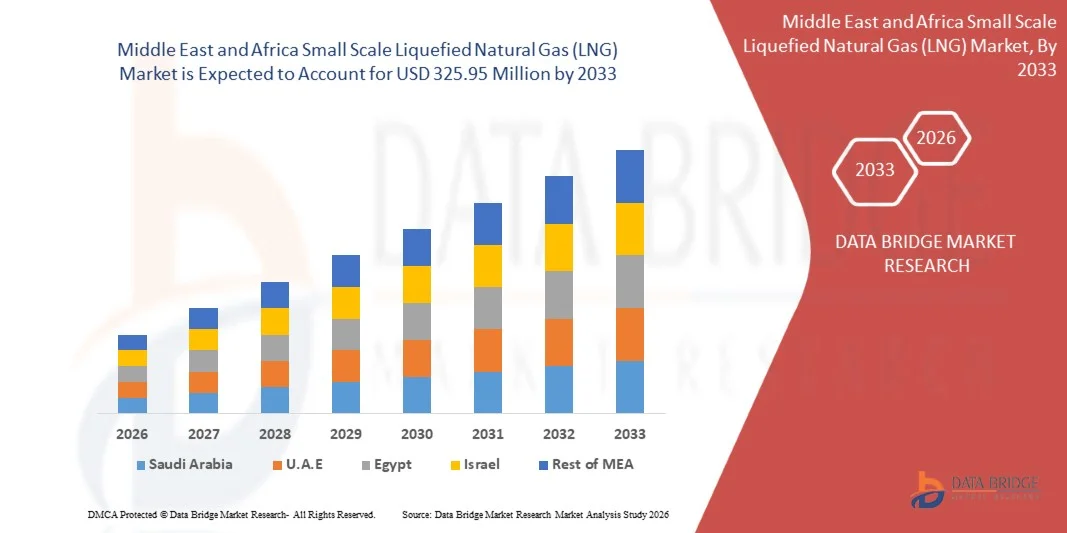
- As per Data Bridge Market Research analysis the Middle East and Africa small scale liquefied natural gas (LNG) market was valued at USD 166.01 million in 2025 and is projected to reach USD 325.95 million by 2033, growing at a CAGR of 8.80% from 2026 to 2033.
- The market is experiencing strong growth driven by increasing demand for cleaner and cost-effective fuel alternatives, rising adoption of LNG in transportation and industrial applications, and expanding small-scale LNG infrastructure across the region.
- Growing efforts to reduce carbon emissions, improve energy access, and diversify fuel supplies are encouraging industries, transportation operators, and energy companies to adopt small-scale LNG solutions.
Market Size & Forecast
- Market Value (2025): USD 166.01 Million
- Expected Market Value (2033): USD 325.95 Million
- Forecast CAGR (2026–2033): 8.80%
- Leading Country in 2025: Saudi Arabia
- Fastest Growing Country: U.A.E.
What are the Major Takeaways of the Middle East and Africa Small Scale Liquefied Natural Gas (LNG) Market?
- Saudi Arabia small scale LNG market is expected to witness significant growth from 2026 to 2033, driven by increasing investments in natural gas infrastructure, industrial expansion, and the country's efforts to diversify its energy mix.
- U.A.E. small scale LNG market is expected to witness strong growth from 2026 to 2033, fueled by expanding LNG infrastructure, increasing marine transportation activity, and rising demand for cleaner fuels.
- The liquefaction terminal segment held the larger market revenue share in 2025, driven by increasing investments in small-scale LNG production facilities and rising demand for flexible LNG supply solutions in remote and off-grid locations. Liquefaction terminals are gaining preference due to their ability to convert natural gas into LNG closer to end-use markets, reducing transportation limitations and supporting decentralized energy distribution.
- The regasification terminal segment is projected to register significant growth from 2026 to 2033, driven by rising demand for LNG import infrastructure, expanding gas distribution networks, and increasing utilization of LNG for industrial and power generation applications. Growing investments in floating and modular regasification solutions are further supporting segment expansion.
- The trucks segment held the largest market revenue share in 2025, driven by its flexibility, lower infrastructure requirements, and suitability for delivering LNG to remote industrial and commercial users. LNG trucking is particularly important in regions where conventional pipeline infrastructure remains limited.
- The shipment and bunkering segment is projected to register the fastest growth from 2026 to 2033, driven by increasing adoption of LNG as a marine fuel and rising investments in LNG bunkering infrastructure. Growing maritime activity and demand for lower-emission marine fuels are accelerating segment expansion.
Report Scope and Middle East and Africa Small Scale Liquefied Natural Gas (LNG) Market Segmentation
|
Attributes |
Middle East and Africa Small Scale Liquefied Natural Gas (LNG) Key Market Insights |
|
Segments Covered |
|
|
Countries Covered |
Middle East and Africa
|
|
Key Market Players |
|
|
Market Opportunities |
|
|
Value Added Data Infosets |
In addition to the insights on market scenarios such as market value, growth rate, segmentation, geographical coverage, and major players, the market reports curated by the Data Bridge Market Research also include import export analysis, production capacity overview, production consumption analysis, price trend analysis, climate change scenario, supply chain analysis, value chain analysis, raw material/consumables overview, vendor selection criteria, PESTLE Analysis, Porter Analysis, and regulatory framework. |
What is the Key Trend in the Middle East and Africa Small Scale Liquefied Natural Gas (LNG) Market?
- The Middle East and Africa LNG market is increasingly focusing on small-scale LNG infrastructure, marine bunkering, and decentralized LNG supply solutions to support cleaner transportation, industrial fuel switching, and energy access.
- For instance, in May 2025, TotalEnergies and OQ Exploration and Production broke ground on the Marsa LNG project in Oman, featuring a 1 million tonnes per year liquefaction plant that is primarily intended to serve the marine fuel market and is expected to become the first marine LNG bunkering hub in the Middle East.
- LNG bunkering and flexible distribution models are gaining importance as shipping operators and industrial users seek lower-emission alternatives to conventional marine and industrial fuels.
- For instance, Shell’s LNG Outlook 2025 reported that LNG bunkering is estimated to reach more than 16 million tonnes by 2030, reflecting increasing adoption of LNG as a marine fuel.
- As Middle Eastern and African energy companies continue investing in LNG liquefaction, bunkering, and distribution infrastructure, the shift toward flexible and lower-carbon LNG supply solutions is expected to strengthen market growth.
What are the Key Drivers of the Middle East and Africa Small Scale Liquefied Natural Gas (LNG) Market?
- Rising demand for cleaner fuels, energy diversification, and reliable gas supplies is increasing investment in LNG production and supporting infrastructure across the Middle East and Africa.
- For instance, in January 2025, ADNOC Gas awarded contracts worth USD 2.1 billion for an LNG pre-conditioning plant, compression facilities, and transmission pipelines supporting the Ruwais LNG project in the UAE, which is expected to more than double ADNOC Gas’ LNG production capacity to over 15 million tonnes per annum.
- Growing LNG demand from transportation, marine applications, industries, and power generation is encouraging energy companies to expand liquefaction and distribution capacity while improving supply flexibility.
- For instance, in June 2025, ADNOC Gas took the final investment decision and awarded USD 5 billion in contracts for the first phase of its Rich Gas Development project, including expansion and efficiency improvements at its Das Island liquefaction facility.
- With increasing investments in LNG infrastructure and the growing need for reliable and lower-emission energy sources, demand for small-scale LNG solutions is expected to expand across transportation, industrial, and remote energy applications.
Which Factors are Challenging the Growth of the Middle East and Africa Small Scale Liquefied Natural Gas (LNG) Market?
- Small-scale LNG projects require significant upfront investment in liquefaction units, storage facilities, specialized transportation, regasification systems, and associated distribution infrastructure.
- These capital-intensive requirements can limit adoption in smaller markets and remote areas where LNG demand volumes may not initially justify the cost of developing dedicated infrastructure.
- For instance, in January 2025, ADNOC Gas announced USD 2.1 billion in contracts for infrastructure required to supply feedstock to the Ruwais LNG project, illustrating the substantial investment required to develop supporting LNG infrastructure at scale.
- In addition, fluctuations in LNG prices, transportation costs, and competition from alternative energy sources can affect project economics and investment decisions across price-sensitive Middle Eastern and African markets.
- The high capital requirements and infrastructure limitations therefore continue to challenge widespread deployment of small-scale LNG solutions, particularly in emerging markets and locations with limited gas distribution networks.
How is the Middle East and Africa Small Scale Liquefied Natural Gas (LNG) Market Segmented?
The market is segmented on the basis of type, mode of supply, storage tank capacity, and application.
- By Type
On the basis of type, the Middle East and Africa small scale liquefied natural gas (LNG) market is segmented into liquefaction terminal and regasification terminal. The liquefaction terminal segment held the larger market revenue share in 2025, driven by increasing investments in small-scale LNG production facilities and rising demand for flexible LNG supply solutions in remote and off-grid locations. Liquefaction terminals are gaining preference due to their ability to convert natural gas into LNG closer to end-use markets, reducing transportation limitations and supporting decentralized energy distribution.
The regasification terminal segment is projected to register significant growth from 2026 to 2033, driven by rising demand for LNG import infrastructure, expanding gas distribution networks, and increasing utilization of LNG for industrial and power generation applications. Growing investments in floating and modular regasification solutions are further supporting segment expansion.
- By Mode of Supply
On the basis of mode of supply, the market is segmented into trucks, shipment and bunkering, rail tanks, pipeline, and others. The trucks segment held the largest market revenue share in 2025, driven by its flexibility, lower infrastructure requirements, and suitability for delivering LNG to remote industrial and commercial users. LNG trucking is particularly important in regions where conventional pipeline infrastructure remains limited.
The shipment and bunkering segment is projected to register the fastest growth from 2026 to 2033, driven by increasing adoption of LNG as a marine fuel and rising investments in LNG bunkering infrastructure. Growing maritime activity and demand for lower-emission marine fuels are accelerating segment expansion.
- By Storage Tank Capacity
On the basis of storage tank capacity, the market is segmented into atmospheric, pressurized, and floating storage (FSU). The atmospheric segment held the largest market revenue share in 2025, driven by its widespread use in LNG storage facilities, industrial applications, and small-scale LNG distribution systems. Atmospheric storage tanks are preferred due to their suitability for large-volume storage, operational reliability, and established infrastructure.
The floating storage (FSU) segment is projected to register significant growth from 2026 to 2033, driven by increasing demand for flexible offshore LNG storage, floating regasification infrastructure, and rapid deployment of LNG facilities in locations with limited onshore infrastructure. Growing investments in floating LNG solutions are supporting segment expansion.
- By Application
On the basis of application, the market is segmented into transportation, heavy-duty vehicles, industrial and power, and others. The industrial and power segment held the largest market revenue share in 2025, driven by rising demand for reliable natural gas supplies, industrial fuel switching, and LNG-based power generation. LNG is increasingly used by industrial facilities and power producers to improve fuel flexibility and reduce dependence on conventional fuels.
The heavy-duty vehicles segment is projected to register significant growth from 2026 to 2033, driven by increasing adoption of LNG-fueled trucks, buses, and other commercial vehicles. Growing efforts to reduce transportation emissions and rising demand for cost-effective alternative fuels are accelerating segment expansion.
Which Region Holds the Largest Share of the Middle East and Africa Small Scale Liquefied Natural Gas (LNG) Market?
- Saudi Arabia small scale LNG market is expected to witness significant growth from 2026 to 2033, driven by increasing investments in natural gas infrastructure, industrial expansion, and the country's efforts to diversify its energy mix.
- The growing demand for LNG in heavy-duty transportation, industrial facilities, and power generation is supporting market development. Moreover, investments in gas processing, distribution networks, and cleaner fuel alternatives are expected to strengthen the adoption of small-scale LNG solutions across the country.
U.A.E. Small Scale Liquefied Natural Gas (LNG) Market Insight
U.A.E. small scale LNG market is expected to witness strong growth from 2026 to 2033, fueled by expanding LNG infrastructure, increasing marine transportation activity, and rising demand for cleaner fuels. The country's strategic position as a global energy and shipping hub is encouraging investments in LNG production, storage, distribution, and bunkering facilities. Furthermore, the growing adoption of LNG for industrial and transportation applications is contributing to market expansion.
Which are the Top Companies in Middle East and Africa Small Scale Liquefied Natural Gas (LNG) Market?
The Middle East and Africa small scale liquefied natural gas (LNG) industry is primarily led by well-established companies, including:
- Abu Dhabi National Oil Company (ADNOC) (U.A.E.)
- QatarEnergy (Qatar)
- Saudi Arabian Oil Company (Saudi Aramco) (Saudi Arabia)
- OQ S.A.O.C. (Oman)
- Oman LNG LLC (Oman)
- Sonatrach S.P.A. (Algeria)
- Sonangol E.P. (Angola)
- Nigerian National Petroleum Company Limited (NNPC Limited) (Nigeria)
- Nigeria LNG Limited (Nigeria)
- Egyptian Natural Gas Holding Company (EGAS) (Egypt)
- Renergen Limited (South Africa)
- Sasol Limited (South Africa)
- Axxela Limited (Nigeria)
- South Atlantic LNG West Africa Limited (Nigeria)
- Highland LNG Limited (Nigeria)

- Interactive Data Analysis Dashboard
- Company Analysis Dashboard for high growth potential opportunities
- Research Analyst Access for customization & queries
- Competitor Analysis with Interactive dashboard
- Latest News, Updates & Trend analysis
- Harness the Power of Benchmark Analysis for Comprehensive Competitor Tracking
Middle East And Africa Small Scale Lng Market, Supply Chain Analysis and Ecosystem Framework
To support market growth and help clients navigate the impact of geopolitical shifts, DBMR has integrated in-depth supply chain analysis into its Middle East And Africa Small Scale Lng Market research reports. This addition empowers clients to respond effectively to global changes affecting their industries. The supply chain analysis section includes detailed insights such as Middle East And Africa Small Scale Lng Market consumption and production by country, price trend analysis, the impact of tariffs and geopolitical developments, and import and export trends by country and HSN code. It also highlights major suppliers with data on production capacity and company profiles, as well as key importers and exporters. In addition to research, DBMR offers specialized supply chain consulting services backed by over a decade of experience, providing solutions like supplier discovery, supplier risk assessment, price trend analysis, impact evaluation of inflation and trade route changes, and comprehensive market trend analysis.
Data collection and base year analysis are done using data collection modules with large sample sizes. The stage includes obtaining market information or related data through various sources and strategies. It includes examining and planning all the data acquired from the past in advance. It likewise envelops the examination of information inconsistencies seen across different information sources. The market data is analysed and estimated using market statistical and coherent models. Also, market share analysis and key trend analysis are the major success factors in the market report. To know more, please request an analyst call or drop down your inquiry.
The key research methodology used by DBMR research team is data triangulation which involves data mining, analysis of the impact of data variables on the market and primary (industry expert) validation. Data models include Vendor Positioning Grid, Market Time Line Analysis, Market Overview and Guide, Company Positioning Grid, Patent Analysis, Pricing Analysis, Company Market Share Analysis, Standards of Measurement, Global versus Regional and Vendor Share Analysis. To know more about the research methodology, drop in an inquiry to speak to our industry experts.
Data Bridge Market Research is a leader in advanced formative research. We take pride in servicing our existing and new customers with data and analysis that match and suits their goal. The report can be customized to include price trend analysis of target brands understanding the market for additional countries (ask for the list of countries), clinical trial results data, literature review, refurbished market and product base analysis. Market analysis of target competitors can be analyzed from technology-based analysis to market portfolio strategies. We can add as many competitors that you require data about in the format and data style you are looking for. Our team of analysts can also provide you data in crude raw excel files pivot tables (Fact book) or can assist you in creating presentations from the data sets available in the report.













