


Middle East and Africa Sunflower Seeds Market Size
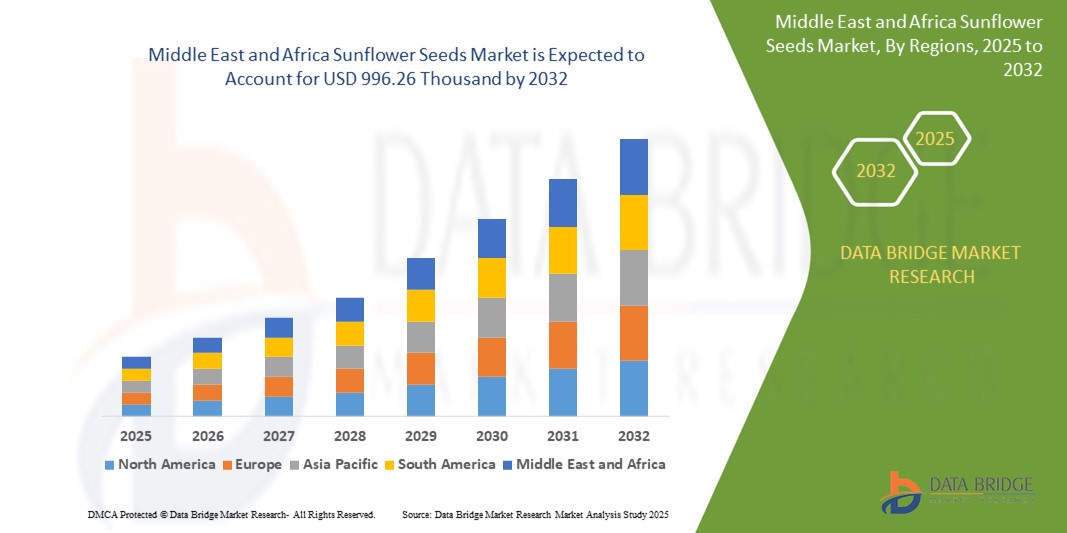
- The Middle East and Africa sunflower seeds market size was valued at USD 180.47 thousand in 2024 and is expected to reach USD 331.57 thousand by 2032, at a CAGR of 7.90% during the forecast period
- The market growth is largely fuelled by the rising demand for healthier snacking options, increasing awareness about the nutritional benefits of sunflower seeds, and their growing use in the food processing and oil extraction industries
- In addition, the expanding popularity of plant-based diets and sustainable agricultural practices is contributing to the increased consumption and cultivation of sunflower seeds across the region
Middle East and Africa Sunflower Seeds Market Analysis
- The market is witnessing steady growth due to rising consumer inclination toward functional foods rich in vitamins, minerals, and antioxidants, which sunflower seeds provide
- Sunflower seeds are widely consumed in roasted form and are increasingly used in breakfast cereals, energy bars, and bakery products, enhancing their visibility in the health food segment
- South Africa dominated the Middle East and Africa sunflower seeds market with the largest revenue share in 2024, driven by its well-established agricultural infrastructure, strong demand for sunflower oil, and rising consumption of sunflower seeds as a nutritious snack
- South Arabia is expected to witness the highest compound annual growth rate (CAGR) in the Middle East and Africa sunflower seeds market due to rising health awareness, increasing demand for nutrient-rich plant-based snacks, and a growing inclination toward Western dietary habits
- The kernel/hulled segment held the largest revenue share in 2024, driven by its widespread use in ready-to-eat snacks, bakery products, and cooking ingredients. Consumers favor hulled sunflower seeds due to their convenience and ease of use in both household and industrial applications. In addition, this type is often preferred by food processors for its versatility and nutritional profile
Report Scope and Middle East and Africa Sunflower Seeds Market Segmentation
|
Attributes |
Middle East and Africa Sunflower Seeds Key Market Insights |
|
Segments Covered |
|
|
Countries Covered |
Middle East and Africa
|
|
Key Market Players |
|
|
Market Opportunities |
• Expansion Of Organic and Flavored Sunflower Seed Products • Rising Demand in Functional Food and Nutraceutical Applications |
|
Value Added Data Infosets |
In addition to the insights on market scenarios such as market value, growth rate, segmentation, geographical coverage, and major players, the market reports curated by the Data Bridge Market Research also include in-depth expert analysis, pricing analysis, brand share analysis, consumer survey, demography analysis, supply chain analysis, value chain analysis, raw material/consumables overview, vendor selection criteria, PESTLE Analysis, Porter Analysis, and regulatory framework. |
Middle East and Africa Sunflower Seeds Market Trends
“Rising Popularity of Sunflower Seeds in Plant-Based and Vegan Diets”
- In the Middle East and Africa, sunflower seeds are gaining traction as a protein-rich, allergen-friendly alternative in plant-based and vegan formulations, driven by rising consumer interest in health, nutrition, and clean-label ingredients. Their high vitamin E, essential fatty acids, and mineral content align with the region’s increasing demand for nutrient-dense, minimally processed foods
- The neutral flavor and smooth consistency of sunflower seeds make them ideal for developing dairy-free alternatives such as plant-based cheese and spreads, especially in countries where lactose intolerance is prevalent. This is opening opportunities for regional startups to offer localized, allergy-friendly dairy alternatives
- For instance, food companies in markets such as South Africa and the UAE have started to introduce vegan spreads and cheeses based on sunflower seeds, responding to growing dietary preferences that avoid common allergens such as nuts and soy while maintaining taste and texture standards
- Local manufacturers are also tapping into the snack and convenience food space by incorporating sunflower seeds into energy bars, seed crackers, and blended snack packs, appealing to urban consumers seeking plant-based protein sources that align with halal, clean-label, and low-allergen dietary requirements
- Rising awareness around sustainability and food security in arid regions is further fueling innovation with sunflower seeds, which require relatively low water for cultivation and have a smaller environmental footprint than tree nuts. This makes them a viable crop for sustainable food product development in water-scarce areas such as North Africa and the Arabian Peninsulaa
Middle East and Africa Sunflower Seeds Market Dynamics
Driver
“Growing Health Awareness and Nutritional Demand”
- The growing focus on wellness and healthy living across the Middle East and Africa is significantly increasing the demand for nutrient-dense food options such as sunflower seeds, particularly among urban populations adopting more active lifestyles. These seeds are becoming a preferred ingredient due to their association with heart health, weight management, and natural energy
- Sunflower seeds are increasingly valued in the region for their composition of heart-healthy fats, plant-based proteins, dietary fiber, and antioxidants, all of which support cardiovascular wellness and long-lasting energy. Their nutritional profile appeals to consumers seeking alternatives to high-sugar and overly processed snacks
- A wide variety of food and beverage products in MEA markets—such as granola bars, trail mixes, smoothie blends, and seed-enriched baked goods—are now incorporating sunflower seeds, offering functional benefits and clean-label appeal
- For instance, several UAE-based snack companies are promoting sunflower seed-based bars as on-the-go energy solutions for fitness enthusiasts and working professionals
- Consumer preferences are rapidly shifting toward minimally processed foods with fewer artificial additives, and sunflower seeds naturally meet these clean-label expectations. Their versatility allows them to be used in raw, roasted, or blended formats without the need for chemical enhancement or preservatives
- This trend is especially evident in markets such as Saudi Arabia and South Africa, where health-conscious shoppers are driving demand for simple, plant-based ingredients, reinforcing sunflower seeds' role in the development of new functional and wellness-oriented product line
Restraint/Challenge
“Climate Dependency and Fluctuating Crop Yields”
- Sunflower cultivation in the Middle East and Africa is particularly vulnerable to climate variability, including fluctuations in rainfall, soil moisture levels, and rising temperatures, which directly influence crop yields and quality. These factors are especially critical in semi-arid and arid regions where irrigation infrastructure is limited
- Unpredictable weather patterns, such as droughts or unseasonal rainfalls, often lead to reduced seed output and compromised quality, making it difficult for producers to meet both domestic and export demands
- For instance, farmers in parts of North Africa have reported poor harvests in recent years due to prolonged dry spells
- Such climatic challenges also contribute to price volatility, affecting not only local growers but also processors and traders downstream in the value chain, particularly in regions where supply chains lack robust cold storage and logistics infrastructure to mitigate disruptions
- The limited availability of viable alternative growing zones across the region further amplifies production risks during adverse weather events, especially in countries such as Sudan, Egypt, and Ethiopia that rely heavily on consistent climatic conditions for sunflower output
- This exposure to climate-related risks underscores the need for investment in climate-resilient seed varieties, irrigation systems, and crop insurance, all of which remain underdeveloped in many parts of the MEA region. Without such measures, sunflower seed supply chains in these markets may face increasing instability in the coming years
Middle East and Africa Sunflower Seeds Market Scope
The market is segmented on the basis of type, product, product type, category, packaging, packaging size, and distribution channel.
• By Type
On the basis of type, the Middle East and Africa sunflower seeds market is segmented into kernel/hulled, inshelled, and semi-shelled. The kernel/hulled segment held the largest revenue share in 2024, driven by its widespread use in ready-to-eat snacks, bakery products, and cooking ingredients. Consumers favor hulled sunflower seeds due to their convenience and ease of use in both household and industrial applications. In addition, this type is often preferred by food processors for its versatility and nutritional profile.
The inshelled segment is expected to witness the fastest growth rate from 2025 to 2032, supported by increasing demand for natural and traditional snacking options. Inshelled seeds are particularly popular in Middle East and Africa and among consumers seeking minimally processed foods, offering a healthier and more engaging snacking experience.
• By Product
On the basis of product, the Middle East and Africa sunflower seeds market is segmented into roasted and unroasted. The roasted segment dominated the market in 2024 due to its enhanced flavor, texture, and longer shelf life, making it a preferred option for packaged snacks and seed-based products. Roasted seeds are also widely used in salad toppings and trail mixes across Middle East and Africaan households.
The unroasted segment is expected to witness the fastest growth rate from 2025 to 2032, owing to rising awareness about raw and minimally processed food consumption. Health-conscious consumers are increasingly opting for unroasted variants to retain the natural nutrients of sunflower seeds.
• By Product Type
On the basis of product type, the Middle East and Africa sunflower seeds market is segmented into original and flavored. The original segment captured the highest revenue share in 2024, driven by its broad acceptance and versatility in multiple applications, including direct consumption and cooking.
The flavored segment is expected to witness the fastest growth rate from 2025 to 2032, supported by the rising preference for taste-enhanced healthy snacks. Varieties such as spicy, salted, and herb-seasoned sunflower seeds are gaining popularity among younger consumers in urban areas.
• By Category
On the basis of category, the Middle East and Africa sunflower seeds market is segmented into organic and inorganic. The inorganic segment led the market in 2024, attributed to its wide availability, cost-effectiveness, and large-scale production across Middle East and Africa.
The organic segment is expected to witness the fastest growth rate from 2025 to 2032, due to increasing demand for chemical-free and eco-friendly food products. Rising awareness about food safety and sustainability is encouraging consumers to shift toward organically grown sunflower seeds.
• By Packaging
On the basis of packaging, the Middle East and Africa sunflower seeds market is segmented into pouches, bottles, and jars. The pouches segment held the largest share in 2024 due to their portability, affordability, and suitability for on-the-go consumption.
Jars is expected to witness the fastest growth rate from 2025 to 2032, particularly in premium segments, as they offer better preservation and visual appeal for retail shelf presentation.
• By Packaging Size
On the basis of packaging size, the Middle East and Africa sunflower seeds market is segmented into 50 oz. The 50 oz packaging size segment has gained traction due to its value-for-money proposition for regular consumers and family-size usage. This size is commonly preferred in both online and store-based retail channels for its convenience and cost-efficiency.
• By Distribution Channel
On the basis of distribution channel, the Middle East and Africa sunflower seeds market is segmented into store-based retailing and non-store retailing. Store-based retailing dominated the market in 2024, supported by the strong presence of supermarkets, hypermarkets, and health food stores offering a wide range of sunflower seed products.
Non-store retailing is expected to witness the fastest growth rate from 2025 to 2032, driven by increasing consumer preference for e-commerce platforms and doorstep delivery. Online retailers are expanding their organic and flavored sunflower seed offerings, further fueling segment growth.
Middle East and Africa Sunflower Seeds Market Regional Analysis
• South Africa dominated the Middle East and Africa sunflower seeds market with the largest revenue share in 2024, driven by its well-established agricultural infrastructure, strong demand for sunflower oil, and rising consumption of sunflower seeds as a nutritious snack
• The country’s favorable climate for sunflower cultivation, coupled with increasing consumer interest in healthy and plant-based food options, supports consistent market demand across both retail and industrial sectors
• Government support for oilseed farming and improvements in food processing capabilities are further contributing to the market's expansion in South Africa
Saudi Arabia Sunflower Seeds Market Insight
Saudi Arabia is expected to witness the fastest growth rate in the Middle East and Africa sunflower seeds market from 2025 to 2032, driven by growing awareness of health and wellness, a rising preference for nutrient-rich snacks, and the adoption of plant-based dietary habits. The country’s expanding retail landscape and increasing availability of flavored and packaged sunflower seed products are enhancing consumer accessibility and interest. In addition, the shift toward Western-style snacking and the rising popularity of clean-label, functional foods are expected to accelerate market growth in the coming years
Middle East and Africa Sunflower Seeds Market Share
The Middle East and Africa Sunflower Seeds industry is primarily led by well-established companies, including:
- Tiger Brands Limited (South Africa)
- Siyabulela Group (Pty) Ltd. (South Africa)
- Pride Milling Company (Pty) Ltd. (South Africa)
- Allied Seed (Pty) Ltd. (South Africa)
- Agthia Group PJSC (U.A.E.)
- Al Dahra Holding LLC (U.A.E.)
- Almarai Company (Saudi Arabia)
- Savola Group (Saudi Arabia)
- National Agricultural Development Company (NADEC) (Saudi Arabia)
- Green Corner General Trading LLC (U.A.E.)

- Interactive Data Analysis Dashboard
- Company Analysis Dashboard for high growth potential opportunities
- Research Analyst Access for customization & queries
- Competitor Analysis with Interactive dashboard
- Latest News, Updates & Trend analysis
- Harness the Power of Benchmark Analysis for Comprehensive Competitor Tracking
Middle East And Africa Sunflower Seeds Market, Supply Chain Analysis and Ecosystem Framework
To support market growth and help clients navigate the impact of geopolitical shifts, DBMR has integrated in-depth supply chain analysis into its Middle East And Africa Sunflower Seeds Market research reports. This addition empowers clients to respond effectively to global changes affecting their industries. The supply chain analysis section includes detailed insights such as Middle East And Africa Sunflower Seeds Market consumption and production by country, price trend analysis, the impact of tariffs and geopolitical developments, and import and export trends by country and HSN code. It also highlights major suppliers with data on production capacity and company profiles, as well as key importers and exporters. In addition to research, DBMR offers specialized supply chain consulting services backed by over a decade of experience, providing solutions like supplier discovery, supplier risk assessment, price trend analysis, impact evaluation of inflation and trade route changes, and comprehensive market trend analysis.
Data collection and base year analysis are done using data collection modules with large sample sizes. The stage includes obtaining market information or related data through various sources and strategies. It includes examining and planning all the data acquired from the past in advance. It likewise envelops the examination of information inconsistencies seen across different information sources. The market data is analysed and estimated using market statistical and coherent models. Also, market share analysis and key trend analysis are the major success factors in the market report. To know more, please request an analyst call or drop down your inquiry.
The key research methodology used by DBMR research team is data triangulation which involves data mining, analysis of the impact of data variables on the market and primary (industry expert) validation. Data models include Vendor Positioning Grid, Market Time Line Analysis, Market Overview and Guide, Company Positioning Grid, Patent Analysis, Pricing Analysis, Company Market Share Analysis, Standards of Measurement, Global versus Regional and Vendor Share Analysis. To know more about the research methodology, drop in an inquiry to speak to our industry experts.
Data Bridge Market Research is a leader in advanced formative research. We take pride in servicing our existing and new customers with data and analysis that match and suits their goal. The report can be customized to include price trend analysis of target brands understanding the market for additional countries (ask for the list of countries), clinical trial results data, literature review, refurbished market and product base analysis. Market analysis of target competitors can be analyzed from technology-based analysis to market portfolio strategies. We can add as many competitors that you require data about in the format and data style you are looking for. Our team of analysts can also provide you data in crude raw excel files pivot tables (Fact book) or can assist you in creating presentations from the data sets available in the report.













