


What is the Middle East and Africa Transfection Market Size and Growth Rate?
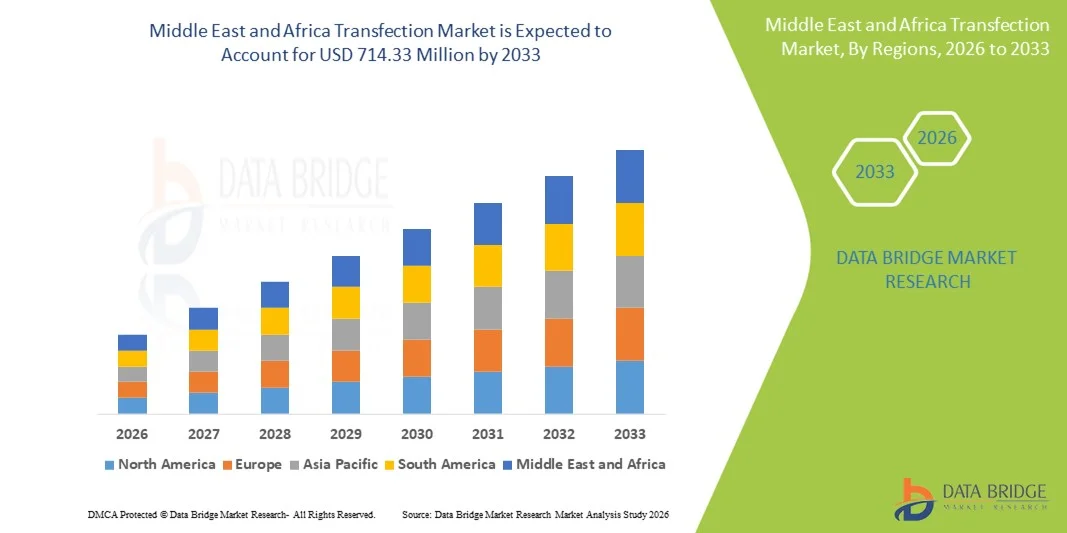
- As per Data Bridge Market Research analysis, the Middle East and Africa transfection market size was valued at USD 326.06 million in 2025 and is expected to reach USD 714.33 million by 2033, at a CAGR of 10.30 % during the forecast period
- The market growth is largely driven by the increasing adoption of transfection technologies across biomedical research, cell and gene therapy development, and vaccine research, supported by rising investments in life sciences infrastructure and academic–industry collaborations across the region
- Furthermore, growing demand for efficient, scalable, and high-precision gene delivery solutions in research institutes, biotechnology companies, and pharmaceutical manufacturing is positioning transfection technologies as a critical enabler of modern molecular and cellular research, thereby significantly accelerating market expansion across the Middle East and Africa
Market Size & Forecast
- Global Market Value (2025): USD 326.06 million
- Expected Market Value (2033): USD 714.33 million
- Forecast CAGR (2026–2033): 10.30%
What are the Major Takeaways of Middle East and Africa Transfection Market?
- Transfection technologies, enabling the delivery of nucleic acids into cells for gene expression and functional studies, are becoming increasingly essential tools in biomedical research, cell and gene therapy development, and vaccine research across the Middle East and Africa due to their central role in advancing molecular biology and therapeutic innovation
- The rising demand for transfection solutions is primarily driven by expanding life sciences research activities, increasing prevalence of genetic and infectious diseases, and growing investments by governments and private organizations in biotechnology and pharmaceutical research infrastructure
- Saudi Arabia dominated the Middle East and Africa transfection market with a revenue share of 34.6% in 2025, supported by strong government-backed research funding, expanding biotechnology initiatives under national healthcare strategies, and increasing adoption of transfection technologies in academic research, genomics studies, and biopharmaceutical development
- South Africa is expected to be the fastest-growing country in the Middle East and Africa transfection market during the forecast period driven by improving laboratory infrastructure, rising international research collaborations, and increasing focus on infectious disease research, vaccine development, and translational medicine
- Non-viral methods dominated the Middle East and Africa transfection market with a market share of 41.8% in 2025, driven by their favorable safety profile, lower immunogenicity, cost-effectiveness, and widespread adoption across research, preclinical, and early-stage clinical applications
Report Scope and Middle East and Africa Transfection Market Segmentation
|
Attributes |
Middle East and Africa Transfection Key Market Insights |
|
Segments Covered |
|
|
Countries Covered |
Middle East and Africa
|
|
Key Market Players |
|
|
Market Opportunities |
|
|
Value Added Data Infosets |
In addition to the insights on market scenarios such as market value, growth rate, segmentation, geographical coverage, and major players, the market reports curated by the Data Bridge Market Research also include in-depth expert analysis, patient epidemiology, pipeline analysis, pricing analysis, and regulatory framework |
What is the Key Trend in the Middle East and Africa Transfection Market?
Rising Adoption of Non-Viral and CRISPR-Based Transfection Technologies
- A significant and accelerating trend in the Middle East and Africa transfection market is the increasing adoption of non-viral and CRISPR-based transfection methods across research, preclinical, and early clinical applications, driven by their improved safety profile, flexibility, and suitability for gene editing workflows
- For instance, several academic and government-funded research centers in Saudi Arabia and the UAE are increasingly utilizing CRISPR transfection systems for functional genomics and disease-target discovery studies, boosting demand for compatible non-viral transfection reagents and kits
- Advancements in transfection technologies are enabling higher efficiency, improved cell viability, and greater precision in nucleic acid delivery, supporting the growing complexity of molecular biology and gene therapy research conducted across the region
- For instance, reagent and kit manufacturers are developing optimized formulations tailored for hard-to-transfect mammalian cells, which are widely used in cancer biology, vaccine research, and infectious disease studies prevalent in the Middle East and Africa
- The increasing integration of transfection technologies with automated laboratory workflows and advanced molecular tools is facilitating streamlined experimentation and higher throughput in research laboratories
- Increasing collaboration between regional universities and global life sciences companies is supporting faster technology transfer and adoption of next-generation transfection platforms
- This trend toward safer, more efficient, and gene-editing-compatible transfection solutions is reshaping research expectations, driving strong demand from academic institutions, biopharma companies, and contract research organizations across the Middle East and Africa
Middle East and Africa Transfection Market Dynamics
Driver
Growing Investment in Life Sciences Research and Biopharmaceutical Development
- The expansion of life sciences research activities and increasing government and private investment in biotechnology and pharmaceutical development are major drivers of transfection market growth in the Middle East and Africa
- For instance, national healthcare and biotechnology strategies in Saudi Arabia are accelerating funding for genomics, cell therapy, and vaccine research, directly increasing demand for advanced transfection technologies
- Rising prevalence of infectious diseases and genetic disorders is prompting greater focus on molecular research and therapeutic development, where transfection plays a critical enabling role
- Furthermore, the establishment of new research institutes, innovation hubs, and biopharma manufacturing facilities is expanding the installed base of laboratories requiring reliable transfection tools
- Increasing foreign direct investment in Middle Eastern biotech hubs is strengthening research capabilities and expanding long-term demand for transfection technologies
- Supportive regulatory initiatives aimed at boosting local drug discovery and biologics production are indirectly stimulating sustained demand for transfection solutions
- The growing involvement of CROs and CDMOs supporting regional and international clinical programs is further propelling the adoption of transfection products across research, preclinical, and early clinical stages
Restraint/Challenge
High Cost and Technical Complexity of Advanced Transfection Technologies
- The relatively high cost of advanced transfection reagents, instruments, and CRISPR-based systems presents a significant challenge, particularly for budget-constrained research institutions and laboratories in parts of Africa
- For instance, sophisticated transfection kits and gene-editing platforms may be financially inaccessible for smaller academic labs, limiting widespread adoption despite strong research interest
- Technical complexity associated with optimizing transfection efficiency for different cell types can also act as a barrier, requiring skilled personnel and repeated protocol optimization
- In addition, limited local manufacturing and dependence on imported transfection products can lead to supply chain delays and higher procurement costs across the region
- Addressing these challenges through localized production, training initiatives, and cost-effective product development will be critical to ensuring sustained growth of the Middle East and Africa transfection market
- Shortage of highly trained molecular biology professionals in certain countries can slow adoption and effective utilization of advanced transfection technologies
- Variability in research funding stability across African nations may further constrain long-term investment in high-end transfection platforms
How is the Middle East and Africa Transfection Market Segmented?
The market is segmented on the basis of type, methods, CRISPR transfection methods, products, organism, types of molecule, application, stage, end user, and distribution channel
- By Type
On the basis of type, the Middle East and Africa transfection market is segmented into transient transfection and stable transfection. The transient transfection segment dominated the market in 2025, driven by its extensive use in short-term gene expression studies, functional genomics, and protein production. Researchers across academic institutes, CROs, and biopharma laboratories prefer transient transfection due to its rapid turnaround time and experimental flexibility. It is widely applied in infectious disease research, vaccine development, and early-stage drug discovery programs expanding across the region. The absence of permanent genome integration reduces regulatory and technical complexity, making it suitable for high-throughput exploratory studies. Strong adoption in university laboratories and government-funded research centers further reinforces its dominant position. Continuous demand from basic research ensures sustained leadership of this segment.
The stable transfection segment is anticipated to witness the fastest growth rate from 2026 to 2033, fueled by increasing demand for long-term gene expression and reproducible cell line development. Growth in cell and gene therapy pipelines is significantly increasing the need for stable expression systems. Biopharma companies are focusing on stable transfection for monoclonal antibody and recombinant protein production. Expansion of preclinical and clinical research infrastructure in Middle Eastern countries supports this trend. Advancements in vector design and selection markers are reducing technical challenges. Rising investments in biologics manufacturing are further accelerating adoption. Long-term commercial production requirements are also strengthening growth prospects.
- By Methods
On the basis of methods, the Middle East and Africa transfection market is segmented into non-viral methods and viral methods. The non-viral methods segment held the largest market revenue share of 41.8% in 2025, driven by their favorable safety profile and lower immunogenicity. These methods are widely adopted in academic research, CROs, and early-stage biopharma development. Non-viral approaches offer cost-effectiveness and ease of handling, making them suitable for routine laboratory use. Their compatibility with gene editing workflows further strengthens demand. Reduced biosafety requirements compared to viral techniques also support broader adoption across the region. High suitability for high-throughput screening reinforces market dominance.
The viral methods segment is expected to witness the fastest growth during the forecast period, driven by increasing demand for high-efficiency gene delivery. Viral vectors are gaining importance in gene therapy and vaccine development programs. Expansion of clinical research capabilities in the Middle East is supporting adoption. Higher transfection efficiency in difficult-to-transfect cells is a major advantage. Increasing oncology and rare disease research is contributing to growth. Continuous improvements in viral vector safety profiles are further driving demand. Rising clinical trial activity is accelerating segment expansion.
- By CRISPR Transfection Methods
On the basis of CRISPR transfection methods, the market is segmented into non-viral methods and viral methods. Non-viral CRISPR transfection methods dominated the market in 2025, driven by growing adoption of ribonucleoprotein-based gene editing approaches. These methods reduce off-target effects and provide transient gene editing, which is preferred in research settings. Academic and government-funded genomics initiatives are significantly driving demand. Lower biosafety and regulatory complexity further encourage adoption. High compatibility with mammalian cell research supports segment leadership. Ease of protocol optimization also supports widespread use.
The viral CRISPR transfection methods segment is expected to grow at the fastest CAGR from 2026 to 2033, supported by increasing use in clinical-stage gene therapy programs. Viral delivery allows stable and efficient gene editing required for therapeutic applications. Rising clinical trials in oncology and genetic disorders are contributing to growth. Improvements in vector engineering are enhancing safety and precision. Strong biopharma investment is accelerating adoption. Expansion of clinical research infrastructure further supports growth. Demand for durable gene expression is a key driver.
- By Products
On the basis of products, the Middle East and Africa transfection market is segmented into reagent & kits, instrument, and software. The reagent & kits segment dominated the market in 2025 due to recurring usage across all research stages. Laboratories require continuous supplies of reagents for routine experiments. Ease of availability and compatibility with multiple cell lines drive adoption. High usage in academic institutions and CROs supports dominance. Frequent repetition of experiments further increases consumption. Broad application across research and development sustains market leadership.
The instrument segment is anticipated to witness the fastest growth rate during the forecast period, driven by increasing automation in laboratories. Biopharma companies and CDMOs are investing in advanced transfection instruments. These systems improve reproducibility and scalability of experiments. Growth in bioproduction activities is supporting adoption. Rising focus on high-throughput workflows is driving demand. Laboratory modernization initiatives across the region further accelerate growth. Long-term efficiency gains are strengthening investment appeal.
- By Organism
On the basis of organism, the market is segmented into mammalian cells, plants, fungi, virus, and bacteria. Mammalian cells dominated the market in 2025, driven by their extensive use in biomedical and therapeutic research. Most gene therapy and vaccine studies rely on mammalian systems due to their relevance to human biology. High focus on cancer and infectious disease research supports dominance. Strong adoption in academic and biopharma laboratories reinforces demand. Availability of well-established protocols further strengthens usage. Continuous research funding sustains market leadership.
The plant, fungi, virus, and bacteria segment is expected to grow at the fastest rate, driven by expanding agricultural and industrial biotechnology research. Governments are supporting food security and bioengineering initiatives. Microbial and plant transfection supports protein production and genetic engineering. Lower costs and scalability drive adoption. Increasing interest in sustainable biotechnology is accelerating growth. Diversification of research applications further supports expansion. Industrial enzyme production is also contributing to demand.
- By Types of Molecule
On the basis of types of molecule, the market is segmented into plasmid DNA, small interfering RNA (siRNA), proteins, DNA oligonucleotides, ribonucleoprotein complexes (RNPs), and others. Plasmid DNA dominated the market in 2025 due to its extensive use in gene expression studies. It is widely applied in transient transfection experiments across laboratories. High availability and ease of manipulation support adoption. Academic research remains a key demand driver. Compatibility with various delivery methods reinforces dominance. Cost-effectiveness further strengthens its position.
The ribonucleoprotein complexes (RNPs) segment is expected to be the fastest growing, driven by increasing adoption of CRISPR-based gene editing. RNPs offer high precision and reduced off-target effects. Rising focus on gene and cell therapy supports growth. Increased funding for advanced genome editing is accelerating demand. Improved delivery efficiency enhances adoption. Strong interest in next-generation therapeutics further drives growth. Regulatory preference for transient editing also supports expansion.
- By Application
On the basis of application, the market is segmented into in vitro application, in vivo application, bioproduction, and others. In vitro application dominated the market in 2025 due to extensive use in basic research and drug discovery. Most academic and early-stage studies rely heavily on in vitro models. Lower cost and experimental flexibility drive adoption. High volume of laboratory research supports dominance. Broad applicability across organisms strengthens demand. Continuous innovation in assay development sustains leadership.
The bioproduction segment is expected to witness the fastest growth rate from 2026 to 2033, driven by rising demand for biologics. Biopharma companies require scalable transfection solutions for manufacturing. Growth in regional biologics production facilities supports expansion. Increasing CDMO involvement accelerates demand. Long-term production requirements favor adoption. Government support for local manufacturing further boosts growth. Export-oriented biologics strategies are also contributing.
- By Stage
On the basis of stage, the market is segmented into research, preclinical, clinical phases, and commercial. The research stage dominated the market in 2025 due to high volumes of academic studies. Government and institutional funding for molecular biology research supports dominance. Most transfection activities occur at early research stages. Flexibility and experimentation drive usage. Wide participation from universities reinforces demand. Continuous pipeline of research projects sustains leadership.
The clinical phases segment is anticipated to grow at the fastest pace during the forecast period, driven by increasing number of gene and cell therapy candidates entering clinical trials across the Middle East and Africa. Expansion of regional clinical research infrastructure is supporting higher adoption of transfection technologies. Growing focus on oncology and rare genetic disease trials is boosting demand for efficient gene delivery methods. Rising government and private funding for translational research is accelerating clinical-stage development. Regulatory improvements enabling advanced therapeutic trials are further supporting growth. Collaboration with global pharmaceutical sponsors is also increasing the use of clinical-grade transfection solutions.
- By End User
On the basis of end user, the market is segmented into biopharma, CROs, CMOs/CDMOs, academia, hospitals, clinical labs, and others. Academia dominated the market in 2025 due to extensive research activity. Universities and research institutes are primary users of transfection technologies. Grant-funded projects support sustained demand. High frequency of experiments reinforces dominance. Broad disciplinary application strengthens usage. Academic research remains a foundational growth driver.
The biopharma and CMOs/CDMOs segment is expected to witness the fastest growth during the forecast period, driven by expanding pipeline of cell and gene therapies across the Middle East and Africa. Increasing outsourcing of research, development, and manufacturing activities is boosting demand for scalable transfection solutions. Growth in biologics and biosimilar production is further accelerating adoption. Rising investments in local biopharmaceutical manufacturing facilities are strengthening market expansion. Collaboration between global pharmaceutical companies and regional CMOs/CDMOs is enhancing technology transfer. In addition, increasing clinical trial activity is driving sustained demand for advanced transfection technologies.
- By Distribution Channel
On the basis of distribution channel, the market is segmented into direct tender, retail sales, and others. The direct tender segment dominated the market in 2025 due to procurement by government-funded institutions. Bulk purchasing agreements support market leadership. Long-term supply contracts ensure consistency. Public research funding plays a key role. Reliability of supply strengthens preference. Institutional dominance sustains growth.
The retail sales segment is expected to grow at the fastest CAGR from 2026 to 2033, driven by the increasing number of private research laboratories and biotechnology startups across the Middle East and Africa. Rising demand for flexible and faster procurement of transfection reagents and kits is supporting retail channel growth. Small and mid-sized laboratories prefer retail sales due to easier access and lower minimum order requirements. Expansion of regional distributors and authorized resellers is improving product availability. Growth of academic spin-offs and early-stage biotech firms is further boosting demand. In addition, increasing adoption of online and catalog-based purchasing is accelerating retail sales expansion.
Middle East and Africa Transfection Market Regional Analysis
- Saudi Arabia dominated the Middle East and Africa transfection market with an revenue share of 34.6% in 2025, supported by strong government-backed research funding, expanding biotechnology initiatives under national healthcare strategies, and increasing adoption of transfection technologies in academic research, genomics studies, and biopharmaceutical development
- Researchers and institutions in the region highly value access to advanced transfection methods, reagents, and instruments for gene expression studies, functional genomics, and vaccine development
- This widespread adoption is further supported by investments in laboratory infrastructure, growing life sciences research activities, and rising collaborations between universities, hospitals, and biopharma companies, establishing Saudi Arabia as the leading hub for transfection research and applications in the Middle East and Africa
The Saudi Arabia Transfection Market Insight
The Saudi Arabia transfection market captured the largest revenue share of 34.6% in 2025 within the Middle East and Africa, fueled by strong government-backed research funding and expanding biotechnology initiatives under national healthcare strategies. Researchers and institutions are increasingly prioritizing advanced transfection technologies for gene expression studies, functional genomics, and vaccine development. The growing focus on academic research, biopharmaceutical development, and genomics studies is further propelling market adoption. Moreover, the country’s investment in modern laboratory infrastructure and life sciences research centers is significantly contributing to market expansion. Strategic collaborations between universities, hospitals, and private biopharma companies are also accelerating the uptake of transfection solutions.
South Africa Transfection Market Insight
The South Africa transfection market is anticipated to grow at the fastest CAGR during the forecast period, driven by improving laboratory infrastructure, rising international research collaborations, and increasing focus on infectious disease research and vaccine development. The country is witnessing a growing demand for efficient transfection methods in both academic and commercial research. Expansion of biopharma and contract research activities is further boosting market growth. In addition, government support and private investments in life sciences research are strengthening the adoption of advanced transfection technologies. South Africa’s focus on translational medicine and clinical research is contributing to rapid market expansion. The increasing number of biotechnology startups and research organizations is also enhancing demand for high-quality transfection products.
Egypt Transfection Market Insight
The Egypt transfection market is poised to grow steadily due to rising investments in molecular biology and biopharmaceutical research. Academic institutions and hospitals are adopting transfection technologies for vaccine development and gene therapy research. The country’s expanding biotechnology sector is promoting market penetration. Government initiatives supporting life sciences research infrastructure are further driving adoption. Egypt’s participation in regional and international collaborations is enhancing access to advanced transfection tools. The demand for cost-effective and reliable reagents and kits is accelerating market growth in both research and commercial segments.
United Arab Emirates (UAE) Transfection Market Insight
The UAE transfection market is witnessing notable growth due to its strong emphasis on biotechnology and healthcare innovation. Research centers and hospitals are increasingly integrating transfection methods for gene therapy, vaccine research, and functional genomics studies. Strategic partnerships with global biopharma companies are boosting technology transfer and adoption. Investment in state-of-the-art laboratory facilities and life sciences parks supports market expansion. Rising government and private funding in translational and preclinical research is enhancing demand for advanced transfection solutions. The UAE’s focus on establishing itself as a hub for biotechnology research is further accelerating growth
Which are the Top Companies in Middle East and Africa Transfection Market?
The Middle East and Africa Transfection industry is primarily led by well-established companies, including:
- Thermo Fisher Scientific Inc. (U.S.)
- Promega Corporation (U.S.)
- QIAGEN (Netherlands)
- Bio Rad Laboratories, Inc. (U.S.)
- Lonza (Switzerland)
- Merck KGaA (Germany)
- F. Hoffmann La Roche Ltd. (Switzerland)
- MaxCyte, Inc. (U.S.)
- Polyplus transfection SA (France)
- Agilent Technologies, Inc. (U.S.)
- Takara Bio Inc. (Japan)
- Sigma Aldrich (U.S.)
- OriGene Technologies, Inc. (U.S.)
- SignaGen Laboratories (U.S.)
- Altogen Biosystems (U.S.)
- Integrated DNA Technologies (U.S.)
- Applied Biological Materials, Inc. (Canada)
- Horizon Discovery Ltd. (U.K.)
- System Biosciences (U.S.)
- Boca Scientific, Inc. (U.S.)
What are the Recent Developments in Middle East and Africa Transfection Market?
- In October 2025, King Faisal Specialist Hospital & Research Centre (KFSH&RC) launched Saudi Arabia’s first gene and cell therapy manufacturing facility, designed to produce advanced T‑cell, stem‑cell, and viral vector therapies, with future expansion into gene‑editing technologies, significantly boosting local biotech capabilities
- In February 2025, Morocco expanded CRISPR gene‑editing research to strengthen agricultural resilience, with early studies at University Mohammed VI Polytechnic exploring how CRISPR can improve crop adaptation to climate challenges illustrating broader regional gene‑editing adoption beyond human therapeutics
- In February 2025, the Bahrain Oncology Centre successfully administered the first CRISPR‑based gene‑editing therapy (Casgevy) in the Middle East to treat a sickle cell disease patient, marking the first time this CRISPR/Cas9 exagamglogene autotemcel treatment was used outside the U.S. and highlighting regional adoption of advanced gene‑editing therapies
- In January 2024, the Saudi Food and Drug Authority (SFDA) approved Casgevy, a CRISPR/Cas9 gene‑edited therapy for sickle cell disease and beta‑thalassemia, advancing gene‑editing therapy access in the Kingdom and supporting precision medicine initiatives
- In December 2023, Bahrain became the first country in the Middle East to approve the CRISPR therapy Casgevy for sickle cell and beta‑thalassemia, following evaluation of safety and efficacy, which laid the groundwork for later clinical use and regional expansion of gene‑editing treatments

- Interactive Data Analysis Dashboard
- Company Analysis Dashboard for high growth potential opportunities
- Research Analyst Access for customization & queries
- Competitor Analysis with Interactive dashboard
- Latest News, Updates & Trend analysis
- Harness the Power of Benchmark Analysis for Comprehensive Competitor Tracking
Data collection and base year analysis are done using data collection modules with large sample sizes. The stage includes obtaining market information or related data through various sources and strategies. It includes examining and planning all the data acquired from the past in advance. It likewise envelops the examination of information inconsistencies seen across different information sources. The market data is analysed and estimated using market statistical and coherent models. Also, market share analysis and key trend analysis are the major success factors in the market report. To know more, please request an analyst call or drop down your inquiry.
The key research methodology used by DBMR research team is data triangulation which involves data mining, analysis of the impact of data variables on the market and primary (industry expert) validation. Data models include Vendor Positioning Grid, Market Time Line Analysis, Market Overview and Guide, Company Positioning Grid, Patent Analysis, Pricing Analysis, Company Market Share Analysis, Standards of Measurement, Global versus Regional and Vendor Share Analysis. To know more about the research methodology, drop in an inquiry to speak to our industry experts.
Data Bridge Market Research is a leader in advanced formative research. We take pride in servicing our existing and new customers with data and analysis that match and suits their goal. The report can be customized to include price trend analysis of target brands understanding the market for additional countries (ask for the list of countries), clinical trial results data, literature review, refurbished market and product base analysis. Market analysis of target competitors can be analyzed from technology-based analysis to market portfolio strategies. We can add as many competitors that you require data about in the format and data style you are looking for. Our team of analysts can also provide you data in crude raw excel files pivot tables (Fact book) or can assist you in creating presentations from the data sets available in the report.













