


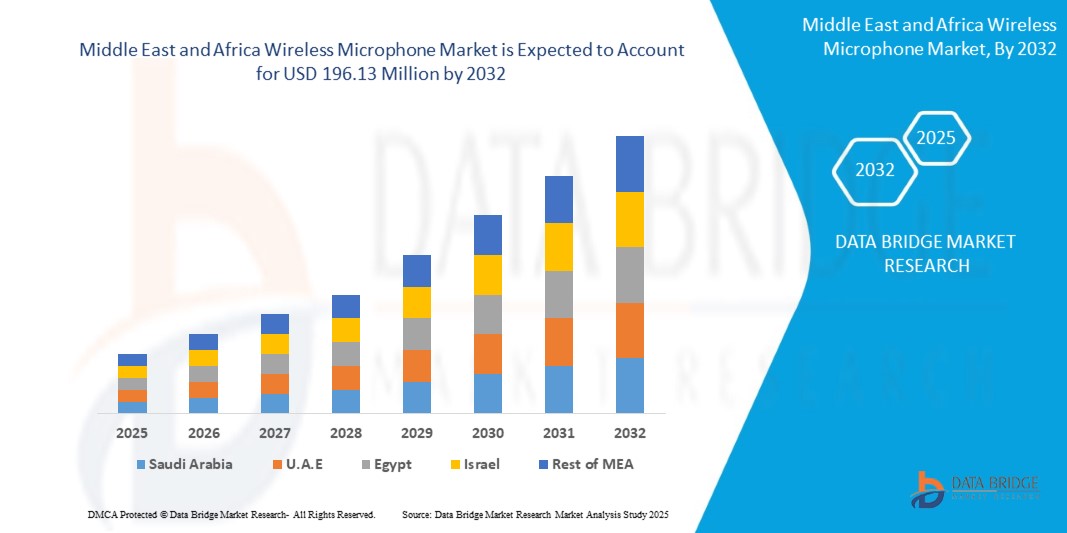
What is the Middle East and Africa Wireless Microphone Market Size and Growth Rate?
- The Middle East and Africa wireless microphone market size was valued at USD 118.51 million in 2024 and is expected to reach USD 196.13 million by 2032, at a CAGR of6.50% during the forecast period
- In the wireless microphone market, emerging technologies such as advanced digital signal processing and improved battery efficiency are revolutionizing audio transmission. In addition, innovations such as frequency hopping spread spectrum and beamforming enhance signal reliability and range. These advancements ensure seamless connectivity and superior audio quality, driving growth in the market
- For instance, the addition of new sports such as baseball, skateboarding, sports climbing, and surfing to the 2020 Tokyo Olympic Games by the International Olympic Committee (IOC) is anticipated to boost the demand for wireless devices in the region, as it will such asly increase the need for connectivity and communication among spectators, athletes, and organizers
What are the Major Takeaways of Wireless Microphone Market?
- The surge in wireless microphone technology is propelled by the automotive sector's increasing automation demands. This trend is evident in driver assistance systems, controllers, and telematics, especially within Electric Vehicles (EVs) and autonomous vehicles. In addition, as connected technologies revolutionize manufacturing, the adoption of wireless microphone-related products is expected to accelerate, particularly in the market
- For instance, Knowles Corporation launched two advanced SiSonicTM MEMS microphones for automotive use in April 2021: SPH1878 and SPH9855. These cutting-edge products uphold Knowles' commitment to superior quality and supply reliability. Specifically designed to meet the growing needs of the automotive industry, they cater to features such as hands-free calling, advanced voice assistance, and in-cabin noise cancellation for enhanced passenger comfort
- U.A.E. is projected to dominate the Middle East and Africa wireless microphone market with a revenue share of 39.64% in 2024, driven by its robust media and entertainment sector, expanding smart education programs, and thriving MICE (Meetings, Incentives, Conferences, and Exhibitions) industry
- The Handheld segment dominated the market with the largest revenue share of 41.2% in 2024, due to its ease of use, portability, and popularity in live events, stage performances, and public speaking environments
Report Scope and Wireless Microphone Market Segmentation
|
Attributes |
Wireless Microphone Key Market Insights |
|
Segments Covered |
|
|
Countries Covered |
Middle East and Africa
|
|
Key Market Players |
|
|
Market Opportunities |
|
|
Value Added Data Infosets |
In addition to the insights on market scenarios such as market value, growth rate, segmentation, geographical coverage, and major players, the market reports curated by the Data Bridge Market Research also include in-depth expert analysis, pricing analysis, brand share analysis, consumer survey, demography analysis, supply chain analysis, value chain analysis, raw material/consumables overview, vendor selection criteria, PESTLE Analysis, Porter Analysis, and regulatory framework. |
What is the Key Trend in the Wireless Microphone Market?
Rising Demand for Compact, Interference-Free, and Smart Wireless Solutions
- A defining trend in the wireless microphone market is the shift toward miniaturized, low-latency, and interference-resistant systems, driven by rising demand from broadcasting, events, education, and hybrid work environments. Users seek clear audio transmission, longer battery life, and minimal signal dropouts
- For instance, Shure (U.S.) and Sennheiser (Germany) are leading innovation with DECT-based and 1.9 GHz digital transmission technology, offering enhanced channel stability and encryption for secure audio in congested RF environments
- Integration of AI-powered noise cancellation, voice tracking, and mobile app control is redefining user experience, particularly for podcasters, vloggers, and virtual presenters who prioritize seamless setup and intelligent features
- Wireless microphones are also being adapted for wearable and lavalier formats to support immersive content creation and hands-free communication in live and remote settings
- Companies such as RØDE (Australia) and Audio-Technica (Japan) are pushing compact USB-C and Lightning-enabled microphones for on-the-go mobile recording, fueling adoption in creator ecosystems
- This trend reflects a broader move toward portable, user-friendly, and digitally enhanced audio tools that cater to both professional and prosumer markets, reshaping how sound is captured and shared in real time
What are the Key Drivers of Wireless Microphone Market?
- The explosive growth of the events, entertainment, and content creation industries is significantly driving the wireless microphone market. Live concerts, sports, streaming, and virtual events demand reliable, high-fidelity wireless audio that supports mobility and large audience interaction
- For instance, in March 2024, Sony Corporation (Japan) launched its UWP-D Series wireless system with NFC Sync and digital audio interface, targeting broadcast journalists and event producers requiring seamless signal pairing and professional-grade sound
- The shift to hybrid classrooms and corporate communications has expanded usage across education and enterprise verticals, where wireless mics enable hands-free, socially distanced interaction and enhanced AV integration
- Increasing demand from houses of worship, fitness centers, and community spaces is also boosting the market as these venues prioritize wireless mobility, voice clarity, and ease of use
- Growth in government and public safety applications, where secure wireless communication is essential for command centers and training environments, is an emerging demand contributor
- Enhanced battery efficiency, Bluetooth Low Energy (BLE), and long-range RF transmission are also catalyzing demand, particularly for ruggedized outdoor and multi-speaker use cases
Which Factor is challenging the Growth of the Wireless Microphone Market?
- A major challenge in the wireless microphone market is frequency spectrum regulation and interference, particularly as UHF and VHF bands become congested or reallocated for 5G and telecom applications
- For instance, many countries have reduced available bandwidth for wireless microphones, forcing manufacturers to develop region-specific models and comply with complex licensing rules, delaying scalability
- High-quality wireless systems remain cost-prohibitive for entry-level users, limiting adoption in developing markets and small content production setups
- Battery management, especially in compact and high-power systems, continues to hinder extended use, while overheating and recharge cycles remain reliability concerns
- Further, limited technical awareness among end-users, coupled with improper mic placement or pairing, leads to poor performance and customer dissatisfaction, especially in unsupervised environments
- Overcoming these barriers will require smarter frequency coordination, user education, and investments in AI-based channel scanning, multi-device sync, and energy-efficient components for global deployment and mass adoption
How is the Wireless Microphone Market Segmented?
The market is segmented on the basis of product type, microphone type, technology, price range, and application.
• By Product Type
On the basis of product type, the market is segmented into Handheld, Clip On, Plug In, and Bodypack. The Handheld segment dominated the market with the largest revenue share of 41.2% in 2024, due to its ease of use, portability, and popularity in live events, stage performances, and public speaking environments.
The Bodypack segment is expected to grow steadily, particularly in fitness, theatre, and broadcast industries where hands-free operation and mobility are essential.
• By Type
On the basis of microphone type, the market is segmented into Micro-Electro-Mechanical System (MEMS) Microphones, Electret Condenser Microphones (ECMs), and Others. The Electret Condenser Microphones (ECMs) segment held the highest share of 52.6% in 2024, attributed to its high sensitivity, low cost, and widespread adoption across consumer and professional-grade wireless systems.
The MEMS segment is poised for rapid growth due to advancements in miniaturization and increased integration into smart devices and compact wireless transmitters.
• By Technology
On the basis of technology, the market is segmented into Bluetooth, Radio Frequency, Bluetooth + Wi-Fi, AirPlay, Wi-Fi, and Others. The Radio Frequency segment accounted for the dominant share of 47.3% in 2024, driven by its superior signal range, reliability in live broadcasting, and suitability for professional audio use.
Bluetooth + Wi-Fi solutions are gaining traction with multi-device pairing and smart integration features, especially in educational and enterprise applications.
• By Price
On the basis of price, the market is segmented into Below 500 USD, 500 - 900 USD, 900 - 1,500 USD, and Above 1,500 USD. The Below 500 USD segment led the market with a revenue share of 38.5% in 2024, favored by hobbyists, podcasters, and small-scale creators looking for budget-friendly solutions without compromising audio quality.
The 900 – 1,500 USD range is expected to grow among professionals seeking studio-grade performance and premium durability.
• By Application
On the basis of application, the market is segmented into Entertainment, Corporate, Education, Sports, and Others. The Entertainment segment emerged as the largest contributor, holding 44.8% of the revenue share in 2024, due to the increased use of wireless microphones in concerts, live shows, television production, and streaming events.
The Corporate and Education sectors are rapidly adopting wireless microphones to enhance virtual conferencing, hybrid classrooms, and training sessions.
Which Region Holds the Largest Share of the Wireless Microphone Market?
- U.A.E. is projected to dominate the Middle East and Africa wireless microphone market with a revenue share of 39.64% in 2024, driven by its robust media and entertainment sector, expanding smart education programs, and thriving MICE (Meetings, Incentives, Conferences, and Exhibitions) industry
- High-profile global events such as COP28 and Expo City Dubai have boosted the demand for professional wireless audio systems in venues, auditoriums, and hospitality infrastructure
- In addition, U.A.E.’s early adoption of 5G and smart AV solutions has positioned it as a regional hub for broadcasting and digital content production, attracting top-tier microphone brands and distributors
Which Region is the Fastest Growing Region in the Wireless Microphone Market?
Saudi Arabia is anticipated to register the fastest CAGR of 8.02% from 2025 to 2032, propelled by large-scale cultural, educational, and entertainment projects under Vision 2030, including NEOM, Qiddiya, and the King Salman Park initiative. Rising demand for wireless AV setups in smart classrooms, mosques, government events, and esports venues is creating new market opportunities. Moreover, strategic collaborations between global tech firms and local integrators are accelerating the deployment of advanced wireless microphone technologies across the kingdom’s evolving infrastructure.
Which are the Top Companies in Wireless Microphone Market?
The wireless microphone industry is primarily led by well-established companies, including:
- Shure Audio Technologies Private Limited (U.S.)
- Sennheiser electronic SE & Co. KG (Germany)
- Cirrus Logic, Inc. (U.S.)
- Lectrosonics (U.S.)
- Audio-Technica Ltd. (Japan)
- RØDE (Australia)
- MIPRO Electronics (Taiwan)
- Yamaha Corporation (Japan)
- LEWITT GmbH (Austria)
- Saramonic (China)
- TONOR (China)
- Phenyx Pro (U.S.)
- Honeywell International Inc. (U.S.)
- Robert Bosch GmbH (Germany)
- Crestron Electronics, Inc. (U.S.)
- Bogen Communications LLC (U.S.)
- SAMSUNG (South Korea)
- Turtle Beach (U.S.)
- Knowles Electronics, LLC. (U.S.)
- Bose Corporation (U.S.)
What are the Recent Developments in Middle East and Africa Wireless Microphone Market?
- In September 2022, Saramonic launched the Blink500 ProX wireless microphone system, enhancing the wireless microphone market with advanced 2.4GHz transmission technology and extended operation time. This upgrade from the Blink500 Pro offers a larger OLED screen for vital information and out-of-the-box functionality, catering to evolving audio needs
- In April 2022, Shure's contribution to the wireless microphone market with the KSM11 Wireless Vocal Microphone Capsule. Featuring premium condenser microphone transducer technology, it delivers natural, transparent sound with high clarity, eliminating the need for additional processing. Ideal for in-person, broadcast, simulcast, and live-streamed performances, it sets a new standard in audio quality
- In March 2022, Yamaha entered into the wireless microphone market with the ADECIA Wireless conferencing solution. Featuring RM-W wireless microphones and RM-CR remote conference processor, alongside VXL-16P Dante PoE line array speakers and SWR Series PoE network switch, it seamlessly integrates for effortless remote conferencing, expanding options for audio solutions
- In March 2021, Sony Electronics expanded the wireless microphone market with the ECM-W2BT Multi-interface and ECM-LV1 compact stereo lavalier microphones. Offering high-quality wireless audio recording with stable connections and low noise, these products, particularly when paired with Sony cameras, provide professional-grade solutions for various recording applications

- Interactive Data Analysis Dashboard
- Company Analysis Dashboard for high growth potential opportunities
- Research Analyst Access for customization & queries
- Competitor Analysis with Interactive dashboard
- Latest News, Updates & Trend analysis
- Harness the Power of Benchmark Analysis for Comprehensive Competitor Tracking
Middle East And Africa Wireless Microphone Market, Supply Chain Analysis and Ecosystem Framework
To support market growth and help clients navigate the impact of geopolitical shifts, DBMR has integrated in-depth supply chain analysis into its Middle East And Africa Wireless Microphone Market research reports. This addition empowers clients to respond effectively to global changes affecting their industries. The supply chain analysis section includes detailed insights such as Middle East And Africa Wireless Microphone Market consumption and production by country, price trend analysis, the impact of tariffs and geopolitical developments, and import and export trends by country and HSN code. It also highlights major suppliers with data on production capacity and company profiles, as well as key importers and exporters. In addition to research, DBMR offers specialized supply chain consulting services backed by over a decade of experience, providing solutions like supplier discovery, supplier risk assessment, price trend analysis, impact evaluation of inflation and trade route changes, and comprehensive market trend analysis.
Data collection and base year analysis are done using data collection modules with large sample sizes. The stage includes obtaining market information or related data through various sources and strategies. It includes examining and planning all the data acquired from the past in advance. It likewise envelops the examination of information inconsistencies seen across different information sources. The market data is analysed and estimated using market statistical and coherent models. Also, market share analysis and key trend analysis are the major success factors in the market report. To know more, please request an analyst call or drop down your inquiry.
The key research methodology used by DBMR research team is data triangulation which involves data mining, analysis of the impact of data variables on the market and primary (industry expert) validation. Data models include Vendor Positioning Grid, Market Time Line Analysis, Market Overview and Guide, Company Positioning Grid, Patent Analysis, Pricing Analysis, Company Market Share Analysis, Standards of Measurement, Global versus Regional and Vendor Share Analysis. To know more about the research methodology, drop in an inquiry to speak to our industry experts.
Data Bridge Market Research is a leader in advanced formative research. We take pride in servicing our existing and new customers with data and analysis that match and suits their goal. The report can be customized to include price trend analysis of target brands understanding the market for additional countries (ask for the list of countries), clinical trial results data, literature review, refurbished market and product base analysis. Market analysis of target competitors can be analyzed from technology-based analysis to market portfolio strategies. We can add as many competitors that you require data about in the format and data style you are looking for. Our team of analysts can also provide you data in crude raw excel files pivot tables (Fact book) or can assist you in creating presentations from the data sets available in the report.













