


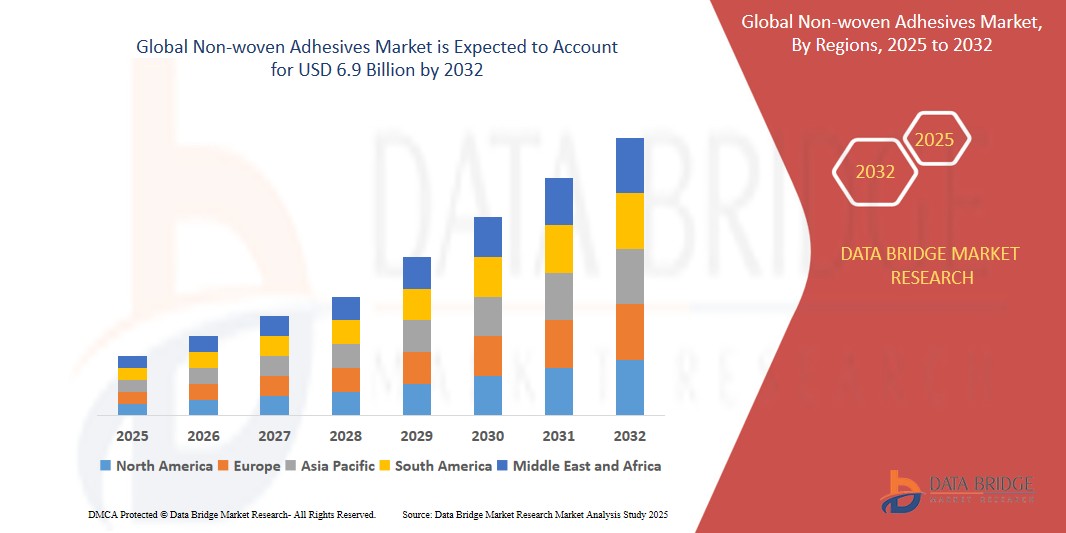
Non-woven Adhesives Market Size
- The Global Non-woven Adhesives Market size was valued at USD 3.68 billion in 2024 and is expected to reach USD 6.9 billion by 2032, at a CAGR of 8.18% during the forecast period
- This growth is driven by factors such as Rising Demand from Hygiene Products and Growth in Medical and Surgical Applications.
Non-woven Adhesives Market Analysis
- Non-woven Adhesives are versatile bonding agents extensively utilized in personal hygiene products, medical textiles, and packaging, owing to their superior adhesion, softness, and compatibility with nonwoven substrates.
- The market demand is primarily driven by the booming hygiene industry, growing population, and increased awareness of personal care. Expanding applications in baby diapers, adult incontinence products, and feminine hygiene items are significantly fueling the global consumption of non-woven adhesives.
- Asia-Pacific holds the largest share in the global non-woven adhesives market. This dominance is attributed to the region's robust manufacturing infrastructure, high demand for hygiene products, and significant investments in the healthcare sector.
- Asia-Pacific is anticipated to be the fastest-growing region in the market over the forecast period, propelled by rising birth rates, improving living standards, and growing adoption of disposable hygiene products across countries such as China, India, and Southeast Asia.
- The Personal Hygiene segment is expected to lead the market, accounting for the largest share due to its critical role in producing high-performance baby diapers, feminine care, and adult care products. Rising consumer expectations for comfort and skin-friendly products are also influencing innovations in non-woven adhesive formulations.
Report Scope and Non-woven Adhesives Market Segmentation
|
Attributes |
Non-woven Adhesives Key Market Insights |
|
Segments Covered |
|
|
Countries Covered |
North America
Europe
Asia-Pacific
Middle East and Africa
South America
|
|
Key Market Players |
|
|
Market Opportunities |
|
|
Value Added Data Infosets |
In addition to the insights on market scenarios such as market value, growth rate, segmentation, geographical coverage, and major players, the market reports curated by the Data Bridge Market Research also include import export analysis, production capacity overview, production consumption analysis, price trend analysis, climate change scenario, supply chain analysis, value chain analysis, raw material/consumables overview, vendor selection criteria, PESTLE Analysis, Porter Analysis, and regulatory framework. |
Non-woven Adhesives Market Trends
“Rising Demand in Personal Hygiene Sector”
- The increasing use of baby diapers, feminine hygiene, and adult incontinence products is significantly boosting demand for non-woven adhesives due to their comfort, strength, and skin-friendliness.
For instance,
- In August 2023, Kimberly-Clark expanded its production capacity in Brazil for adult incontinence products. The move responded to growing demand from an aging population, increasing the requirement for reliable, skin-safe non-woven adhesives critical for product comfort and secure bonding in personal hygiene products.
- Growing environmental concerns are pushing manufacturers to develop bio-based, solvent-free, and low-VOC non-woven adhesives, aligning with global sustainability goals and consumer preferences for eco-friendly hygiene products.
- Innovations in hot-melt technology are enhancing performance, reducing consumption, and improving bonding efficiency in non-woven hygiene applications, enabling faster production lines and lower operational costs for manufacturers.
- Rapid urbanization, rising income levels, and awareness of hygiene in countries like India, China, and Brazil are fueling strong growth in non-woven adhesive usage across consumer and medical applications.
Non-woven Adhesives Market Dynamics
Driver
“Rising Demand from Hygiene Products”
- Non-woven adhesives are crucial in the production of hygiene products like diapers, sanitary pads, and adult incontinence items due to their soft bonding, flexibility, and skin-friendly properties.
- The increasing birth rate in emerging economies and growing awareness about hygiene are fueling the demand for disposable hygiene products, directly driving non-woven adhesive consumption.
- Aging populations in developed nations are also contributing to the demand for adult incontinence products, where reliable adhesive solutions are essential for product performance and comfort.
- Manufacturers are investing in advanced non-woven adhesive technologies to improve bonding strength and reduce skin irritation, thereby supporting market expansion in the hygiene segment.
For instance,
- In January 2024, Procter & Gamble reported a surge in sales of baby diapers across Asia-Pacific, citing rising birth rates and hygiene awareness. This increased demand directly boosted the consumption of non-woven adhesives used in diaper manufacturing, especially in India and Southeast Asia..
Opportunity
“Emerging Markets in Asia-Pacific”
- Growing environmental concerns are creating demand for bio-based, sustainable adhesives that reduce the environmental footprint of disposable hygiene products.
- R&D in green chemistry and renewable raw materials is enabling the production of biodegradable non-woven adhesives that meet regulatory and consumer expectations.
- Brand owners and manufacturers are increasingly committing to sustainability goals, driving the adoption of eco-friendly adhesive formulations in non-woven products.
- These sustainable solutions offer market differentiation and open new segments among environmentally conscious consumers, creating long-term growth potential for green adhesive technologies.
Restraint/Challenge
“Volatility in Raw Material Prices”
- Non-woven adhesives rely on petrochemical-based raw materials, whose prices are subject to volatility due to geopolitical tensions, supply chain disruptions, and fluctuating crude oil prices.
- Such fluctuations lead to inconsistent production costs, affecting the profitability of adhesive manufacturers and limiting market growth in cost-sensitive regions.
- Frequent price changes can also hinder long-term contracts and planning for OEMs using non-woven adhesives, especially in hygiene product manufacturing.
- This volatility increases the need for stable supply agreements and alternative raw material sourcing, which may not always be feasible for smaller players.
Non-woven Adhesives Market Scope
The market is segmented on the basis of By type, application and technology.
|
Segmentation |
Sub-Segmentation |
|
By Type |
|
|
By Application |
|
|
By Technology |
|
In 2025, the Styrenic is projected to dominate the market with a largest share in Global Non-Woven Adhesives Market
In 2025, the Styrenic segment is projected to dominate the market, holding the largest share in the type category due to its excellent performance, versatility, processability, and strong demand in hygiene applications. Its superior bonding strength, flexibility, and compatibility with various substrates make it ideal for baby diapers and sanitary products.
The baby care segment is expected to witness fastest growth during the forecast period in Global Non-Woven Adhesives Market
Baby care is expected to witness fastest growth in Global Non-Woven Adhesives Market on account of continuous rise in demand from emerging countries including China and India. This is attributed to the numerous factors including rise in infant population, along with increasing awareness about baby hygiene through social media and other promotional activities.
Non-woven Adhesives Market Regional Analysis
“Asia-Pacific Holds the Largest Share in the Non-woven Adhesives Market”
- Asia-Pacific (APAC) holds the largest share in the global non-woven adhesives market. This dominance is attributed to the region's robust manufacturing infrastructure, high demand for hygiene products, and significant investments in the healthcare sector.
- China holds the largest share in the global non-woven adhesives market. This dominance is attributed to China's extensive manufacturing capabilities, robust production of hygiene products, and significant demand from both domestic and export markets.
“Asia-Pacific is Projected to Register the Highest CAGR in the Non-woven Adhesives Market”
- Asia-Pacific (APAC) region is projected to register the highest CAGR in the Non-woven Adhesives Market during the forecast period. This growth is driven by increasing demand from emerging economies, expanding manufacturing infrastructure, and rising awareness of hygiene and personal care products.
- China is projected to register the highest compound annual growth rate (CAGR) in the non-woven adhesives market during the forecast period. This growth is driven by factors such as increasing demand for hygiene products, expanding manufacturing capabilities, and significant investments in the healthcare sector.
Non-woven Adhesives Market Share
The market competitive landscape provides details by competitor. Details included are company overview, company financials, revenue generated, market potential, investment in research and development, new market initiatives, global presence, production sites and facilities, production capacities, company strengths and weaknesses, product launch, product width and breadth, application dominance. The above data points provided are only related to the companies' focus related to market.
The Major Market Leaders Operating in the Market Are:
- Palmetto Adhesives (U.S.)
- Henkel Adhesive Technologies India Private Limited (India)
- CoPIND SRL (Italy)
- H.B. Fuller Company (U.S.)
- Sav Holding S.p.A. (Italy)
- Bostik (France)
- MORESCO Corporation (Japan)
- ADTEK Consolidated Sdn. Bhd. (Malaysia)
- Beardow Adams (United Kingdom)
- Lohmann-koester GmbH & Co. KG (Germany)
- KRATON CORPORATION (U.S.)
- Evonik Industries AG (Germany)
- 3M (U.S.)
- COLQUÍMICA (Portugal)
- tesa Tapes Private Limited (India, subsidiary of tesa SE – Germany)
- Teraoka Seisakusho Co., Ltd. (Japan)
- Dow (U.S.)
- Arkema (France)
- LINTEC Corporation (Japan)
Latest Developments in Global Non-woven Adhesives Market
- In February 2021, Henkel introduced Technomelt Supra ECO, a new line of hot melt adhesives offering enhanced sustainability and reduced CO₂ emissions without compromising performance. This innovation aims to strengthen Henkel's position in the adhesives industry and cater to a broader range of applications.
- In December 2020, H.B. Fuller announced the availability of Advantra adhesives, designed for extreme cold storage conditions, including vaccine and medication packaging. These adhesives provide secure bonds at -94°F with tamper-evident fiber tear, addressing the challenges of cold chain logistics.
- In November 2020, Henkel, in collaboration with a partner, developed the Technomelt Advance MED range, a tailormade polyolefin adhesive line for the personal care industry. This range aims to minimize chemical odor and VOC emissions, suitable for medical facemasks, isolation gowns, and surgical drapes.
- In November 2020, H.B. Fuller introduced Full-Care 5885, an adhesive designed to meet the growing demand for natural-based hygiene articles. This product offers high-performance 100% cotton bonding at a low cost, catering to the evolving needs of the hygiene industry.
- In September 2020, Arkema announced the start-up of a new industrial adhesives plant in Nara, Japan, through its Bostik-Nitta joint venture. This expansion aims to serve the growing markets of diapers, hygiene, packaging, labeling, transportation, and electronics in Japan.

- Interactive Data Analysis Dashboard
- Company Analysis Dashboard for high growth potential opportunities
- Research Analyst Access for customization & queries
- Competitor Analysis with Interactive dashboard
- Latest News, Updates & Trend analysis
- Harness the Power of Benchmark Analysis for Comprehensive Competitor Tracking
Non Woven Adhesives Market, Supply Chain Analysis and Ecosystem Framework
To support market growth and help clients navigate the impact of geopolitical shifts, DBMR has integrated in-depth supply chain analysis into its Non Woven Adhesives Market research reports. This addition empowers clients to respond effectively to global changes affecting their industries. The supply chain analysis section includes detailed insights such as Non Woven Adhesives Market consumption and production by country, price trend analysis, the impact of tariffs and geopolitical developments, and import and export trends by country and HSN code. It also highlights major suppliers with data on production capacity and company profiles, as well as key importers and exporters. In addition to research, DBMR offers specialized supply chain consulting services backed by over a decade of experience, providing solutions like supplier discovery, supplier risk assessment, price trend analysis, impact evaluation of inflation and trade route changes, and comprehensive market trend analysis.
Data collection and base year analysis are done using data collection modules with large sample sizes. The stage includes obtaining market information or related data through various sources and strategies. It includes examining and planning all the data acquired from the past in advance. It likewise envelops the examination of information inconsistencies seen across different information sources. The market data is analysed and estimated using market statistical and coherent models. Also, market share analysis and key trend analysis are the major success factors in the market report. To know more, please request an analyst call or drop down your inquiry.
The key research methodology used by DBMR research team is data triangulation which involves data mining, analysis of the impact of data variables on the market and primary (industry expert) validation. Data models include Vendor Positioning Grid, Market Time Line Analysis, Market Overview and Guide, Company Positioning Grid, Patent Analysis, Pricing Analysis, Company Market Share Analysis, Standards of Measurement, Global versus Regional and Vendor Share Analysis. To know more about the research methodology, drop in an inquiry to speak to our industry experts.
Data Bridge Market Research is a leader in advanced formative research. We take pride in servicing our existing and new customers with data and analysis that match and suits their goal. The report can be customized to include price trend analysis of target brands understanding the market for additional countries (ask for the list of countries), clinical trial results data, literature review, refurbished market and product base analysis. Market analysis of target competitors can be analyzed from technology-based analysis to market portfolio strategies. We can add as many competitors that you require data about in the format and data style you are looking for. Our team of analysts can also provide you data in crude raw excel files pivot tables (Fact book) or can assist you in creating presentations from the data sets available in the report.













