North America and Latin America Plant Breeding and CRISPR Plants Market Size
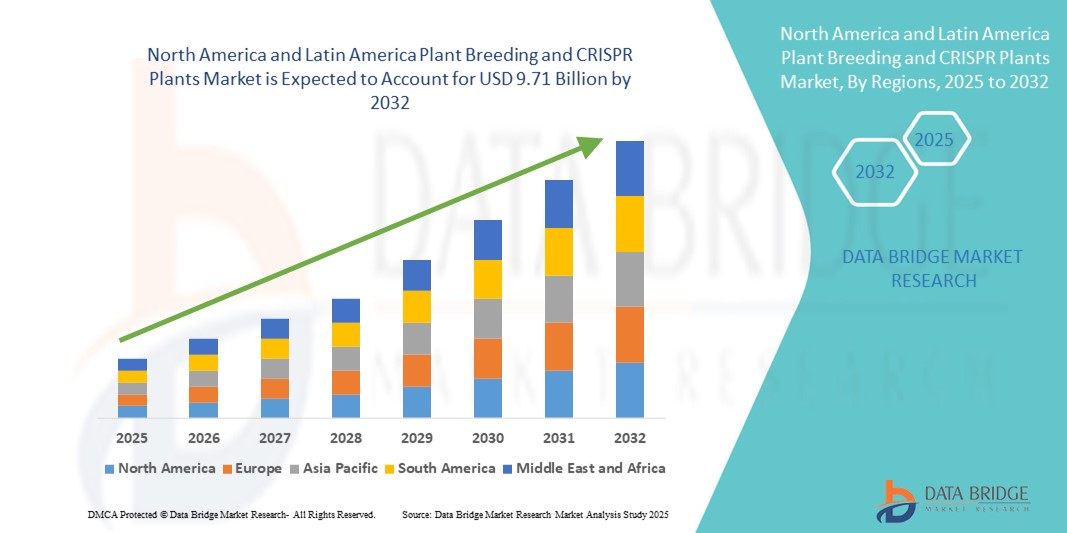
- The North America and Latin America plant breeding and CRISPR plants market size was valued at USD 9.71 billion in 2024 and is expected to reach USD 37.76 billion by 2032, at a CAGR of 18.50% during the forecast period
- The market growth is largely driven by the rising demand for high-yield, disease-resistant, and climate-resilient crops, along with increasing adoption of advanced genomic tools and biotechnology in agriculture
- Furthermore, growing governmental and private sector investments in agri-genomics, alongside favorable regulatory frameworks for gene editing technologies, are positioning CRISPR as a transformative tool in crop development. These converging factors are accelerating the implementation of precision breeding techniques, thereby significantly boosting the industry's growth
North America and Latin America Plant Breeding and CRISPR Plants Market Analysis
- Plant breeding and CRISPR-based crop development are becoming increasingly vital in enhancing agricultural productivity, nutritional value, and environmental resilience across North and Latin America, driven by the need for sustainable and precision-based farming practices
- The surging demand for genetically optimized crops is primarily fueled by climate change challenges, rising food security concerns, and the push for higher yields with minimal resource inputs, making modern breeding techniques indispensable in the region's agri-biotech landscape
- North America dominated the plant breeding and CRISPR plants market with the largest revenue share of 47,1% in 2024, characterized by strong research infrastructure, high adoption of agri-genomic technologies, and supportive regulatory pathways, especially in the U.S., where public and private sector collaborations are accelerating the commercialization of gene-edited crops
- Latin America is expected to be the fastest growing region in the plant breeding and CRISPR plants market during the forecast period due to expanding agricultural land, rising biotech investments, and increasing government support for advanced crop improvement initiatives
- The cereals & grains segment dominated the plant breeding and CRISPR plants market with a share of 41.8% in 2024, driven by the high demand for improved varieties of maize, wheat, and rice that offer enhanced resistance to pests, drought, and diseases
Report Scope and North America and Latin America Plant Breeding and CRISPR Plants Market Segmentation
|
Attributes |
North America and Latin America Plant Breeding and CRISPR Plants Key Market Insights |
|
Segments Covered |
|
|
Countries Covered |
|
|
Key Market Players |
|
|
Market Opportunities |
|
|
Value Added Data Infosets |
In addition to the insights on market scenarios such as market value, growth rate, segmentation, geographical coverage, and major players, the market reports curated by the Data Bridge Market Research also include in-depth expert analysis, pricing analysis, brand share analysis, consumer survey, demography analysis, supply chain analysis, value chain analysis, raw material/consumables overview, vendor selection criteria, PESTLE Analysis, Porter Analysis, and regulatory framework. |
North America and Latin America Plant Breeding and CRISPR Plants Market Trends
Precision Agriculture Through AI and Genomic Integration
- A significant and accelerating trend in the North America and Latin America plant breeding and CRISPR plants market is the convergence of advanced genomic technologies with artificial intelligence (AI) to drive precision agriculture and crop improvement at scale. This synergy is optimizing breeding cycles, accelerating trait identification, and enhancing decision-making in agricultural research
- For instance, Corteva Agriscience and Benson Hill have been investing in AI-powered breeding platforms that integrate multi-omic data to identify superior genetic traits with greater speed and accuracy. Similarly, Brazil’s EMBRAPA is leveraging AI to enhance genomic prediction models for crop varieties adapted to specific climatic and soil conditions
- AI integration enables predictive modeling to assess how CRISPR-edited traits will perform under various environmental stresses, significantly reducing trial-and-error in field testing. This leads to improved selection efficiency, shorter development timelines, and more robust crop varieties tailored to regional agricultural challenges
- The adoption of these technologies is fostering a new wave of “smart breeding,” where gene-editing platforms such as CRISPR-Cas9 are combined with machine learning to improve resistance to drought, pests, and diseases while maintaining high yield potential
- This trend is fundamentally transforming traditional plant breeding by enabling scalable, data-driven innovation. It is attracting increased investment from agribusinesses and governments across North and Latin America, as both regions seek to enhance food security and sustainability in the face of climate change
North America and Latin America Plant Breeding and CRISPR Plants Market Dynamics
Driver
Accelerating Demand for Climate-Resilient and High-Yield Crops
- The growing challenges posed by climate change, such as erratic weather patterns, droughts, and crop diseases, are major drivers accelerating the demand for climate-resilient and high-yield crops in North America and Latin America
- For instance, in March 2024, Syngenta announced a collaboration with CIMMYT to develop CRISPR-edited maize varieties that resist heat stress, a critical concern for Latin American farmers. Such collaborations are expected to support market growth in the coming years
- CRISPR and modern breeding tools enable rapid development of crop varieties that can withstand environmental extremes while meeting the nutritional and economic needs of farmers. These technologies offer precise control over desirable traits without the extended timeframes required by conventional breeding
- In North America, the adoption is further driven by supportive regulatory frameworks and strong R&D infrastructure. Meanwhile, Latin America is seeing rising investment from multinational seed companies aiming to meet growing food demands in expanding agricultural zones
- The ability to address region-specific challenges, such as drought tolerance in Mexico or fungal resistance in Brazil, makes CRISPR breeding tools particularly valuable, propelling their integration into public and private breeding programs across both regions
Restraint/Challenge
Regulatory Uncertainty and Public Perception Hurdles
- Despite the potential benefits, the adoption of CRISPR and gene-edited crops in North America and Latin America faces regulatory and societal challenges that can slow market growth. Divergent regulatory stances and slow policy updates hinder timely commercialization and cross-border trade
- For instance, while the U.S. has taken a more permissive approach to gene-edited crops that do not contain foreign DNA, regulatory ambiguity in some Latin American countries has led to delays in approvals and commercialization efforts
- Public skepticism and ethical concerns regarding genetically modified organisms (GMOs) and gene-editing persist in several countries, further complicating adoption. Misinformation and lack of consumer education on the difference between CRISPR and traditional transgenics often amplify resistance
- Moreover, small and medium-sized agricultural firms may find compliance with evolving biosafety and labeling requirements costly and complex, limiting their participation in this high-tech market
- Overcoming these challenges will require harmonized regulatory frameworks, increased transparency, and robust public outreach initiatives to build consumer and stakeholder trust in gene-edited agriculture
North America and Latin America Plant Breeding and CRISPR Plants Market Scope
The market is segmented on the basis of type, trait, and application.
- By Type
On the basis of type, the plant breeding and CRISPR plants market is segmented into conventional breeding, biotechnological method, and genetic engineering. The conventional breeding segment held the largest market revenue share in 2024, owing to its widespread adoption, cost-effectiveness, and long-standing acceptance in crop improvement programs across both regions. Farmers and breeders continue to rely on traditional cross-breeding techniques to enhance traits such as yield, pest resistance, and climate adaptability, especially in staple crops.
The genetic engineering segment is projected to witness the fastest growth rate from 2025 to 2032 due to its ability to introduce precise genetic changes with minimal unintended mutations. This method, which includes CRISPR-Cas systems, is gaining traction for its efficiency, regulatory acceptance (particularly in the U.S.), and ability to rapidly develop crops that address evolving climate and disease pressures. Latin American countries are also beginning to accelerate trials and commercialization of gene-edited crops, particularly in corn and soybeans.
- By Trait
On the basis of trait, the market is segmented into herbicide tolerance, yield improvement, disease resistance, temperature tolerance, grain size improvement, stress tolerance, drought resistance, and others. The herbicide tolerance segment dominated the market in 2024, driven by the increasing adoption of herbicide-tolerant crops to manage weeds more effectively and reduce manual labor in large-scale commercial agriculture, especially in countries such as the U.S., Brazil, and Argentina.
The drought resistance segment is expected to grow at the fastest rate from 2025 to 2032, as both regions face increased water stress due to climate change. Breeding programs are increasingly focused on developing drought-resilient varieties of maize, wheat, and soybeans to sustain productivity in water-limited environments.
- By Application
On the basis of application, the market is segmented into cereal & grains, oilseed & pulses, fruits & vegetables, cash crops, turf & ornamental, herbs and microgreen, medicinal crop, and other crop types. The cereal & grains segment held the largest market share of 41.8% in 2024, due to the dominance of staple crops such as maize, wheat, and rice in North and Latin American agriculture. These crops are a primary focus for yield improvement, pest resistance, and resilience breeding using both traditional and CRISPR-based methods.
The fruits & vegetables segment is anticipated to register the fastest CAGR from 2025 to 2032. Growing consumer demand for nutrient-dense, longer shelf-life, and visually appealing produce is driving innovation in CRISPR-edited varieties such as tomatoes, lettuce, and strawberries. In addition, the increasing presence of vertical farming and greenhouse operations in the U.S. and parts of Latin America is supporting the adoption of high-value horticultural crop breeding.
North America and Latin America Plant Breeding and CRISPR Plants Market Regional Analysis
- North America dominated the plant breeding and CRISPR plants market with the largest revenue share of 47,1% in 2024, characterized by strong research infrastructure, high adoption of agri-genomic technologies, and supportive regulatory pathways, especially in the U.S., where public and private sector collaborations are accelerating the commercialization of gene-edited crops
- Consumers in the region highly value the convenience, advanced security features, and seamless integration offered by North America and Latin America Plant Breeding and CRISPR Plantss with other smart devices such as thermostats and lighting systems.
- This widespread adoption is further supported by high disposable incomes, a technologically inclined population, and the growing preference for remote monitoring and control, establishing North America and Latin America Plant Breeding and CRISPR Plantss as a favored solution for both residential and commercial properties
U.S. North America and Latin America Plant Breeding and CRISPR Plants Market Insight
The U.S. plant breeding and CRISPR plants market captured the largest revenue share of 84% in 2024 within North America, fueled by advanced R&D infrastructure, favorable regulatory frameworks, and a strong presence of agri-biotech leaders. The nation’s focus on precision agriculture and food security is driving investment in CRISPR technologies across staple crops such as corn, soybean, and wheat. In addition, public-private partnerships and research collaborations with land-grant universities are further accelerating trait development, commercialization, and technology transfer across the U.S. farming ecosystem.
Canada Plant Breeding and CRISPR Plants Market Insight
The Canada plant breeding and CRISPR plants market is projected to grow at a robust CAGR during the forecast period, supported by strategic agricultural innovation programs and increased adoption of sustainable farming practices. Canadian producers are actively investing in gene-edited crops for improved yield, herbicide resistance, and climate adaptability—particularly in oilseeds and grains. Government initiatives, such as the Protein Industries Supercluster, are fostering a favorable environment for innovation and commercialization of plant biotechnology.
Mexico Plant Breeding and CRISPR Plants Market Insight
The Mexico plant breeding and CRISPR plants market is poised for strong growth, backed by rising food security concerns and a push toward modernizing the agricultural sector. Government support for sustainable farming, coupled with increasing awareness of biotechnology’s role in improving yields, is encouraging adoption among both smallholders and commercial growers. CRISPR-based improvements in corn, fruits, and vegetables are of particular interest, especially in high-altitude and arid regions requiring climate-adapted varieties.
Latin America Plant Breeding and CRISPR Plants Market Insight
The Latin America plant breeding and CRISPR plants market is projected to grow at a substantial CAGR during the forecast period, fueled by the region’s strong agricultural foundation and growing demand for high-yield, climate-resilient crops. Countries such as Brazil, Argentina, and Mexico are leading the adoption of CRISPR technologies, supported by favorable regulatory policies, expanding R&D capabilities, and increasing collaboration with global seed companies. The need to enhance productivity, combat crop diseases, and adapt to climate variability is driving the adoption of advanced breeding techniques across major crops such as soybeans, maize, sugarcane, and fruits. The region’s focus on export-driven agriculture and sustainability is further propelling the market for gene-edited and precision-bred crop varieties.
Brazil Plant Breeding and CRISPR Plants Market Insight
The Brazil plant breeding and CRISPR plants market is anticipated to expand at a significant CAGR throughout the forecast period, driven by its status as a global agricultural powerhouse. With a high dependence on soybean, sugarcane, and corn production, Brazil is leveraging CRISPR technology to improve productivity, disease resistance, and environmental resilience. Supportive biosafety regulations and active collaborations between local research institutions and global seed companies are facilitating rapid deployment of gene-edited crop varieties across commercial farms.
Argentina Plant Breeding and CRISPR Plants Market Insight
The Argentina plant breeding and CRISPR plants market is expected to grow steadily, supported by progressive regulatory policies and a longstanding commitment to agricultural biotechnology. As one of the first countries in Latin America to greenlight CRISPR-edited crops, Argentina has created a robust framework for innovation. The market is gaining momentum in key crops such as wheat, maize, and soybeans, with national and international R&D collaborations driving cost-effective, climate-resilient seed development tailored to local growing conditions.
North America and Latin America Plant Breeding and CRISPR Plants Market Share
The North America and Latin America Plant Breeding and CRISPR Plants industry is primarily led by well-established companies, including:
- Corteva Agriscience (U.S.)
- Bayer AG (Germany)
- Syngenta Group (Switzerland)
- BASF SE (Germany)
- KWS SAAT SE & Co. KGaA (Germany)
- Limagrain (France)
- DLF Seeds A/S (Denmark)
- Sakata Seed Corporation (Japan)
- Rijk Zwaan Zaadteelt en Zaadhandel B.V. (Netherlands)
- Takii & Co., Ltd. (Japan)
- Bejo Zaden B.V. (Netherlands)
- Enza Zaden Beheer B.V. (Netherlands)
- East-West Seed (Thailand)
- Seminis Vegetable Seeds, Inc. (U.S.)
- Bioceres Crop Solutions Corp. (Argentina)
- KeyGene N.V. (Netherlands)
- Pairwise Plants Services Inc. (U.S.)
- Inari Agriculture, Inc. (U.S.)
- Benson Hill, Inc. (U.S.)
- InVivo Group (France)
What are the Recent Developments in North America and Latin America Plant Breeding and CRISPR Plants Market?
- In March 2023, Corteva Agriscience, a leading U.S. agritech company, announced a groundbreaking CRISPR-based gene-editing technology to combat multiple corn diseases. The technique packages multiple disease-resistance traits into a single genomic location using native genes, offering enhanced protection to elite corn hybrids and demonstrating Corteva’s drive toward precision breeding for North American agriculture
- In 2022, Embrapa (Brazilian Agricultural Research Corporation) utilized CRISPR to deactivate antinutritional factors in soybeans, improve oil quality, and activate drought tolerance genes. This work reflects Brazil’s advancing capabilities in CRISPR plant innovations
- In March 2023, Bioceres Crop Solutions Corp. (Argentina) announced that its drought-tolerant HB4 wheat received regulatory approval in Brazil, following prior approval in Argentina. This milestone paves the way for commercialization across Latin America, reinforcing regional leadership in resilient gene-edited crops
- In May 2024, Pairwise, a U.S.-based agri-genomics startup, expanded commercialization of CRISPR-edited mustard leafy greens—the first CRISPR food available in North America—through an exclusive licensing agreement with Bayer to scale distribution across retail markets
- In July 2024, a study published in Oil Crop Science demonstrated that CRISPR-Cas9 knockout of the E4 gene promoted faster maturation in soybeans with no detected off-target effects, providing a potential avenue to improve crop adaptation to changing growing seasons
- In December 2024, researchers introduced a novel DNA-free, genotype-independent CRISPR/Cas9 system for soybean (in planta bombardment-RNP method) that avoids foreign DNA and traditional tissue culture, offering a streamlined and potentially more acceptable gene-editing approach for soybean improvement

- Interactive Data Analysis Dashboard
- Company Analysis Dashboard for high growth potential opportunities
- Research Analyst Access for customization & queries
- Competitor Analysis with Interactive dashboard
- Latest News, Updates & Trend analysis
- Harness the Power of Benchmark Analysis for Comprehensive Competitor Tracking
Data collection and base year analysis are done using data collection modules with large sample sizes. The stage includes obtaining market information or related data through various sources and strategies. It includes examining and planning all the data acquired from the past in advance. It likewise envelops the examination of information inconsistencies seen across different information sources. The market data is analysed and estimated using market statistical and coherent models. Also, market share analysis and key trend analysis are the major success factors in the market report. To know more, please request an analyst call or drop down your inquiry.
The key research methodology used by DBMR research team is data triangulation which involves data mining, analysis of the impact of data variables on the market and primary (industry expert) validation. Data models include Vendor Positioning Grid, Market Time Line Analysis, Market Overview and Guide, Company Positioning Grid, Patent Analysis, Pricing Analysis, Company Market Share Analysis, Standards of Measurement, Global versus Regional and Vendor Share Analysis. To know more about the research methodology, drop in an inquiry to speak to our industry experts.
Data Bridge Market Research is a leader in advanced formative research. We take pride in servicing our existing and new customers with data and analysis that match and suits their goal. The report can be customized to include price trend analysis of target brands understanding the market for additional countries (ask for the list of countries), clinical trial results data, literature review, refurbished market and product base analysis. Market analysis of target competitors can be analyzed from technology-based analysis to market portfolio strategies. We can add as many competitors that you require data about in the format and data style you are looking for. Our team of analysts can also provide you data in crude raw excel files pivot tables (Fact book) or can assist you in creating presentations from the data sets available in the report.