


What is the Automated Border Control Market Size and Growth Rate?
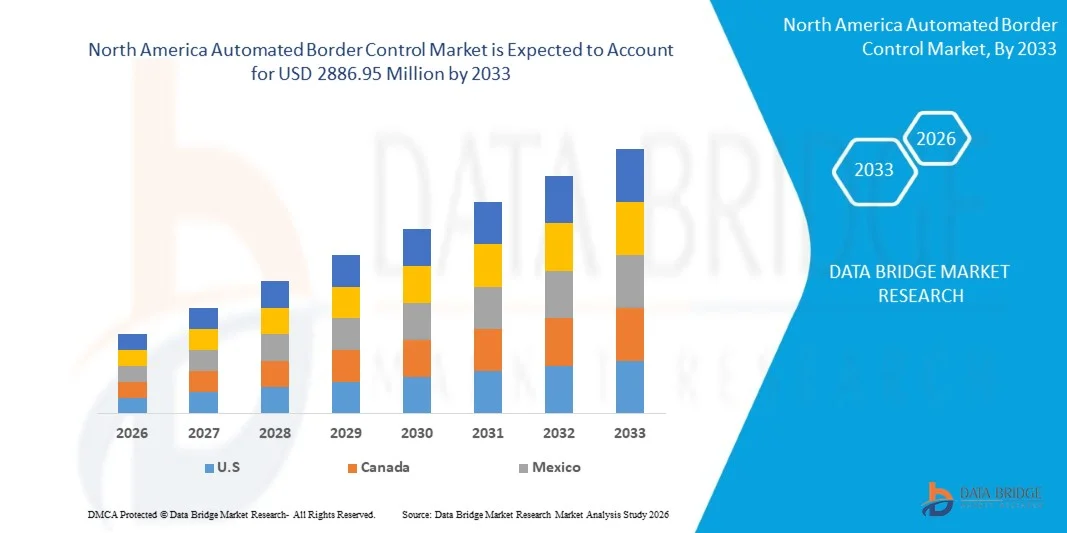
- As per Data Bridge Market Research Analysis the North America automated border control market size was valued at USD 708.32 million in 2025 and is expected to reach USD 2886.95 million by 2033, at a CAGR of 19.2% during the forecast period
- The market growth is largely fueled by increasing global air travel and cross-border passenger movement, leading to higher demand for efficient and automated immigration processing systems at airports and border checkpoints
- Furthermore, rising government focus on strengthening border security and adopting advanced biometric technologies is establishing automated border control systems as essential infrastructure for modern border management. These converging factors are accelerating the deployment of e-gates and kiosks, thereby significantly boosting the industry's growth
Market Size & Forecast
- Global Market Value (2025): USD 708.32 million
- Expected Market Value (2033): USD 2886.95 million
- Forecast CAGR (2026–2033): 19.2%
What are the Major Takeaways of Automated Border Control Market?
- Automated border control systems, offering biometric-based identity verification and seamless passenger processing at immigration checkpoints, are becoming critical components of modern border management across airports, land borders, and seaports due to their ability to enhance security, reduce wait times, and improve operational efficiency
- The escalating demand for automated border control solutions is primarily fueled by increasing adoption of biometric technologies, rising concerns over illegal immigration and identity fraud, and a growing preference for contactless and self-service travel experiences among passengers
- S. dominated the automated border control market in 2025, due to high international passenger traffic, strong investments in airport modernization, and early adoption of advanced biometric border management systems across major airports
- Canada is expected to be the fastest growing region in the automated border control market during the forecast period due to rising cross-border travel, increasing investments in smart airport infrastructure, and growing adoption of biometric-based identity verification systems
- Hardware segment dominated the market with a market share of 54.8% in 2025, due to the extensive deployment of biometric scanners, document readers, cameras, and gate systems required for border control operations. These physical components form the backbone of ABC systems, ensuring secure identity verification and seamless passenger movement. Governments and airport authorities continue to invest heavily in upgrading hardware infrastructure to support next-generation biometric technologies
Report Scope and Automated Border Control Market Segmentation
|
Attributes |
Automated Border Control Key Market Insights |
|
Segments Covered |
|
|
Countries Covered |
North America
|
|
Key Market Players |
|
|
Market Opportunities |
|
|
Value Added Data Infosets |
|
What is the Key Trend in the Automated Border Control Market?
“Increasing Adoption of Biometric and Contactless Border Control Technologies”
- A significant trend in the automated border control market is the increasing adoption of biometric and contactless technologies, driven by the need for faster, more secure, and seamless passenger processing across global border checkpoints. This shift is transforming traditional immigration procedures into highly automated and efficient systems that minimize human intervention and enhance traveler experience
- For instance, Home Office initiated programs to deploy contactless border solutions in the United Kingdom, enabling travelers to pass through checkpoints without physical interaction or the use of e-gates. Such implementations demonstrate the growing reliance on digital identity verification and biometric authentication to streamline border operations
- Airports are rapidly integrating facial recognition and e-passport verification systems into e-gates to support high passenger throughput while maintaining strict security standards. This trend is improving operational efficiency and reducing congestion at immigration checkpoints, especially in high-traffic international hubs
- Governments are investing in advanced biometric technologies such as iris recognition and fingerprint scanning to strengthen identity verification and prevent fraud. These systems enhance accuracy and reliability, supporting national security objectives while enabling smooth cross-border movement
- The demand for contactless solutions has accelerated due to increasing emphasis on hygiene and safety in travel environments, encouraging authorities to deploy touchless verification systems. This is reinforcing the transition toward fully automated and user-friendly border control experiences
- The market is witnessing continuous innovation in biometric platforms and digital travel credentials, which is driving the evolution of integrated and intelligent border management systems. This trend is positioning automated border control technologies as essential components of future-ready and secure global travel infrastructure
Automated Border Control Market Dynamics
Driver
“Rising Global Air Passenger Traffic and Cross-Border Movement”
- The rising volume of international air travel and cross-border movement is significantly driving the demand for automated border control systems, as authorities seek efficient solutions to manage increasing passenger flows. These systems enable faster processing and reduce dependency on manual checks, improving overall border management efficiency
- For instance, International Air Transport Association highlights the continuous growth in global passenger traffic, prompting airports to adopt automated solutions such as biometric e-gates and kiosks to handle large volumes efficiently. This trend is accelerating the deployment of advanced border technologies across major international airports
- Airports are expanding infrastructure and integrating automated systems to minimize wait times and enhance passenger experience during peak travel periods. This is driving investments in scalable and high-performance border control solutions capable of managing large traveler volumes
- The increase in international tourism and business travel is further intensifying the need for seamless and secure border processing systems. Automated solutions help governments balance efficiency with strict security requirements in high-traffic environments
- The continuous growth in global mobility and air travel is reinforcing the long-term demand for automated border control technologies. This driver is strengthening market expansion by supporting the transition toward faster, smarter, and more efficient border management systems
Restraint/Challenge
“High Initial Investment and Integration Complexity”
- The automated border control market faces challenges due to the high initial investment required for deploying advanced biometric systems, infrastructure, and integrated software platforms. These costs can be significant for governments and authorities, particularly in developing regions with budget constraints
- For instance, Thales Group provides advanced biometric border systems that require substantial investment in hardware, software, and system integration, making large-scale deployment financially demanding. This highlights the cost-intensive nature of implementing comprehensive automated border solutions
- Integrating automated systems with existing legacy infrastructure and national security databases presents technical complexities that require specialized expertise. This can lead to longer implementation timelines and increased project costs
- The need for continuous system upgrades, maintenance, and cybersecurity enhancements further adds to operational expenses. Authorities must ensure that systems remain secure, reliable, and compliant with evolving regulations
- These financial and technical constraints continue to limit widespread adoption, particularly in regions with limited resources. The challenge of balancing cost, complexity, and performance remains a critical factor influencing the pace of market growth
How is the Automated Border Control Market Segmented?
The market is segmented on the basis of type, component, and application.
- By Type
On the basis of type, the automated border control market is segmented into ABC e-gates and ABC kiosks. The ABC e-gates segment dominated the market with the largest market revenue share in 2025, driven by its ability to enable fully automated passenger processing with minimal human intervention. These systems enhance throughput efficiency at immigration checkpoints by integrating biometric verification such as facial recognition and e-passport authentication. Airports increasingly prefer e-gates due to their capability to handle high passenger volumes while maintaining stringent security standards. The growing emphasis on contactless travel and reduced processing time further strengthens the adoption of e-gates across major international airports. In addition, advancements in biometric accuracy and system interoperability have reinforced their position as the primary solution for modern border management infrastructure.
The ABC kiosks segment is anticipated to witness the fastest growth rate from 2026 to 2033, fueled by their flexibility in pre-processing passenger data before reaching border control officers. These kiosks allow travelers to scan passports, capture biometric data, and complete declarations, thereby reducing congestion at primary inspection points. Governments are increasingly deploying kiosks to complement existing border systems and enhance operational efficiency without large infrastructure overhauls. Their cost-effectiveness and ease of deployment make them suitable for both developed and emerging markets. The integration of advanced software interfaces and multilingual support further improves user experience, contributing to their rapid adoption.
- By Component
On the basis of component, the automated border control market is segmented into hardware, software, and services. The hardware segment dominated the market with the largest market revenue share of 54.8% in 2025, driven by the extensive deployment of biometric scanners, document readers, cameras, and gate systems required for border control operations. These physical components form the backbone of ABC systems, ensuring secure identity verification and seamless passenger movement. Governments and airport authorities continue to invest heavily in upgrading hardware infrastructure to support next-generation biometric technologies. The increasing installation of e-gates and kiosks across international terminals further accelerates hardware demand. In addition, the need for durable, high-performance equipment capable of operating in high-traffic environments supports sustained growth of this segment.
The software segment is expected to witness the fastest CAGR from 2026 to 2033, driven by the rising importance of data analytics, biometric matching algorithms, and system integration capabilities. Advanced software solutions enable real-time identity verification, risk assessment, and seamless communication between border control databases and security agencies. The growing adoption of artificial intelligence and machine learning enhances accuracy and reduces false positives in identity checks. Cloud-based platforms and centralized control systems are further enabling scalability and remote monitoring of border operations. Continuous updates and cybersecurity enhancements also contribute to the increasing reliance on sophisticated software solutions.
- By Application
On the basis of application, the automated border control market is segmented into airport, land port, and seaport. The airport segment dominated the market with the largest market revenue share in 2025, driven by the high volume of international air travel and the need for efficient passenger processing systems. Airports are early adopters of ABC technologies due to increasing passenger traffic and the necessity to minimize wait times while ensuring strict security compliance. The integration of biometric e-gates with airline and immigration databases enhances operational efficiency and passenger experience. Continuous investments in smart airport infrastructure and digital transformation initiatives further strengthen this segment’s dominance. In addition, regulatory mandates supporting biometric identification at airports are accelerating widespread adoption.
The land port segment is anticipated to witness the fastest growth rate from 2026 to 2033, fueled by increasing cross-border travel and trade activities across regional boundaries. Governments are focusing on modernizing land border checkpoints to improve security and reduce congestion caused by manual inspections. The deployment of portable and scalable ABC solutions is enabling efficient processing of travelers in high-traffic border regions. Growing concerns related to illegal migration and security threats are further driving the adoption of automated systems at land ports. Enhanced connectivity and integration with national security databases also support the rapid expansion of this segment.
Which Region Holds the Largest Share of the Automated Border Control Market?
- S. dominated the automated border control market with the largest revenue share in 2025, driven by high international passenger traffic, strong investments in airport modernization, and early adoption of advanced biometric border management systems across major airports
- The demand for automated border control solutions is further supported by continuous innovation and large-scale deployment of biometric technologies such as facial recognition, iris scanning, and e-passport verification by companies such as NEC Corporation and Thales Group, focusing on seamless passenger processing, enhanced security screening, and integrated border management systems
- The presence of advanced security infrastructure, strong government regulations on border protection, and increasing focus on contactless travel solutions reinforces the U.S. leadership position in the North America market. Growing adoption of e-gates and automated kiosks across international airports further strengthens market dominance
Canada Automated Border Control Market Insight
Canada is projected to register the fastest CAGR in the North America automated border control market from 2026 to 2033, supported by rising cross-border travel, increasing investments in smart airport infrastructure, and growing adoption of biometric-based identity verification systems. The country’s strong focus on enhancing border security while improving passenger convenience is accelerating the deployment of automated solutions. Market growth is further supported by expansion activities and technology deployments from companies such as SITA and Vision-Box, focusing on digital identity management, seamless passenger flow, and advanced e-gate systems. Increasing emphasis on secure and efficient border operations positions Canada as the fastest-growing country in the region during the forecast period.
Mexico Automated Border Control Market Insight
Mexico is expected to grow steadily from 2026 to 2033, driven by increasing international tourism, rising cross-border movement, and expanding airport infrastructure development. The growing need to enhance border security and reduce processing times is creating demand for automated border control systems across major transit hubs. Increasing awareness regarding biometric identification and digital border management is further supporting market expansion. Market development is strengthened by deployments and service capabilities from companies such as Indra Sistemas and Gunnebo Group, focusing on automated gates, identity verification systems, and integrated border control solutions. Rising investments in transportation infrastructure and tourism sector growth contribute to sustained expansion of the North America automated border control market throughout the forecast period.
Which are the Top Companies in Automated Border Control Market?
The automated border control industry is primarily led by well-established companies, including:
- Secunet (Germany)
- IER (France)
- IDEMIA (France)
- Dermalog (Malaysia)
- Identification Systems GmbH (Germany)
- SITA (Switzerland)
- Cognitec Systems GmbH (Germany)
- Securiport LLC (U.S.)
- Veridos (Greece)
- HID Global Corporation (U.S.)
- NEC Corporation (Japan)
- Indra Sistemas (Spain)
- Accenture (Ireland)
- Gunnebo AB (Sweden)
- Vision Box (Portugal)
- Collins Aerospace (U.S.)
- Aware, Inc. (U.S.)
- Vancouver Airport Authority (Canada)
- Atos S.E. (France)
What are Latest Developments in Automated Border Control Market?
- In July 2022, the U.K. Home Secretary revealed plans to introduce contactless border checkpoints as part of a broader strategy to modernize the country’s border infrastructure. The Home Office announced its intention to pilot new technology in 2024 that would allow select travelers to enter the United Kingdom and complete automated border checks without using eGates or interacting with a Border Force official. This initiative is designed to leverage advanced biometric verification and digital identity systems to enable seamless passenger movement while maintaining strict security standards. It represents a significant shift toward fully automated, frictionless border crossings, reducing wait times and enhancing traveler convenience across major entry points
- In June 2022, Bangladesh became the first South Asian country to implement electronic airport checkpoints, introducing e-gates at Hazrat Shahjalal International Airport for e-passport holders. These gates allow passengers to complete immigration procedures efficiently through automated identity verification and biometric authentication with minimal manual intervention. The deployment enhances processing speed, reduces congestion at immigration counters, and improves overall passenger experience. This advancement highlights Bangladesh’s commitment to adopting smart border technologies and strengthening digital infrastructure within its aviation sector
- In April 2022, Smiths Detection launched iCMORE Money, an advanced automated currency detection software designed to identify concealed money in carry-on luggage. The system is capable of detecting up to 100 banknotes across currencies such as Euro, U.S. Dollar, and Saudi Riyal, even when rolled or stacked within bags. By integrating with existing X-ray screening systems, the solution enhances the ability of security agencies to detect illicit financial transfers and suspicious activities at checkpoints. This innovation strengthens border security operations by improving inspection accuracy while maintaining efficient passenger throughput
- In February 2021, Tallinn Airport and the Narva Road Border Crossing introduced an automated border control system aimed at streamlining border procedures. The system incorporates biometric verification and automated document checks to accelerate passenger processing at both air and land entry points. This implementation significantly improved operational efficiency by reducing manual inspections and wait times for travelers. The initiative reflects Estonia’s continued focus on digital innovation and the modernization of its border management systems
- In January 2021, IDEMIA, in collaboration with Sopra Steria, signed a contract to deploy a biometric border control system in France. The solution is based on advanced biometric technologies, including facial recognition and fingerprint authentication, to enhance identity verification processes at border checkpoints. It is intended to strengthen both the security and efficiency of border operations by enabling faster and more reliable passenger processing. This move underscores France’s strategic investment in modern biometric systems to support automated border control and improve national security infrastructure

- Interactive Data Analysis Dashboard
- Company Analysis Dashboard for high growth potential opportunities
- Research Analyst Access for customization & queries
- Competitor Analysis with Interactive dashboard
- Latest News, Updates & Trend analysis
- Harness the Power of Benchmark Analysis for Comprehensive Competitor Tracking
North America Automated Border Control Market, Supply Chain Analysis and Ecosystem Framework
To support market growth and help clients navigate the impact of geopolitical shifts, DBMR has integrated in-depth supply chain analysis into its North America Automated Border Control Market research reports. This addition empowers clients to respond effectively to global changes affecting their industries. The supply chain analysis section includes detailed insights such as North America Automated Border Control Market consumption and production by country, price trend analysis, the impact of tariffs and geopolitical developments, and import and export trends by country and HSN code. It also highlights major suppliers with data on production capacity and company profiles, as well as key importers and exporters. In addition to research, DBMR offers specialized supply chain consulting services backed by over a decade of experience, providing solutions like supplier discovery, supplier risk assessment, price trend analysis, impact evaluation of inflation and trade route changes, and comprehensive market trend analysis.
Data collection and base year analysis are done using data collection modules with large sample sizes. The stage includes obtaining market information or related data through various sources and strategies. It includes examining and planning all the data acquired from the past in advance. It likewise envelops the examination of information inconsistencies seen across different information sources. The market data is analysed and estimated using market statistical and coherent models. Also, market share analysis and key trend analysis are the major success factors in the market report. To know more, please request an analyst call or drop down your inquiry.
The key research methodology used by DBMR research team is data triangulation which involves data mining, analysis of the impact of data variables on the market and primary (industry expert) validation. Data models include Vendor Positioning Grid, Market Time Line Analysis, Market Overview and Guide, Company Positioning Grid, Patent Analysis, Pricing Analysis, Company Market Share Analysis, Standards of Measurement, Global versus Regional and Vendor Share Analysis. To know more about the research methodology, drop in an inquiry to speak to our industry experts.
Data Bridge Market Research is a leader in advanced formative research. We take pride in servicing our existing and new customers with data and analysis that match and suits their goal. The report can be customized to include price trend analysis of target brands understanding the market for additional countries (ask for the list of countries), clinical trial results data, literature review, refurbished market and product base analysis. Market analysis of target competitors can be analyzed from technology-based analysis to market portfolio strategies. We can add as many competitors that you require data about in the format and data style you are looking for. Our team of analysts can also provide you data in crude raw excel files pivot tables (Fact book) or can assist you in creating presentations from the data sets available in the report.













