


North America Chromatography Solvents Market Size
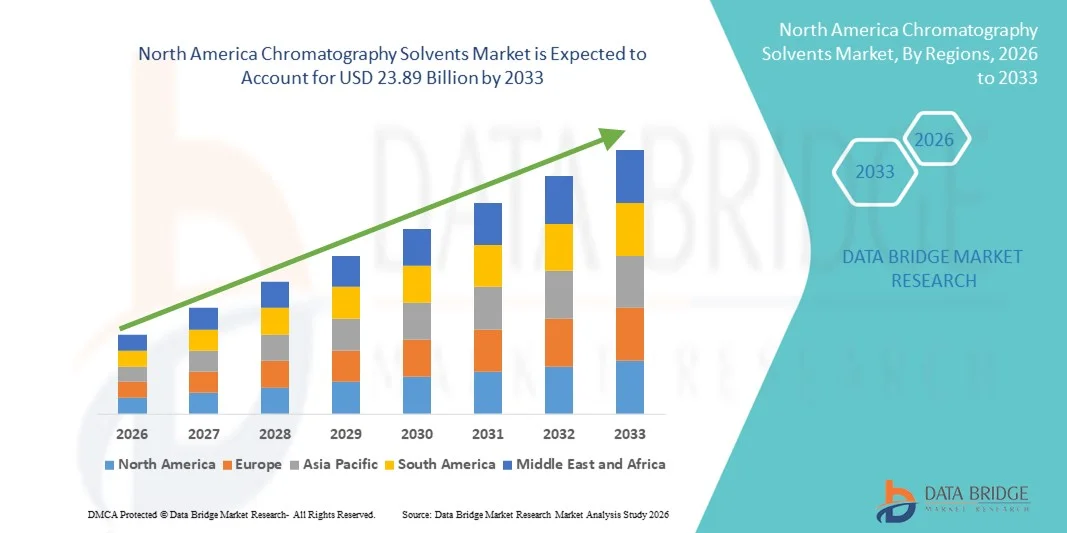
- The North America chromatography solvents market size was valued at USD 13.40 billion in 2025 and is expected to reach USD 23.89 billion by 2033, at a CAGR of 7.5% during the forecast period
- The market growth is largely fueled by the growing adoption and technological progress within analytical laboratories, particularly in pharmaceutical R&D, clinical diagnostics, and quality control applications, which depend heavily on high‑performance chromatography solvents for accurate separation and analysis
- Furthermore, rising demand for reliable, high‑purity solvents in biotechnological research, environmental testing, food safety, and academic applications is establishing chromatography solvents as essential components of modern analytical workflows. These converging factors are accelerating the uptake of solvents throughout the region, thereby significantly boosting the industry’s growth
North America Chromatography Solvents Market Analysis
- Chromatography solvents, essential for separation, purification, and analytical applications in pharmaceutical, biotechnology, environmental, and food testing laboratories, are increasingly vital components of modern analytical workflows due to their high purity, reproducibility, and compatibility with advanced chromatography techniques
- The escalating demand for chromatography solvents is primarily fueled by the growing adoption of advanced analytical technologies, increasing pharmaceutical R&D activities, stringent regulatory requirements for drug and food safety, and the rising need for precise and reliable laboratory testing
- The United States dominated the North America chromatography solvents market with the largest revenue share of 65.9% in 2025, characterized by the high concentration of pharmaceutical and biotechnology companies, advanced laboratory infrastructure, and strong R&D expenditure, with innovations in HPLC, GC, and UPLC techniques driving significant demand
- Canada is the expected to be the fastest growing country in North America chromatography solvents market, supported by increasing investments in pharmaceutical manufacturing, clinical diagnostics, and food safety testing laboratories, along with growing adoption of high-purity solvents
- HPLC segment dominated the North America chromatography solvents market with a market share of 45.2% in 2025, driven by their critical role in pharmaceutical quality control, clinical diagnostics, and high-precision analytical applications
Report Scope and North America Chromatography Solvents Market Segmentation
|
Attributes |
North America Chromatography Solvents Key Market Insights |
|
Segments Covered |
|
|
Countries Covered |
North America
|
|
Key Market Players |
|
|
Market Opportunities |
|
|
Value Added Data Infosets |
In addition to the insights on market scenarios such as market value, growth rate, segmentation, geographical coverage, and major players, the market reports curated by the Data Bridge Market Research also include in-depth expert analysis, patient epidemiology, pipeline analysis, pricing analysis, and regulatory framework |
North America Chromatography Solvents Market Trends
Rising Adoption of High-Purity and Specialty Solvents
- A significant and accelerating trend in the North America chromatography solvents market is the growing use of high-purity and specialty solvents in pharmaceutical, biotechnology, and analytical laboratories, enhancing precision and reproducibility in testing and research
- For instance, HPLC-grade acetonitrile and methanol are increasingly used in drug development and quality control workflows, ensuring highly accurate chromatographic separations and reliable analytical results
- Integration of ultra-high-performance liquid chromatography (UHPLC) techniques with specialty solvents allows laboratories to reduce analysis time and solvent consumption while maintaining superior resolution and sensitivity
- The adoption of automated sample preparation and chromatography systems in combination with advanced solvents facilitates higher throughput and consistency, streamlining complex laboratory workflows
- Collaborations between solvent producers and analytical instrument manufacturers are enhancing solvent compatibility and overall workflow efficiency, improving performance across diverse laboratory platforms
- This trend toward more efficient, precise, and application-specific solvent usage is fundamentally reshaping expectations for laboratory performance and accuracy, with manufacturers developing tailored solvent solutions for niche analytical applications
- The demand for chromatography solvents that support specialized analytical methods is growing rapidly across pharmaceutical, clinical, and environmental laboratories, as these sectors increasingly prioritize accuracy, reproducibility, and compliance with regulatory standards
North America Chromatography Solvents Market Dynamics
Driver
Growing Demand Driven by Pharmaceutical R&D and Quality Control Needs
- The increasing pharmaceutical and biotechnology R&D activities, coupled with stringent regulatory requirements for drug safety and quality, are significant drivers for the heightened demand for chromatography solvents
- For instance, in March 2025, MilliporeSigma launched a new line of ultra-high-purity solvents specifically for analytical chromatography, targeting pharmaceutical quality control applications
- As laboratories focus on precise and reproducible analytical results, chromatography solvents enable advanced techniques such as HPLC, GC, and UHPLC for drug development, environmental testing, and food safety analysis
- Furthermore, the growing popularity of automated laboratory workflows and high-throughput analysis is making chromatography solvents an essential component of modern analytical laboratories
- The need for reliable, high-performance solvents that meet stringent regulatory and quality standards is a key factor propelling adoption in both pharmaceutical and academic sectors
- Expansion of contract research organizations (CROs) and outsourcing of analytical testing is increasing regional demand for standardized, high-quality chromatography solvents
- Rising focus on personalized medicine and biologics development is driving laboratories to adopt advanced solvent systems to handle complex biomolecule separations efficiently
Restraint/Challenge
High Cost and Regulatory Compliance Hurdles
- The relatively high cost of high-purity chromatography solvents compared to bulk-grade chemicals poses a significant challenge to broader market adoption, particularly for smaller laboratories or budget-conscious institutions
- For instance, acetonitrile price volatility in North America has periodically increased operational costs for analytical laboratories, limiting accessibility for routine testing
- Strict regulatory compliance and documentation requirements for solvent purity, handling, and disposal add complexity for manufacturers and end-users, potentially slowing market growth
- Additionally, supply chain disruptions or shortages of specialty solvents can affect consistent laboratory operations, increasing reliance on robust sourcing strategies
- Overcoming these challenges through cost optimization, local production, and compliance-focused solutions will be vital for sustained growth of the chromatography solvents market in North America
- Environmental and sustainability concerns over solvent disposal and VOC emissions are compelling companies to invest in greener, less hazardous alternatives, which may require additional R&D and capital investment
- The need for specialized training in solvent handling and laboratory safety protocols can limit adoption in smaller or emerging laboratories, adding operational and compliance burdens
North America Chromatography Solvents Market Scope
The market is segmented on the basis of application, type, technology, and end user.
- By Application
On the basis of application, the North America chromatography solvents market is segmented into analytical chromatography and preparative chromatography. The analytical chromatography segment dominated the market with the largest market revenue share of 60% in 2025, driven by its widespread use in pharmaceutical quality control, environmental testing, food safety analysis, and clinical diagnostics. Analytical chromatography requires high-purity solvents to ensure accurate, reproducible separation and detection of complex mixtures. Laboratories in the U.S. particularly prioritize analytical applications due to stringent regulatory standards and high R&D activity. The availability of specialized solvents such as HPLC-grade acetonitrile, methanol, and water has further strengthened demand. Moreover, the segment benefits from the expansion of CROs and contract testing laboratories focusing on high-throughput and precise analytical workflows. Pharmaceutical, biotechnology, and academic research laboratories heavily rely on analytical chromatography, reinforcing its dominant position in the region.
The preparative chromatography segment is expected to witness the fastest growth rate of 8.5% from 2026 to 2033, fueled by increasing demand in biopharmaceutical manufacturing for protein, peptide, and antibody purification. Preparative chromatography requires large volumes of high-quality solvents for process-scale separations, particularly in biologics production. The rise in monoclonal antibody therapies and complex biologics has created a need for scalable purification workflows, driving solvent consumption. Preparative applications also benefit from automation and process optimization technologies, improving efficiency and reducing solvent waste. The growing adoption of personalized medicine and biologics manufacturing in North America further supports the rapid growth of this segment.
- By Type
On the basis of type, the market is segmented into polar solvents and non-polar solvents. The polar solvents segment dominated the market with the largest revenue share of 55% in 2025, driven by their extensive use in HPLC, UHPLC, and GC applications for polar analytes. Solvents such as methanol, acetonitrile, and water are essential for achieving high resolution and reproducibility in analytical separations. The segment benefits from stringent pharmaceutical and environmental testing regulations, requiring reliable and consistent solvent performance. Polar solvents are critical in quality control, clinical diagnostics, and environmental monitoring, where precise analytical results are mandatory. North American laboratories invest heavily in high-purity polar solvents to maintain compliance and meet research accuracy standards. The established supply chains and broad availability of polar solvents further reinforce their dominant market position.
The non-polar solvents segment is expected to witness the fastest CAGR from 2026 to 2033, driven by increasing use in preparative chromatography, sample extraction, and purification of hydrophobic compounds. Solvents such as hexane, toluene, and dichloromethane are critical for lipid, organic compound, and polymer separations. Rising demand in biopharmaceutical purification, cosmetic ingredient testing, and specialty chemical analysis contributes to this growth. Non-polar solvents also support environmentally friendly and green chemistry approaches when optimized for reduced toxicity and VOC emissions. Growth in small biotech firms and contract manufacturing facilities further drives adoption.
- By Technology
On the basis of technology, the market is segmented into LC, HPLC, UHPLC, GC, and others. The HPLC segment dominated the market with the largest revenue share of 45.2% in 2025, driven by its critical role in pharmaceutical R&D, quality control, and regulatory compliance. HPLC applications require high-purity solvents to achieve reproducible separations, making it the backbone of analytical laboratories. The widespread adoption of HPLC in both clinical diagnostics and environmental testing has reinforced its leading position. North American laboratories heavily invest in HPLC systems for precise quantification and method validation, particularly in drug development. Strong support from solvent manufacturers for HPLC-grade solvents ensures consistent performance and reliability. HPLC’s flexibility in analyzing diverse compound types also strengthens its dominance.
The UHPLC segment is expected to witness the fastest growth rate of 9% from 2026 to 2033, fueled by its enhanced resolution, speed, and reduced solvent consumption compared to conventional HPLC. UHPLC is increasingly adopted in high-throughput pharmaceutical, biotechnology, and academic laboratories for complex sample analysis. The need for faster analysis without compromising accuracy is driving solvent demand for UHPLC. Integration with automated systems and process optimization technologies enhances efficiency and supports rapid growth. Regulatory and environmental considerations also encourage laboratories to switch to UHPLC to reduce solvent usage and waste.
- By End User
On the basis of end user, the market is segmented into pharmaceutical, biotechnology industry, academics and research, environmental, cosmetic industry, and food and beverage. The pharmaceutical industry segment dominated the market with the largest revenue share of 45% in 2025, driven by the extensive use of chromatography solvents in drug discovery, formulation, quality control, and regulatory compliance testing. Solvents such as HPLC-grade acetonitrile, methanol, and water are essential for precise analytical separations in active pharmaceutical ingredient (API) and formulation analysis. North American pharmaceutical companies are major consumers due to stringent FDA and EMA guidelines. Strong R&D investment and high-volume testing reinforce the dominance of this end-user segment. Additionally, contract testing and outsourced analytical services further amplify solvent consumption in pharmaceutical workflows.
The biotechnology industry segment is expected to witness the fastest growth rate of 10% from 2026 to 2033, fueled by the rising adoption of chromatography solvents in biologics manufacturing, protein purification, and complex biomolecule analysis. Increasing development of monoclonal antibodies, vaccines, and gene therapies requires large volumes of high-purity solvents for preparative and analytical applications. The expansion of biotech startups and contract manufacturing organizations (CMOs) in North America further supports rapid adoption. Advanced solvent formulations optimized for protein stability and separation efficiency are increasingly in demand, driving growth. Regulatory compliance and the push for high-throughput and automated processes also contribute to this segment’s accelerated growth.
North America Chromatography Solvents Market Regional Analysis
- The United States dominated the North America chromatography solvents market with the largest revenue share of 65.9% in 2025, characterized by the high concentration of pharmaceutical and biotechnology companies, advanced laboratory infrastructure, and strong R&D expenditure, with innovations in HPLC, GC, and UPLC techniques driving significant demand
- Laboratories in the region highly value the precision, reproducibility, and high purity offered by chromatography solvents, which are critical for pharmaceutical quality control, environmental testing, clinical diagnostics, and food safety analysis
- This widespread adoption is further supported by strong R&D investment, a technologically advanced laboratory ecosystem, and the growing demand for high-throughput and automated analytical workflows, establishing chromatography solvents as an essential component in both research and commercial laboratory applications
U.S. Chromatography Solvents Market Insight
The U.S. chromatography solvents market captured the largest revenue share of 65.9% in 2025 within North America, fueled by the strong presence of pharmaceutical and biotechnology companies and the region’s advanced laboratory infrastructure. Laboratories are increasingly prioritizing high-purity solvents for pharmaceutical quality control, clinical diagnostics, and environmental testing. The growing demand for automated, high-throughput analytical workflows, combined with the adoption of HPLC, UHPLC, and GC technologies, further propels the market. Moreover, stringent regulatory requirements and a focus on R&D investment are significantly contributing to market expansion.
Canada Chromatography Solvents Market Insight
The Canada chromatography solvents market is expected to grow at a substantial CAGR during the forecast period, driven by expanding pharmaceutical and biotech activities and increasing investments in clinical and environmental laboratories. The adoption of high-performance analytical technologies, along with the demand for precise and reproducible testing, fosters solvent usage. Canadian laboratories emphasize compliance with quality and regulatory standards, increasing the consumption of high-purity solvents. The country also benefits from collaborations between solvent manufacturers and analytical service providers, accelerating adoption in research and industrial labs.
Mexico Chromatography Solvents Market Insight
The Mexico chromatography solvents market is anticipated to expand at a considerable CAGR during the forecast period, fueled by growing pharmaceutical manufacturing and chemical industries, alongside increasing regulatory compliance requirements. Rising demand for environmental and food testing is promoting the adoption of high-purity analytical solvents. Mexico’s laboratories are investing in advanced chromatography techniques, including HPLC and GC, to meet quality standards. The development of local distribution networks and the presence of regional solvent suppliers are improving accessibility, supporting market growth in both research and commercial applications.
North America Chromatography Solvents Market Share
The North America Chromatography Solvents industry is primarily led by well-established companies, including:
- Thermo Fisher Scientific Inc (U.S.)
- Merck KGaA (Germany)
- Agilent Technologies (U.S.)
- Avantor Inc (U.S.)
- Honeywell International Inc (U.S.)
- VWR International (U.S.)
- Tedia Company Inc (U.S.)
- Spectrum Chemical Manufacturing Corp (U.S.)
- Regis Technologies Inc (U.S.)
- Columbus Chemical Industries (U.S.)
- GFS Chemicals Inc (U.S.)
- Restek Corporation (U.S.)
- PerkinElmer Inc (U.S.)
- Waters Corporation (U.S.)
- Bio Rad Laboratories (U.S.)
- Phenomenex (U.S.)
- SPEX CertiPrep (U.S.)
- Zymo Research (U.S.)
- MilliporeSigma Supelco (U.S.)
- Bio Solutions (U.S.)
What are the Recent Developments in North America Chromatography Solvents Market?
- In December 2025, Thermo Fisher Scientific announced the release of a new range of Fisher Chemical UHPLC Gradient Grade Solvents designed for ultra‑high performance liquid chromatography, offering lower baseline noise, fewer pump blockages, and enhanced sensitivity for high‑throughput analytical applications in pharmaceutical and biotech labs
- In October 2025, Merck Life Science (MilliporeSigma in the U.S. and Canada) introduced bio‑based HPLC‑grade solvents that support greener chromatography workflows, helping laboratories reduce reliance on fossil‑derived reagents while maintaining high analytical performance
- In September 2025, Thermo Fisher Scientific completed its acquisition of Solventum’s Purification and Filtration business, strengthening its portfolio in bioprocess filtration and separation technologies that support downstream purification workflows in drug development laboratories that rely on high‑purity solvents and separation processes. This strategic move is expected to enhance Thermo Fisher’s capabilities to serve pharmaceutical and biotech labs with integrated purification and solvent support solutions
- In June 2025, Thermo Fisher Scientific released new ultra‑high purity UHPLC gradient‑grade solvents designed for high‑sensitivity chromatography applications in analytical and research laboratories, offering extremely low filtration (0.1 µm), reduced baseline noise, and improved performance under high pressure. These solvents are ideal for UHPLC workflows in pharmaceutical, biotech, and environmental labs requiring consistent, interference‑free results in high‑throughput analysis
- In March 2025, Axcend launched a compact full‑stack chromatography system with real‑time monitoring and automated sampling capability, enhancing liquid chromatography workflows which indirectly increases the demand and use of high‑quality chromatography solvents in analytical labs

- Interactive Data Analysis Dashboard
- Company Analysis Dashboard for high growth potential opportunities
- Research Analyst Access for customization & queries
- Competitor Analysis with Interactive dashboard
- Latest News, Updates & Trend analysis
- Harness the Power of Benchmark Analysis for Comprehensive Competitor Tracking
Data collection and base year analysis are done using data collection modules with large sample sizes. The stage includes obtaining market information or related data through various sources and strategies. It includes examining and planning all the data acquired from the past in advance. It likewise envelops the examination of information inconsistencies seen across different information sources. The market data is analysed and estimated using market statistical and coherent models. Also, market share analysis and key trend analysis are the major success factors in the market report. To know more, please request an analyst call or drop down your inquiry.
The key research methodology used by DBMR research team is data triangulation which involves data mining, analysis of the impact of data variables on the market and primary (industry expert) validation. Data models include Vendor Positioning Grid, Market Time Line Analysis, Market Overview and Guide, Company Positioning Grid, Patent Analysis, Pricing Analysis, Company Market Share Analysis, Standards of Measurement, Global versus Regional and Vendor Share Analysis. To know more about the research methodology, drop in an inquiry to speak to our industry experts.
Data Bridge Market Research is a leader in advanced formative research. We take pride in servicing our existing and new customers with data and analysis that match and suits their goal. The report can be customized to include price trend analysis of target brands understanding the market for additional countries (ask for the list of countries), clinical trial results data, literature review, refurbished market and product base analysis. Market analysis of target competitors can be analyzed from technology-based analysis to market portfolio strategies. We can add as many competitors that you require data about in the format and data style you are looking for. Our team of analysts can also provide you data in crude raw excel files pivot tables (Fact book) or can assist you in creating presentations from the data sets available in the report.













