


What is the North America Deep Brain Stimulation Systems Market Size and Growth Rate?
- The North America deep brain stimulation systems market size was valued at USD 1.09 billion in 2025 and is expected to reach USD 3.46 billion by 2033, at a CAGR of 15.5% during the forecast period
- The market growth is largely fueled by rising prevalence of movement and neuropsychiatric disorders continuous technological advances in neurostimulation hardware and closed-loop systems, and increasing procedure volumes driven by improved clinical evidence and broader indications
- Furthermore, strong R&D investment, favorable reimbursement shifts in selected U.S. programs, and growing capacity in specialized surgical centers are driving adoption of DBS as a durable, precise neuromodulation therapy across both hospital and ambulatory settings together these factors are accelerating uptake of DBS solutions and significantly boosting the region’s market growth
What are the Major Takeaways of North America Deep Brain Stimulation Systems Market?
- Deep brain stimulation systems, offering targeted electrical neuromodulation through implanted electrodes and pulse generators, are increasingly vital therapeutic solutions for managing complex neurological and movement disorders in the United States and Canada, due to their proven long-term efficacy, programmability, and ability to significantly improve patients’ quality of life
- The escalating demand for deep brain stimulation systems is primarily fueled by the rising prevalence of Parkinson’s disease, essential tremor, dystonia, and other treatment-resistant neurological conditions, along with growing awareness of neuromodulation therapies and continuous technological advancements such as rechargeable and adaptive (closed-loop) DBS systems
- The United States dominated the North America deep brain stimulation systems market with a revenue share of 82.5% in 2025, characterized by advanced healthcare infrastructure, high healthcare expenditure, strong clinical research activity, favorable reimbursement pathways, and a high concentration of specialized neurosurgical centers performing DBS procedure
- Canada is expected to witness steady growth during the forecast period due to increasing diagnosis rates of movement disorders, expanding access to specialized neurological care, and gradual integration of DBS therapies within publicly funded healthcare systems
- Parkinson’s disease segment dominated the deep brain stimulation systems market with a share 61.9% in 2025, driven by the high disease burden, extensive clinical validation of DBS efficacy, and increasing preference for surgical intervention among patients with medication-refractory symptoms
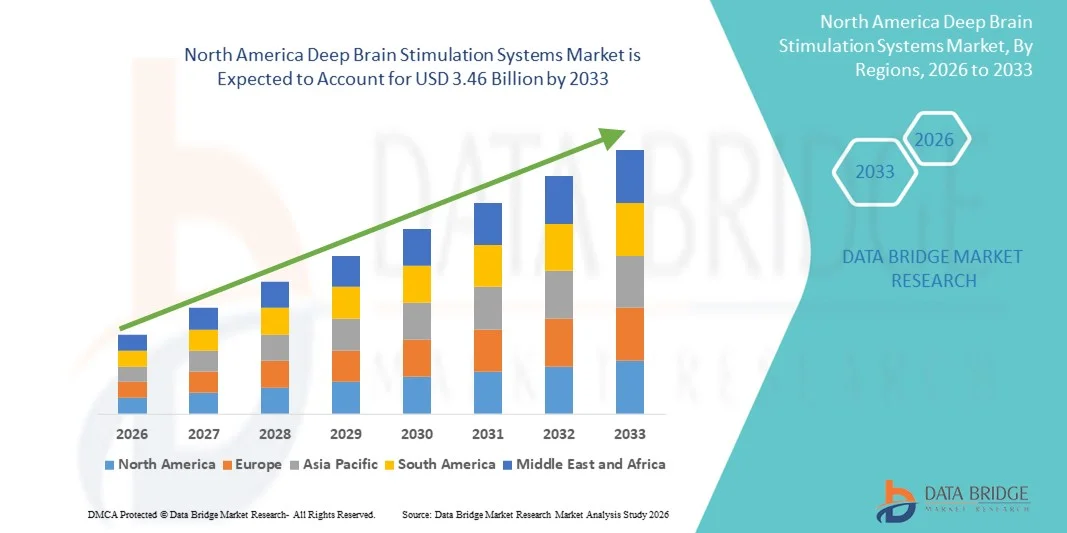
Report Scope and North America Deep Brain Stimulation Systems Market Segmentation
|
Attributes |
North America Deep Brain Stimulation Systems Key Market Insights |
|
Segments Covered |
|
|
Countries Covered |
North America
|
|
Key Market Players |
|
|
Market Opportunities |
|
|
Value Added Data Infosets |
In addition to the insights on market scenarios such as market value, growth rate, segmentation, geographical coverage, and major players, the market reports curated by the Data Bridge Market Research also include in-depth expert analysis, patient epidemiology, pipeline analysis, pricing analysis, and regulatory framework |
What are the North America Deep Brain Stimulation Systems Market Trends?
Advancement Toward Adaptive and Personalized Neuromodulation
- A significant and accelerating trend in the North America deep brain stimulation systems market is the shift toward adaptive (closed-loop) DBS technologies that can automatically adjust stimulation parameters based on real-time neural signals, improving clinical precision and patient outcomes
- These next-generation DBS systems are enhancing therapeutic effectiveness by reducing side effects and optimizing symptom control through continuous monitoring of brain activity and personalized stimulation delivery
- For instance, leading manufacturers have introduced sensing-enabled implantable pulse generators that allow clinicians to tailor therapy based on patient-specific neural biomarkers, supporting more individualized treatment pathways
- Technological advancements are also improving device longevity and patient convenience through the adoption of rechargeable batteries, smaller implant sizes, and wireless programming capabilities, reducing the need for frequent surgical replacements
- The integration of advanced software analytics and remote programming tools is enabling clinicians to fine-tune DBS therapy more efficiently, supporting long-term disease management and improved patient follow-up
- This trend toward smarter, data-driven, and patient-centric DBS solutions is reshaping clinical expectations for neuromodulation therapies, driving increased adoption across specialized neurological centers in North America
North America Deep Brain Stimulation Systems Market Dynamics
Driver
Rising Burden of Neurological Disorders and Technological Progress
- The increasing prevalence of Parkinson’s disease, essential tremor, dystonia, and other refractory neurological conditions, combined with rapid technological advancements in neuromodulation, is a key driver accelerating demand for deep brain stimulation systems in North America
- For instance, ongoing clinical research and expanded FDA approvals for new DBS indications and device upgrades are reinforcing clinician confidence and encouraging wider adoption of DBS procedures
- As pharmacological therapies often lose effectiveness over time, DBS offers a long-term, adjustable treatment option for patients with medication-refractory symptoms, strengthening its role in advanced neurological care
- Furthermore, strong healthcare infrastructure, high healthcare spending, and the presence of specialized neurosurgical centers are supporting higher procedure volumes and faster uptake of innovative DBS technologies
- Growing awareness among patients and physicians regarding the benefits of DBS, along with improved surgical techniques and post-implantation management, is further propelling market growth across the U.S. and Canada
- Expanding clinical indications beyond movement disorders into psychiatric and cognitive conditions is creating additional demand for DBS therapies
Restraint/Challenge
High Procedure Costs and Limited Patient Accessibility
- The high overall cost associated with deep brain stimulation therapy, including device implantation, surgery, and long-term follow-up, remains a significant challenge to broader market penetration in North America
- For instance, despite favorable reimbursement in certain cases, coverage limitations and strict eligibility criteria can restrict patient access to DBS, particularly within publicly funded healthcare systems
- The complexity of DBS procedures requires highly skilled neurosurgeons and multidisciplinary care teams, limiting availability to specialized centers and creating geographic access disparities
- In addition, concerns related to surgical risks, device-related complications, and the need for periodic battery replacement or device management can deter some patients from opting for DBS therapy
- Patient hesitancy due to the invasive nature of brain surgery and long-term implant dependence continues to act as a psychological and clinical barrier
- Addressing these challenges through cost optimization, expanded reimbursement frameworks, improved patient selection, and continued technological innovation will be essential for sustaining long-term growth in the North America deep brain stimulation systems market
North America Deep Brain Stimulation Systems Market Scope
The market is segmented on the basis of product type, type, application, and end user.
- By Product Type
On the basis of product type, the North America deep brain stimulation systems market is segmented into single-channel deep brain stimulators and dual-channel deep brain stimulators. The dual-channel deep brain stimulator segment dominated the market in 2025, driven by its ability to stimulate bilateral brain targets simultaneously, which is particularly critical for managing advanced Parkinson’s disease and complex movement disorders. Clinicians prefer dual-channel systems due to their superior therapeutic flexibility, enabling independent programming of each electrode for optimized symptom control. These systems support a wider range of indications and allow personalized treatment adjustments over time. Their higher clinical efficacy and strong physician familiarity have supported widespread adoption across major neurosurgical centers. In addition, dual-channel systems are often paired with advanced software and sensing capabilities, reinforcing their dominance.
The single-channel deep brain stimulator segment is expected to witness the fastest growth during the forecast period, driven by increasing use in early-stage or unilateral neurological conditions. These systems offer a cost-effective alternative for selected patients who do not require bilateral stimulation. Rising healthcare cost pressures and expanding patient access initiatives are encouraging adoption of single-channel devices. Technological improvements have also enhanced their precision and reliability. Growing acceptance in outpatient and specialized clinics further supports segment growth.
- By Type
On the basis of type, the market is segmented into rechargeable and non-rechargeable deep brain stimulation systems. The non-rechargeable segment held the largest market revenue share in 2025, supported by its long-standing clinical use and simplicity of operation. These systems are preferred for elderly patients or those with cognitive challenges, as they eliminate the need for regular charging compliance. Many clinicians continue to rely on non-rechargeable devices due to predictable performance and established surgical workflows. Their suitability for patients with lower stimulation energy requirements further strengthens adoption. Strong reimbursement familiarity has also contributed to their continued dominance.
The rechargeable segment is anticipated to grow at the fastest rate from 2026 to 2033, driven by increasing demand for longer device lifespan and reduced replacement surgeries. Rechargeable systems significantly lower long-term healthcare costs by extending battery life up to 15 years. Advances in wireless charging and patient-friendly charging systems have improved user acceptance. These devices are particularly favored for younger patients and those requiring high-energy stimulation. Growing emphasis on value-based care is accelerating adoption of rechargeable DBS systems.
- By Application
On the basis of application, the market is segmented into obsessive compulsive disorder (OCD), Parkinson’s disease, essential tremor, epilepsy, and dystonia. The Parkinson’s disease segment dominated the North America DBS systems market in 2025 with a market share of 61.9%, driven by the high prevalence of the condition and strong clinical evidence supporting DBS efficacy. DBS is widely adopted for patients with medication-refractory symptoms, such as tremors and motor fluctuations. Long-term symptom control and improved quality of life have made DBS a standard therapeutic option in advanced Parkinson’s care. High awareness among neurologists and patients further supports segment dominance. Favorable reimbursement and guideline inclusion reinforce sustained demand.
The obsessive compulsive disorder (OCD) segment is expected to witness the fastest growth during the forecast period, driven by expanding clinical trials and regulatory approvals for psychiatric indications. Increasing recognition of DBS as a viable option for treatment-resistant OCD is fueling adoption. Growing mental health awareness and unmet therapeutic needs are accelerating research investments. Advances in targeting precision and adaptive stimulation are improving outcomes in psychiatric applications. These developments are positioning OCD as a key future growth area for DBS systems.
- By End User
On the basis of end user, the market is segmented into hospitals, ambulatory surgical centers (ASCs), and neurological clinics. The hospitals segment accounted for the largest market share in 2025, driven by the availability of advanced surgical infrastructure and multidisciplinary care teams. DBS implantation requires highly specialized neurosurgical expertise, imaging capabilities, and post-operative monitoring, which are predominantly available in hospitals. High patient inflow and complex case handling further strengthen hospital dominance. Hospitals also serve as primary centers for clinical research and training. Strong reimbursement alignment supports continued utilization in hospital settings.
The ambulatory surgical centers (ASCs) segment is projected to grow at the fastest rate over the forecast period, driven by the shift toward cost-effective and outpatient surgical care. Improvements in minimally invasive surgical techniques are enabling DBS-related procedures to be performed safely in ASC settings. Shorter hospital stays and lower procedural costs are attracting both providers and patients. Increasing investment in specialized ASCs with neurology focus is supporting growth. This trend aligns with broader healthcare system efforts to optimize efficiency and reduce inpatient burden.
North America Deep Brain Stimulation Systems Market Regional Analysis
- The United States dominated the North America deep brain stimulation systems market with a revenue share of 82.5% in 2025, characterized by advanced healthcare infrastructure, high healthcare expenditure, strong clinical research activity, favorable reimbursement pathways, and a high concentration of specialized neurosurgical centers performing DBS procedure
- Patients and clinicians in the region highly value the long-term clinical efficacy, precision symptom control, and programmability offered by DBS systems, particularly for conditions such as Parkinson’s disease, essential tremor, and dystonia
- This widespread adoption is further supported by high healthcare spending, strong clinical research activity, favorable reimbursement frameworks in the U.S., and the presence of specialized neurosurgical centers, establishing DBS as a preferred advanced therapy across the region
U.S. Deep Brain Stimulation Systems Market Insight
The U.S. deep brain stimulation systems market captured the largest revenue share of 82.5% in 2025 within North America, fueled by the high prevalence of neurological disorders such as Parkinson’s disease, essential tremor, and dystonia. Patients and clinicians are increasingly prioritizing advanced neuromodulation therapies for medication-refractory conditions. The growing number of specialized neurosurgical centers, favorable reimbursement frameworks, and robust clinical research supporting DBS efficacy further propels market growth. Moreover, technological advancements in adaptive and rechargeable systems, combined with remote programming capabilities, are significantly contributing to the expansion of the DBS market in the country.
Canada Deep Brain Stimulation Systems Market Insight
The Canada deep brain stimulation systems market is expected to grow at a steady CAGR during the forecast period, driven by increasing diagnosis rates of movement disorders and expanding access to specialized neurological care. Patients are showing a growing preference for DBS as an effective alternative to pharmacological therapies for advanced Parkinson’s disease and other refractory conditions. Government support and publicly funded healthcare initiatives are gradually enhancing accessibility to DBS procedures. The adoption of innovative DBS devices, including sensing-enabled and adaptive systems, is accelerating market penetration. Furthermore, awareness campaigns and clinical programs are educating patients and physicians, supporting adoption across major urban centers
Mexico Deep Brain Stimulation Systems Market Insight
The Mexico DBS systems market is expected to grow steadily during the forecast period, driven by increasing awareness of neurological disorders such as Parkinson’s disease, essential tremor, and dystonia. Patients and clinicians are gradually adopting DBS as an effective therapy for medication-refractory conditions. Expansion of specialized neurology centers and investment in advanced surgical infrastructure are supporting market growth. Government initiatives and improving healthcare reimbursement frameworks are gradually enhancing patient access to DBS procedures. Technological advancements, including rechargeable and adaptive DBS systems, are encouraging adoption. Furthermore, collaborations with global device manufacturers and training programs for neurosurgeons are facilitating market penetration across urban healthcare facilities.
Which are the Top Companies in North America Deep Brain Stimulation Systems Market?
The North America Deep Brain Stimulation Systems industry is primarily led by well-established companies, including:
- Medtronic (Ireland)
- Boston Scientific Corporation (U.S.)
- Abbott (U.S.)
- Aleva Neurotherapeutics (Switzerland)
- Beijing PINS Medical Co., Ltd. (China)
- SceneRay Corporation Ltd. (China)
- NeuroPace, Inc. (U.S.)
- LivaNova PLC (U.K.)
- Functional Neuromodulation Ltd. (U.S.)
- NeuroSigma, Inc. (U.S.)
- Synapse Biomedical Inc. (U.S.)
- Soterix Medical Inc. (U.S.)
- FHC, Inc. (U.S.)
- Bioinduction Ltd. (U.K.)
- Newronika S.p.A. (Italy)
- Nuvectra Corporation (U.S.)
- Deep Brain Innovations LLC (U.S.)
- Renishaw plc (U.K.)
- Nexstim Plc (Finland)
- Nevro Corp. (U.S.)
What are the Recent Developments in North America Deep Brain Stimulation Systems Market?
- In February 2025, Medtronic earned U.S. FDA approval for the world’s first adaptive deep brain stimulation system designed to automatically adjust therapy based on real‑time brain activity for people with Parkinson’s disease, marking a major milestone in personalized closed‑loop neuromodulation technology
- In December 2025, the U.S. FDA approved Flow Neuroscience’s FL‑100, the first at‑home brain stimulation device for treating moderate to severe major depressive disorder, representing a broader trend in neuromodulation technology reaching ambulatory and home settings
- In September 2024, Abbott initiated the TRANSCEND pivotal clinical study to evaluate the use of its deep brain stimulation system for treatment‑resistant depression (TRD), with the U.S. FDA granting Breakthrough Device designation to expedite development
- In January 2024, Medtronic received FDA approval for its Percept™ RC rechargeable neurostimulator featuring exclusive BrainSense™ sensing technology, enabling clinicians to capture and record patient brain signals with advanced programming flexibility
- In March 2023, researchers at Michigan Technological University developed a ‘smart’ deep brain stimulation system aimed at improving energy efficiency and responsiveness for Parkinson’s treatment through neuromorphic computing, highlighting ongoing innovation in DBS technology beyond commercial products

- Interactive Data Analysis Dashboard
- Company Analysis Dashboard for high growth potential opportunities
- Research Analyst Access for customization & queries
- Competitor Analysis with Interactive dashboard
- Latest News, Updates & Trend analysis
- Harness the Power of Benchmark Analysis for Comprehensive Competitor Tracking
Data collection and base year analysis are done using data collection modules with large sample sizes. The stage includes obtaining market information or related data through various sources and strategies. It includes examining and planning all the data acquired from the past in advance. It likewise envelops the examination of information inconsistencies seen across different information sources. The market data is analysed and estimated using market statistical and coherent models. Also, market share analysis and key trend analysis are the major success factors in the market report. To know more, please request an analyst call or drop down your inquiry.
The key research methodology used by DBMR research team is data triangulation which involves data mining, analysis of the impact of data variables on the market and primary (industry expert) validation. Data models include Vendor Positioning Grid, Market Time Line Analysis, Market Overview and Guide, Company Positioning Grid, Patent Analysis, Pricing Analysis, Company Market Share Analysis, Standards of Measurement, Global versus Regional and Vendor Share Analysis. To know more about the research methodology, drop in an inquiry to speak to our industry experts.
Data Bridge Market Research is a leader in advanced formative research. We take pride in servicing our existing and new customers with data and analysis that match and suits their goal. The report can be customized to include price trend analysis of target brands understanding the market for additional countries (ask for the list of countries), clinical trial results data, literature review, refurbished market and product base analysis. Market analysis of target competitors can be analyzed from technology-based analysis to market portfolio strategies. We can add as many competitors that you require data about in the format and data style you are looking for. Our team of analysts can also provide you data in crude raw excel files pivot tables (Fact book) or can assist you in creating presentations from the data sets available in the report.













