


What is the North America Industrial Boilers Market Size and Growth Rate?
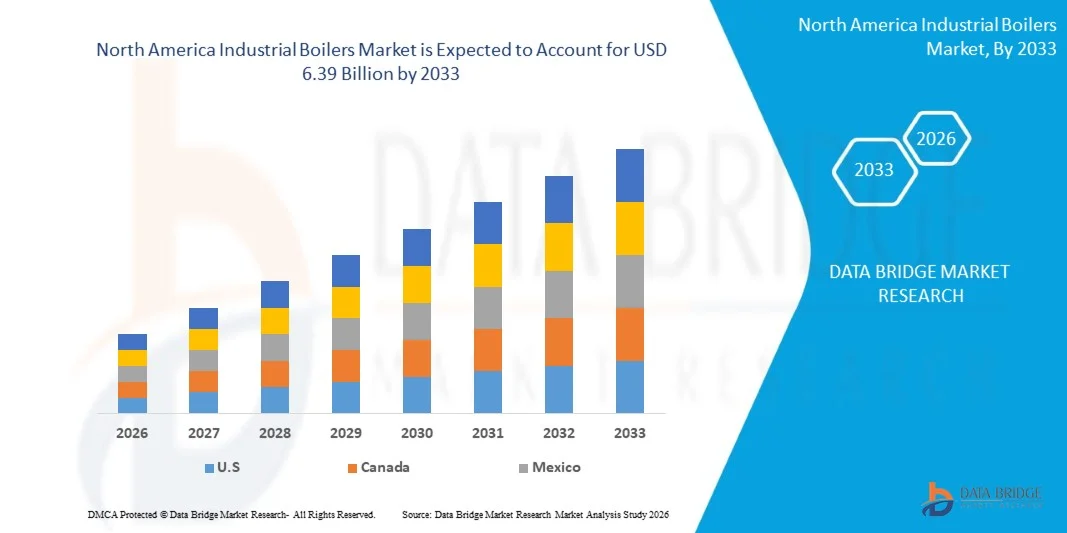
- As per Data Bridge Market Research analysis, the North America industrial boilers market was valued at USD 4.04 billion in 2025 and is projected to reach USD 6.39 billion by 2033, growing at a CAGR of 5.90% from 2026 to 2033.
- The market is experiencing consistent growth driven by increasing demand for energy-efficient industrial heating systems, replacement of aging boiler infrastructure, and expanding applications across chemicals and petrochemicals, food and beverages, pulp and paper, and metal processing industries.
- The increasing focus on industrial energy efficiency, stricter emissions requirements, and the modernization of manufacturing facilities across the U.S., Canada, and Mexico is encouraging industries to adopt advanced boiler technologies. Non-condensing boilers continue to serve high-temperature industrial applications, while electrification, cleaner fuels, and smart boiler control systems are creating opportunities for improved operational efficiency and reduced emissions.
Market Size & Forecast
- Global Market Value (2025): USD 4.04 Billion
- Expected Market Value (2033): USD 6.39 Billion
- Forecast CAGR (2026–2033): 5.90%
- Leading Country in 2025: United States
- Fastest Growing Country: Mexico
What are the Major Takeaways of the North America Industrial Boilers Market?
- The United States dominated the North America industrial boilers market with the largest revenue share of 82% in 2025, supported by established industrial infrastructure, ongoing boiler replacement, and demand from chemical, food processing, and manufacturing industries.
- Mexico is expected to be the fastest-growing country at a CAGR of 4.2% from 2026 to 2033, fueled by industrial expansion and increasing demand for efficient steam generation systems.
- The carrier fire tube boilers segment led the market with a 47% share in 2025, driven by their cost-effectiveness, simpler construction, and suitability for low- to medium-capacity industrial steam applications.
- Water tube boilers are the fastest-growing tubing methods type, projected to register a CAGR of 4.5%, reflecting the surge in demand for high-pressure and high-capacity steam generation.
- The medium pressure boilers segment dominated the stream pressure category with a 42% revenue share in 2025, led by its broad applicability across manufacturing and process industries.
- Process boilers accounted for 58% of the market share in 2025, preferred by extensive demand for controlled steam across industrial production processes
- The biomass boilers segment is the fastest-growing fuel type category, with a CAGR of 8.4%, driven by the increasing industrial interest in renewable fuels and lower-carbon process heating.
Report Scope and North America Industrial Boilers Market Segmentation
|
Attributes |
North America Industrial Boilers Key Market Insights |
|
Segments Covered |
|
|
Countries Covered |
North America
|
|
Key Market Players |
|
|
Market Opportunities |
|
|
Value Added Data Infosets |
In addition to the insights on market scenarios such as market value, growth rate, segmentation, geographical coverage, and major players, the market reports curated by the Data Bridge Market Research also include in-depth expert analysis, geographically represented company-wise production and capacity, network layouts of distributors and partners, detailed and updated price trend analysis and deficit analysis of supply chain and demand. |
What is the Key Trend in the North America Industrial Boilers Market?
- Industrial facilities across North America are increasingly adopting high-efficiency and lower-emission boiler systems to reduce fuel consumption, operating costs, and air emissions while maintaining reliable steam generation.
- For instance, in November 2024, Vicinity Energy commissioned a 42 MW industrial-scale electric boiler at its Cambridge, Massachusetts facility, enabling carbon-free thermal energy production and demonstrating the growing adoption of electrified industrial steam generation in North America.
- Advanced combustion controls, heat recovery, condensing technologies, and automated monitoring are increasingly being integrated into industrial boiler systems to improve thermal efficiency and optimize fuel utilization.
- Manufacturers and industrial operators are also exploring electrification, biomass, and flexible fuel technologies as alternatives to conventional fossil-fuel-fired boilers, particularly where emissions reduction and energy transition objectives are becoming more important.
- For instance, in October 2024, the U.S. Department of Energy awarded Kohler’s Vikrell Electric Boiler & Microgrid System more than USD 588,000 for Phase 1, supporting installation of electric boilers alongside a 21 MW solar array and 20.5 MW battery system at its Arizona manufacturing facility, with estimated CO₂ reductions of 7,865 metric tons annually.
- As manufacturers prioritize energy efficiency, emissions reduction, and operational reliability, the adoption of advanced boiler technologies is expected to accelerate, reinforcing high-efficiency and digitally enabled systems as important components of modern industrial steam generation.
What are the Key Drivers of the North America Industrial Boilers Market?
- The expansion of manufacturing, chemicals, food processing, pulp and paper, and other energy-intensive industries is increasing demand for reliable industrial steam and process-heating systems across North America.
- For instance, in June 2024, the U.S. Department of Energy proposed funding a project to retrofit a gas-fired steam boiler at Dow Chemical’s Charleston, West Virginia manufacturing plant with thermochemical energy-storage technology, targeting more efficient process steam generation and demonstrating continued investment in industrial steam-system modernization.
- Increasing regulatory emphasis on controlling particulate matter, nitrogen oxides, sulfur dioxide, mercury, hydrogen chloride, and carbon monoxide is encouraging industrial facilities to upgrade boilers and associated emission-control systems.
- For instance, in October 2024, the U.S. Department of Energy awarded Kohler more than USD 588,000 for Phase 1 of its Vikrell Electric Boiler & Microgrid System in Casa Grande, Arizona, with the planned system expected to reduce process-heating CO₂ emissions by an estimated 7,865 metric tons annually and replace natural-gas boiler use with electric boilers.
- With industrial production requiring dependable process heat and facilities simultaneously seeking greater energy efficiency and emissions compliance, investment in modern, efficient, and lower-emission industrial boiler systems is expected to remain an important market driver
Which Factors are Challenging the Growth of the North America Industrial Boilers Market?
- Advanced industrial boilers require significant upfront investment for equipment replacement, engineering, installation, controls, combustion systems, and emissions-management technologies, creating financial barriers for smaller facilities.
- For instance, in April 2024, the U.S. Department of Energy noted that retrofitting existing large buildings with boiler electrification systems presents greater challenges than new construction, highlighting the technical and integration costs associated with replacing existing fossil-fuel boiler infrastructure.
- The economic challenge is amplified when facilities must replace functioning legacy boilers before the end of their useful operating lives, as operators must balance capital expenditure against long-term fuel and maintenance savings.
- For instance, in October 2024, the U.S. Department of Energy announced USD 5 million for five industrial electrification projects, noting that integrating new electric process-heating technologies into facilities designed around conventional heating systems remains a significant challenge.
- The high capital requirements, lengthy installation periods, and complexity of integrating new boilers with existing steam infrastructure continue to challenge replacement projects, particularly for smaller industrial facilities and cost-sensitive manufacturing operations.
How is the North America Industrial Boilers Market Segmented?
The North America industrial boilers market is segmented on the basis of tubing methods, steam pressure, steam usage, fuel type, product type, boiler horsepower, and industry.
- By Tubing Methods
On the basis of tubing methods, the North America industrial boilers market is segmented into carrier fire tube boilers and water tube boilers. The carrier fire tube boilers segment dominated the market with 47% share in 2025, owing to their cost-effectiveness, simpler construction, and suitability for low- to medium-capacity industrial steam applications. These boilers are widely used across food processing, healthcare, packaging, laundries, and smaller manufacturing facilities. Their comparatively simple operation and maintenance requirements make them attractive to industrial facilities seeking reliable steam generation. Fire tube systems can also be installed as packaged units, reducing installation complexity and downtime. Their ability to support moderate steam requirements makes them suitable for a broad range of industrial operations.
The water tube boilers segment is projected to register the fastest growth at a CAGR of 4.5% during forecast period, driven by rising demand for high-pressure and high-capacity steam generation. These boilers circulate water through tubes exposed to hot combustion gases, allowing them to operate efficiently under demanding industrial conditions. They are particularly suitable for large manufacturing plants, chemical facilities, pulp and paper operations, and other energy-intensive applications. Water tube systems can provide greater steam output and support advanced combustion and emissions-control technologies. Increasing modernization of industrial facilities is encouraging replacement of conventional systems with higher-efficiency boiler configurations. Their suitability for demanding steam loads is further strengthening adoption among large industrial users.
- By Steam Pressure
On the basis of steam pressure, the North America industrial boilers market is segmented into high pressure boilers, medium pressure boilers, and low pressure boilers. The medium pressure boilers segment dominated the market with 42% share in 2025, supported by its broad applicability across manufacturing and process industries. These boilers provide sufficient steam pressure for food processing, pharmaceutical production, automotive manufacturing, packaging, and general industrial heating. Their operating characteristics allow facilities to balance steam requirements with fuel efficiency and operating costs. Medium pressure systems are also compatible with a wide range of industrial steam distribution networks. Their versatility makes them suitable for facilities that do not require the extremely high pressure associated with specialized heavy industrial applications.
The high pressure boilers segment is projected to register the fastest growth at a CAGR of 4.5% during forecast period, driven by increasing requirements for high-temperature process steam and large-scale industrial operations. High pressure boilers are capable of supporting demanding thermal processes while delivering substantial steam output. They are particularly suitable for chemical processing, pulp and paper, automotive manufacturing, and other energy-intensive applications. Increasing industrial automation and process optimization are encouraging the adoption of boilers capable of maintaining stable pressure under variable loads. Modern high pressure systems can also incorporate advanced combustion controls and heat-recovery technologies. Industrial operators are increasingly replacing aging equipment with systems offering improved efficiency and operational reliability.
- By Steam Usage
On the basis of steam usage, the North America industrial boilers market is segmented into process boilers, utility boilers, and marine boilers. The process boilers segment dominated the market with 58% share in 2025, owing to extensive demand for controlled steam across industrial production processes. Process boilers are widely used for heating, drying, sterilization, cooking, chemical processing, and other manufacturing activities. Food processing, pharmaceutical, pulp and paper, and chemical industries represent important users of process steam. These systems provide dependable thermal energy required for continuous and controlled industrial operations. Their ability to deliver consistent steam quality supports production efficiency and product quality.
The utility boilers segment is projected to register the fastest growth at a CAGR of 4.8% during forecast period, supported by rising demand for centralized steam generation and integrated industrial energy systems. Utility boilers are used where facilities require substantial and continuous thermal energy for multiple operations. Their integration with combined heat and power systems can improve overall energy utilization and reduce losses. Industrial facilities are increasingly evaluating centralized steam systems as part of broader energy-efficiency modernization programs. Advances in combustion controls, heat recovery, and emissions-management technologies are improving the performance of utility boiler systems. Growing investment in large manufacturing facilities is creating additional requirements for dependable utility steam generation.
- By Fuel Type
On the basis of fuel type, the North America industrial boilers market is segmented into coal-fired boilers, oil-fired boilers, gas-fired boilers, biomass boilers, and others. The gas-fired boilers segment dominated the market with a 56.5% share in 2025, supported by widespread natural gas availability, established distribution infrastructure, and comparatively lower emissions than conventional coal-fired systems. Natural gas boilers are extensively used across food processing, manufacturing, pharmaceutical, automotive, and chemical facilities. They provide reliable steam generation and can respond efficiently to changing industrial load requirements. Modern gas-fired systems increasingly incorporate advanced burners and automated combustion controls to improve efficiency. Their compatibility with existing industrial energy infrastructure also supports replacement and retrofit projects.
The biomass boilers segment is projected to register the fastest growth at a CAGR of 8.4% during forecast period, driven by increasing industrial interest in renewable fuels and lower-carbon process heating. Biomass boilers can utilize wood residues, agricultural waste, and other renewable organic materials as fuel sources. Their adoption is particularly relevant to industries that generate biomass residues within their own production processes. Pulp and paper, agriculture, food processing, and wood-related industries provide favorable applications for biomass-fired systems. Growing decarbonization initiatives are encouraging industrial operators to evaluate renewable alternatives to conventional fossil fuels. Improvements in combustion, fuel handling, and emissions-control technologies are increasing the practicality of biomass systems.
- By Product Type
On the basis of product type, the North America industrial boilers market is segmented into condensing hot water boiler, integrated condensing hot water boiler, integrated condensing steam boiler, split condensing steam boiler, electric heated steam boiler, electric hot water boilers, and others. The condensing hot water boiler segment dominated the market with 31% share in 2025, supported by increasing demand for energy-efficient heating technologies. Condensing boilers recover additional heat from exhaust gases that would otherwise be lost through the flue. This technology can improve fuel utilization and reduce operating costs in suitable industrial applications. Condensing hot water systems are increasingly considered during facility modernization and boiler replacement projects. Their compact configuration and compatibility with advanced controls further support adoption.
The electric heated steam boiler segment is projected to register the fastest growth at a CAGR of 6.0% during forecast period, driven by increasing industrial electrification and efforts to reduce direct fossil-fuel combustion. Electric steam boilers generate thermal energy without on-site combustion emissions, making them suitable for facilities pursuing lower-carbon heating strategies. They can also provide highly controllable steam output for applications requiring precise thermal management. Increasing availability of renewable electricity is improving the potential environmental benefits of electric process heating. Their compact configuration can be advantageous for facilities where space and installation flexibility are important considerations. Industrial decarbonization programs are encouraging manufacturers to evaluate electric alternatives to conventional gas-fired systems.
- By Boiler Horsepower
On the basis of boiler horsepower, the North America industrial boilers market is segmented into 10–150 BHP, 151–300 BHP, and 301–600 BHP. The 10–150 BHP segment dominated the market with 32% share in 2025, owing to its widespread application across facilities with moderate steam requirements. These boilers are commonly used in food processing, pharmaceuticals, laundries, healthcare facilities, packaging, and smaller manufacturing operations. Their relatively compact configuration makes them easier to install within existing industrial facilities. Lower equipment and installation requirements also make this capacity range attractive to smaller and medium-sized operators. The systems provide adequate steam for heating, cleaning, sterilization, and selected manufacturing processes.
The 301–600 BHP segment is projected to register the fastest growth at a CAGR of 4.8% during forecast period, driven by increasing demand for high-capacity steam generation in large industrial facilities. These boilers are suited to operations requiring substantial and continuous steam output. They are increasingly used in large manufacturing facilities, pulp and paper plants, petrochemical operations, and other energy-intensive industries. Industrial modernization is encouraging operators to replace older high-capacity systems with more efficient equipment. Advanced combustion controls and heat-recovery technologies can further improve the performance of these larger boiler systems. Expansion of industrial production capacity is creating additional demand for dependable high-output steam generation.
- By Industry
On the basis of industry, the North America industrial boilers market is segmented into food industry, breweries, laundries and cleaning firms, construction, pharmaceutical, automotive, pulp and paper, hospitals, agriculture, packaging, and others. The food industry segment dominated the market with 24% share in 2025, supported by extensive requirements for process steam in cooking, heating, sterilization, cleaning, and sanitation operations. Food-processing facilities require dependable thermal energy to maintain production quality and meet stringent hygiene requirements. Industrial boilers are used across dairy processing, meat processing, bakery production, beverage manufacturing, and prepared-food operations. Growing demand for processed and packaged foods is encouraging expansion and modernization of production facilities. Energy-efficient boiler systems can also help food manufacturers manage operating expenses and emissions.
The pulp and paper segment is projected to register the fastest growth at a CAGR of 5.3% during forecast period, driven by substantial steam requirements throughout pulp processing and paper manufacturing operations. Steam is extensively used for drying, heating, evaporation, and other energy-intensive processes within paper mills. Modern boiler systems can help facilities improve fuel utilization while supporting continuous high-temperature production requirements. Replacement of aging steam infrastructure is creating additional demand for efficient industrial boiler technologies. Pulp and paper manufacturers are also evaluating biomass and waste-derived fuels to improve energy sustainability. Integration of advanced controls and heat-recovery technologies is further improving boiler performance within these facilities.
Which Country Holds the Largest Share of the North America Industrial Boilers Market?
- The United States dominated the North America industrial boilers market with the largest revenue share of 824% in 2025, supported by established industrial infrastructure, ongoing boiler replacement, and demand from chemical, food processing, and manufacturing industries
- The country also benefits from substantial investments in chemicals and petrochemicals, food processing, pulp and paper, and other industrial applications, alongside increasing replacement of aging boiler infrastructure. Growing emphasis on energy efficiency, lower-emission technologies, and modernization of industrial facilities continues to support the U.S. leadership position in the North America industrial boilers market.
Canada Industrial Boilers Market Insight
The Canada industrial boilers market is expected to witness steady growth, driven by increasing investments in food processing, pulp and paper, chemical manufacturing, and other industrial activities. Growing demand for efficient steam-generation systems, replacement of aging boiler infrastructure, and increasing adoption of cleaner and biomass-based technologies are supporting regional market expansion. In addition, government emphasis on industrial emissions reduction, energy efficiency, and sustainable technologies is encouraging manufacturers to upgrade existing boiler systems and adopt advanced solutions.
Mexico Industrial Boilers Market Insight
The Mexico industrial boilers market is growing rapidly, driven by expanding manufacturing activities, increasing industrial investments, and rising demand for reliable steam-generation systems. Growing development of industrial facilities and increasing activity across manufacturing, food processing, chemicals, and other energy-intensive industries are significantly boosting market demand. In addition, modernization of existing industrial infrastructure, increasing adoption of energy-efficient boiler technologies, and the need for dependable process heating are positioning Mexico as one of the fastest-growing country-level markets for industrial boilers in North America.
Which are the Top Companies in North America Industrial Boilers Market?
The North America industrial boilers industry is primarily led by well-established companies, including:
- Babcock & Wilcox Enterprises, Inc. (U.S.)
- The Cleaver-Brooks Company, Inc. (U.S.)
- Hurst Boiler and Welding Company, Inc. (U.S.)
- Burnham Commercial Boilers (U.S.)
- Clayton Industries (U.S.)
- Fulton (U.S.)
- Miura America Co., LTD. (U.S.)
- Superior Boiler (U.S.)
- Johnston Boiler Company (U.S.)
- Rentech Boiler Systems (U.S.)
- Parker Boiler Co. (U.S.)
- Vapor Power International, LLC (U.S.)
- Mitsubishi Heavy Industries, Ltd. (Japan)
- IHI Corporation (Japan)
- John Cockerill (Belgium)
- Thermax Limited (India)
- Sofinter S.p.A. (Italy)
- Doosan Enerbility Co., Ltd. (South Korea)
- Bosch Industriekessel GmbH (Germany)
- GROUPE ATLANTIC (France)
What are Latest Developments in North America Industrial Boilers Market?
- In December 2025, Babcock & Wilcox Canada was awarded a more than USD 10 million contract by Irving Pulp & Paper Limited to install boiler equipment as part of a USD 20 million upgrade project at the company’s pulp and paper mill in Saint John, New Brunswick. The project involves upgrading a B&W-manufactured Stirling power boiler with equipment including a superheater, lower furnace water walls, overfire air system, economizer, and tubular air heater. The upgrade is designed to enable higher boiler temperatures and support a future steam turbine installation, strengthening the efficiency and steam-generation capabilities of the Canadian industrial facility
- In October 2024, the U.S. Department of Energy awarded Kohler Co. more than USD 588,000 to begin Phase 1 of the Vikrell Electric Boiler & Microgrid System project at its manufacturing facility in Casa Grande, Arizona. The project plans to install electric boilers together with a solar array and battery energy-storage system to reduce emissions associated with natural-gas boilers used for industrial process heating. The development demonstrates the increasing application of electrified boiler systems and renewable-energy integration for industrial thermal processes in North America.
- In June 2024, the U.S. Department of Energy proposed funding for RedoxBlox to develop and field-test thermochemical energy-storage technology for industrial steam generation at Dow Chemical’s manufacturing plant in Charleston, West Virginia. The project includes plans to retrofit an existing gas-fired steam boiler with thermochemical energy-storage technology designed to improve the efficiency of steam generation for chemical process heating. The development highlights the growing integration of energy storage and advanced thermal technologies with existing industrial boiler infrastructure
- In November 2022, Babcock & Wilcox announced a contract worth more than USD 24 million to supply two industrial package boilers, auxiliary equipment, and advanced emissions-control technologies for a petroleum refinery in North America. B&W Thermal was selected to design and supply the package boilers, burners, economizers, and associated equipment, while B&W Environmental would provide emissions-control technologies. The project reflects continued investment in reliable industrial steam generation and emissions-management systems within North America's petroleum-refining sector.
- In January 2022, Babcock & Wilcox Renewable was awarded a contract worth more than USD 11 million to design, manufacture, supply, and install equipment for a biomass boiler upgrade in Canada. The project includes replacement of boiler pressure parts and upgrades to the wood-feed and air systems, with Babcock & Wilcox Canada providing installation services. The development supports the modernization of biomass-fired industrial boiler infrastructure and demonstrates growing interest in renewable-fuel-based steam generation within Canada's pulp, paper, and forestry-related industries.

- Interactive Data Analysis Dashboard
- Company Analysis Dashboard for high growth potential opportunities
- Research Analyst Access for customization & queries
- Competitor Analysis with Interactive dashboard
- Latest News, Updates & Trend analysis
- Harness the Power of Benchmark Analysis for Comprehensive Competitor Tracking
North America Industrial Boilers Market, Supply Chain Analysis and Ecosystem Framework
To support market growth and help clients navigate the impact of geopolitical shifts, DBMR has integrated in-depth supply chain analysis into its North America Industrial Boilers Market research reports. This addition empowers clients to respond effectively to global changes affecting their industries. The supply chain analysis section includes detailed insights such as North America Industrial Boilers Market consumption and production by country, price trend analysis, the impact of tariffs and geopolitical developments, and import and export trends by country and HSN code. It also highlights major suppliers with data on production capacity and company profiles, as well as key importers and exporters. In addition to research, DBMR offers specialized supply chain consulting services backed by over a decade of experience, providing solutions like supplier discovery, supplier risk assessment, price trend analysis, impact evaluation of inflation and trade route changes, and comprehensive market trend analysis.
Data collection and base year analysis are done using data collection modules with large sample sizes. The stage includes obtaining market information or related data through various sources and strategies. It includes examining and planning all the data acquired from the past in advance. It likewise envelops the examination of information inconsistencies seen across different information sources. The market data is analysed and estimated using market statistical and coherent models. Also, market share analysis and key trend analysis are the major success factors in the market report. To know more, please request an analyst call or drop down your inquiry.
The key research methodology used by DBMR research team is data triangulation which involves data mining, analysis of the impact of data variables on the market and primary (industry expert) validation. Data models include Vendor Positioning Grid, Market Time Line Analysis, Market Overview and Guide, Company Positioning Grid, Patent Analysis, Pricing Analysis, Company Market Share Analysis, Standards of Measurement, Global versus Regional and Vendor Share Analysis. To know more about the research methodology, drop in an inquiry to speak to our industry experts.
Data Bridge Market Research is a leader in advanced formative research. We take pride in servicing our existing and new customers with data and analysis that match and suits their goal. The report can be customized to include price trend analysis of target brands understanding the market for additional countries (ask for the list of countries), clinical trial results data, literature review, refurbished market and product base analysis. Market analysis of target competitors can be analyzed from technology-based analysis to market portfolio strategies. We can add as many competitors that you require data about in the format and data style you are looking for. Our team of analysts can also provide you data in crude raw excel files pivot tables (Fact book) or can assist you in creating presentations from the data sets available in the report.













