


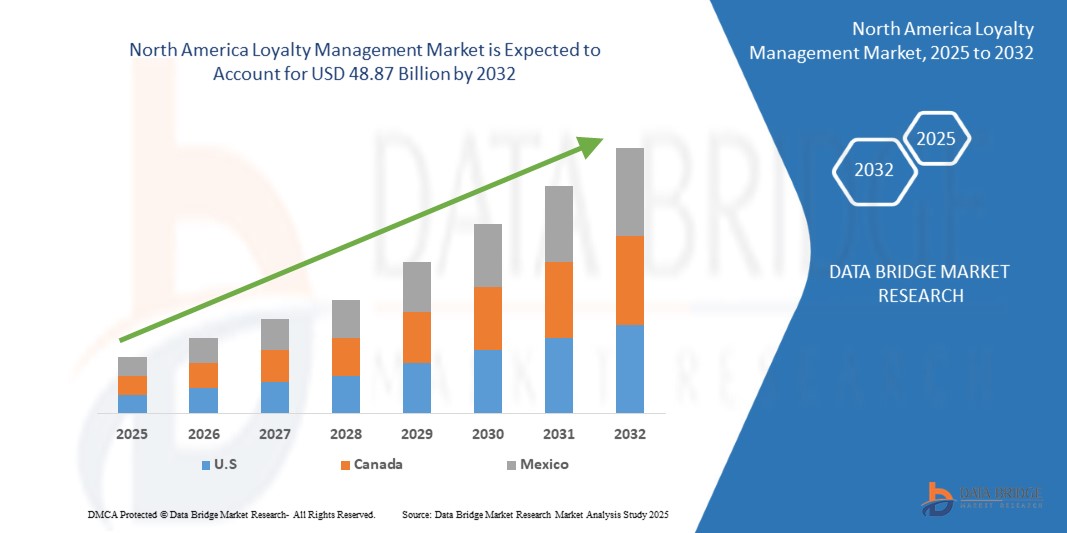
Loyalty Management Market Size
- The North America Loyalty Management Market size was valued at USD 12.45 Billion in 2024 and is expected to reach USD 48.87 Billion by 2032, at a CAGR of 18.7% during the forecast period
- This growth is driven by Surge in the adoption of advanced technologies such as artificial intelligence, growing focus on the management of customer experience and rising development of retail and e-commerce markets are the major factors attributable to the growth of the loyalty management market..
Loyalty Management Market Analysis
- Loyalty management is an approach used by the companies to attract and retain the customers, employees, suppliers, and shareholders. Loyalty management approach is used to build trust among the customers and stakeholders. Loyalty management enhances the goodwill of the company or the organization and develops and maintains healthy relationship between customers and companies for a longer period of time.
- U.S. is expected to dominate the Loyalty Management Market due to Rising focus on the technological advancements to obtain a cost-efficient and environmental friendly method of transportation will emerge as the major market growth driving factor. Surge in the demand for oil and gas, growing infrastructural development especially in the developing economies and surge in the offshore activities, such as deep water production and development will further aggravate the growth of the market.
- Customer Loyalty is expected to dominate the solution segment due to its critical role in enhancing customer engagement and driving repeat business. As companies increasingly focus on personalized experiences and retention strategies to maintain competitive advantage, investments in customer loyalty programs have surged particularly in sectors like retail, BFSI, and travel fueling the demand for robust loyalty management solutions.
Report Scope and Loyalty Management Market Segmentation
|
Attributes |
Loyalty Management Key Market Insights |
|
Segments Covered |
|
|
Countries Covered |
North America
|
|
Key Market Players |
|
|
Market Opportunities |
|
|
Value Added Data Infosets |
In addition to the insights on market scenarios such as market value, growth rate, segmentation, geographical coverage, and major players, the market reports curated by the Data Bridge Market Research also include import export analysis, production capacity overview, production consumption analysis, price trend analysis, climate change scenario, supply chain analysis, value chain analysis, raw material/consumables overview, vendor selection criteria, PESTLE Analysis, Porter Analysis, and regulatory framework. |
Loyalty Management Market Trends
“Rising Adoption of Advanced Technologies Such as AI and Big Data Analytics”
- The integration of artificial intelligence and big data analytics is transforming loyalty programs by enabling real-time customer insights, predictive behavior modeling, and hyper-personalized marketing strategies. This enhances customer engagement, optimizes campaign performance, and improves overall customer experience.
- AI-powered loyalty systems can automate and scale personalized offers across multiple channels, resulting in higher retention rates and increased customer lifetime value. These technological capabilities are increasingly being integrated into loyalty platforms to meet evolving consumer expectations.
For instance,
- In January 2024, Oracle enhanced its loyalty management platform by integrating AI-based analytics tools that help brands predict churn risk, segment high-value customers, and deliver tailored loyalty campaigns, thereby improving retention and program ROI.
Loyalty Management Market Dynamics
Driver
“Growing Focus on Customer Experience and Relationship Management”
- Enterprises across various sectors are shifting towards customer-centric business models, recognizing that personalized loyalty programs strengthen brand loyalty and differentiate them in competitive markets.
- By fostering emotional connections and long-term engagement through rewards, exclusive access, and tier-based programs, businesses can drive repeat purchases and amplify brand advocacy.
For instance,
- In October 2024, Brierley launched a revamped loyalty strategy for a leading U.S. retail chain, integrating customer journey mapping and omnichannel experience design to elevate personalization and retention metrics across stores and digital platforms.
Opportunity
“Emerging Opportunities in Non-Traditional Verticals like Healthcare and Manufacturing”
- The penetration of loyalty management solutions is expanding beyond retail and BFSI into verticals such as healthcare, manufacturing, and IT & telecom, where stakeholder engagement is becoming increasingly critical.
- These industries are leveraging loyalty programs not just for customer retention, but also for employee engagement, partner collaboration, and service optimization—offering untapped growth potential for solution providers.
For instance,
- In August 2023, Comarch SA collaborated with a North American pharmaceutical group to deploy a custom-built loyalty platform aimed at increasing patient adherence and engagement through gamified rewards and educational incentives.
Restraint/Challenge
“Data Privacy Concerns and Compliance Challenges”
- Growing concerns over data security, along with evolving regulatory frameworks such as GDPR, CCPA, and regional data protection laws, are complicating the deployment of loyalty programs.
- Businesses face challenges in securely collecting, storing, and processing sensitive customer information while ensuring transparency and consent. Non-compliance can result in reputational damage and hefty penalties.
For instance,
- In July 2024, a leading telecom provider in Canada faced a class-action lawsuit over improper handling of loyalty program data, highlighting the critical need for secure architecture and compliant data practices in loyalty platforms..
Loyalty Management Market Scope
The loyalty management market is segmented on the basis of solution, deployment type, organization size, vertical, and type of offering capacity.
|
Segmentation |
Sub-Segmentation |
|
By Solution |
|
|
By Deployment Type |
|
|
By Organization Size |
|
|
By Vertical |
|
|
By Type of Offering Capacity |
|
In 2025, the customer loyalty segment is projected to dominate the Loyalty Management Market with the largest share in the solution segment
The customer loyalty segment is expected to dominate the market with the largest share of 53.19% in 2025 due to the rising emphasis on enhancing customer retention, increasing repeat purchases, and strengthening brand engagement. Businesses are increasingly investing in robust loyalty programs to build long-term relationships, improve customer lifetime value, and stay competitive in the evolving digital landscape.
In 2025, the on-demand segment is expected to dominate the Loyalty Management Market with the largest share in the deployment type segment
The on-demand segment is projected to hold the largest share of 61.14% in 2025, driven by the growing adoption of cloud-based loyalty platforms that offer scalability, real-time data access, and cost-effective deployment. The increasing preference for SaaS models among SMEs and large enterprises alike is propelling the shift towards on-demand loyalty solutions across various industries.
Loyalty Management Market Regional Analysis
“U.S. Holds the Largest Share and fastest geowing in the Loyalty Management Market”
- The United States is expected to lead the North America Loyalty Management Market due to its advanced digital infrastructure, strong presence of major loyalty solution providers (such as Oracle, SAP, and IBM), and early adoption of customer-centric technologies across sectors like retail, BFSI, and hospitality.
- The country’s mature e-commerce ecosystem and high consumer expectations are pushing enterprises to invest heavily in data-driven loyalty programs and personalized customer engagement strategies.
- Furthermore, regulatory clarity and a robust IT infrastructure make the U.S. a favorable environment for deploying advanced loyalty management platforms.
Loyalty Management Market Share
The market competitive landscape provides details by competitor. Details included are company overview, company financials, revenue generated, market potential, investment in research and development, new market initiatives, global presence, production sites and facilities, production capacities, company strengths and weaknesses, product launch, product width and breadth, application dominance. The above data points provided are only related to the companies' focus related to market.
The Major Market Leaders Operating in the Market Are:
- Kognitiv Corporation(Canada)
- Comarch SA(Poland)
- Epsilon Data Management, LLC.(United States)
- ICF International Inc.(United States)
- Brierley (United States)
- BOND BRAND LOYALTY INC.(Canada)
- Ketchup Loyalty Marketing(Canada)
- Kobie (United States)
- Oracle (United States)
- SAP(Germany)
- TIBCO Software Inc.(United States)
Latest Developments in North America Loyalty Management Market
- In March 2025, Oracle announced the launch of its next-generation Loyalty Cloud platform in North America, offering real-time personalization, AI-powered insights, and seamless integration with e-commerce and CRM systems. This new solution is designed to help retailers and financial institutions increase customer engagement and lifetime value by delivering tailored rewards and omnichannel experiences. The platform also supports advanced gamification features to boost customer retention.
- In February 2025, Salesforce expanded its Loyalty Management module for the North American market with new industry-specific templates for travel, healthcare, and telecom sectors. These enhancements enable faster deployment of loyalty programs while supporting tiered rewards, partner offers, and real-time point redemption across digital channels. The update reflects the increasing demand for agile, scalable loyalty platforms in diverse service industries.
- In January 2025, Kobie Marketing partnered with a leading Canadian telecom provider to deploy an AI-powered customer loyalty engine. The solution incorporates behavioral analytics and machine learning to predict customer churn and deliver hyper-personalized offers. The rollout aims to increase customer retention and digital engagement across mobile, broadband, and streaming services in Canada.
- In December 2024, Comarch SA introduced its upgraded Loyalty Marketing Platform in the U.S. with enhanced data analytics, blockchain-based transaction validation, and real-time performance dashboards. The platform is being adopted by a major North American airline to transform its frequent flyer program into a more secure and flexible ecosystem, improving user trust and reward tracking.

- Interactive Data Analysis Dashboard
- Company Analysis Dashboard for high growth potential opportunities
- Research Analyst Access for customization & queries
- Competitor Analysis with Interactive dashboard
- Latest News, Updates & Trend analysis
- Harness the Power of Benchmark Analysis for Comprehensive Competitor Tracking
Data collection and base year analysis are done using data collection modules with large sample sizes. The stage includes obtaining market information or related data through various sources and strategies. It includes examining and planning all the data acquired from the past in advance. It likewise envelops the examination of information inconsistencies seen across different information sources. The market data is analysed and estimated using market statistical and coherent models. Also, market share analysis and key trend analysis are the major success factors in the market report. To know more, please request an analyst call or drop down your inquiry.
The key research methodology used by DBMR research team is data triangulation which involves data mining, analysis of the impact of data variables on the market and primary (industry expert) validation. Data models include Vendor Positioning Grid, Market Time Line Analysis, Market Overview and Guide, Company Positioning Grid, Patent Analysis, Pricing Analysis, Company Market Share Analysis, Standards of Measurement, Global versus Regional and Vendor Share Analysis. To know more about the research methodology, drop in an inquiry to speak to our industry experts.
Data Bridge Market Research is a leader in advanced formative research. We take pride in servicing our existing and new customers with data and analysis that match and suits their goal. The report can be customized to include price trend analysis of target brands understanding the market for additional countries (ask for the list of countries), clinical trial results data, literature review, refurbished market and product base analysis. Market analysis of target competitors can be analyzed from technology-based analysis to market portfolio strategies. We can add as many competitors that you require data about in the format and data style you are looking for. Our team of analysts can also provide you data in crude raw excel files pivot tables (Fact book) or can assist you in creating presentations from the data sets available in the report.













