


Minimally Invasive Medical Robotics, Imaging and Visualization Systems and Surgical Instruments Market Size
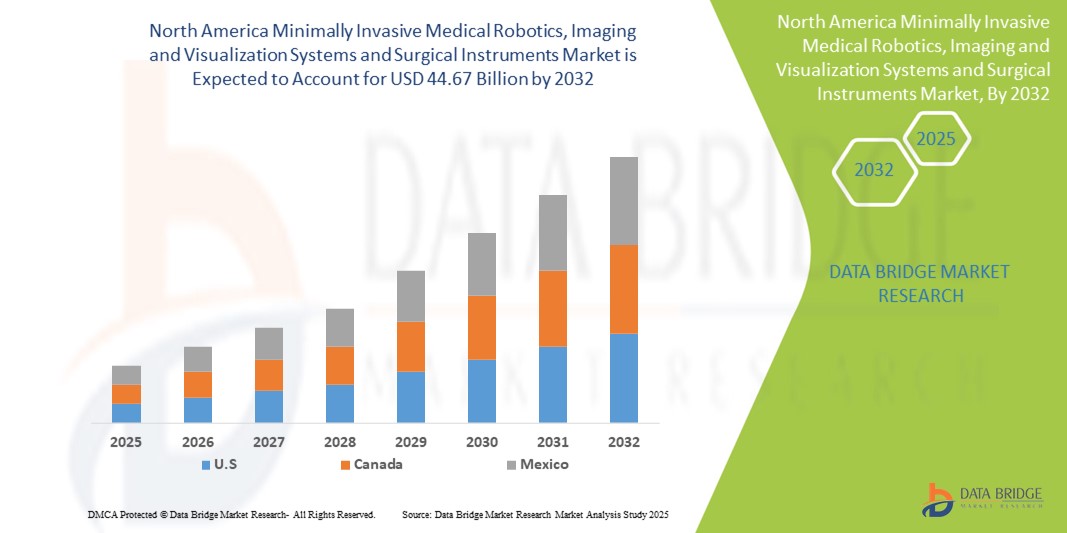
- The North America minimally invasive medical robotics, imaging and visualization systems and surgical instruments market size was valued at USD 24.32 billion in 2024 and is expected to reach USD 44.67 billion by 2032, at a CAGR of 7.90% during the forecast period
- The market growth is largely fueled by the increasing adoption of advanced medical technologies and the growing preference for minimally invasive procedures across hospitals and surgical centers
- Rising demand for precision, reduced patient recovery times, and enhanced surgical outcomes is driving the uptake of minimally invasive medical robotics, imaging, and visualization systems
Minimally Invasive Medical Robotics, Imaging and Visualization Systems and Surgical Instruments Market Analysis
- Minimally Invasive Medical Robotics, Imaging and Visualization Systems and Surgical Instruments are increasingly transforming modern surgical procedures by enabling precision, reduced invasiveness, and enhanced patient outcomes, with applications across hospitals, specialty clinics, and ambulatory surgical centers
- The escalating demand for these systems is primarily fueled by rising adoption of minimally invasive procedures, growing awareness of improved surgical outcomes, and increasing hospital investments in advanced medical technologies
- U.S. dominated the North America minimally invasive medical robotics, imaging and visualization systems and surgical instruments market with a revenue share of 72% in 2024, supported by strong demand for minimally invasive and precision surgeries, ongoing product launches, and robust reimbursement frameworks that encourage adoption of advanced surgical instruments and robotic systems
- Canada is expected to be the fastest-growing country in the minimally invasive medical robotics, imaging and visualization systems and Surgical Instruments market during the forecast period, projected to register a strong CAGR of 12.5%, driven by increased investments in healthcare infrastructure, growing adoption of robotic-assisted procedures, and expanding access to advanced surgical technologies in hospitals and specialty clinics
- The surgical devices technology segment dominated the North America minimally invasive medical robotics, imaging and visualization systems and surgical instruments market with a 55% share in 2024, driven by ongoing innovation in precision surgical instruments, energy-based tools, and minimally invasive devices
Report Scope and Minimally Invasive Medical Robotics, Imaging and Visualization Systems and Surgical Instruments Market Segmentation
|
Attributes |
Minimally Invasive Medical Robotics, Imaging and Visualization Systems and Surgical Instruments Key Market Insights |
|
Segments Covered |
|
|
Countries Covered |
North America
|
|
Key Market Players |
|
|
Market Opportunities |
|
|
Value Added Data Infosets |
In addition to the insights on market scenarios such as market value, growth rate, segmentation, geographical coverage, and major players, the market reports curated by the Data Bridge Market Research also include in-depth expert analysis, pricing analysis, brand share analysis, consumer survey, demography analysis, supply chain analysis, value chain analysis, raw material/consumables overview, vendor selection criteria, PESTLE Analysis, Porter Analysis, and regulatory framework. |
Minimally Invasive Medical Robotics, Imaging and Visualization Systems and Surgical Instruments Market Trends
Rapid Adoption of Minimally Invasive Medical Robotics, Imaging and Visualization Systems and Surgical Instruments
- A significant and accelerating trend in the North America minimally invasive medical robotics, imaging and visualization systems, and surgical instruments market is the growing adoption of advanced robotic and imaging technologies in surgical procedures, enabling higher precision, reduced invasiveness, and faster patient recovery. This trend is reshaping surgical practices across hospitals, specialty clinics, and ambulatory surgical centers
- For instance, robotic-assisted surgical platforms are increasingly being implemented for complex procedures such as urological, gynecological, and cardiovascular surgeries, allowing surgeons to perform operations with enhanced dexterity and minimal trauma to patients. Similarly, advanced imaging and visualization systems provide real-time, high-resolution guidance during surgeries, improving accuracy and reducing intraoperative complications
- The integration of artificial intelligence (AI) and machine learning algorithms in surgical robotics and imaging systems is further enhancing procedural planning, intraoperative decision-making, and predictive analytics, which improves surgical outcomes and reduces human error
- Tele-surgery and remote monitoring capabilities are gaining traction, allowing expert surgeons to guide procedures from different locations and support hospitals in underserved areas, expanding access to specialized care
- The adoption of minimally invasive techniques is reducing postoperative complications, hospital stays, and overall healthcare costs, which is driving stronger demand from healthcare providers and insurance payers alike
- Continuous innovations in haptic feedback, 3D visualization, and augmented reality are enabling surgeons to have better tactile and visual perception during operations, enhancing precision in complex procedures
- The market is also benefiting from the increasing volume of outpatient and ambulatory surgeries, which favor minimally invasive approaches due to quicker recovery times and lower risk of infection
- Rising patient awareness and demand for faster recovery and less invasive procedures are influencing hospitals to invest in state-of-the-art robotic and imaging technologies to maintain competitive advantages
- Strategic partnerships and collaborations between medical device manufacturers and healthcare institutions are accelerating the introduction of next-generation robotic and imaging systems, ensuring rapid adoption and continuous technology upgrades
- The rising focus on patient safety, efficiency, and minimally invasive approaches continues to fuel the adoption of these technologies, reinforcing the critical role of robotic and imaging systems in modern surgical care
Minimally Invasive Medical Robotics, Imaging and Visualization Systems and Surgical Instruments Market Dynamics
Driver
Growing Need Due to Advancements in Minimally Invasive Surgeries and Imaging Technologies
- The increasing demand for precise, minimally invasive surgical procedures, combined with technological advancements in medical robotics, imaging, and visualization systems, is a significant driver for the heightened adoption of these solutions
- For instance, in 2024, several leading manufacturers introduced next-generation robotic-assisted surgical platforms with integrated real-time imaging and visualization capabilities, aimed at improving surgical outcomes and reducing patient recovery time. Such initiatives by key players are expected to drive the market growth in the forecast period
- As hospitals and specialty clinics seek to enhance procedural accuracy and patient safety, the integration of high-definition imaging, AI-assisted navigation, and robotic precision is becoming increasingly critical for complex surgeries
- Furthermore, the rising prevalence of chronic conditions requiring surgical intervention, such as cardiovascular disorders, orthopedic injuries, and urological conditions, is fueling demand for advanced minimally invasive devices and systems
- The convenience of reducing surgical invasiveness, shortening hospital stays, and improving post-operative recovery is a key factor propelling the adoption of these solutions in both hospital and outpatient settings
- The trend towards technologically advanced operating rooms and the increasing availability of user-friendly robotic and imaging systems further contributes to market growth
Restraint/Challenge
High Initial Costs, Technical Complexity, and Regulatory Hurdles
- One of the primary challenges limiting the widespread adoption of minimally invasive medical robotics and advanced imaging systems is the high capital investment required. The acquisition cost for state-of-the-art robotic surgical platforms, imaging devices, and integrated visualization systems can run into millions of dollars, making it difficult for smaller hospitals and clinics to invest
- Beyond cost, the technical complexity of these systems poses a barrier. Surgeons and operating room staff require specialized training to operate robotic platforms safely and efficiently, which involves time, resources, and additional expenses for hospitals
- Maintenance and software updates are critical for system reliability; any technical malfunction during surgery can have serious patient safety implications. This dependence on highly skilled technical support further increases operational costs and limits adoption in resource-constrained facilities
- In addition, navigating the regulatory and compliance landscape for medical devices can delay product introduction and increase costs, as manufacturers must meet strict safety, efficacy, and quality standards set by authorities such as the FDA in the U.S.
- The integration of robotic and imaging systems into existing surgical workflows may require extensive modifications to operating rooms, which adds logistical and financial challenges
- Despite these restraints, ongoing efforts by manufacturers to introduce modular systems, user-friendly interfaces, and remote training programs are helping overcome some adoption barriers, although the perceived complexity and premium pricing still pose significant challenges, particularly in developing regions
- Addressing these constraints through cost optimization, simplified training, and regulatory support will be essential for broader market penetration and long-term growth
Minimally Invasive Medical Robotics, Imaging and Visualization Systems and Surgical Instruments Market Scope
The market is segmented on the basis of product, technology, and application.
- By Product
On the basis of product, the minimally invasive medical robotics, imaging and visualization systems and surgical instruments market is segmented into surgical devices, imaging and visualization systems, electrosurgical devices, and medical robotics. The medical robotics segment dominated the largest market revenue share of 38.5% in 2024, driven by the increasing adoption of robotic-assisted surgeries across multiple specialties. Hospitals are investing heavily in robotic platforms due to their ability to provide enhanced precision, reduce intraoperative errors, and shorten patient recovery times. Robotic systems are particularly favored in urological, gynecological, and cardiovascular procedures, offering better patient outcomes and improved surgical efficiency. Their integration with advanced surgical tools allows surgeons to perform complex procedures with minimal invasiveness. Additionally, continuous innovation, favorable reimbursement policies, and rising awareness about the benefits of robotic surgery are supporting strong market dominance in North America.
The imaging and visualization systems segment is expected to witness the fastest CAGR of 13.2% from 2025 to 2032, driven by the growing demand for high-resolution intraoperative imaging and real-time visualization. Advanced imaging systems help surgeons perform minimally invasive procedures with enhanced accuracy, reducing complications and improving safety. Rising adoption of technologies such as 3D imaging, fluorescence imaging, and augmented reality in operating rooms further supports rapid growth. Hospitals and surgical centers are increasingly integrating imaging solutions with robotic platforms to improve surgical outcomes. The segment benefits from a surge in complex surgical procedures and rising investments in advanced hospital infrastructure. Growing awareness among healthcare professionals regarding the advantages of enhanced visualization is also contributing to accelerated market adoption.
- By Technology
On the basis of technology, the minimally invasive medical robotics, imaging and visualization systems and surgical instruments market is segmented into surgical devices and imaging devices technology. The surgical devices technology segment dominated the market with a 55% share in 2024, driven by ongoing innovation in precision surgical instruments, energy-based tools, and minimally invasive devices. Hospitals continue to prioritize advanced surgical tools to enhance efficiency, reduce operative complications, and improve patient safety. Electrosurgical devices and advanced hand instruments are being widely adopted in various surgical specialties due to their reliability and performance. Continuous product launches, coupled with training programs for surgeons, strengthen the segment’s market dominance. Growing investments by hospitals in advanced surgical theaters and supportive reimbursement frameworks further reinforce its leading position. This segment remains essential for minimally invasive surgeries, offering consistent performance across high-volume procedures.
The imaging devices technology segment is expected to register the fastest CAGR of 12% from 2025 to 2032, fueled by increasing demand for intraoperative imaging, advanced navigation systems, and real-time visualization tools. The rise in complex surgeries across neurology, orthopedics, and cardiovascular specialties is driving adoption. Hospitals are increasingly integrating imaging devices with robotic and minimally invasive platforms to improve surgical precision. Innovations such as augmented reality overlays and 3D imaging are enhancing the utility of imaging devices. Supportive government initiatives, rising healthcare infrastructure investments, and the need for better surgical outcomes are further propelling rapid growth. The segment benefits from both technological advancements and a growing preference for minimally invasive surgical procedures.
- By Application
On the basis of application, the minimally invasive medical robotics, imaging and visualization systems and surgical instruments market is segmented into cardio-thoracic surgery, vascular surgery, neurological surgery, ENT/respiratory surgery, cosmetic surgery, gastrointestinal surgery, gynecological surgery, urological surgery, orthopedic surgery, oncology surgery, and dental surgery. The urological surgery segment dominated the market with a share of 20.5% in 2024, driven by the widespread use of minimally invasive and robotic-assisted techniques for prostate, kidney, and bladder procedures. These surgeries provide reduced patient recovery times, lower complication rates, and enhanced precision compared with traditional approaches. Hospitals are increasingly investing in advanced urological surgical platforms to meet growing demand. Rising prevalence of urological disorders, patient preference for minimally invasive procedures, and strong reimbursement frameworks contribute to sustained market dominance. Continuous development of innovative robotic instruments and enhanced imaging solutions further strengthen this segment’s leadership in North America.
The neurological surgery segment is expected to witness the fastest CAGR of 14% from 2025 to 2032, fueled by the increasing adoption of minimally invasive and robotic-assisted techniques for brain and spine procedures. Advanced imaging and navigation tools enable precise tumor resections and complex neurological interventions. The rising prevalence of neurological disorders and increasing investments in hospital infrastructure support rapid growth. Integration of neurosurgical robotic platforms with high-resolution imaging is improving surgical outcomes and patient safety. Growing awareness among neurosurgeons about innovative treatment options, coupled with favorable reimbursement policies, further propels market adoption. Increasing complexity of surgical cases and technological advancements continue to drive this segment’s accelerated expansion.
Minimally Invasive Medical Robotics, Imaging and Visualization Systems and Surgical Instruments Market Regional Analysis
- North America dominated the minimally invasive medical robotics, imaging and visualization systems and surgical instruments market with the largest revenue share of in 2024, driven by strong demand for minimally invasive procedures, precision surgeries, and advanced surgical technologies across hospitals and specialty clinics
- Healthcare providers in the region highly value the precision, reduced recovery time, and enhanced procedural outcomes offered by robotic-assisted surgical systems and advanced imaging and visualization technologies
- This widespread adoption is further supported by high healthcare expenditure, a technologically advanced medical workforce, and increasing awareness among patients and clinicians about the benefits of minimally invasive surgery, establishing advanced surgical systems as preferred solutions in both hospitals and specialty centers
U.S. Minimally Invasive Medical Robotics, Imaging and Visualization Systems and Surgical Instruments Market Insight
The U.S. minimally invasive medical robotics, imaging and visualization systems and surgical instruments market captured the largest revenue share of 72% in 2024 within North America, fueled by strong adoption of robotic-assisted procedures, frequent product launches, and supportive reimbursement frameworks. Hospitals and surgical centers are increasingly prioritizing precision surgeries, minimally invasive interventions, and advanced imaging solutions to improve patient outcomes. The growing preference for technologically advanced surgical systems, combined with continuous innovations in robotics, imaging, and visualization platforms, further propels the industry. Moreover, regulatory support, increasing investments in healthcare infrastructure, and the expanding prevalence of complex surgical cases are significantly contributing to the market's expansion.
Canada Minimally Invasive Medical Robotics, Imaging and Visualization Systems and Surgical Instruments Market Insight
The Canada minimally invasive medical robotics, imaging and visualization systems and surgical instruments market is emerging as the fastest-growing market for Minimally Invasive Medical Robotics, Imaging and Visualization Systems and Surgical Instruments, projected to register a CAGR of 12.5% during the forecast period. The growth is primarily driven by increasing investments in healthcare infrastructure, expansion of specialty surgical centers, and rising adoption of robotic-assisted procedures across hospitals and clinics. Healthcare providers in Canada are increasingly prioritizing minimally invasive surgery and advanced imaging technologies to enhance precision, reduce patient recovery times, and improve procedural outcomes. The market benefits from government initiatives supporting advanced surgical technologies, improved access to hospitals and specialty clinics, and growing awareness about the advantages of minimally invasive and image-guided procedures.
Minimally Invasive Medical Robotics, Imaging and Visualization Systems and Surgical Instruments Market Share
The minimally invasive medical robotics, imaging and visualization systems and surgical instruments industry is primarily led by well-established companies, including:
- General Electric Company (U.S.)
- Koninklijke Philips N.V. (Netherlands)
- CONMED Corporation (U.S.)
- Siemens (Germany)
- Lidco Building Technologies (U.K.)
- Applied Medical Resources Corporation (U.S.)
- CNSystems Medizintechnik GmbH (Austria)
- Uscom (Australia)
- Smith + Nephew (U.K.)
- Getinge AB (Sweden)
- ICU Medical, Inc. (U.S.)
- Alphatec Spine Inc. (U.S.)
- Baxter (U.S.)
- Abbott (U.S.)
- Edwards Lifesciences Corporation (U.S.)
- Olympus Corporation (Japan)
- CooperSurgical, Inc. (U.S.)
- Zimmer Biomet (U.S.)
- Drägerwerk AG & Co. KGaA (Germany)
- FUJIFILM Corporation (Japan)
- Osypka Medical GmbH (Germany)
Latest Developments in North America Minimally Invasive Medical Robotics, Imaging and Visualization Systems and Surgical Instruments Market
- In April 2023, a Seattle medical tech startup, Proprio, received FDA clearance for its innovative surgical imaging tool, Paradigm. This device is the first light-enabled navigation tool for spine surgery approved by the FDA. Paradigm utilizes light field computer vision and AI to create a real-time 3D visual image of the spine during surgery, which could significantly enhance clinical outcomes
- In October 2024, CMR Surgical, a UK-based company, announced that the U.S. FDA had approved the upgraded version of its Versius Surgical System for assisting in gall bladder removal surgeries. This robotic device is intended for patients aged 22 and older who qualify for minimally invasive procedures. The approval was granted via the FDA's De Novo application process, marking it as a novel medical device without an existing market precedent. CMR Surgical plans to partner with select U.S. hospitals before broader expansion
- In October 2024, CMR Surgical announced that the U.S. FDA had approved the upgraded version of its Versius Surgical System for assisting in gall bladder removal surgeries. This robotic device is intended for patients aged 22 and older who qualify for minimally invasive procedures. The approval was granted via the FDA's De Novo application process, marking it as a novel medical device without an existing market precedent. CMR Surgical plans to partner with select U.S. hospitals before broader expansion
- In March 2025, Zimmer Biomet announced its acquisition of Monogram Technologies for approximately USD177 million to enhance its robotics portfolio, particularly in surgical robotics. Monogram specializes in semi- and fully autonomous surgical technologies, including a semi-autonomous knee replacement system approved by the FDA in March 2025. The acquisition is part of Zimmer's strategy to broaden its presence in the growing global robotic surgery market, expected to reach USD16 billion by 2030
- In July 2025, Zimmer Biomet announced its acquisition of Monogram Technologies for approximately USD177 million to enhance its robotics portfolio, particularly in surgical robotics. Monogram specializes in semi- and fully autonomous surgical technologies, including a semi-autonomous knee replacement system approved by the FDA in March 2025. The acquisition is part of Zimmer's strategy to broaden its presence in the growing global robotic surgery market, expected to reach USD16 billion by 2030

- Interactive Data Analysis Dashboard
- Company Analysis Dashboard for high growth potential opportunities
- Research Analyst Access for customization & queries
- Competitor Analysis with Interactive dashboard
- Latest News, Updates & Trend analysis
- Harness the Power of Benchmark Analysis for Comprehensive Competitor Tracking
Data collection and base year analysis are done using data collection modules with large sample sizes. The stage includes obtaining market information or related data through various sources and strategies. It includes examining and planning all the data acquired from the past in advance. It likewise envelops the examination of information inconsistencies seen across different information sources. The market data is analysed and estimated using market statistical and coherent models. Also, market share analysis and key trend analysis are the major success factors in the market report. To know more, please request an analyst call or drop down your inquiry.
The key research methodology used by DBMR research team is data triangulation which involves data mining, analysis of the impact of data variables on the market and primary (industry expert) validation. Data models include Vendor Positioning Grid, Market Time Line Analysis, Market Overview and Guide, Company Positioning Grid, Patent Analysis, Pricing Analysis, Company Market Share Analysis, Standards of Measurement, Global versus Regional and Vendor Share Analysis. To know more about the research methodology, drop in an inquiry to speak to our industry experts.
Data Bridge Market Research is a leader in advanced formative research. We take pride in servicing our existing and new customers with data and analysis that match and suits their goal. The report can be customized to include price trend analysis of target brands understanding the market for additional countries (ask for the list of countries), clinical trial results data, literature review, refurbished market and product base analysis. Market analysis of target competitors can be analyzed from technology-based analysis to market portfolio strategies. We can add as many competitors that you require data about in the format and data style you are looking for. Our team of analysts can also provide you data in crude raw excel files pivot tables (Fact book) or can assist you in creating presentations from the data sets available in the report.













